Introduction: The Cultural Preference for Hard Work
In the sociological and economic narratives of the Western world, the concept of “hard work” occupies a position of nearly unquestioned moral and practical authority. From the Protestant work ethic to modern meritocratic ideals, the prevailing cultural framework suggests a linear relationship between labor intensity and professional success: the more effort one invests, the greater the reward. This narrative serves a vital institutional function, providing a legible and egalitarian metric for performance that is easily monitored by managers, educators, and peers.
However, a rigorous structural analysis of long-term professional trajectories reveals a profound tension between this effort-based narrative and the actual mechanisms of economic reward. While effort is a necessary baseline for any productive activity, it is rarely the primary determinant of outsized career outcomes. Instead, professional success is more accurately modeled as a function of “leverage”—the capacity to multiply the impact of a single unit of effort through systems, capital, networks, technology, or strategic positioning. In an increasingly non-linear global economy, the multiplication factor of leverage often matters more than the raw quantity of labor applied. Despite this, individuals and institutions continue to emphasize effort-based signaling, often because leverage is harder to measure, slower to compound, and intellectually more complex than the visible exertion of hard work.
Defining Career Leverage
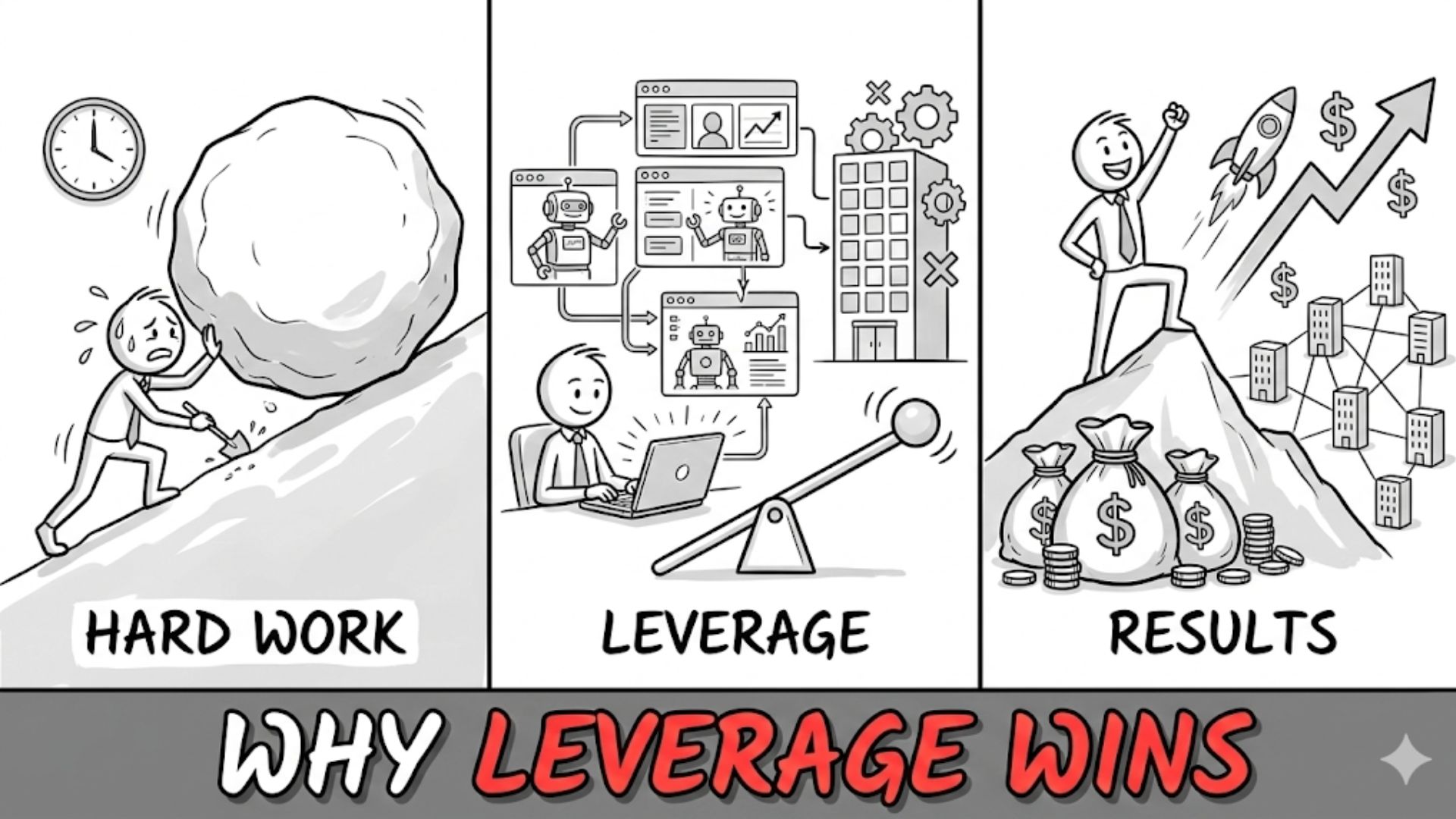
In physics, a lever allows an operator to move a heavy object by applying a smaller force over a greater distance. In the context of economic productivity and career development, leverage functions similarly: it is a structural mechanism that decouples input (time and effort) from output (value and reward). Without leverage, an individual’s productivity is limited by their biological constraints—the number of hours they can work and the physical or mental intensity they can maintain.
Career leverage exists in several distinct, often overlapping forms:
- Technological Leverage: The use of software, automation, and digital tools to perform tasks that would otherwise require significant human labor. This is the most scalable form of leverage in the modern era, as the marginal cost of replicating software is near zero.
- Capital Leverage: The deployment of financial resources to amplify the scale of an operation. This allows an individual or entity to command more resources than they personally possess.
- Network Leverage: The utilization of social capital and professional relationships to access information, opportunities, and distribution channels. A well-positioned individual in a dense network can achieve more with a single request than an isolated individual can through months of labor.
- Informational Leverage: Possession of rare, valuable, and non-obvious information that allows for superior decision-making or strategic positioning.
- Reputation Leverage: The use of a personal or professional brand to lower transaction costs. A high-trust reputation acts as an automated “pre-filter” that attracts opportunities without active searching.
- Organizational Leverage: The ability to coordinate and direct the labor of others toward a unified objective.
Leverage fundamentally changes the “multiplication factor” of an individual’s hour. While the unleveraged worker remains in a 1:1 relationship with their output, the leveraged professional operates at ratios of 1:10, 1:1,000, or even 1:1,000,000.
Read also: The Strategic Calculus of Long-Term Compounding
The Economics of Scalable Work
To understand why leverage produces asymmetric outcomes, we must distinguish between linear and scalable work.
Linear work is characterized by a direct, constant ratio between effort and output. Common examples include service-based roles such as manual labor, hourly consulting, or traditional craftsmanship. In these models, to double your output, you must essentially double your time or your intensity. Because human time is a finite resource, linear work has an inherent “ceiling” on its economic potential.
Scalable work, by contrast, involves the creation or management of systems where the output can grow exponentially while the input remains relatively flat. A software engineer writes a piece of code once, but that code can serve millions of users simultaneously. An author writes a book once, but it can be read by an infinite audience.
Modern economic structures—specifically digital technology and global distribution networks—have dramatically lowered the barriers to scaling. In the 20th century, scaling required massive physical infrastructure and large-scale capital investments. In the 21st century, the marginal cost of replication for digital goods and information is virtually zero. This creates a “winner-take-most” dynamic where individuals who possess the right leverage can capture a disproportionate share of the total value created in a market.
Why Effort Alone Often Produces Linear Outcomes
Despite its moral appeal, labor-intensive work is structurally limited. These limitations are not a reflection of the worker’s character but are inherent to the nature of unleveraged tasks.
- Time Constraints: Labor-intensive work is bound by the 24-hour day. No matter how “hard” one works, they cannot manufacture more time. Consequently, their income and impact are capped by their hourly rate.
- Attention and Cognitive Limits: High-intensity effort eventually meets the law of diminishing returns. Beyond a certain threshold of hours worked, the quality of decision-making and creativity declines, meaning that more effort often results in lower-quality output.
- Lack of Distribution: Effort spent on a “one-to-one” task (e.g., teaching a single student) stays within that single interaction. Without a distribution mechanism (e.g., recording that lesson for a global audience), the effort cannot reach beyond the immediate physical or temporal proximity.
Effort without leverage tends to produce incremental outcomes. One may get a 3% raise or a marginal promotion through sheer hard work, but they are unlikely to achieve the non-linear “step-function” changes in status or wealth that characterize leveraged careers.
Read also: Why Working IN Your Business Is Slowly Destroying It
Compounding in Careers
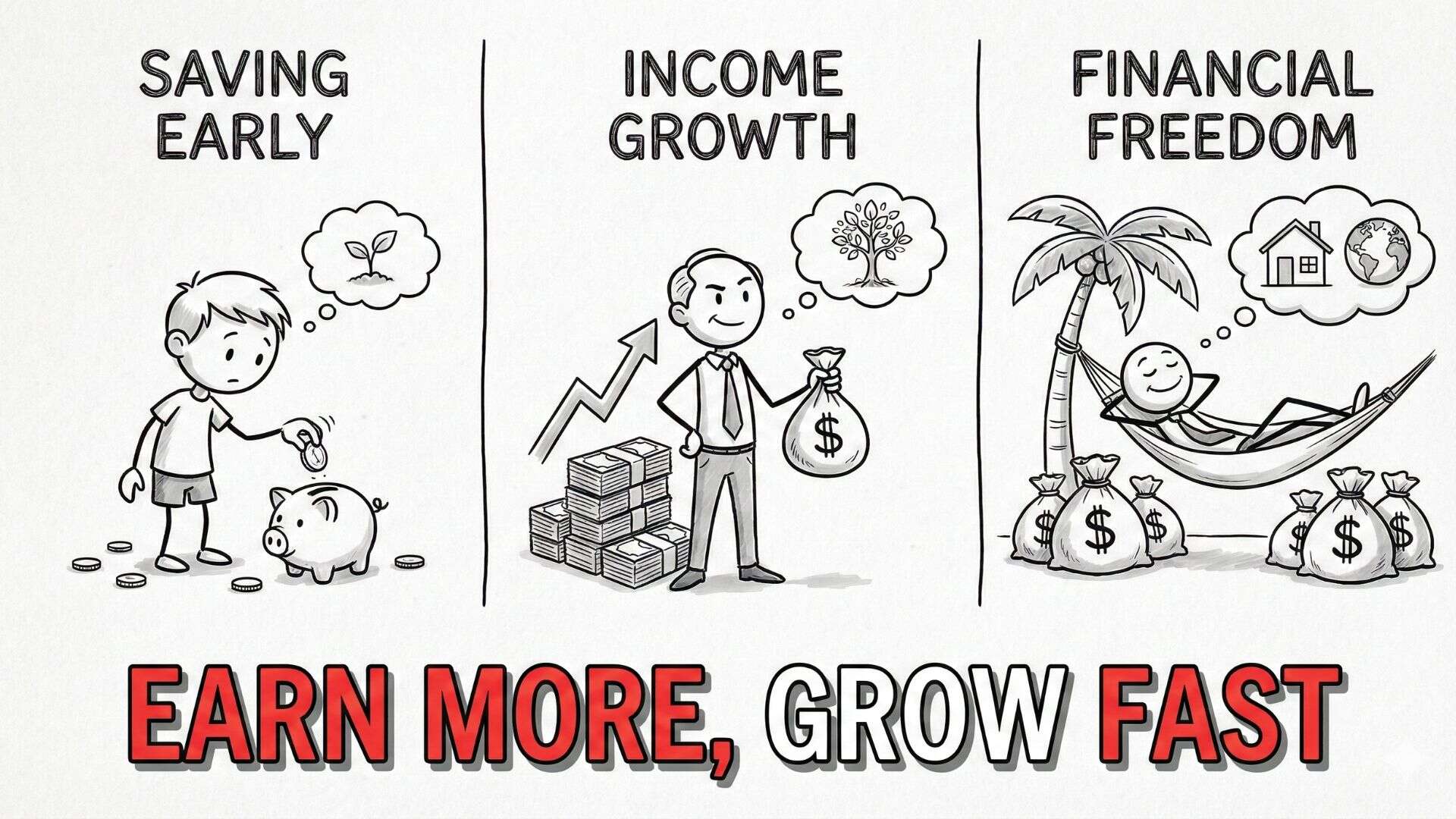
Leverage is not a static asset; it is a compounding one. Small advantages in leverage early in a career create widening divergence in outcomes over time.
This compounding effect is most visible in Reputation and Trust Networks. A professional who builds a strong reputation early on finds that future opportunities come to them with less effort. This “pull” mechanism allows them to spend more time on high-leverage activities rather than hunting for new work.
Similarly, Skill Accumulation in high-leverage domains (such as coding, capital allocation, or strategic communication) compounds. As the individual becomes more proficient, they can leverage more complex tools and larger amounts of capital.
Over a thirty-year horizon, the gap between the linear worker and the leveraged worker becomes astronomical. The leveraged worker is not necessarily working “harder” in the final decade; in fact, they may be working less. However, the systems, reputation, and capital they have compounded over the preceding decades now do the “heavy lifting” for them.
Time Horizon Misalignment
One of the primary reasons individuals fail to build leverage is a misalignment of time horizons. Building leverage—whether it is writing a book, building a software product, or cultivating a deep professional network—requires a significant upfront investment of time with no immediate payoff.
This creates a conflict with present bias and temporal discounting. Human biology is predisposed to favor immediate rewards (a paycheck today) over larger, uncertain rewards in the distant future.
- Delayed Rewards: Leverage-building activities often look like “doing nothing” in the short term. The software developer may spend months coding without a single user; the linear worker, meanwhile, earns a steady wage from day one.
- Uncertain Outcomes: Leverage is probabilistic. Not every network connection or every piece of content leads to an asymmetric win. Effort, conversely, is certain; if you work the hour, you get the pay.
Because of these factors, most individuals revert to linear labor. It provides the immediate dopamine hit of a “job well done” and the security of immediate compensation, even though it ensures a lower terminal outcome.
Read also: Why Financial Education Changes Behavior
Incentive Structures That Favor Visible Effort
Institutional design significantly reinforces the preference for effort over leverage. Most organizations are built to manage and measure visible labor rather than scalable impact.
- Performance Metrics: It is easier for a manager to track “hours at the desk” or “number of emails sent” than it is to track “strategic positioning” or “system optimization.” Consequently, employees are incentivized to signal effort through long hours and “busy-ness.”
- Promotion Systems: Many traditional promotion paths are “queuing systems” based on tenure and visible dedication. This rewards those who “put in their time” rather than those who find ways to multiply the organization’s output through leverage.
- Hourly Compensation: The billable hour model (common in law and consulting) explicitly punishes leverage. If a lawyer uses a tool to solve a problem in ten minutes that previously took ten hours, their billable revenue drops. This creates a structural incentive to maintain labor intensity and ignore efficiency-boosting leverage.
This creates a state of effort signaling, where the appearance of hard work becomes a social currency. Even when leverage produces a superior result, the individual may feel compelled to apologize for the “ease” with which it was achieved, fearing they will be perceived as lazy or uncommitted.
Feedback Loop Distortion
The value of leverage is further obscured by feedback loop distortion. In linear work, the feedback is clear and rapid: “I dug the hole, and now the hole is there.” In leverage-building, the feedback is often delayed and noisy.
In the early stages, leverage-building activities often feel like a waste of time. Learning a complex new technology or building an audience requires thousands of hours of effort before the “tipping point” is reached. During this long gestation period, the external environment provides very little positive reinforcement.
This leads many to abandon the pursuit of leverage just before it begins to compound. They mistake the “flat” part of the exponential curve for a failure of strategy. Without a robust mental model of how delayed feedback functions, it is rational—though sub-optimal—to return to the immediate, reliable feedback of linear labor.
Read also: The Psychology of Holding vs Selling Assets
Path Dependency in Career Development
Career outcomes are highly path-dependent, meaning that early decisions significantly constrain or expand the future opportunity set. The selection of an industry, a geography, or a peer group early in one’s career determines the “ceiling” of available leverage.
- Industry Selection: Some industries are structurally unleveraged (e.g., local artisanal services), while others are natively leveraged (e.g., venture capital or software). Once an individual becomes specialized in an unleveraged field, the “switching costs” to move into a leveraged field increase every year.
- Network Formation: Being part of a high-leverage network (e.g., a prestigious university or a top-tier tech firm) provides “access leverage” that persists for decades.
- Skill Specialization: Mastering a skill that can be multiplied by technology (e.g., data science) provides more leverage than mastering a skill that remains purely manual.
The “rich get richer” dynamic in careers is often a result of early path dependency where a small initial leverage advantage allowed for more compounding, which in turn provided more leverage to capture future opportunities.
Structural Sources of Career Leverage
To navigate a modern economy, one must understand the specific mechanisms that generate leverage.
Technology Leverage
Technology acts as a force multiplier for human thought. A single individual using modern AI, cloud computing, and automation tools can perform the work that previously required entire departments. This form of leverage is “permissionless”—you do not need a boss or a bank’s approval to write code or use a tool. It is the most accessible form of leverage for the modern knowledge worker.
Network Leverage
Social capital is the ability to mobilize resources through relationships. High-leverage networks are characterized by “weak ties” that provide access to non-redundant information. A vast, diverse network is more leveraged than a small, dense one because it provides a wider “surface area” for luck and opportunity.
Capital Leverage
Capital is “stored labor.” By using capital to hire others, buy tools, or acquire assets, an individual leverages the labor and time of others. While traditionally the most powerful form of leverage, it is also the most “permissioned”—you typically need a track record or collateral to access significant capital.
Media and Distribution Leverage
In the “attention economy,” the ability to reach an audience is a massive multiplier. Whether through a blog, a podcast, or a social media following, media leverage allows a single message to reach millions. This creates Reputation Leverage, where the individual becomes a “trusted brand,” further lowering the cost of acquiring new opportunities.
Read also: Why Simplicity Wins in Personal Finance
Why Leverage Produces Disproportionate Outcomes
Leverage leads to highly unequal distributions of success, often following a Power Law (or 80/20 rule). In unleveraged environments, performance usually follows a normal distribution (a bell curve). Most people are average, and the “best” is only slightly better than the average.
In leveraged environments, the “best” can be 10,000 times more productive than the average. This is due to:
- Marginal Cost of Replication: In digital markets, it costs nothing to serve the ten-millionth customer. Therefore, the market leader can capture almost the entire market.
- Scalability Advantages: The person with the best system or the best reputation can handle infinitely more volume than the person working manually.
- Winner-Take-Most Dynamics: Consumers and investors gravitate toward the “best” because technology makes the best easily accessible. There is no reason to use the 10th best search engine or the 50th best heart surgeon if the #1 is accessible.
Small advantages in leverage are amplified by these economic factors, resulting in the massive disparities in wealth and influence seen in modern professional life.
Common Misunderstandings About Career Leverage
The concept of leverage is often misunderstood as a “shortcut” or an excuse for laziness. This is a category error.
- Leverage Amplifies Effort: Leverage is not a replacement for work; it is a multiplier of work. If your effort is zero, your leverage (no matter how large) will still produce zero ($0 \times 1,000 = 0$). Leverage actually increases the stakes of your effort, making it more important to work on the right things.
- Leverage is Not “Gaming the System”: Building a system, a brand, or a network is a rigorous, difficult form of work. It is “meta-work”—working on the career rather than just in the career.
- Visibility $\neq$ Leverage: Being “famous” or “busy” is not the same as being leveraged. Many visible professionals are highly unleveraged (e.g., celebrities whose income stops the moment they stop performing). True leverage is often quiet and systemic.
Read also: How Loss Aversion Impacts Portfolio Decisions
Broader Conceptual Connections
Career leverage is a specific application of broader strategic frameworks.
- Second-Order Thinking: The leveraged professional asks, “What is the long-term impact of this activity?” rather than just “What is the immediate reward?”
- Opportunity Cost: Every hour spent on linear labor is an hour not spent building leverage. The true cost of “hard work” is often the foregone opportunity to build a scalable system.
- Systems Thinking: A leveraged career is managed as a system of inputs, processes, and multipliers, rather than a series of isolated tasks.
- Capital Allocation: In this context, “time” is the capital being allocated. The goal is to allocate time to the “assets” (skills, networks, systems) with the highest “yield” (leverage).
Conclusion: Reframing Career Success as a Leverage Problem
The traditional emphasis on labor intensity provides a comforting but increasingly inaccurate model of professional success. In a non-linear economy, the raw quantity of effort is a secondary variable; the primary variable is the multiplication factor of that effort.
Career outcomes are fundamentally a leverage problem. Individuals who operate within scalable systems, utilize technological tools, command capital, and cultivate deep networks will always experience dramatically different results than those who rely on labor alone. This explains the “paradox of the hard worker”—why individuals with similar levels of intelligence and work ethic can end their careers with such vastly different levels of impact and wealth.
Reframing success as a leverage problem requires a shift in focus: from asking “How can I work harder?” to “What can I build, own, or position myself within that multiplies the value of my work?” While effort is the engine of a career, leverage is the transmission that determines how much of that power actually reaches the wheels. Without it, even the most powerful engine will merely spin in place.