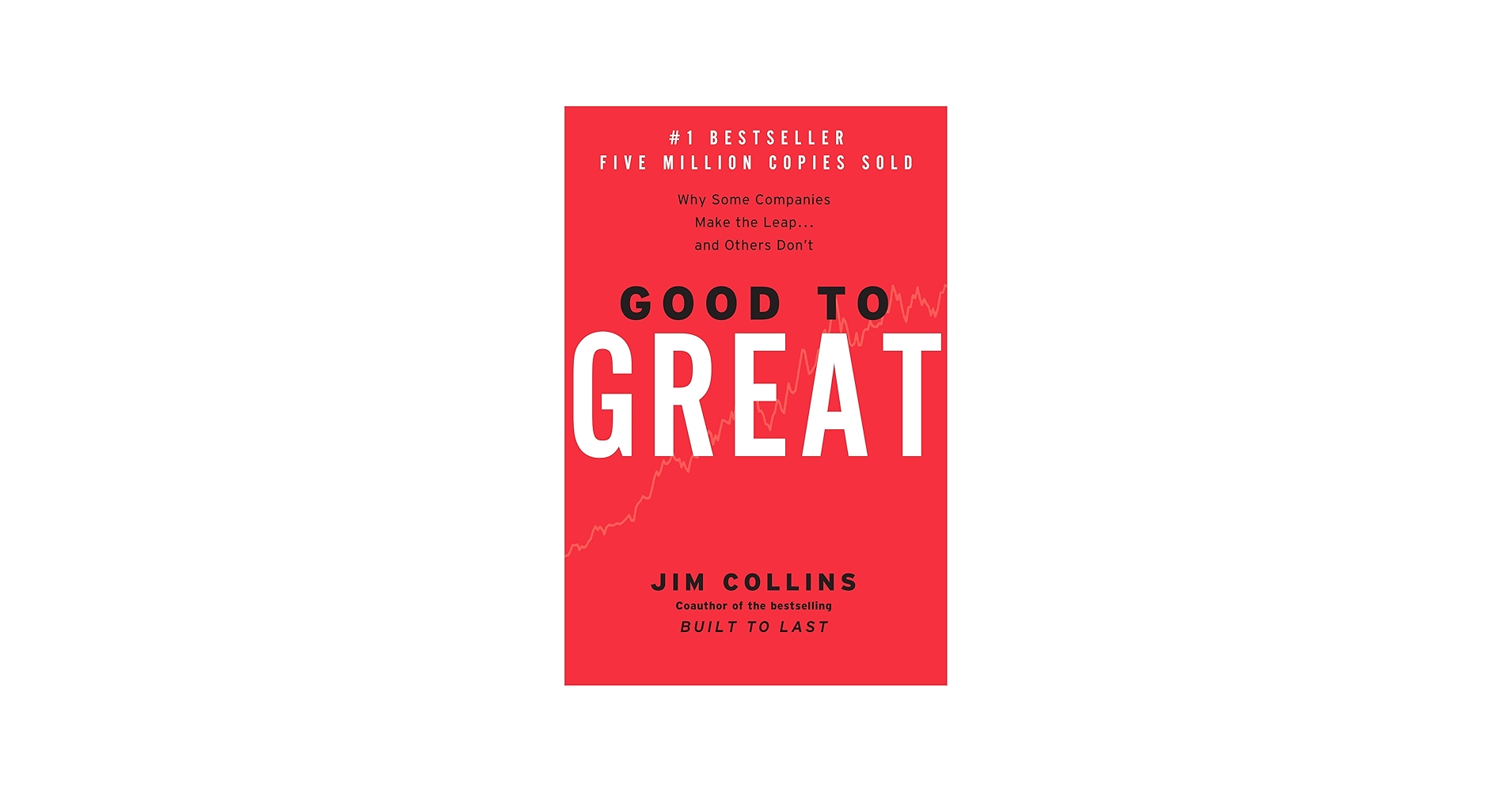
Star Rating: ★★★★★ (5/5)
One-Sentence Verdict: A research-based exploration of how companies move from average performance to long-term greatness through disciplined leadership, strategic clarity, and consistent execution.
Best For: CEOs, founders, managers, and anyone building a team or organization.
Difficulty: Medium.
While many business books offer anecdotal insights or fleeting management trends, Good to Great investigates the empirical “physics” of high performance. It provides a strategic roadmap for moving beyond the gravitational pull of mediocrity toward sustained, market-beating excellence.
——————————————————————————–
1. Introduction: The Silent Saboteur of Excellence
The central thesis of Jim Collins’ work is a profound strategic warning: “Good is the enemy of great.” This is the “silent assassin” of ambition for schools, governments, and corporations. When an organization is performing adequately, it lacks the existential shock required to trigger reinvention. While failure mandates radical change, mediocrity often leads to permanent inertia. Settling for a “good life” or a “good company” is a strategic trap that prevents the realization of true potential.
To decode the “black box” of transformation, Collins and his team conducted a massive 5-year study. This was not a cursory review but a “death march of financial analysis.” The scale of the research establishes its credibility:
- Universe of Study: 1,435 companies screened from the Fortune 500 (1965–1995).
- Effort: 10.5 people-years of work.
- Data Points: 6,000 articles coded, 2,000 pages of interview transcripts, and 384 million bytes of data.
The team identified 11 “good-to-great” companies that outperformed the general market by 6.9 times over the 15 years following their transition. By contrasting these successes against a “direct comparison” group that had similar resources but failed to make the leap, the research debunked several corporate myths. Greatness, the data proved, is not a function of circumstance, industry, or luck; it is a matter of conscious choice. The first indicator of this choice is found in the paradoxical nature of its leadership.
Read also: Why Career Leverage Dominates Labor Intensity
——————————————————————————–
2. Level 5 Leadership: The Paradox of Humility and Will
The research revealed that the “celebrity CEO”—the larger-than-life, charismatic outsider—is actually negatively correlated with sustained greatness. Instead, every good-to-great company was led by a Level 5 Leader.
The Hierarchy of Capabilities
To understand Level 5, one must recognize the hierarchy of executive capabilities:
- Level 1 (Highly Capable Individual): Makes productive contributions through talent and knowledge.
- Level 2 (Contributing Team Member): Works effectively with others in a group setting.
- Level 3 (Competent Manager): Organizes people and resources toward predetermined objectives.
- Level 4 (Effective Leader): Catalyzes commitment to a clear, compelling vision.
- Level 5 (Level 5 Executive): Builds enduring greatness through a paradoxical blend of extreme personal humility and intense professional will.
Case Study Analysis: Humility and Ferocious Resolve
- Darwin Smith (Kimberly-Clark): A mild-mannered lawyer who wore J.C. Penney suits and spent vacations on a backhoe. Yet, he possessed “ferocious resolve.” Growing up as a poor farm boy, Smith once lost part of a finger on the job at International Harvester, went to class that evening, and returned to work the next day. As CEO, he showed the same stoic determination when he decided to sell the mills—the core of the company’s identity—to bet everything on consumer paper products. He moved from being 36% behind the market to outperforming industry giant Procter & Gamble.
- Colman Mockler (Gillette): A quiet, gracious gentleman who refused to capitulate to corporate raiders like Ronald Perelman. Mockler chose to fight for the future greatness of secret projects like the Sensor razor rather than taking a massive personal payout.
| Attribute | Level 4 Leader (Show Horse) | Level 5 Leader (Plow Horse) |
| Ambition | Primarily for the self and personal ego. | Primarily for the company and its legacy. |
| Succession | Often sets up successors for failure (to prove own worth). | Sets up successors for even greater success. |
| Archetype | Patton or Caesar (Charismatic/Commanding). | Lincoln or Socrates (Humble/Inquisitive). |
The Window and the Mirror: Level 5 leaders look out the window to apportion credit to factors outside themselves (luck, people) when things go well. Conversely, they look in the mirror to apportion responsibility for failures, never blaming bad luck or external factors.
Read also: Why the Traditional Accounting Formula Is Killing Your Business
——————————————————————————–
3. First Who, Then What: Rigorous People Management
Good-to-great leaders do not begin with a new vision or strategy. They begin with the composition of the team. As Collins notes, “People are not your most important asset. The right people are.”
The Bus Analogy
If you get the right people on the bus (and the wrong people off) before you figure out where to drive it, you gain agility. If people are on the bus because of the destination, you face mutiny if you must pivot. If they are on the bus because of their peers and a shared commitment to excellence, direction changes become seamless.
- Case Study: Wells Fargo (Dick Cooley): Cooley focused on “hiring extraordinary people” before banking deregulation hit. Because they had the best talent “on the bus,” they pivotally outperformed the market threefold while competitors like Bank of America struggled with top-down command structures.
Rigorous vs. Ruthless
A “rigorous” culture applies exacting standards at all levels, whereas a “ruthless” culture involves mindless firing during crises. Rigor requires three practical disciplines:
- When in doubt, don’t hire—keep looking. Growth is limited by the ability to attract the right people.
- When you know you need to make a people change, act. Letting the wrong people linger is unfair to the right people.
- Put your best people on your biggest opportunities, not your biggest problems. Managing problems makes you good; exploiting opportunities makes you great.
Read also: The Math of Scaling Without Burning Out
——————————————————————————–
4. Confront the Brutal Facts: The Stockdale Paradox
Greatness requires a “climate where the truth is heard.” Charismatic leaders often hinder this because people filter data to please them. To counter this, Level 5 leaders establish four practices:
- Lead with questions, not answers.
- Engage in dialogue and debate, not coercion.
- Conduct autopsies without blame.
- Build “red flag” mechanisms: Systems (like a “short pay” trigger or non-cancellable data feeds) that turn data into information that cannot be ignored.
The Stockdale Paradox
Named after Admiral Jim Stockdale, a POW in Vietnam, this paradox is the psychological foundation of greatness: Maintain unwavering faith that you will prevail in the end AND, at the same time, confront the most brutal facts of your current reality.
Stockdale noted that the “optimists” were the ones who didn’t make it; they died of a broken heart when their naive hopes for a Christmas or Easter release were dashed. Great companies, like Kroger, faced the brutal fact that the old grocery model was obsolete and systematically overhauled their entire asset base into the supermarket model. Meanwhile, A&P clung to its denial and faded into irrelevance.
Read also: A Structural Analysis of the Unseen
——————————————————————————–
5. The Hedgehog Concept: Simplicity Within the Three Circles
The “Fox” knows many things and pursues many paths, leading to scattered effort. The “Hedgehog” knows one big thing—simplicity. A Hedgehog Concept is the intersection of Three Circles:
- What you can be the best in the world at: This is a rigorous distinction. Just because you have a “core competence” you’ve practiced for decades doesn’t mean you can be the best at it. If you can’t be the best, that business cannot be your core.
- What drives your economic engine: Identifying the single “Economic Denominator”—such as profit per customer visit—that has the greatest impact.
- What you are deeply passionate about: Finding what already ignites the team.
Finding this intersection prevents a company from chasing fads. If an opportunity doesn’t fit all three circles, a good-to-great company has the discipline to say no.
——————————————————————————–
6. A Culture of Discipline & Technology Accelerators
A “Culture of Discipline” is the magical alchemy of an ethic of entrepreneurship combined with the discipline of action. When you have disciplined people, you don’t need hierarchy; when you have disciplined thought, you don’t need bureaucracy.
- The “Stop Doing” List: Disciplined companies are more focused on what to remove than what to add.
- Technology’s Role: Technology is an accelerator, not a creator of momentum. Great companies are pioneers in the application of tech, but only for the sake of their specific mission.
- Comparison: Walgreens took a measured approach to the internet, only launching a site when it could accelerate its convenience-based Hedgehog Concept. Drugstore.com failed because it used tech to create hype without an underlying economic engine.
Read also: The Psychological Mechanics of Self-Mastery
——————————————————————————–
7. The Flywheel and the Doom Loop
Transformations never happen in a “miracle moment.” They resemble a massive, heavy Flywheel. At first, it takes immense effort to move it an inch. But through consistent pushes in a single direction, it builds momentum. Eventually, the buildup results in a breakthrough—a revolutionary leap in results without a revolutionary process.
The Doom Loop: This is the opposite pattern. Companies (like Warner Lambert) lurch from one new CEO or “grand program” to another. By constantly changing direction, they fail to build cumulative momentum and eventually fall into a cycle of decline.
——————————————————————————–
8. Conclusion: From Sustained Results to Enduring Greatness
The “enduring physics” of performance consists of three pillars: Disciplined People, Disciplined Thought, and Disciplined Action. Greatness is not a function of luck or industry; it is a conscious choice to apply these timeless principles.
Good to Great serves as the strategic prequel to Collins’ Built to Last. While Good to Great provides the framework for the transition to high performance, Built to Last provides the enduring core values and purpose required to maintain iconic status for decades.
Read also: A Structural Analysis of Systemic Fragility
——————————————————————————–
9. Call to Action: Evaluating Your Own Flywheel
To move your organization toward greatness, you must move beyond “good enough” and evaluate the integrity of your flywheel:
- The Bus: Are you settling for “competent” people, or are you rigorously ensuring the right people are in the right seats before you set the strategy?
- The Facts: What is the “brutal fact” you are currently ignoring? Are you building “red flag” mechanisms that force you to face the truth?
- The Circles: Have you identified your Hedgehog Concept, or are you a “fox” chasing every market trend?
- The Momentum: Are you making consistent pushes in one direction, or are you stuck in a “doom loop” of changing priorities?