Introduction: The Most Expensive Costs Are the Ones We Do Not See
In the discourse of capital allocation and strategic decision-making, attention is predominantly directed toward the “seen.” Corporate balance sheets meticulously track depreciating assets, quarterly expenditures, and realized revenue. Individuals monitor their bank balances and the visible progression of their careers. Yet, the most significant determinant of long-term strategic health is rarely the explicit expense or the realized gain; it is the “unseen” value of the paths not taken.
Opportunity cost—the value of the next best alternative foregone—is a foundational concept in economic theory, yet it remains systematically underestimated in practice. This neglect is not a product of intellectual ignorance but a consequence of structural and cognitive architectures that favor visible data over counterfactual reasoning. The paradox is profound: while opportunity costs do not appear on any ledger, they are often the most expensive costs an entity incurs. Because these costs are invisible, they create distorted incentives, encourage the misallocation of capital, and induce a hidden fragility that only becomes apparent when the divergence between the chosen path and the foregone alternative becomes too large to ignore.
Defining Opportunity Cost as a Structural Constraint
At its core, opportunity cost is a reflection of scarcity. In a world of finite time, capital, and attention, every choice to pursue one objective is simultaneously a choice to abandon all others. Rigorous economic reasoning defines opportunity cost not merely as the “cost of a choice,” but as the net value of the most attractive alternative that was sacrificed.
Read also: Why Simplicity Wins in Personal Finance
Explicit vs. Implicit Costs
Strategic clarity requires a sharp distinction between explicit and implicit costs. Explicit costs involve an actual outlay of resources—the salary paid to an employee, the capital spent on a machine, or the tuition paid for an MBA. These are highly “legible”; they are easily quantified and tracked. Implicit costs, conversely, do not involve a direct transfer of resources. They represent the “foregone income” or the “lost optionality” that results from a specific allocation.
If a professional spends four years in a specialized role, the explicit cost is minimal (perhaps only the stress of the work). The implicit cost, however, is the value of the skills, network, and equity they could have accumulated had they spent those four years in a different, higher-leverage environment. Because opportunity cost is an implicit constraint, it exists regardless of whether the decision-maker acknowledges it. It is an immutable law of allocation: to be “here” is the structural impossibility of being “there.”
The Core Mechanism: Invisibility and Cognitive Bias
The systematic underestimation of opportunity cost is rooted in the architecture of human cognition. The brain is an efficiency engine, evolved to prioritize immediate, sensory information over abstract, hypothetical simulations.
The Substitution Heuristic and Present Bias
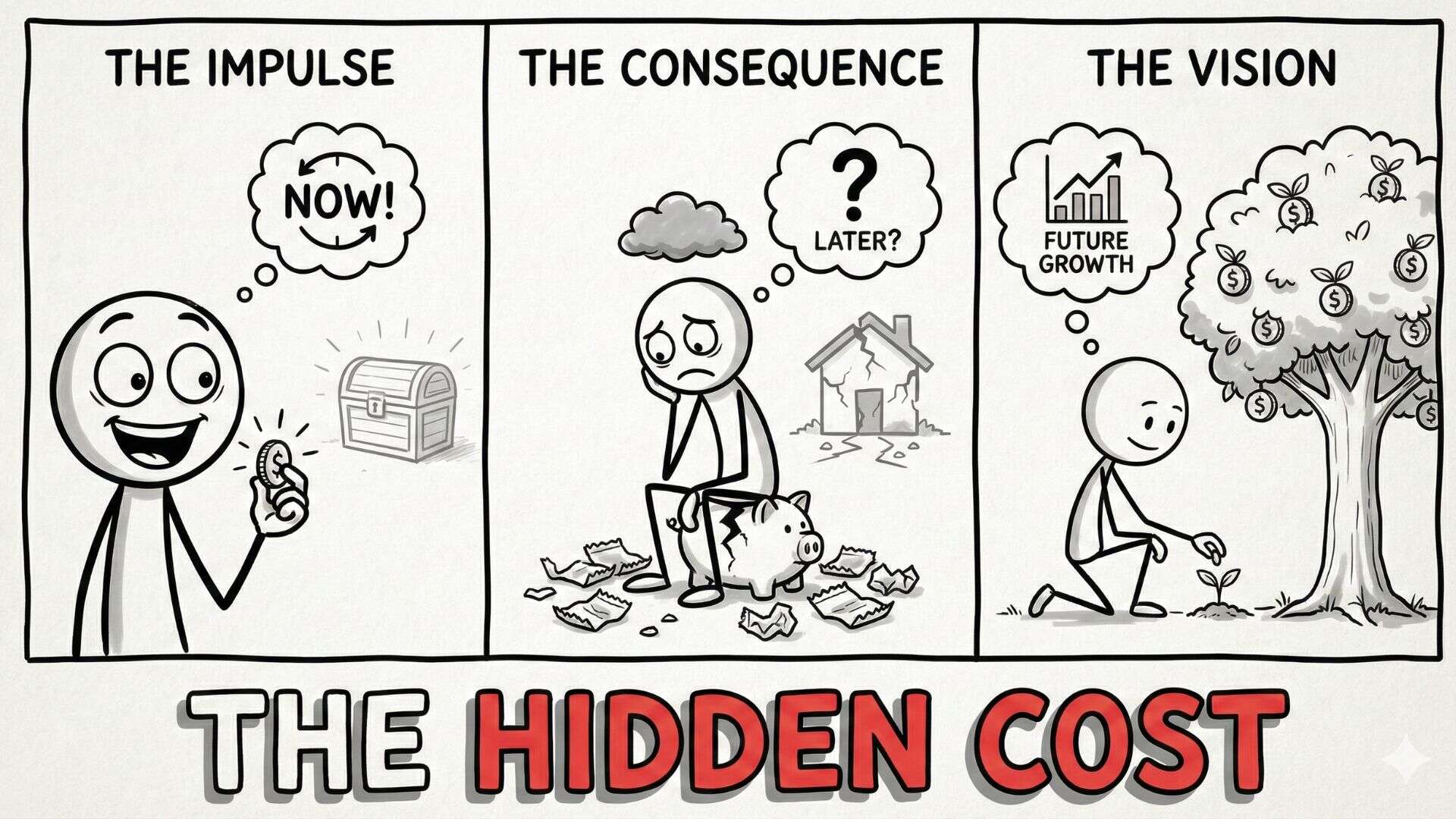
When faced with a complex decision involving trade-offs, the human brain often employs a “substitution heuristic.” Instead of calculating the long-term value of various alternatives, it solves a simpler problem: “How much do I want this visible option right now?” This is compounded by present bias—the tendency to over-weight immediate rewards relative to future outcomes. Because the chosen path offers immediate feedback (even if negative), and the foregone alternative offers only theoretical value, the brain discounts the latter into insignificance.
Loss Aversion and Status Quo Bias
Loss aversion dictates that the pain of losing $1,000 is psychologically twice as powerful as the joy of gaining $1,000. In the context of opportunity cost, this creates a profound distortion. An explicit cost is felt as a “loss,” while a foregone opportunity is merely a “non-gain.” Consequently, decision-makers are often willing to incur massive opportunity costs to avoid relatively small explicit losses. This leads directly to status quo bias, where the individual or institution perceives the current path as “cost-free” simply because it requires no new explicit outlay, ignoring the accelerating cost of the alternatives being sacrificed every day.
Read also: How Loss Aversion Impacts Portfolio Decisions
Time Horizon Misalignment and Discounting the Future
Opportunity cost is a time-dependent variable. Its power is rarely apparent in the immediate term; it magnifies as the time horizon extends. This magnification is frequently lost in the process of temporal discounting.
Hyperbolic Discounting
Standard economic models often use exponential discounting, but human behavior follows a hyperbolic pattern. We discount the near future at a much higher rate than the distant future. This makes the “unseen” trade-offs of a decision appear negligible today. A minor misallocation of time or capital may only result in a 1% delta in performance this year. However, in non-linear systems, that 1% represents a divergent path that, over twenty years, results in a terminal value that is orders of magnitude different.
The Crowding Out of Optionality
Short-term metrics—such as quarterly earnings or monthly performance reviews—act as “noise” that crowds out the “signal” of long-term opportunity cost. Institutions that optimize for the highest visible return in the next six months often do so by liquidating their optionality. Optionality is the right, but not the obligation, to take action in the future. By committing all resources to a singular, visible path to satisfy short-term stakeholders, an organization incurs the massive opportunity cost of being unable to pivot when a more valuable alternative emerges.
Read also: The Cost of Overconfidence in Investing
Incentive Structures and Institutional Blind Spots
Institutional environments are rarely designed to optimize for opportunity cost. Most incentive structures are built around “legibility”—the ability to measure and justify an outcome to a superior or a shareholder.
The Legibility Trap
Corporate compensation, political cycles, and performance reviews reward realized outcomes, not sacrificed alternatives. A CEO who delivers a 5% increase in earnings is rewarded, even if a different capital allocation strategy would have yielded 20%. The 15% delta is invisible; it cannot be proven in a courtroom or an earnings call because the counterfactual path was never taken. This creates an environment where “safe” mediocrity is incentivized over the “risky” pursuit of higher-value alternatives, simply because the cost of mediocrity is an unseen opportunity cost, while the cost of a failed alternative is a visible explicit loss.
Institutional Short-Termism
The “Institutional Imperative”—the tendency for organizations to mimic the behavior of their peers—reinforces this blind spot. If every firm in an industry is over-investing in a declining legacy business, the opportunity cost of not pivoting to a new technology is shared by all. Because the cost is aggregate and unseen, no single actor feels the pressure to change until the entire industry faces structural obsolescence.
Read also: Why Long-Term Thinking Is a Financial Advantage
Feedback Loop Distortion and the Absence of Counterfactual Evidence
The most significant structural reason why opportunity cost remains invisible is the total absence of direct feedback. Learning systems, both biological and algorithmic, rely on “reward signals” to calibrate future behavior.
The Success Trap
If a decision-maker chooses Path A and achieves a positive result, the feedback loop reinforces the “correctness” of that choice. This is the Success Trap. Without a visible counterfactual—what would have happened on Path B—it is impossible to know if Path A was truly optimal or merely “sufficient.” In decision science, this is known as the absence of counterfactual evidence. Because we never see the “ghost” of the foregone alternative, we cannot learn from the mistake of choosing a sub-optimal path.
Reinforcement Learning and Local Optima
In reinforcement learning theory, agents often get stuck in local optima. They find a strategy that works well in their immediate environment and stop exploring alternatives. The opportunity cost of not exploring the “global optimum” is invisible because the agent is receiving constant positive reinforcement from its current sub-optimal state. In human terms, this manifests as the “good is the enemy of the great.” As long as the current choice produces a visible gain, the invisible cost of the better alternative remains ignored.
Read also: Mastering The 5 AM Club for Elite Performance and Cognitive Sovereignty
Compounding and Path Dependency
The power of opportunity cost is most visible—and most destructive—when viewed through the lens of compounding. Small allocation decisions made today do not merely add up; they multiply over time.
Non-Linear Magnification
In linear systems, the cost of a mistake is fixed. In non-linear compounding systems (like wealth, knowledge, or reputation), the cost of a sub-optimal allocation is the compounded value of the delta over time. If an investor chooses an asset that returns 7% instead of one that returns 10%, the “cost” in Year 1 is only 3%. In Year 30, however, the 10% asset is worth more than double the 7% asset. The opportunity cost has compounded into a total loss of more than 100% of the initial capital’s potential.
Path Dependency and Reversibility
Early decisions in a system’s lifecycle create path dependency. Each allocation of time or capital “locks in” certain constraints and “closes off” certain alternatives. This reduces reversibility. The opportunity cost of a decision today is not just the immediate alternative foregone, but the entire tree of future options that can no longer be accessed because of today’s commitment. High-agency decision-making requires distinguishing between “Type 1” (irreversible) and “Type 2” (reversible) decisions, as the opportunity cost of an irreversible mistake is effectively infinite in the context of that specific path.
Read also: How Anchoring Bias Affects Financial Choices
Opportunity Cost in Key Domains
The structural consequences of invisible trade-offs propagate through every high-stakes domain of human endeavor.
- Financial Capital Allocation: Investors often focus on “not losing money” (avoiding explicit loss) rather than “maximizing return per unit of risk.” By holding cash during an inflationary period or staying in low-yield bonds, they incur a massive opportunity cost in terms of the compounded purchasing power they could have gained in equities or productive assets.
- Career Specialization vs. Flexibility: Early-career professionals often specialize deeply to secure immediate salary gains. The opportunity cost is career optionality. By becoming a specialist in a narrow, fragile domain, they give up the ability to pivot when that domain is disrupted by technology or market shifts.
- Skill Accumulation: Every hour spent mastering a commoditized skill (one that many others possess) is an hour not spent acquiring a “rare and valuable” skill stack. The opportunity cost is the pricing power and leverage that only unique expertise can command.
- Entrepreneurial Strategy: Founders often optimize for “product features” rather than “distribution channels.” The explicit cost is the R&D budget; the opportunity cost is the market share and network effects they could have captured had they allocated that same energy to growth.
- Institutional Investment: Pension funds and endowments often favor “private equity” for its smoothed returns, ignoring the opportunity cost of the liquidity and lower fees found in public markets. The cost is unseen because the “volatility” of the alternative is perceived as a greater risk than the “underperformance” of the chosen path.
Second-Order Effects and Hidden Fragility
Ignoring opportunity cost creates a systematic bias toward efficiency at the expense of resilience. Efficiency is a first-order gain; resilience is a second-order necessity.
The Efficiency Trap
When a system is optimized to minimize explicit costs (e.g., a “just-in-time” supply chain), it appears highly profitable. However, the opportunity cost of this efficiency is redundancy. By removing all “waste,” the system loses its ability to absorb shocks. When a disruption occurs, the “unseen” cost of the missing redundancy—the total collapse of the supply chain—far outweighs the “seen” savings of the efficiency gains.
Overexposure to Single Strategies
By failing to account for the opportunity cost of not diversifying, individuals and institutions create overexposure to single points of failure. They perceive diversification as a “cost” (lower potential return) rather than as the “purchase” of optionality. This increases systemic fragility, as the entity has traded its ability to survive a variety of future states for a slightly higher visible return in the most likely future state.
Read also: Why Cash Flow Thinking Beats Net Worth Obsession
Why Awareness Does Not Eliminate the Problem
Even among those who are intellectually aware of the concept, opportunity cost is rarely factored into real-time decision-making. This persistence is due to structural pressures and cognitive limits.
Attention Scarcity and Cognitive Load
Evaluating opportunity cost requires a high level of cognitive simulation. The decision-maker must not only analyze the visible path but also construct and analyze multiple “phantom” paths. In an environment of information overload and decision fatigue, the brain lacks the “attention capital” to perform these simulations. We default to the most legible, sensory data because the cognitive load of counterfactual reasoning is too high.
Structural Pressures and Visible Performance
In any hierarchical system, the pressure to “show results” is immense. Prudence—the act of avoiding a bad path or waiting for a better opportunity—is invisible. It looks like “doing nothing.” In a culture that rewards activity over results, the pressure to make a visible, explicit allocation is often stronger than the rational need to account for what is being sacrificed. Even if the allocator knows the opportunity cost is high, they may still choose the sub-optimal path because it is defensible to their peers or superiors.
Common Misunderstandings About Opportunity Cost
To utilize the concept as a strategic tool, one must clarify several conceptual oversimplifications.
- Not Purely Financial: Opportunity cost applies to all scarce resources, including time, attention, emotional energy, and social capital. Spending an evening in a low-value social circle has an opportunity cost in terms of the high-value relationships that could have been nurtured instead.
- Not Only for High-Stakes Decisions: While most visible in big decisions, opportunity cost compounds most effectively in daily micro-allocations. The “cost” of a 30-minute daily distraction is not 30 minutes; it is the compounded value of the deep work that was never performed over a 20-year career.
- Impossibility of Precise Calculation: Opportunity cost involves predicting the outcome of an alternative path that will never exist. It cannot be calculated with four decimal points. Therefore, it must be treated as a probabilistic framework rather than an accounting metric.
- Regret vs. Opportunity Cost: Regret is backward-looking and emotional; it is the pain of a choice already made. Opportunity cost is forward-looking and analytical; it is a tool for evaluating the next decision. One should not seek to “minimize regret,” but to “optimize for the highest-value foregone alternative.”
Read also: The Difference Between Volatility and Risk
Structural Principles for Better Time Allocation
While opportunity cost cannot be perfectly eliminated, its destructive power can be mitigated through structural principles.
1. Explicitly List the Counterfactuals
A rigorous decision process must require the explicit naming and evaluation of at least two “next-best” alternatives. By making the “unseen” visible, the decision-maker forces the brain to move beyond the substitution heuristic and engage in counterfactual simulation.
2. Preserving Optionality as a Primary Objective
When the future is uncertain, the opportunity cost of “locking in” a path is high. Strategic durability requires valuing optionality as a positive asset. A decision that preserves future alternatives is often superior to one that offers a slightly higher immediate return but closes off the rest of the decision tree.
3. The Reversibility Filter
Distinguish between reversible and irreversible decisions. If a decision is reversible (Type 2), the opportunity cost of “being wrong” is low, as the alternative can still be pursued later. If a decision is irreversible (Type 1), the opportunity cost must be analyzed with extreme rigor, as the foregone alternatives are sacrificed permanently.
Connections to Broader Thinking Frameworks
Opportunity cost is the conceptual anchor for many of the most powerful mental models in decision science.
- Second-Order Thinking: The realization that every first-order gain has a second-order trade-off.
- Incentive Design: The understanding that systems will ignore opportunity cost unless it is made “visible” through specific reporting or compensation structures.
- Capital Allocation Theory: The fundamental rule that “there are no good or bad investments, only better or worse uses of capital.”
- Risk Asymmetry: The recognition that the opportunity cost of “not taking a small-downside/infinite-upside risk” is the most expensive mistake a strategist can make.
Read also: How an Insignificant Ape Conquered the World
Conclusion: The Structural Power of the Unseen
Opportunity cost is the ultimate “dark matter” of the strategic universe. It is invisible, yet it exerts a constant gravitational pull on the trajectory of our lives, businesses, and societies. Its invisibility is not a flaw in the concept, but the source of its power. Because it is unseen, it is the variable that separates the “sufficient” from the “optimal.”
Reframing decision-making around opportunity cost requires a fundamental shift in perspective: from monitoring what we are doing to contemplating what we are not doing. It requires the intellectual courage to look past the visible gains on the ledger and account for the compounded value of the abandoned paths. In the final analysis, strategic mastery is not just about making the right choices; it is about having the structural discipline to account for the price of every “yes.” Every decision is an allocation of a finite life; to ignore the opportunity cost is to spend that life without ever knowing what it could have bought.