1. THE SNAPSHOT
Rating: ★★★★★ (A Mind-Expanding Masterpiece)
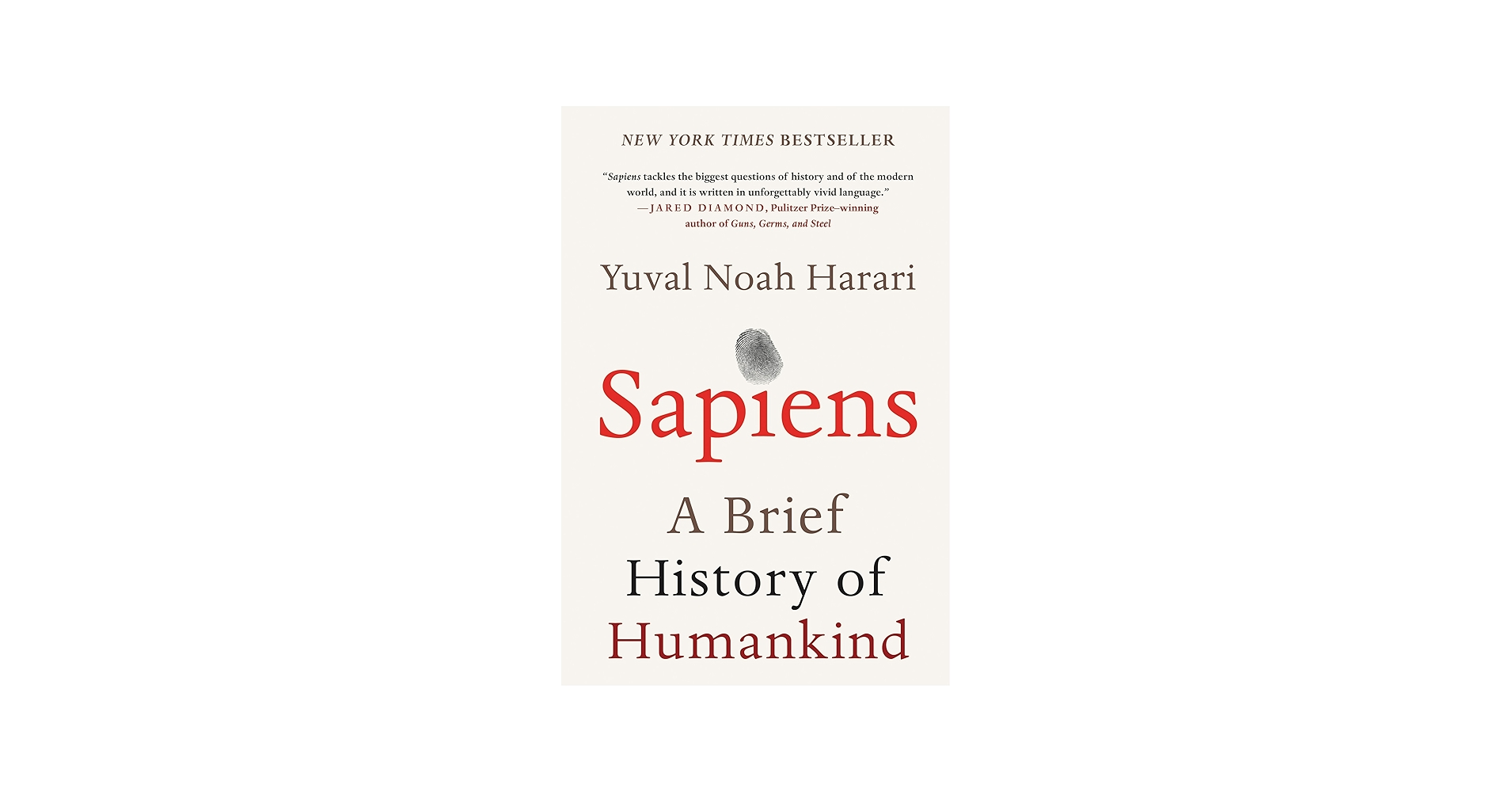
The Verdict: A landmark work of big history that reveals how our unique ability to believe in “shared fictions” propelled a mediocre ape from the middle of the food chain to the throne of the planet.
Target Audience: Deep thinkers, skeptics, and those who suspect that “progress” is a gilded cage. Difficulty: Medium.
Why It Matters Yuval Noah Harari does not merely summarize history; he deconstructs the human condition. By synthesizing biological evolution with sociological constructs, he forces us to confront the fact that our most sacred institutions—money, human rights, and nations—exist only within our collective imagination. It is a work that makes the reader feel the crushing weight of 70,000 years, transforming the way we view the very reality we inhabit.
To understand our trajectory toward a god-like future, we must first return to the African savannah, back when humans were “animals of no significance.”
——————————————————————————–
2. INTRODUCTION: THE RISE FROM INSIGNIFICANCE
Understanding our biological origins is not an exercise in nostalgia; it is a strategic necessity. As we acquire the power to engineer the code of life and bypass natural selection, we must understand the fragile primate currently holding the controls.
Two million years ago, Homo sapiens was not the protagonist of the world. We were merely one species in a crowded genus of humans. Our siblings were diverse: the muscular Neanderthalensis in Europe, the durable Erectus in Asia, and the tropical Soloensis. On the island of Flores, one-meter-tall Homo floresiensis hunted dwarf elephants, a bizarre evolutionary side-quest in the human story.
“The most important thing to know about prehistoric humans is that they were insignificant animals with no more impact on their environment than gorillas, fireflies or jellyfish.”
The ascent of the “wise man” was driven by three cataclysmic shifts:
- The Cognitive Revolution: The accidental rewiring of our brains that gave us the power of fiction.
- The Agricultural Revolution: History’s greatest trap, which traded individual happiness for population growth.
- The Scientific Revolution: The moment we admitted our ignorance and gained the power to end history itself.
How did this middle-of-the-food-chain ape bypass the slow crawl of genetic evolution to dominate the globe?
Read also: The Threat of AI & The History of Truth
——————————————————————————–
3. REVOLUTION 1: THE COGNITIVE REVOLUTION (70,000 YEARS AGO)
In the animal kingdom, the ultimate weapon is not a claw, but a story. Around 70,000 years ago, the “Tree of Knowledge” mutation allowed Sapiens to transcend Biological Reality—the world of rivers and lions—and inhabit an Imagined Reality. We became the only species capable of talking about things that do not exist.
The Gossip Theory Social cooperation is the bedrock of Sapiens’ power. Our language likely evolved not just to warn of predators, but to gossip. By tracking social information—who is honest and who is a cheat—Sapiens built trust. However, gossip has a ceiling: 150 individuals. Beyond this “magic number,” groups splinter. To govern millions, we needed a more potent myth.
The Legend of Peugeot Strangers cooperate through “Shared Fictions.” Consider Peugeot SA. The company is not its factories, its cars, or its managers. If a disaster killed every employee and leveled every plant, the company would remain. It is a “legal fiction” created by modern lawyers—the heirs of ancient sorcerers.
Harari notes a biting linguistic link: just as a Catholic priest exclaims “Hoc est corpus meum” (This is my body) to turn bread into the flesh of a god, a lawyer performs a similar “hocus pocus” with legal liturgy to incorporate a company. Because we all believe the story, we cooperate. This ability to unite around ghosts, nations, and corporations is why Sapiens rule the world while chimpanzees remain locked in zoos.
——————————————————————————–
4. REVOLUTION 2: THE AGRICULTURAL REVOLUTION (12,000 YEARS AGO)
Roughly 12,000 years ago, Sapiens abandoned the freedom of foraging for the drudgery of farming. Traditional history calls this progress. Harari calls it history’s biggest fraud.
The Wheat Argument Evolution is a cold accountant; it cares for the number of DNA copies, not the quality of the life that carries them. We did not domesticate wheat; wheat domesticated us. This grass forced a nomadic ape into permanent settlements and back-breaking labor. It offered a “niche for imbeciles,” where unremarkable genes could survive as long as they worked the fields.
Population vs. Happiness The forager’s “original affluent society” was characterized by a varied diet and a work week of only three to six hours a day. The Agricultural Revolution replaced this with a peasant’s life of malnutrition, disease, and hierarchy. It was an evolutionary success (more humans) but an individual catastrophe. We traded the campfire gossip of the free for the sweatshops of the soil.
——————————————————————————–
5. THE UNIFICATION OF HUMANKIND: THE THREE GLOBAL ORDERS
As food surpluses grew, so did the power of our myths. Disparate cultures were ground together by the “brutal effectiveness” of three universal systems, creating a single global historical arena:
- Money: The most successful fiction ever told. It is a system of universal trust that allows strangers to cooperate without needing to share a god or a king.
- Empires: Though born in blood, empires were the ultimate cultural mergers. They dissolved local identities to create a “single historical arena,” making humanity believe in universal political orders.
- Religions: Universal moral systems that provided the “law of religion,” grounding social hierarchies in a perceived cosmic truth.
These “Imagined Realities” unified the world by convincing people that their local myths were, in fact, universal laws.
Read also: Why One Index Fund Can Buy Your Freedom
——————————————————————————–
6. REVOLUTION 3: THE SCIENTIFIC REVOLUTION (500 YEARS AGO)
Five hundred years ago, humanity made its most daring strategic move: we admitted we were ignorant. Ancient traditions like Christianity or Islam claimed that everything worth knowing was already known. The Scientific Revolution was the “Discovery of Ignorance.”
By admitting “we don’t know,” we gained the power to seek. This revolution was fueled by a marriage between Science, Capitalism, and Empire. We began to view the future as a place of growth, leading to Credit—a shared fiction regarding future wealth that allows us to build the present using tomorrow’s money. The State and Market eventually replaced the family and community, leading to the “Permanent Revolution” of modern life.
——————————————————————————–
7. THE ULTIMATE QUESTION: ARE WE HAPPIER TODAY?
We have acquired god-like power. We can split the atom, walk on the moon, and re-engineer the genetic code. But our biochemical system remains that of a hunter-gatherer.
Are we any happier than the forager of 30,000 years ago? We have mastered our environment but lost the communal intimacy of our ancestors. We are plagued by modern alienation and ecological destruction, possessing the power of creators but the anxieties of an underdog.
“Is there anything more dangerous than dissatisfied and irresponsible gods who don’t know what they want?”
Read also: The Blueprint for Permissionless Wealth and Perpetual Peace
——————————————————————————–
8. CRITICAL ANALYSIS: PROS, CONS, AND “THE RECEPTION”
A book this provocative inevitably “gores everyone’s ox.” Harari’s sweeping narrative has been met with both worship and suspicion.
| PROS | CONS |
| Brilliant Synthesis: Masterfully links biology, economics, and history into a cohesive “Big History.” | Broad Generalizations: Critics argue the scope is so vast it skims the surface of complex historical nuances. |
| Worldview-Transforming: Challenges the fundamental “fictions” of money, nations, and human rights. | Reductionist View: Some feel he reduces complex human spirit and philosophy to mere biological functions. |
| Provocative Vigor: Engaging storytelling (perfectly captured by Derek Perkins’ narration). | Perceived Bias: Critics point to a Eurocentric lens or “biased views” on religion and the American Constitution. |
——————————————————————————–
9. CONCLUSION: THE ANIMAL THAT BECAME A GOD
The human journey has led us to a terrifying precipice. We are no longer an animal of no significance; we are on the verge of transcending natural selection through intelligent design. As we move toward the “End of Homo Sapiens,” we face a haunting reality: we have become gods, but irresponsible ones. We have the power to create and destroy, yet we lack a moral compass to guide the “code of life” we now hold in our hands.
——————————————————————————–
10. CALL TO ACTION (CTA)
Question everything you believe. Read Sapiens.