

THE SNAPSHOT
- Star Rating: 5/5 (A Modern Classic)
- One-Sentence Verdict: Naval Ravikant provides a masterclass in escaping the “rat race” by building permissionless wealth through leverage and achieving internal peace by mastering the skill of happiness.
- Best For: Creators, Entrepreneurs, Deep Thinkers, and those seeking an exit from the time-for-money trap.
- Difficulty: Easy to read, hard to master.
——————————————————————————–
1. INTRODUCTION: THE PHILOSOPHER KING OF SILICON VALLEY
In the hyper-accelerated landscape of the mid-2020s, the noise of “hustle culture” has become a deafening roar of low-signal effort. Amidst this chaos, the voice of Naval Ravikant emerges not as a shouting guru, but as a minimalist philosopher who has successfully navigated the intersection of extreme financial success and internal tranquility. Known widely as the “Philosopher King of Silicon Valley,” Naval first captivated the global consciousness with his seminal “How to Get Rich (Without Getting Lucky)” tweetstorm—a concentrated burst of economic wisdom that challenged the traditional industrial-age notions of labor.
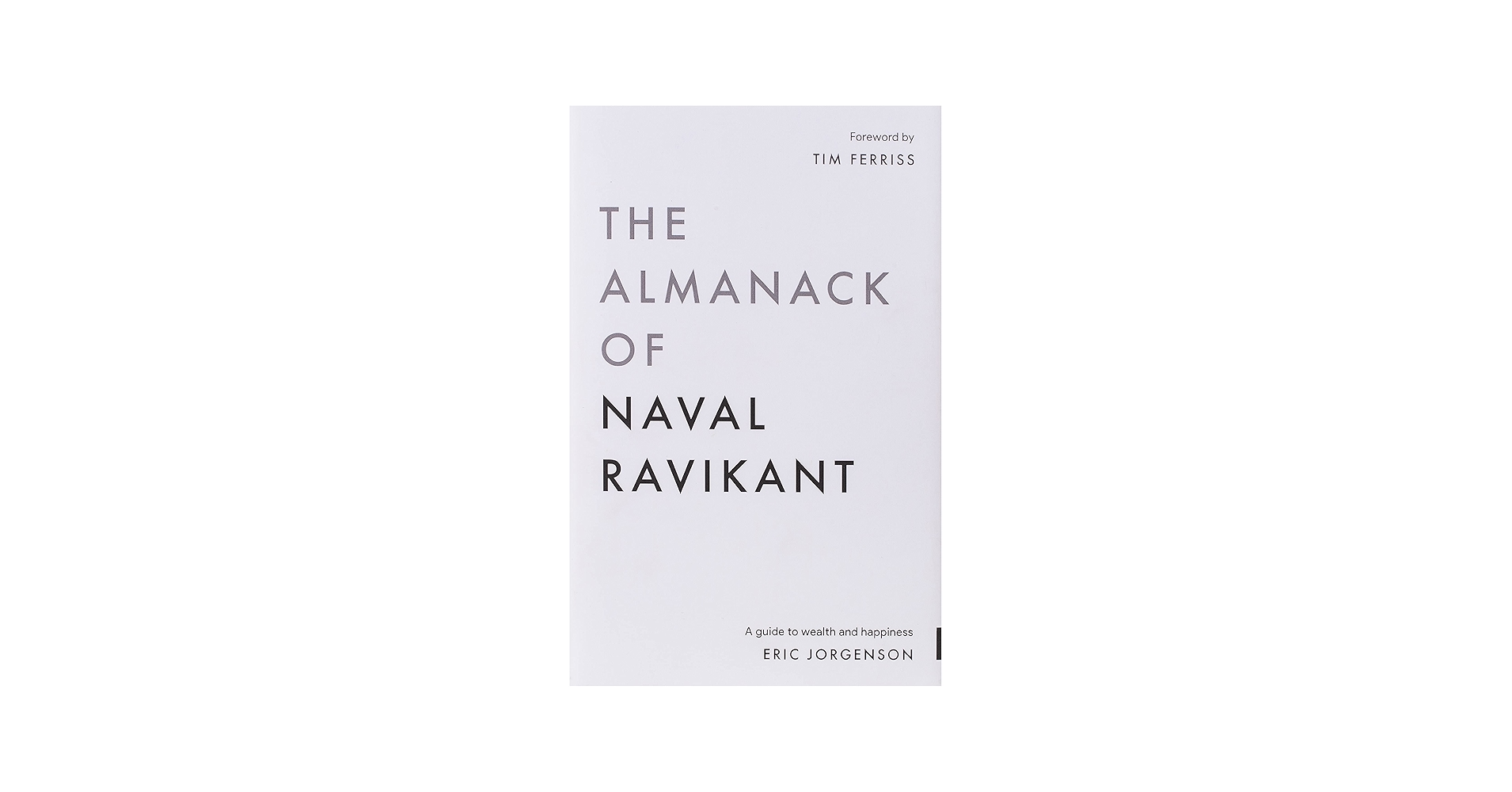
The Almanack of Naval Ravikant summary is a study of a singular life-operating system. As we navigate 2026, a year defined by the total integration of artificial intelligence and the sovereign individual, Naval’s insights have transformed from strategic advantages into survival imperatives. He represents a new archetype: the wealthy monk, the technical philosopher, the venture capitalist with the heart of a Stoic. This book curates a decade of his wisdom into a guide for how to get rich without getting lucky, moving beyond the tactical and into the foundational mechanics of how wealth and peace actually function in a world of infinite leverage.
Read also: Why Most Investors Underperform the Market
——————————————————————————–
2. PART 1: THE MECHANICS OF WEALTH CREATION
To build a life of freedom, you must first understand the fundamental game you are playing. Most people spend their lives playing the wrong games because they fail to distinguish between money, wealth, and status. Naval argues that distinguishing between these three is the prerequisite for financial independence.
Wealth creation is not about “working hard” in the traditional sense—you can work 80 hours a week in a restaurant and never get rich. Wealth is an understanding of how to build systems that work for you. Status, conversely, is a zero-sum game. To be number one in a status hierarchy, someone else must be number two. Status games are predatory and ancient, rooted in our evolutionary past as tribal monkeys. Wealth games, however, are positive-sum; they create new value for society and, in doing so, create freedom for the individual.
- Wealth: Assets that earn while you sleep. It is the factory, the code, the house being rented, or the computer program running at night serving customers. It is the ability to have your material needs met without your physical presence.
- Money: A tool to transfer wealth. It is “social credits”—an IOU from society saying that you did something useful in the past, and society owes you something in the future.
- Status: Your place in the social hierarchy. It is a zero-sum game where you gain by putting others down or ranking above them.
Earn with your mind, not your time.
The transition to actual freedom begins when you stop playing for status and start playing for wealth. Status games make you into an angry, combative person because you are constantly defending your rank. As Naval warns, status seekers are often “sharks” who live in a world where everyone is trying to tear each other down.
“Sharks eat well but live a life surrounded by sharks.”
Wealth games allow you to be an artist, creating value that society does not yet know how to get, but will eventually want.
——————————————————————————–
3. THE PILLARS: SPECIFIC KNOWLEDGE & ACCOUNTABILITY
In an economy increasingly dominated by automation, the only “moat” an individual has is their own uniqueness. To escape competition, you must embrace authenticity. Naval’s formula for this begins with Naval Ravikant specific knowledge and Accountability. These are the tools that allow you to build a personal brand and a unique value proposition that cannot be easily replicated by an algorithm.
Specific Knowledge: The Competitive Moat
Specific Knowledge is the knowledge you cannot be trained for. If society can train you to do something, it can eventually train a computer to do it, or it can train someone else to replace you. Specific knowledge is found at the intersection of your DNA, your unique upbringing, and your genuine curiosity.
“Building specific knowledge will feel like play to you but will look like work to others.”
It is found by pursuing your obsession rather than what is currently “hot” in the market. In a 2026 context, where AI can handle any task with a standardized training set, specific knowledge is the only thing that remains non-commoditized. It is often highly technical or creative and is taught through apprenticeships and trial-and-error.
Consider the 1,000x programmer. In a support role, the input (hours) is tied directly to output. But a 1,000x programmer, using their specific knowledge, can write a single viral loop or a piece of core infrastructure that creates billions in value. The gap between the mediocre and the master is no longer 10%; it is orders of magnitude.
Accountability: The Equity of the Individual
Taking business risks under your own name is the ultimate act of confidence. Accountability is a double-edged sword; it allows you to take credit when things go well and forces you to bear the brunt of failure when they don’t. However, society rewards those who are willing to be the “Captain of the Ship.”
Without accountability, you cannot build a reputation, and without a reputation, you cannot gain the trust required for high-level leverage. This leads to the Principal-Agent Problem: an agent (employee) never has the same incentives as a principal (owner).
“If you want it done, then go. And if not, then send.” — Julius Caesar (quoted by Naval)
To get rich, you must be a principal. You must take on the risk of your own name. By being accountable, you gain Equity—a piece of the upside. You will never get rich renting out your time; you must own a piece of a business to gain financial freedom.
Character as Destiny: The Diver Example
Naval explains that character and reputation eventually create a specific type of deterministic luck. He uses the example of the Best Deep-Sea Diver in the World. If someone finds a sunken treasure ship, they will seek out the best diver. The diver didn’t “get lucky” finding the treasure; their reputation for excellence made the luck find them.
If you can’t decide, the answer is no.
——————————————————————————–
4. THE MULTIPLIER: THE 3 TYPES OF LEVERAGE
If judgment is the steering wheel, leverage is the engine. You can be the best driver in the world, but you won’t get far on a bicycle. To create wealth at scale, you need to apply a force multiplier to your judgment.
“Give me a lever long enough and a place to stand, and I will move the earth.” — Archimedes
Naval deconstructs leverage into three distinct categories:
- Labor: This is the oldest and “worst” form of leverage. It involves having other humans work for you. It is permission-based—someone has to agree to follow you. It is messy, requiring complex management, and is prone to “mutiny.”
- Capital: The dominant form of leverage in the 20th century. It is also permission-based—someone has to give you the money. It scales better than labor, but it requires a track record of demonstrated judgment.
- Code and Media: The most critical form of leverage for the modern era. These are Permissionless. You do not need anyone’s permission to write a blog, record a podcast, or ship code. This is the leverage behind the newly rich.
The Industrial Age vs. The Age of Leverage The 40-hour work week is a relic of the Industrial Age, where labor was a linear input. In 2026, we live in the Age of Leverage. In this era, the “armies of robots” Naval speaks of are no longer metaphorical; they are the AI agents and LLMs packed into data centers. AI is the ultimate form of permissionless code leverage. It allows one person to do the work of a thousand agents. In this world, the gap between the leveraged and the un-leveraged is the gap between the wealthy and the working class.
Read also: The Secret Habits and Disciplined Wisdom of the World’s Best Traders
——————————————————————————–
5. THE FORMULA: “PRODUCTIZE YOURSELF”
The strategic synergy of Naval’s philosophy can be distilled into two words: Productize Yourself. This is the ultimate formula for escaping competition through authenticity and scaling your unique value.
- “Yourself” = Specific Knowledge + Accountability. It is the part of the equation that is unique, authentic, and irreplaceable.
- “Productize” = Leverage. It is the “how” that allows you to take your unique self and scale it to millions through code, media, or capital.
When you productize yourself, you are no longer competing with anyone else because no one can compete with you on being you. In the AI-driven economy, “Productizing” now means automating your specific knowledge. It means creating a digital version of your judgment that can work while you sleep.
All the returns in life, whether in wealth, relationships, or knowledge, come from compound interest.
You must play long-term games with long-term people. The goal is to eventually be paid for your Judgment rather than your time. As a leveraged worker, your “input” (hours worked) becomes totally disconnected from your “output” (value created).
——————————————————————————–
6. PART 2: THE ARCHITECTURE OF HAPPINESS
Once the problem of money is solved, the problem of the mind remains. Naval treats happiness as a skill to be mastered, much like wealth creation. It is the “default state” that emerges when you remove the sense that something is missing.
The Contract of Desire The fundamental hurdle to happiness is Desire. Naval provides a stark perspective on our internal drives:
“Desire is a contract you make with yourself to be unhappy until you get what you want.”
Most of us walk around in a constant state of “nexting”—thinking about the next meeting or the next purchase. This keeps us trapped in a delusion of the future. To be happy is to be present. It is the absence of the “monkey mind” chattering about what could be.
The Three Choices Framework
Naval offers a simple, brutal framework for any difficult situation:
- Change it: Take action to alter the reality.
- Accept it: Reach a state of total internal equanimity with the reality.
- Leave it: Remove yourself from the situation entirely.
Misery comes from sitting in the middle. If you are not changing it, not leaving it, and not accepting it, you are in a state of self-inflicted torture.
The Three Definitions of Retirement
Retirement isn’t an age; it’s a state of being. Naval defines it in three ways:
- When your passive income exceeds your burn rate.
- When you become a monk and drive your burn rate to zero.
- When you are doing what you love so much that the concept of “work” disappears.
Mental Models for Peace
- Envy is the Enemy: You cannot “cherry-pick” parts of someone else’s life. If you want someone’s wealth, you must take their entire life—their fears, their failures, and their internal struggles.
- Single-Player Games: Realize that life is a single-player game. All your interpretations are yours alone. External validation is a multiplayer game you cannot win.
- Happiness is a Choice: It is a habit developed by replacing anticipation with presence.
——————————————————————————–
7. CRITICAL ANALYSIS: THE DEMOCRACY OF LEVERAGE
A common criticism of Naval’s philosophy is that it is “elitist”—the musings of a billionaire who has already “won.” However, this ignores the Immigrant Context of Naval’s own life.
Naval grew up in Queens, NY, in a single-parent household. He was a poor immigrant who worked a paper route, washed dishes, and delivered food for an illegal catering company. His “luck” was the local library, where he spent his after-school hours reading the best thinkers in history. He moved from blue-collar to “leveraged” in a single generation by utilizing the “intelligence lottery” of Stuyvesant High School and Dartmouth.
Permissionless leverage—writing, coding, media—is the most democratic wealth-building tool in history. In the 20th century, you needed a bank’s permission for capital or a union’s permission for labor. In 2026, you only need an internet connection. AI has dropped the cost of the “army of robots” to near zero. These principles are not a luxury; they are a roadmap for anyone starting from zero to move from renting their time to owning their life.
Read also: An Analytical Inquiry into Patience and Financial SUCCESS
——————————————————————————–
8. CONCLUSION: FREEDOM AS THE ULTIMATE KPI
Wealth is merely a tool to buy back your time. Time is the canvas upon which you find true happiness and internal peace. The ultimate KPI for a successful life is Freedom.
Freedom “To” vs. Freedom “From” Most people seek the “freedom to”—the freedom to do whatever they want. But Naval points toward a deeper, internal freedom: the “freedom from.”
- Freedom from anger.
- Freedom from reaction.
- Freedom from sadness.
- Freedom from the need to be liked.
In the grand timeline of the universe, our struggles are infinitesimal. We are “monkeys with plans” on a tiny rock.
“Our lives are a blink of a firefly in the night. You’re just barely here. You have to make the most of every minute.”
When you acknowledge your death and the futility of seeking “immortality” through legacy, you are finally free to play the game of life for the fun of it. When you are at peace, you are at your most productive. When you do things for their own sake, you create your best work.
——————————————————————————–
9. CALL TO ACTION (CTA)
Stop renting out your time. Start building your specific knowledge. Embrace the accountability of your own name and apply the leverage of code and media to everything you do.
Play long-term games with long-term people. Start by reading this book.

