
I write about how to think more clearly, decide more wisely, and build the kind of mental frameworks that actually hold up in real life — not just in books.
Why I started this blog
A few years ago, I made a decision I was absolutely certain about. I had the data, the momentum, and the support of people I respected. Six months later, it had cost me significant time, money, and confidence.
When I looked back at what went wrong, the failure wasn’t in the execution. The failure was in how I had thought about the decision in the first place. I had reasoned by analogy instead of from first principles. I had let sunk costs distort my judgment. I had ignored the signals that didn’t fit what I wanted to believe.
The tools to think better had existed for decades — in psychology, philosophy, behavioral economics, and cognitive science. I just hadn’t been using them. Nobody had ever taught me how.
That experience sent me on a multi-year project of reading, applying, and stress-testing every framework I could find for clearer thinking. Mental models. Cognitive biases. Decision frameworks. The science of memory and learning. The behavioral economics of money. I became genuinely obsessed.
Building the Mind is where I document what I’ve learned — and more importantly, how I’ve tried to use it. Not as academic theory, but as practical tools for real decisions in a real life.
“The quality of your decisions determines the quality of your life. And the quality of your decisions is determined by the quality of your thinking. That’s the only leverage point I know of that touches everything else.”
A little background
I’m not an academic. I don’t have a PhD in cognitive science or a research position at a university. What I have is a decade of working in environments where thinking clearly — or failing to — had real and visible consequences. Business decisions, financial choices, creative projects, and interpersonal situations where the stakes were concrete enough that you couldn’t pretend the outcome didn’t matter.
That background shapes everything I write here. I am not interested in mental models as intellectual exercises. I am interested in them as instruments — things that change what you actually do when it matters.
The frameworks I write about are the ones I use myself. The examples I draw on are from my own experience — the decisions that worked and the ones that didn’t, and my best reconstruction of why. I write in the first person because this is genuine personal experience, not curated theory.
What I read, study, and draw from
The intellectual influences on this blog are a specific mix: the behavioral economics of Kahneman and Thaler, the mental models tradition of Charlie Munger and Shane Parrish, the philosophy of Stoicism and its application to decision-making, the cognitive psychology of memory and learning, and a deep reading of applied thinkers across business, science, and history.
I also read widely in areas that are not obviously connected to thinking — literature, biography, history — because the best frameworks often arrive in unexpected packaging.
What Building the Mind is about
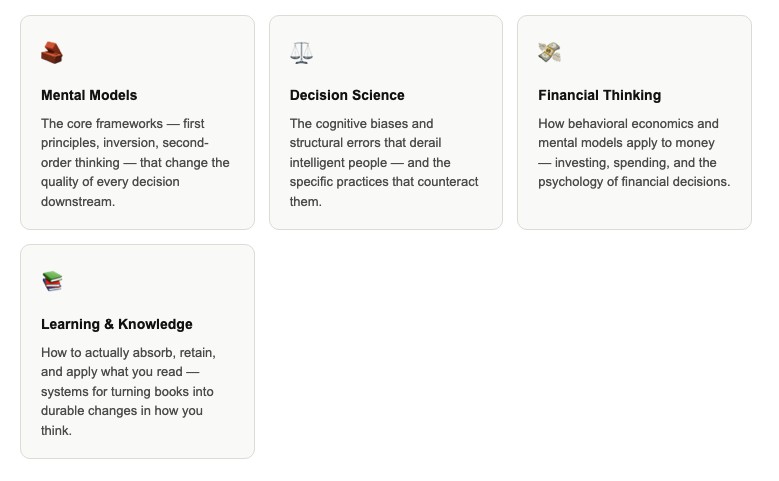
Every article on this blog sits within one of four areas. They’re interconnected — the same way the skill of thinking clearly doesn’t stay in any one box.
Who this blog is for
You’ll feel at home here if…
You read books about thinking, decision-making, or behavioral economics — and you want to apply them, not just collect them.
You have made decisions you understood intellectually were probably wrong, and done it anyway — and you want to understand why that happens and how to reduce it.
You believe the quality of your thinking is one of the highest-leverage things you can develop — and you’re looking for a writer who treats it that way.
You are tired of self-help content that sounds good in theory and falls apart on contact with actual life.
This blog is not for people looking for life hacks, quick fixes, or motivational content. It is for people who are willing to think carefully and who find that rewarding in itself — and who want writing that respects that.
How I approach writing here
- 🔍 First person, always Every article is written from lived experience. The stories are real. The mistakes are mine. I write this way because generic advice is everywhere — specific experience is rarer and more useful.
- 📐 Grounded in research, not just opinion Where scientific research exists — in behavioral economics, cognitive psychology, memory science — I use it and cite it. Opinion dressed as insight is not something I aim to produce.
- 🔧 Application over theory Every article ends with something you can actually do. Frameworks without implementation paths are intellectual entertainment — useful, but not the point of this blog.
- ✂️ Honest about what doesn’t work I write about the frameworks I’ve tried that failed as much as the ones that worked. The failure cases are usually more instructive — and more honest.
- ⏳ Long-form and unhurried Ideas that deserve space get space. I do not publish on a rigid schedule at the expense of quality. Every article on this site took considerably longer to write than it takes to read.
The journey so far
- The expensive decision that started it all A business decision made with confidence and poor reasoning that cost me significantly — and sent me looking for better tools for thinking.
- Two years of reading everything I could find Kahneman. Munger. Thaler. Taleb. Marcus Aurelius. Shane Parrish. A deep reading of behavioral economics, philosophy, and cognitive science — followed by an equally deep attempt to actually apply it.
- Building and testing the frameworks Running the ideas through real decisions: career pivots, investment choices, creative projects, relationship dynamics. Keeping notes on what held up under pressure and what collapsed.
- Building the Mind launches The decision to write publicly — to document what I’d learned in a form that might be useful to others going through the same process of trying to think better.
- Ongoing — one article at a time Every piece published here represents something I’ve genuinely worked through — read, applied, stress-tested, and found worth sharing. That standard doesn’t change.
A note on transparency: Building the Mind occasionally contains affiliate links to books and resources I personally use and recommend. If you purchase through these links, I may earn a small commission at no additional cost to you. All opinions are my own — I only recommend things I have read or used directly. This blog also displays advertising through Google AdSense. The presence of ads does not influence editorial content. For full details, see the Privacy Policy and Affiliate Disclaimer.