

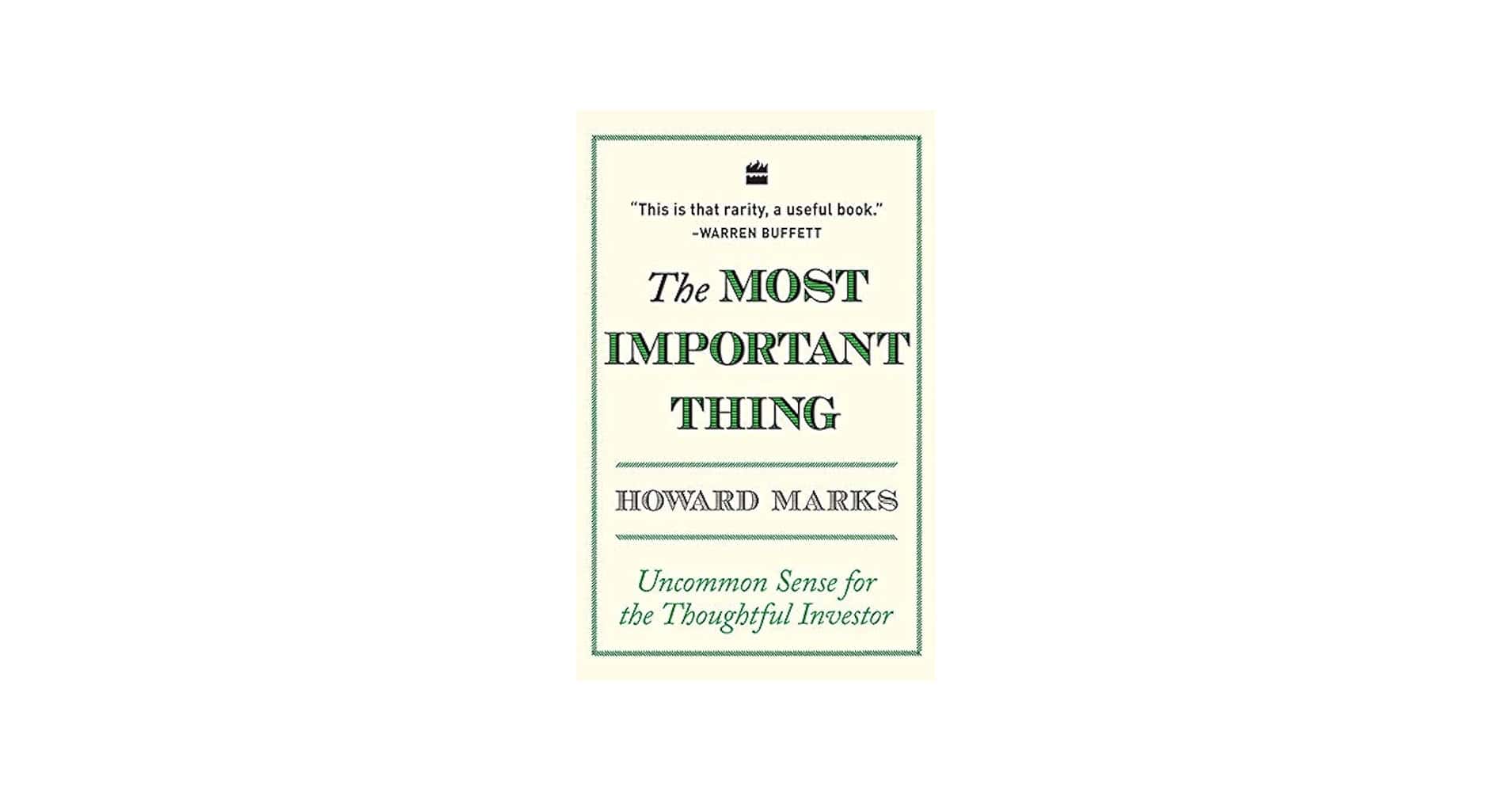
Star Rating: 5/5 (Warren Buffett’s Top Pick)
One-Sentence Verdict: This is an institutional masterclass in investment philosophy that prioritizes the synthesis of market psychology, risk management, and the self-correcting nature of cycles over the hollow certainty of quantitative formulas.
Best For: Value Investors, Portfolio Managers, and HNW Individuals seeking to move beyond first-level consensus.
Difficulty: Hard. While the prose is elegant, the execution requires rigorous psychological introspection and the courage to endure the discomfort of being “wrong” before being right.
Purchase “The Most Important Thing” on Amazon
——————————————————————————–
1. INTRODUCTION: THE ENDORSEMENT OF A LIFETIME
In the upper echelons of institutional finance, Howard Marks is widely regarded as a “teacher’s teacher.” As the co-founder of Oaktree Capital Management, his clinical yet philosophical approach to credit and distressed debt has turned his client memos into required reading for the world’s most successful capital allocators. This reputation was cemented by Warren Buffett’s famous admission: “When I see memos from Howard Marks in my mail, they’re the first thing I open and read.”
The Most Important Thing is not a manual for stock screening; it is a strategic brief for the brain. Marks argues that while financial analysis is a necessary baseline, it is the “human side of investing”—navigating the messiness of emotion and the fallibility of consensus—that separates the great from the merely average. Our objective is not to provide a magic formula, but to equip the thoughtful investor with a disciplined thought process capable of surviving the market’s inevitable pendulum swings.
——————————————————————————–
2. THE FOUNDATION: SECOND-LEVEL THINKING
To achieve superior results, one must start with a sobering mathematical reality: you cannot perform like the crowd and expect to outperform the crowd. In a zero-sum market, outperformance requires divergent thinking. This is the strategic necessity of Second-Level Thinking.
Marks deconstructs the cognitive planes as follows:
- First-Level Thinking: Simplistic and consensus-driven. A first-level thinker says, “It’s a good company, let’s buy the stock.” It is superficial, reactive, and ultimately ineffective because the “goodness” of the company is already baked into the price.
- Second-Level Thinking: Complex, convoluted, and contrarian. The second-level thinker asks, “It’s a good company, but is it perceived as a great company? If it is priced for perfection and reality is merely ‘good,’ the stock is a sell.”
To operate at this level, an investor must relentlessly ask:
- What is the range of likely future outcomes?
- What does the consensus think will happen, and how does my expectation differ?
- Is the current price too bullish or too bearish relative to that consensus?
- What will happen to the price if the consensus is right, and what if I am right?
The 2×2 Matrix Logic: Conventional behavior leads to average results (good or bad). Only unconventional behavior—holding a non-consensus view that turns out to be correct—leads to superior results. However, being “unconventional and wrong” is the quickest path to career termination. This is why most stay in the herd. To capture alpha, you must be unconventional and more right than the consensus.
Read also: The Blueprint for Permissionless Wealth and Perpetual Peace
——————————————————————————–
3. THE LIMITATIONS OF MARKET EFFICIENCY
There exists a fundamental tension between the “Chicago School” of academic finance and the reality of human volatility. The Efficient Market Hypothesis (EMH) posits that information is reflected immediately in prices and that investors are rational, objective actors.
Marks offers a “Second-Level” rebuttal: Markets are often speedy, but they are rarely right. As Paul Johnson notes, the primary flaw in EMH is the assumption of objectivity. Humans are driven by greed and fear, not just spreadsheets.
The Yahoo Case Study: In January 2000, Yahoo was priced at $237. By April 2001, it sat at $11. To argue the market was “efficient” at both points is an absurdity. The market incorporated information quickly, but its judgment was catastrophically wrong.
The Resolution: Marks treats efficiency as a “rebuttable presumption.” For mainstream, highly-followed assets, the market is usually “efficient enough” to make finding bargains a waste of time. Instead, the thinking investor should seek out niches characterized by:
- Socially unacceptable or controversial assets (the “un-investable”).
- Areas with “forced sellers” who must liquidate regardless of intrinsic value.
- Inefficient pockets where information is not evenly distributed.
——————————————————————————–
4. REDEFINING AND RECOGNIZING RISK
Risk management is the essential element of investing. While the masses focus on “how much can I make?”, the superior investor—emulating Seth Klarman’s obsession with downside protection—focuses on “what can I lose?”.
- Volatility vs. Loss: Academia defines risk as volatility (Beta). Marks rejects this as a matter of convenience for mathematicians. Real risk is the probability of permanent loss of capital.
- The Perversity of Risk: Risk is at its highest precisely when it is perceived to be at its lowest. In “risk-is-gone” environments, investors abandon prudence, bid up prices, and create the very bubbles they fear.
- Unseen Risk: Marks invokes the concept of “alternative histories.” Just because a disaster did not happen doesn’t mean the portfolio was safe. Like a game of Russian Roulette with 1,000 chambers, just because the bullet didn’t fire today doesn’t mean you weren’t playing a lethal game.
Specific Institutional Risks:
- Career Risk: The fear that being unconventional and wrong will lead to firing.
- Benchmark Risk: The psychological pressure to track an index, even into a bubble.
- Illiquidity: Being unable to exit a position when the “fatal bullet” finally arrives.
——————————————————————————–
5. THE MARKET PENDULUM AND CYCLES
Cycles are self-correcting because “success carries the seeds of failure.” When things go well, lenders become lax and investors become bold, which inevitably leads to capital destruction.
The Pendulum of Psychology: The market swings between greed and fear. Marks identifies the Three Stages of a Bull Market:
- When a few forward-looking people believe things will get better.
- When most investors realize improvement is taking place.
- When everyone concludes things will get better forever.
In response to the 2008 crisis, Marks formulated the Three Stages of a Bear Market:
- When just a few thoughtful investors recognize that things won’t always be rosy.
- When most investors recognize things are deteriorating.
- When everyone is convinced things can only get worse.
The Credit Cycle Mandate: Prosperity leads to providers of capital becoming less risk-averse. They lower interest rates and ease covenants, eventually financing projects that shouldn’t be financed. As Marks notes, “the worst loans are made at the best of times.” You cannot predict the future, but you must know “where we stand” in the cycle to adjust your defensive posture.
Read also: How to Cure Excusitis and Unlock Your True Potential
——————————————————————————–
6. CONTRARIANISM AND THE MARGIN OF SAFETY
Being a contrarian is psychologically grueling. It requires being a lone dissenter when the herd is profiting. However, as Joel Greenblatt cautions, you shouldn’t just jump in front of a Mack truck because no one else is. True contrarianism is based on value.
“Investment success doesn’t come from buying good things, but from buying things well.” — Howard Marks
- Price vs. Value: The most important relationship in investing is the gap between price and intrinsic value.
- Margin of Safety: Buying “what everyone hates” provides protection because the price is already depressed by pessimism.
- The Skeptic’s Epiphany: True skepticism isn’t just being a permabear. It is being pessimistic when the crowd is optimistic, but also—critically—being optimistic when the crowd is despondent.
——————————————————————————–
7. CRITICAL ANALYSIS: IS ACTIVE INVESTING DEAD?
The rise of passive indexing is a rational response to the fact that most active managers fail. However, Marks offers a nuanced defense: human emotion ensures that markets will never be perfectly efficient.
Active management (Alpha) is only possible through “Uncommon Sense.” Computers cannot account for the shifting tides of human psychology. While most will fail to beat the index, the “thinking investor” can exploit the emotional errors of the crowd. As Christopher Davis notes, understanding the flawed incentives of institutional “silos” often reveals mispricings that a passive index will blindly swallow.
——————————————————————————–
8. PROS AND CONS: A SOPHISTICATED CRITIQUE
| Pros (Strengths) | Philosophical Trade-offs |
| Defensive Focus: Prioritizes capital preservation, the bedrock of long-term compounding. | Repetition as Pedagogy: Marks admits the “21 things” overlap; this is a deliberate tool to reinforce a multi-layered wall of discipline. |
| Psychological Mastery: Moves beyond the spreadsheet to address the human errors of the herd. | Absence of Formulas: Provides no screeners or valuation math. It provides a lens, not a map. |
| Timelessness: Principles of cycles and human nature do not age with market regimes. | High Conviction Required: Following this path is lonely and requires the stomach to “look wrong” for years. |
——————————————————————————–
9. CONCLUSION: UPGRADING YOUR THINKING
Howard Marks’ philosophy is built on 21 “bricks”—ranging from second-level thinking and risk control to patient opportunism and reasonable expectations. Together, these bricks form a solid wall of investment discipline. Individually, they are mere observations; synthesized, they represent a fortress against the volatility of the human psyche.
Investing is ultimately an intuitive, adaptive art form. It requires us to accept that “we don’t know what lies ahead,” while simultaneously preparing for the range of what might happen.
As Marks frequently reminds us regarding the harsh reality of the markets:
“Experience is what you got when you didn’t get what you wanted.”
The ultimate goal of this creed is to ensure that your experience eventually transforms into the wisdom required to survive the next cycle.
Read also: An Analytical Inquiry into Patience and Financial SUCCESS
——————————————————————————–
CALL TO ACTION
The most vital investment you can make is in the quality of your own decision-making process.
Upgrade your thinking before you upgrade your portfolio.

