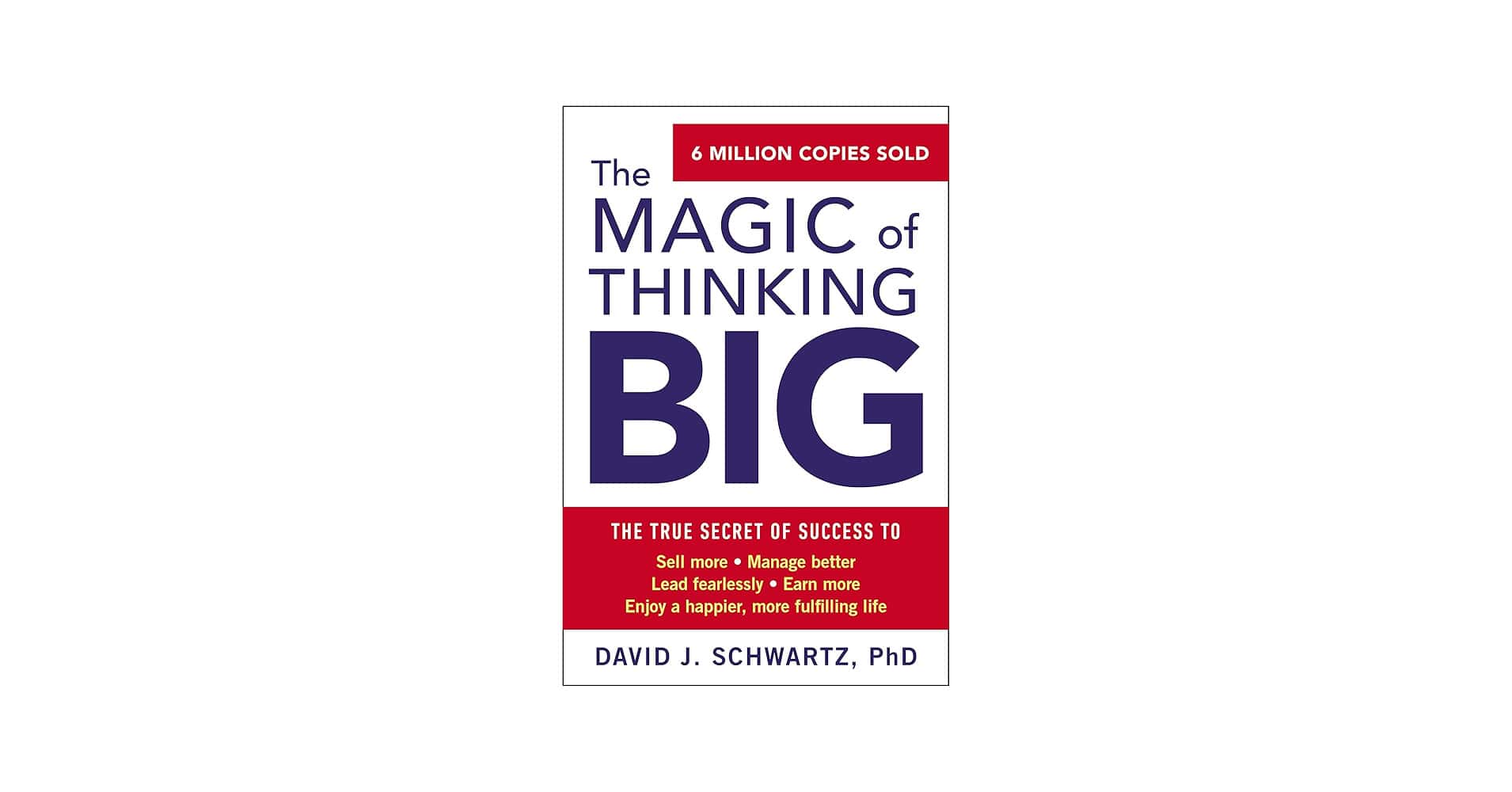
Star Rating: 5/5 (A Self-Help Classic)
One-Sentence Verdict: Your success—measured by your bank account, your influence, and your happiness—is determined not by your native intelligence or your luck, but by the literal size of your thinking.
Best For: Salespeople, Entrepreneurs, Corporate Climbers, and anyone feeling “stuck” in a cycle of mediocrity.
Difficulty: Very Easy.
Action Step: Buy The Magic of Thinking Big on Amazon
——————————————————————————–
INTRODUCTION: The Great Intellectual Fallacy
Listen closely, my friend, because what I am about to tell you is the difference between a life of scraping by and a life of abundance. Most people walk through their days under a profound and damaging delusion. They see the “Big Winners”—the men and women with the five-bedroom homes, the prestigious titles, and the influential circles—and they assume these people possess a “super-brain.” They believe success is reserved for those with a high IQ or a specialized pedigree.
As Dr. David J. Schwartz proved over sixty years ago, this is the Great Intellectual Fallacy. Success has very little to do with the quantity of your brains and everything to do with the quality of your thoughts.
I want you to consider a case study that Dr. Schwartz witnessed personally: the story of “Harry the Salesman.” At a high-stakes sales meeting, a marketing vice president pointed to Harry—a man who looked as average as any man could look. Yet, in the previous year, Harry had earned just under $60,000. To put that in perspective, the other representatives in his company averaged only $12,000.
The executive challenged the room: “Is Harry five times smarter than the rest of you? No. I checked our personnel tests, and they show his intelligence is strictly average. Did he work five times harder? No—the reports show he actually took more time off than most of you. Did he have a better territory? No. Better health? No. Better education? No.”
So, what was the $48,000 difference?
The difference, the executive concluded, was that Harry thought five times bigger. While the “Average Guy” was looking for reasons why he couldn’t close a deal, Harry was visualizing $60,000 in his bank account and acting accordingly. He understood that the size of one’s brain is secondary to the magnitude of one’s mental vision.
If you are currently feeling like a “small” person in a “big” world, it is because you have allowed your internal “Thought Factory” to run a defective production line. You are selling yourself short, and it is time we fixed that.
Read also: The Secret Habits and Disciplined Wisdom of the World’s Best Traders
——————————————————————————–
THE THOUGHT FACTORY: Mr. Triumph vs. Mr. Defeat
Your mind is a busy factory, producing thousands of thoughts every single day. This factory is managed by two foremen: Mr. Triumph and Mr. Defeat.
Mr. Triumph is your internal expert in manufacturing positive thoughts. He specializes in providing reasons why you can, why you are qualified, and why you will succeed. Mr. Defeat, however, is your internal expert in inadequacy. He produces the “why-you-will-fail” chain of thoughts. Both foremen are intensely obedient; the moment you give them a mental signal, they snap to attention.
The Production Logs: A Comparison
| Foreman | Typical Directive | Output/Production | Final Destination |
| Mr. Triumph | “Today is a wonderful day.” | Suggests: “The weather is refreshing. You can catch up on work. It’s good to be alive.” | Successfulville, U.S.A. |
| Mr. Defeat | “Today is a lousy day.” | Suggests: “It’s too hot. Business will be bad. You might get sick. People are on edge.” | Second Class Street |
So what? Here is the psychology you must grasp: The more work you give either of these foremen, the stronger they become. If you fertilize Mr. Defeat’s line with repetition, he eventually hires more staff and takes over the entire factory. You’ll find yourself living on Second Class Street—a crowded, miserable place where people wait for “fate” to change their lives.
To move to First Class Avenue, you must fire Mr. Defeat immediately. He is a liability you cannot afford. You must use Mr. Triumph 100% of the time. When a thought enters your mind, ask Mr. Triumph to go to work. He will show you how you can succeed. But before you can fully empower him, we must vaccinate you against the most common disease found in the Thought Factory: Excusitis.
——————————————————————————–
THE DISEASE OF FAILURE: EXCUSITIS
I have studied thousands of people, and I can tell you that every failure suffers from a mind-deadening thought disease called Excusitis. People who are “going nowhere” have a bookful of reasons to explain why. They select a “good” excuse, repeat it until they believe it is a fact, and then use it as a crutch to save face. Identifying these alibis is the first step toward your “vaccination” against failure.
Health Excusitis
This ranges from “I don’t feel good” to chronic ailments. Millions use bad health as a shield against responsibility.
The Cure: You must follow the “live until you die” philosophy. Schwartz tells the story of two men. One had a plastic valve put in his heart—an operation that literally made a ticking sound. Instead of worrying about death, this man was ticking with optimism, planning to study law and enter government work. Contrast him with the “living dead”—diabetics who pity themselves into invalidism.
I see this in my own coaching: one man with a mild ailment stays in bed, while another, like a manager Schwartz knew, takes thirty times the insulin but refuses to “think himself to bed.” He praised the scientists who found insulin and got back to the joy of work. Affirmation: “It is better to wear out than to rust out.”
Intelligence Excusitis (CORE FOCUS)
This is the silent killer of potential. Most people make two basic errors: they underestimate their own brainpower and overestimate the other fellow’s.
We often hear that “knowledge is power,” but that is a half-truth. Knowledge is only potential power. Consider Phil F., a senior officer at a major advertising agency earning $30,000 a year (while his subordinates earned less than $10,000). Phil knew next to nothing about statistics or research techniques. He wasn’t a college graduate. Why was he worth three times more? Because he was a “human engineer.” He was 100% positive, he could inspire others, and he understood what made people tick.
“The thinking that guides your intelligence is much more important than how much intelligence you have.”
As Dr. Edward Teller, a father of the hydrogen bomb, noted: a child doesn’t need a lightning-fast mind to be a scientist; they only need a high degree of interest.
The Three Cures for Intelligence Excusitis:
- Never sell yourself short. Focus on your assets. Manage your brains; don’t worry about how much IQ you have.
- Attitude over IQ. Remind yourself daily that your attitudes are more important than your intelligence. Use your mind to find ways to win, not to prove you will lose.
- Think, don’t memorize. Use your mind to create and develop ideas. Ask yourself: “Am I using my mental ability to make history, or merely to record history made by others?”
Age Excusitis
“I’m too old” or “I’m too young” are barricades built by a fearful mind. Schwartz cured a 40-year-old man named Cecil by showing him that his productive life (ages 20 to 70) was 50 years long. At 40, Cecil had used only 40% of his time; he had 60%—30 years—left!
I often tell my clients about Schwartz’s relative who decided to become a minister at age 45. He had no money and three children, but he spent five years in training and had twenty glorious years of service ahead of him. Or consider Bill, who graduated from Harvard in the 1920s, made a fortune, and then decided to become a professor. He enrolled at the University of Illinois at age 51 and earned his degree at 55. If you know your job and understand people, you are old enough. Age is a liability only if you believe it is.
Luck Excusitis
You must accept the Law of Cause and Effect. When you see “Mr. Success” get a $112,000 order, don’t call him lucky. He likely spent months planning, staying up nights figuring out the customer’s needs, and getting engineers to make preliminary designs.
“Mr. Mediocre” suffers a setback and blames fate. “Mr. Success” receives a setback, learns from it, and profits. Luck is a phantom used by the weak to explain away the results of the strong. If General Motors were reorganized based on luck—pulling names out of a hat for the role of president—it would fall apart in a week. Success comes from doing the things that produce success.
Read also: How Your Brain Tricks You (And How to Fix It)
——————————————————————————–
ACTION CURES FEAR: THE CONFIDENCE BUILDING TECHNIQUES
Fear is the great success-shredder. But here is a secret I want you to burn into your memory: fear is not something you are born with; it is a product of hesitation.
The physiological mechanism is simple: Action cures fear. When you hesitate, you give Mr. Defeat time to manufacture reasons to be afraid. When you act, you destroy the evidence of the fear. You must master these confidence building techniques to survive in a competitive world.
The Success Offensive
- The “Front Row” Principle: In every meeting you attend, where do people sit first? The back rows. They want to be “unnoticed” because they are afraid. Sit in the front row. Make it a habit to be visible.
- The “Speak Up” Habit: Be a “volunteer” to speak. Every time you fail to speak in a meeting, you feel even more inferior. Speaking up is a vitamin for your confidence.
- Using Eye Contact: Look the other person in the eye. Shifty eyes say “I’m afraid” or “I’m hiding something.” Direct eye contact says, “I am honest, and I believe in what I am saying.”
- The “Smile Big” Technique: You cannot feel down and give a real, “tooth-showing” smile at the same time. Smile at everyone. It melts opposition and builds your internal strength.
So what? Waiting for “perfect conditions” is a form of creative stagnation. If you wait until everything is 100% right before you act, you will wait forever. The “Magic of NOW” is the only viable strategy. Successful people don’t wait for the wind to change; they adjust their sails immediately. Action is the only way to build a “store of confidence” in your memory bank.
——————————————————————————–
ENVIRONMENT: GO FIRST CLASS
Your mind is a product of its surroundings. Schwartz calls this “psychological sunshine” or “thought poison.” If you associate with small thinkers, you will think small. If you associate with big thinkers, you will grow big. You cannot think big in a small-minded environment.
Analysis of Your Surroundings
- Dress and Appearance: You represent what you think you are. Schwartz is clear: “You look important because it helps you think important.” If your clothes are “Second Class Street,” your thoughts will be too. Spend more for fewer clothes. Choose quality over quantity. High-quality clothing provides a psychological lift that changes how you carry yourself.
- The Social Circle: Negativity is contagious. If you hang around gossipers and “negativity thinkers” who tell you why things won’t work, you are drinking thought poison. Big people do not laugh at big ideas. They know big ideas are possible.
- The “Consult the Experts” Rule: If you want advice, go to someone who has succeeded. If you want to know how to build a million-dollar business, don’t ask the man who has spent thirty years in a cubicle complaining about the boss.
So what? While internal action changes you from the inside, your external environment provides the “psychological sunshine” to keep that confidence growing. To move to First Class Avenue, you must consciously choose a first-class environment—from the books you read to the people you call friends.
——————————————————————————–
HOW TO THINK LIKE A LEADER
To achieve big success, you need the support of others. You cannot “order” people to support you; you must lead them. Leadership is not a title; it is a way of thinking. In Chapter 13, Schwartz outlines the four rules for gaining the support of those around you.
The Four Pillars of Leadership
- Trade Minds with the People You Want to Influence: Put yourself in the other person’s shoes. If you were them, how would you want to be treated? What would make you want to work harder?
- The “Be-Human” Approach: Put people first. Treat them as individuals with their own dreams. When you make others feel important, they will move mountains for you.
- Think Progress, Believe in Progress, Push for Progress: Never settle for the status quo. A leader always asks, “How can we do it better?” This progressive thinking is magnetic. People want to follow someone who is going somewhere.
- The Solitude Mandate (Tap Your Supreme Thinking Power): Every great leader takes time to think in silence. Spend at least 30 minutes a day alone with your thoughts. This is where the big ideas—the “mountain-moving” ideas—are born.
——————————————————————————–
THE POWER OF BELIEF: MOVING MOUNTAINS
I want to leave you with one final story from the Source Context. A state highway department once sent notices to twenty-one engineering firms to design eight bridges at a cost of $5,000,000. The commission was $200,000.
The four largest firms submitted proposals. Of the remaining seventeen small firms, sixteen said, “It’s too big for us. I wish we could handle it, but it’s no use trying.” But one firm with only three engineers studied the plans and said, “We can do it. We’ll submit a proposal.”
They got the job.
Belief is the thermostat that regulates what we accomplish. If you set your thermostat to “mediocre,” you will stay in a cold, dark place. If you set it to “Big,” your mind will find the “how-to” to make it happen.
Read also: Why You Can’t Beat the Market (And Shouldn’t Try)
——————————————————————————–
THE MOST POWERFUL DAVID SCHWARTZ QUOTES ON THINKING BIG
- “Life is too short to be little.”
- “The size of your success is determined by the size of your belief.”
- “Think Big and you’ll live big—in income, friends, and respect.”
- “Look at things not as they are, but as they can be. Visualization adds value to everything.”
——————————————————————————–
CRITICAL ANALYSIS: TIMELESS WISDOM VS. VINTAGE EXAMPLES
Written in 1959, The Magic of Thinking Big is a product of its time, and we must address that.
Pros and Cons
- Pros:
- Radical Practicality: Unlike modern “manifesting” books, Schwartz demands action and discipline.
- The Excusitis Concept: It remains the most effective diagnostic tool for self-sabotage ever written.
- Instant Results: The confidence-building techniques work the moment you try them.
- Cons:
- Dated Language: The 1950s corporate anecdotes (the “stay-at-home wife” or “Indians vs. Chiefs”) can feel archaic.
- Simplified Anecdotes: Some stories feel “neat,” potentially glossing over systemic barriers.
So what? Despite the vintage coat of paint, the core psychology is more relevant now than ever. In our era of social media comparison, the “Intelligence Excusitis” and “Environment” chapters are vital. We are currently drowning in “thought poison” from digital environments; Schwartz’s directive to “Go First Class” with your psychological consumption is a necessary lifeline for your sanity and your success.
——————————————————————————–
CONCLUSION: LIFE IS TOO SHORT TO BE LITTLE
The central thesis of this work is simple yet staggering: The size of your success is determined by the size of your belief.
If you think in nickels and dimes, you will live a nickel-and-dime life. If you think in millions and grand achievements, you will eventually inhabit that reality. You are a product of your own thoughts. You have a “Thought Factory” inside you that can either build a cathedral or a shack. The choice of foreman—Mr. Triumph or Mr. Defeat—is yours and yours alone.
Believe Big. Adjust your thermostat forward. Launch your success offensive with the honest, sincere belief that you can—and will—succeed.
——————————————————————————–
CALL TO ACTION
Stop making excuses. Start making progress. The world is full of “Indians” but lacks “Chiefs.” There is a vacancy waiting for you on First Class Avenue, but you can’t get there carrying a suitcase full of alibis.
Vaccinate yourself against Excusitis today. Fire Mr. Defeat. Sit in the front row of your life.