

1. THE SNAPSHOT (EXECUTIVE SUMMARY)
THE EMPIRICIST’S VERDICT
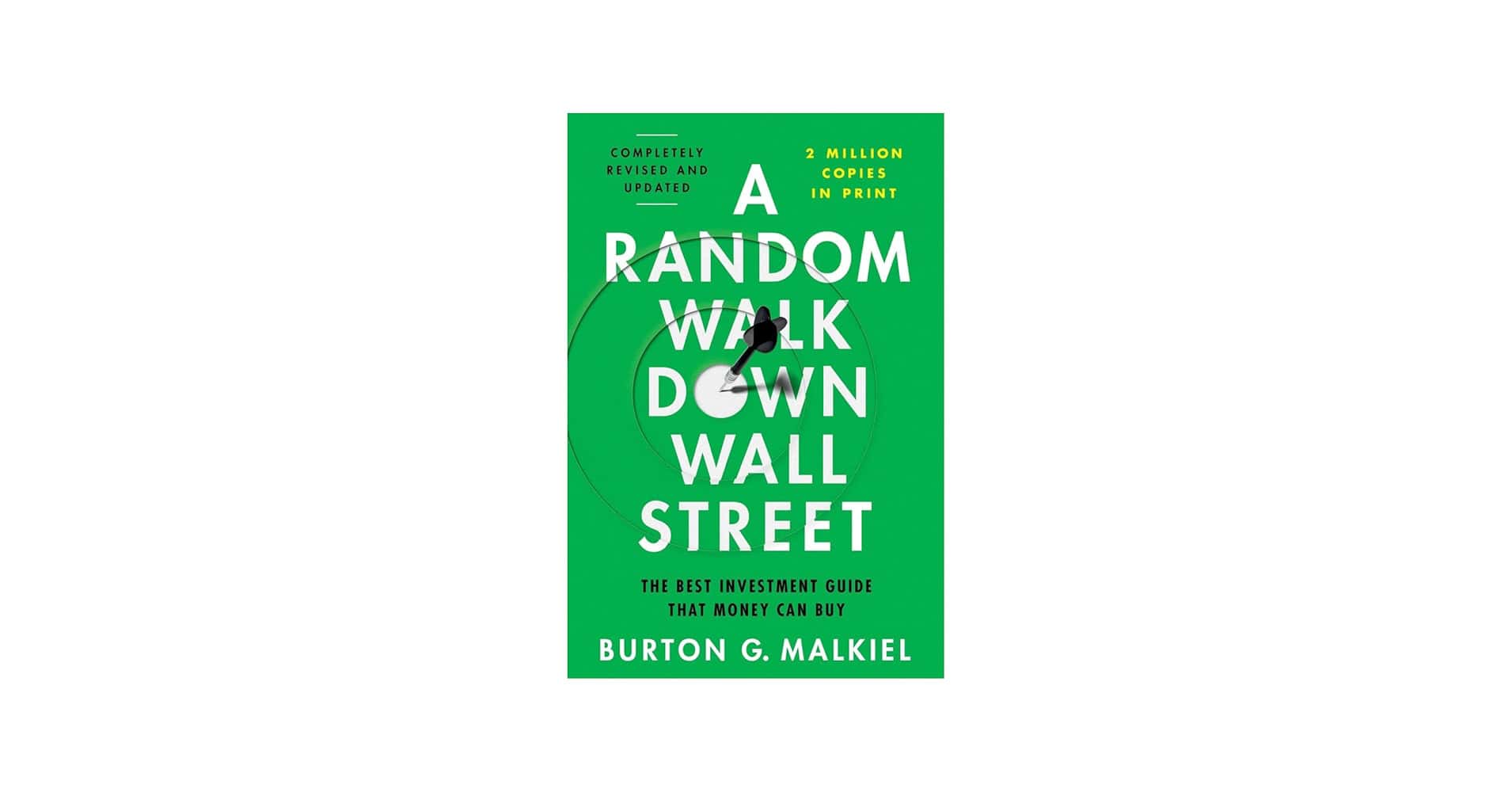
Buy A Random Walk Down Wall Street on Amazon
——————————————————————————–
2. INTRODUCTION: THE MONKEY, THE DARTBOARD, AND THE TRUTH ABOUT WALL STREET
If you find yourself enchanted by the polished charisma of CNBC pundits or the “proprietary alpha” promised by high-fee mutual fund managers, Burton Malkiel has a cold, data-driven shower waiting for you. The central thesis of A Random Walk Down Wall Street is an intentional insult to the multi-billion dollar financial services complex: the idea that a blindfolded primate has as much chance of picking a winning portfolio as a high-priced “expert.”
“A blindfolded monkey throwing darts at a newspaper’s stock pages could select a portfolio that would do just as well as one carefully selected by experts.”
This is not a mere rhetorical flourish or a cynical joke. It is an empirical reality backed by over fifty years of market data. This brings us to the “Random Walk” theory. In the context of finance, a “random walk” means that the future path of price movements is as unpredictable as the next step of a drunkard in an alleyway. Each price change is independent of the last.
Because the market is an information-processing machine, price movements occur in response to “news.” By definition, news is unpredictable—if it were predictable, it wouldn’t be news. Therefore, if news is random, price changes must be random as well. For the “Wall Street Wizards,” this is an existential threat. Their entire industry is built on the premise that they possess a crystal ball made of spreadsheets and sentiment analysis. Malkiel’s work effectively shatters that crystal ball, replacing it with a mirror that reflects the statistical impossibility of consistently outperforming the aggregate market after fees and taxes.
Read also: The Temporal Architecture of Capital: How Time Horizon Changes Investment Decisions
——————————————————————————–
3. THE CORE THEORY: EFFICIENT MARKET HYPOTHESIS (EMH)
The intellectual bedrock of the passive indexing revolution is the Efficient Market Hypothesis (EMH). To the financial empiricist, the stock market is not a chaotic casino governed by whims; it is a hyper-efficient system where information travels at the speed of light and is “priced in” almost instantly.
The logic is simple: at any given moment, the current price of a stock reflects everything that is known about it—from its last quarterly earnings to the geopolitical stability of its supply chain. When new information emerges, thousands of rational participants (and their algorithms) act on it immediately. By the time you read a “hot tip” in a newsletter or see a breaking news alert on your phone, the window for profit has slammed shut. You are not trading on an edge; you are trading on an echo.
Malkiel breaks down EMH into three distinct forms, each a progressively harder pill for active traders to swallow:
- The Weak Form: This asserts that all past price information is already reflected in the current price. Therefore, studying historical charts—the hallmark of technical analysis—is a total waste of time.
- The Semi-Strong Form: This claims that all publicly available information is priced in. This means that neither “fundamental analysis” of balance sheets nor reading every press release will give you an advantage, as the market has already digested that data.
- The Strong Form: The most extreme version, which suggests that even private (insider) information is often reflected in market prices.
The inescapable conclusion for the rational investor is a simple, bolded truth: “Nobody consistently knows more than the market.” While there are occasional glitches in the system—temporary bubbles or flashes of irrationality—the market remains “efficient enough” to ensure that the average person trying to beat it is actually just participating in a high-cost exercise in futility.
——————————————————————————–
4. DEBUNKING THE TWO RELIGIONS: CASTLES IN THE AIR VS. FIRM FOUNDATIONS
Wall Street has spent a century attempting to codify market movements into two distinct “religions.” Malkiel treats both with the skepticism they deserve, viewing them as elaborate frameworks designed to justify high management fees.
Subsection: The Castle in the Air (Technical Analysis)
Technical analysis is the financial world’s version of astrology. Its practitioners, known as “Chartists,” believe that by staring at price graphs long enough, they can identify patterns—”head and shoulders,” “pennants,” or “support and resistance levels”—that predict the future.
Malkiel is ruthlessly dismissive, equating chart reading to “reading tea leaves.” The strategy relies on the “Castle in the Air” theory: the idea that a stock’s value is irrelevant; what matters is what someone else might be willing to pay for it tomorrow. This is the “Greater Fool Theory” in action. Empirically, these patterns are purely retrospective. A “support level” is only visible after it has failed or succeeded. Once you account for the high transaction costs and the tax drag of frequent trading, technical analysis has a success rate that would make a coin-flipper look like a genius.
Subsection: The Firm Foundation (Fundamental Analysis)
The more “respectable” cousin is fundamental analysis, which seeks to determine a stock’s “intrinsic value” by dissecting earnings, dividends, and growth prospects. This is the “Firm Foundation” theory. While it is more logical than staring at charts, it is still built on a foundation of sand.
Why? Because fundamental analysis requires predicting the future, and humans are notoriously terrible at it. The “intrinsic value” of a stock is based on projected earnings, but as Malkiel points out, the “experts” are consistently wrong about those projections. He even shares a dark joke common in accounting circles regarding EBITDA: it stands for “Earnings Before I Tricked the Dumb Auditor.”
Furthermore, even if a fundamentalist correctly predicts a company’s growth, they often get the “multiple” (the price the market is willing to pay for that growth) entirely wrong. In the end, fundamental analysis is simply an educated guess about an unknowable future, and the market’s collective guess is almost always more accurate than yours.
——————————————————————————–
5. THE SOLUTION: MODERN PORTFOLIO THEORY AND THE INDEXING REVOLUTION
If picking winners is a fool’s errand, the solution is to stop playing the game and start owning the board. This is the strategic shift from “picking” to “capturing.” It relies on Modern Portfolio Theory (MPT), which focuses on the relationship between risk and return across a total portfolio rather than individual stocks.
Malkiel describes Diversification as the “only free lunch” in finance. By holding a broad array of assets, you can eliminate “unsystematic risk”—the risk that a single CEO gets arrested or a single factory burns down—without lowering your expected return. This leads to the most famous advice in the book:
“Don’t look for the needle; buy the entire haystack.”
By purchasing Index Funds, you guarantee that you will own the next Amazon or Nvidia, and the inevitable failures of the losers will be neutralized by the broad upward march of the market. You stop worrying about which stock is “in play” and start focusing on the only variable you can actually control: costs.
Read also: Unshakeable Summary: How to Thrive When the Market Crashes (Tony Robbins)
The Math of the “Compounding Catastrophe”
This is where the financial empiricist proves that active management is mathematically suicidal. Let’s look at the “empirical teeth” of the fee argument. Consider two investors, both starting with $100,000 and a 30-year time horizon, assuming a 7% gross market return.
- Investor A (The Indexer): Uses a low-cost index fund with an expense ratio of 0.05%. Their net return is 6.95%. After 30 years, they have approximately $748,000.
- Investor B (The “Active” Dreamer): Uses a managed fund with a 1.5% fee (a standard rate for many actively managed mutual funds). Their net return is 5.5%. After 30 years, they have approximately $498,000.
Investor B has paid a $250,000 “stupidity tax” to their fund manager. They have forfeited one-third of their potential wealth to a “purveyor of expensive hope” who, statistically, likely underperformed the index anyway. Fees aren’t just a cost of doing business; they are a parasitic drain on the miracle of compounding.
——————————————————————————–
6. LIFE-CYCLE INVESTING: A ROADMAP FOR EVERY AGE
Malkiel doesn’t just advocate for a static “buy and hold” approach; he offers a dynamic Life-Cycle Guide that aligns asset allocation with your specific time horizon and your “risk to sleep” index.
- Young Investors: You have the luxury of time. Your portfolio should be aggressively tilted toward stocks. Market crashes should be viewed as “clearance sales” for your future wealth.
- Older Investors: As the finish line approaches, the role of bonds increases. Bonds aren’t there for growth; they are a hedge against the volatility that could force you to sell stocks at the bottom of a cycle just to pay your mortgage.
Malkiel’s 50th-anniversary insights introduce more sophisticated layers to the traditional portfolio, including REITs (Real Estate Investment Trusts) for inflation protection, Home Ownership as a foundational asset, and even small allocations to Gold and Collectibles for their low correlation to the stock market.
Factor Investing and Risk Parity
The modern edition tackles two complex strategies: Factor Investing and Risk Parity.
- Factor Investing (or “Smart Beta”) involves tilting a portfolio toward specific “factors” that have historically outperformed, such as “Value” (stocks that look cheap) or “Momentum” (stocks that are rising). Malkiel acknowledges these can work but warns they often become overcrowded and lose their edge.
- Risk Parity is a strategy that allocates capital based on the risk each asset contributes rather than the dollar amount. While academically interesting, Malkiel remains firm: for the average person, these are often just more complex ways to pay higher fees.
Finally, he embraces the rise of Automated Investment Advisers (Robo-advisors). These platforms provide the disciplined rebalancing and Tax-Loss Harvesting (the “crown jewel” of tax management) once reserved for the ultra-wealthy, all for a fraction of a human advisor’s cost.
——————————————————————————–
7. CRITICAL ANALYSIS: THE MADNESS OF CROWDS AND THE “EFFICIENT ENOUGH” MARKET
The “No-Nonsense Empiricist” must address the obvious: if markets are efficient, why do they occasionally lose their minds? Malkiel devotes significant space to the history of financial insanity, from the Tulip Mania of 1637—where a single bulb could cost more than a house—to the South Sea Bubble of 1720, which famously wiped out even Sir Isaac Newton.
His analysis of modern bubbles, like the 1990s Dot-Com craze and the recent Bitcoin bubble, serves as a warning. Markets are driven by humans, and humans are prone to the “Castle in the Air” delusions. However, his counter-point is vital: Recognizing a bubble is not the same as profiting from it. As the saying goes, the market can remain irrational longer than you can remain solvent. Attempting to time the peak of a bubble is just another form of gambling.
The Coin Flip Analogy
What about the legends like Warren Buffett or the “Wizards” who win year after year? Malkiel uses a brilliant statistical analogy to explain them. Imagine a coin-flipping contest with 1,000 participants. After ten rounds, statistics dictate that about one person will have flipped “heads” ten times in a row. This person will be hailed as a “Master of the Coin” and interviewed by the financial press. In reality, they are simply a statistical certainty in a large enough sample size.
In a world of thousands of fund managers, a few must win by chance alone. The problem is that past performance has zero predictive power for future results. Today’s “Wizard” is almost always tomorrow’s “Lucky Fool.”
Read also: Principles by Ray Dalio Summary: The Ultimate Algorithm for Life and Work
——————————————————————————–
8. PROS AND CONS OF THE RANDOM WALK STRATEGY
To maintain our empirical rigor, we must evaluate the strategy’s ledger:
| Pros | Cons |
| Data-Driven Success: 50 years of evidence prove indexing beats 90% of active managers. | “Dry” Academic Tone: It offers the excitement of watching paint dry; it won’t give you a “rush.” |
| Fee Minimization: Every penny saved in fees is a penny that compounds for you. | No “Bragging Rights”: You will never be the person who “found the next Apple” at a cocktail party. |
| Tax Efficiency: Index funds have lower turnover, meaning fewer capital gains taxes. | Bond Context: Historical advice on bonds must be adjusted for today’s specific interest rate environments. |
| Stress Reduction: Eliminates the need to monitor the “financial astrologers” on TV. | Requires Brutal Maturity: You must accept that you aren’t smarter than the collective market. |
——————————————————————————–
9. CONCLUSION: EMBRACING THE DULLNESS OF WEALTH
The final, biting takeaway from A Random Walk Down Wall Street is that successful investing should be incredibly boring. If you are having “fun,” if your heart is racing, or if you feel like you’ve discovered a secret that the rest of the world has missed, you are almost certainly gambling.
Wall Street thrives on the “illusion of control.” They want you to believe that the market is a puzzle that can be solved with the right advisor, the right software, or the right chart. Malkiel proves that the market isn’t a puzzle; it’s a mirror. It reflects the collective wisdom of the world.
By embracing Index Funds, staying diversified across REITs, Gold, and Bonds, and lowering your fees to the absolute minimum, you stop being a victim of the financial industry and start being a beneficiary of global economic growth. The path to wealth is not a sprint toward “hot” stocks; it is a long, disciplined walk.
Stop gambling. Start investing.
——————————————————————————–
10. CALL TO ACTION (CTA)
Don’t take my word for it—look at the data yourself. The first step to reclaiming your returns from the “Wall Street Wizards” is to internalize the evidence.
Get your copy of A Random Walk Down Wall Street on Amazon today.

