

[!IMPORTANT]
Star Rating: 5/5 (A Masterpiece)
One-Sentence Verdict: A systematic guide to viewing life as a machine and creating an “Idea Meritocracy” to achieve meaningful work and relationships by leveraging radical truth and transparency.
Best For: Managers, Entrepreneurs, Systems Thinkers, and High-Performance Leaders.
Difficulty: Hard (Highly dense, clinical, and lengthy).
[Click Here to View Principles: Life and Work on Amazon]
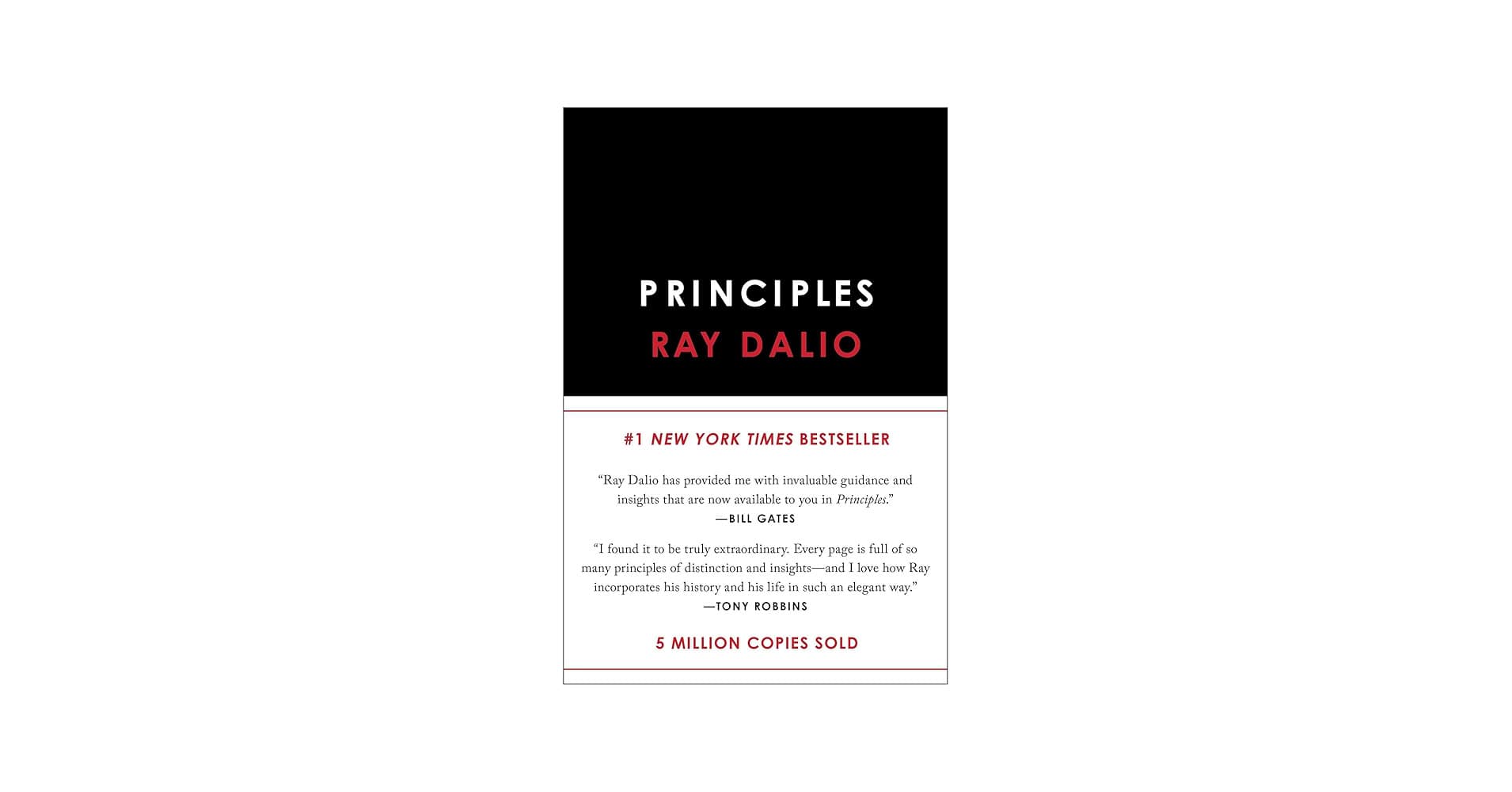
The snapshot provided above only reveals the surface of Ray Dalio’s rigorous system. To truly understand the “algorithm” of success he proposes, one must dive deep into the clinical, logic-driven mechanics that transformed a “two-bedroom apartment” startup into Bridgewater Associates—the world’s largest hedge fund and the fifth most important private company in the United States, according to Fortune. This is not a “self-help” book in the traditional sense; it is a technical manual for the human operating system.
——————————————————————————–
1. Introduction: The Bridgewater Code
Ray Dalio is often characterized as the “philosopher king of the financial universe,” yet his personal philosophy is rooted in a brutal, hyper-realist observation of the natural world. He posits that he is not “special.” Rather, his success—and the survival of Bridgewater after a near-fatal bankruptcy in the early 1980s—is a direct result of operating by a specific set of principles. These principles are essentially “the code” he used to navigate reality.
Dalio’s core mandate is “looking to nature to learn how reality works.” In nature, evolution is the single greatest force in the universe; it is the only thing that is permanent and it drives everything. For Dalio, a successful life is one that contributes to the evolution of the whole by operating consistently with reality’s laws. The transition from an “ordinary kid” in Long Island to a “Shaper”—someone who can move from a high-level visualization to the actualization of a complex machine—is a process of stripping away emotional delusion and replacing it with logical rigor. This summary deconstructs the machine Dalio has built and provides the blueprint for you to build your own.
2. The Fundamental Equation: Pain + Reflection = Progress
At the heart of Dalio’s logic lies a singular mathematical foundation for evolution. To the unoptimized mind, pain is a deterrent. To the Shaper, pain is data.
Pain + Reflection = Progress
Most leaders fail because they are biologically programmed to avoid pain. From a systems perspective, avoiding pain is a failure of the feedback loop. Dalio argues that pain is a vital signal from the “machine” indicating that an improvement is required. If you encounter the “first-order” pain of failure—a lost investment, a failed hire, or a strategic blunder—and you react by retreating or blaming others, the machine remains broken.
Hyper-realism dictates that you must go toward the pain. By reflecting on the “why” behind the discomfort, you move from the first-order consequence (the sting of failure) to the “second-order” gain (the evolution of your system). The logic is mathematically inevitable: those who embrace the pain of pushing their limits and reflect accurately on the causes will evolve; those who do not will stagnate and eventually die.
Read also: The Cognitive Architecture of Temporal Myopia: The Hidden Cost of Short-Term Financial Thinking
3. Part 1: Life Principles – Navigating the Personal Machine
Before an organization can be optimized, the individual must optimize their own “personal machine.” Dalio’s Life Principles focus on stripping away the psychological “fog” that obscures truth.
3.1 Embrace Reality and Deal with It
The most fundamental life principle is to be a Hyper-Realist. This involves accepting reality as it is, not wishing it were different. Dalio suggests that truth—or an accurate understanding of reality—is the essential foundation for any good outcome. Wishing for a different world is a failure of logic. Dalio’s formula for success is: Dreams + Reality + Determination = A Successful Life.
In this framework, “good” is defined by what is consistent with the laws of nature. A hyper-realist understands that reality is optimizing for the whole, not for the individual. Therefore, success requires aligning your personal incentives with the group’s evolutionary goals.
3.2 The “Two Yous” and Radical Open-Mindedness
Dalio identifies a biological conflict within the human brain. He describes this as the struggle between the Two Yous:
- The Lower-Level You (The Primitive Ego): Driven by the amygdala, this version of you seeks comfort, avoids criticism, and reacts emotionally. This is the source of the “ego barrier” and the “blind spot barrier.”
- The Higher-Level You (The Rational Thinker): Driven by the prefrontal cortex, this version seeks truth and progress. It is capable of looking down on the machine from a higher level.
To be Radically Open-Minded, you must allow the Higher-Level You to manage the Lower-Level You. Most people’s ego barriers make them defensive when they receive feedback, which prevents them from seeing their own weaknesses objectively. Dalio argues that your ability to deal well with “not knowing” is far more important than whatever it is you currently know. Radical open-mindedness requires a sincere belief that you might not know the best possible path and a willingness to “triangulate” your view with other believable people.
3.3 The 5-Step Process: The Operational Engine
The “Holy Grail” of Dalio’s life principles is the 5-Step Process. It is an iterative loop that must be performed sequentially. Jumping steps—particularly skipping diagnosis—is a primary cause of systemic failure.
- Clear Goals: You must prioritize. You can have almost anything you want, but you cannot have everything you want. Distinguish between your “goals” (long-term objectives) and “desires” (first-order temptations like comfort or ego validation).
- Identify Problems: View problems as potential improvements screaming at you. You must not tolerate them. Ignoring a problem is a choice to allow the machine to degrade.
- Diagnosis: This is the most critical buffer. You must distinguish between proximate causes (the action that failed) and root causes (the underlying reason, usually related to someone’s mental wiring or the machine’s design). You must diagnose the “what is” before deciding “what to do.”
- Design a Plan: Create a “movie script” that details who will do what through time. A good design bypasses the root causes discovered in step 3.
- Push Through to Completion: This is the execution phase. It requires the self-discipline to follow the “script” and the establishment of clear metrics to ensure you are progressing as planned.
Once a Shaper masters their personal 5-Step loop, they are ready to scale that logic into a collective “Work Machine.”
Read also: The Behavior Gap Summary: How to Stop Losing Money (2026 Review)
——————————————————————————–
4. Part 2: Work Principles – Building the Idea Meritocracy
Dalio defines the “Work Machine” as a combination of Culture and People. To build a world-class organization, one must create an Idea Meritocracy—a system where the best ideas win, regardless of hierarchy.
4.1 Radical Truth and Radical Transparency
In Dalio’s system, hiding problems is considered a “capital offense.” The organization operates on Radical Truth (refusing to lie to oneself or others) and Radical Transparency (making almost everything visible to everyone). Transparency is used as a tool to enforce justice and ensure that everyone has the same high-quality information.
This environment is designed to achieve Meaningful Work and Meaningful Relationships. Relationships are made “meaningful” through the shared struggle of seeking truth, while work is made “meaningful” by being excellent. At Bridgewater, this manifests as “tough love”—an uncompromising commitment to excellence that is ultimately kinder than being “nice” and allowing someone to fail.
4.2 Believability-Weighted Decision Making
An Idea Meritocracy is not a democracy, nor is it an autocracy. It utilizes Believability-Weighted Decision Making. In a democracy (1 person, 1 vote), a majority can be wrong. In an autocracy, one person can be wrong. In an Idea Meritocracy, the weight of an opinion is determined by the “believability” of the person offering it.
A believable person is defined by two criteria:
- They have successfully accomplished the task in question at least three times.
- They have a logical explanation of the cause-effect relationships that lead them to their conclusion.
| Feature | Democracy (1 Person, 1 Vote) | Autocracy (Top-Down) | Idea Meritocracy (Believability-Weighted) |
| Logic | Popularity / Equality | Authority / Power | Quality of reasoning / Track record |
| Weighting | All votes equal | Leader’s vote is final | Weighted by past success (3x rule) |
| Goal | Consensus | Compliance | Finding the best answer |
| Conflict | Resolved by voting | Resolved by decree | Resolved by thoughtful disagreement |
| Accountability | Diluted across group | Rests on the leader | Rests on the “Responsible Party” (RP) |
4.3 Tools of the Machine
To implement an Idea Meritocracy at scale, the system must be hard-coded into tools. Dalio uses several specific technologies to bypass human bias:
- Baseball Cards: Digital profiles for all employees that distill their strengths, weaknesses, and personality attributes based on assessments like PrinciplesYou. This allows the “Designer” to see people as they are, not as they wish to be.
- Issue Logs: A systematic database for tracking every mistake. Failing to log a mistake is a firing offense because it robs the machine of an opportunity to diagnose and improve.
- Process Flow Diagrams: High-level visualizations that treat departments as engineered systems, showing how work flows between roles.
- The Dot Collector: A tool used in meetings to gather real-time feedback on people’s logic and performance, which eventually populates their Baseball Cards.
——————————————————————————–
5. Viewing Life as a Machine
The overarching metaphor of Dalio’s work is that everything—from the economy to the human body—is a machine. He encourages the reader to “look down on your machine and yourself within it from a higher level.”
5.1 The Designer vs. The Doer
One of Dalio’s most important management principles is the distinction between your role as a Designer and your role as a Doer.
- The Designer: The high-level strategist who tweaks the levers, writes the “movie script,” and ensures the right people are in the right roles (finding a “click”).
- The Doer: The person inside the machine who executes the tactical tasks.
Most leaders fail because they are too busy being “Doers”—reacting to “shiny objects” and immediate crises—and never step back to analyze why the machine is producing poor outcomes. Dalio mandates that for every case you deal with, you must have two purposes: 1) to solve the case at hand, and 2) to diagnose the machine level to ensure the problem never recurs.
5.2 Double-Doing vs. Double-Checking
To ensure mission-critical tasks are done correctly, Dalio advocates for “Double-doing” rather than just “Double-checking.” Double-checking is often unreliable because the checker assumes the doer did it right. “Double-doing” involves having two believable people do the same task independently and comparing their results. This is a high-cost but high-reliability design principle for a high-stakes “machine.”
——————————————————————————–
6. Critical Analysis: The Human vs. The Algorithm
While Dalio’s approach is logically impeccable, it presents extreme psychological and cultural challenges. We must analyze these trade-offs with radical transparency.
6.1 The Psychological Toll
The primary criticism of Dalio’s system is that it is “robotic.” Humans are not naturally hyper-realists; we are emotional, social animals. The “pain” involved in “Radical Transparency”—such as having your weaknesses exposed on a Baseball Card for 1,500 colleagues to see—can lead to chronic stress. As reviewer James Adams notes, while the principles are “honorable,” the system is often directed toward “CEOs and VPs,” making it difficult for “small cogs in a big wheel” to handle the intensity.
6.2 The “Cult” vs. The “Optimization”
Critics often describe Bridgewater’s culture as “cult-like.” Dalio argues this is a misunderstanding of a rigorous idea meritocracy. He notes that the “Lower-Level You” feels attacked when the “Higher-Level You” is receiving accurate criticism. However, many find the “probing deep and hard” culture to be exhausting. Dalio acknowledges that Bridgewater is not for everyone; it requires a specific “Shaper” personality type that values truth over comfort. If a person is not a “click” for this intensity, Dalio’s logic dictates they must be “shot” (fired) for the good of the organization and their own personal evolution.
6.3 The Burden of Thoughtful Disagreement
The “Idea Meritocracy” requires an enormous amount of time spent “getting in sync.” Dalio admits that you must “spend lavishly on time and energy to get in sync” because it is the best investment you can make. However, this creates a high cognitive load. Reviewers like “Bell” have noted that the repetition of the principles and the constant “triangulating” can lead to boredom or “decision fatigue.” The trade-off is clear: you gain a higher probability of being right, but you lose the speed and social ease of traditional hierarchy.
Read also: Why Most People Underestimate the Power of Compounding
——————————————————————————–
7. The Balanced Scorecard: Pros and Cons
Pros:
- Radical Actionability: Unlike vague business “wisdom,” Dalio provides a 600-page manual of specific, numbered rules.
- Mathematical Precision: The 5-Step Process and Believability-Weighting provide a framework for removing human bias from decision-making.
- Evolutionary Growth: The “Pain + Reflection” loop is perhaps the most effective personal growth engine ever documented.
- Brutal Honesty: The book is a “breath-taking, fully-loaded” account of the trade-offs required for elite performance.
Cons:
- Cultural Intensity: The requirement for “Radical Transparency” and “Tough Love” can be psychologically damaging for those not wired for it.
- Extreme Repetitiveness: Dalio loops key concepts (Idea Meritocracy, Radical Truth) constantly, making for a “dry” reading experience.
- Implementation Difficulty: Most small-scale entrepreneurs lack the technological infrastructure (like the “Dot Collector”) to implement these principles at scale.
——————————————————————————–
8. Conclusion: Evolve or Die
The ultimate takeaway of Principles by Ray Dalio is that evolution is the only path to survival. In a world of hyper-competition and shifting realities, you either evolve or you die. The quality of your life is not a matter of luck; it is a direct result of the quality of the decisions made within your personal “machine.”
Principles are not just advice; they are the laws for successfully dealing with reality. By systemizing your decision-making, acknowledging your internal “Two Yous,” and ruthlessly applying the 5-Step Process, you stop being a victim of your biology and start becoming the architect of your future. As Dalio reminds us: “Truth—or, more precisely, an accurate understanding of reality—is the essential foundation for any good outcome.”

