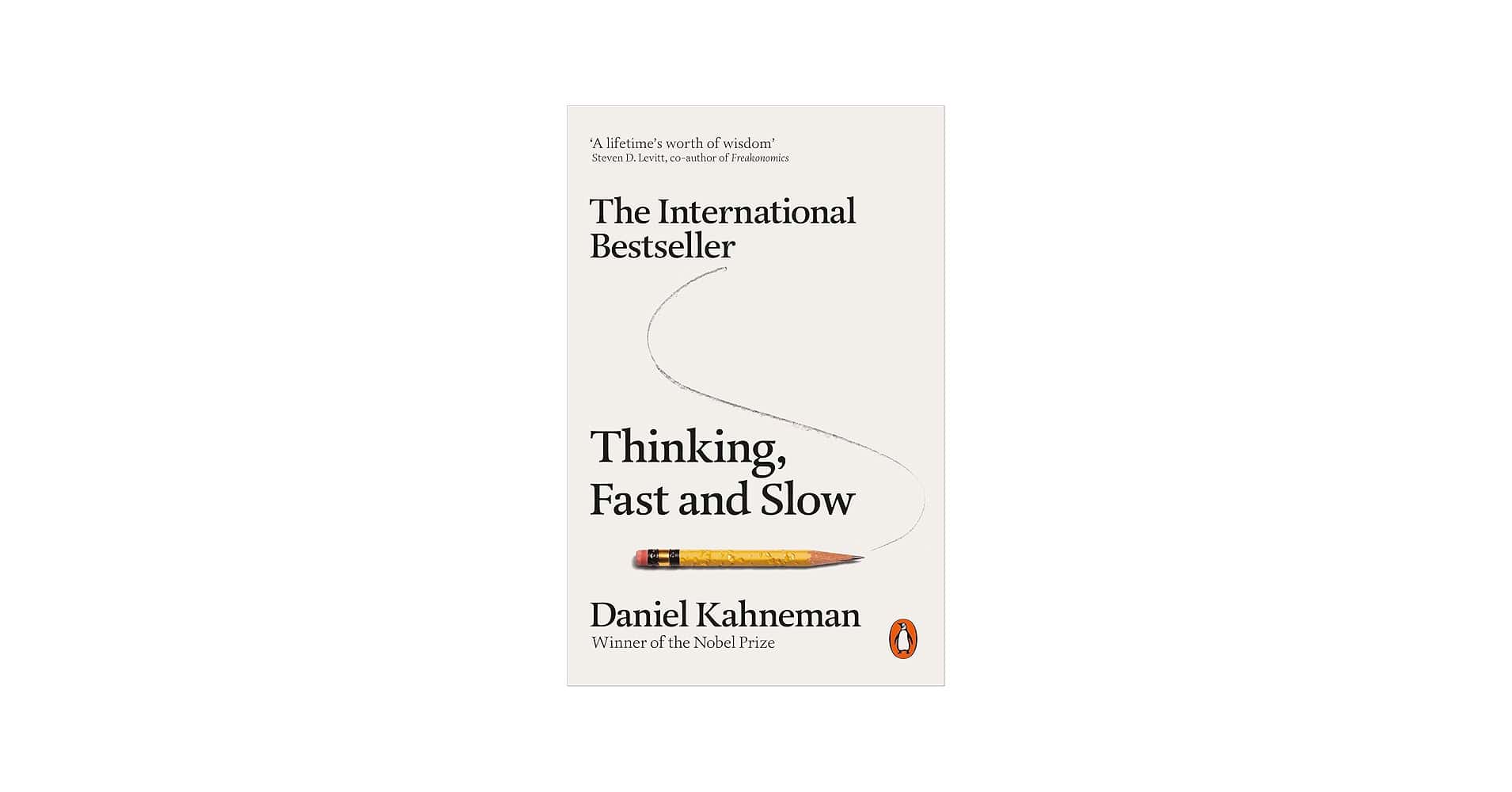
The book that made everything else make sense: I read Thinking, Fast and Slow after already encountering loss aversion, confirmation bias, anchoring, and a dozen other cognitive phenomena. What Kahneman’s book gave me was the unifying architecture — the two-system model of the mind that explains why these biases exist and why they’re so difficult to escape. This is the summary I wish I’d had before reading the book.
Star Rating: 5/5 (A Nobel Prize Winner’s Masterpiece)
One-Sentence Verdict: The definitive autopsy of the human mind, proving that our decisions are driven more by biological shortcuts than by logic.
Best For: Marketers, Investors, and Psychology Geeks.
Difficulty: Hard (Academic and dense).
Call to Action: Check Price on Amazon
Why this book matters above all others in the genre
The behavioral economics and cognitive psychology section of any bookshelf is crowded. There are books on specific biases, books on heuristics, books on nudging, books on rationality and its limits. Most of them are good. None of them does what Thinking, Fast and Slow does: it provides the theoretical architecture beneath all the specific phenomena.
Kahneman spent five decades as a research psychologist before writing this book. The two-system model he describes — System 1 and System 2 — is not a pop psychology framework. It is a synthesis of decades of experimental work, culminating in a Nobel Prize in Economics in 2002. Reading it changes not just what you know about cognitive biases but how you understand the mind that generates them.
Read also: 7 Lessons From a World-Class Poker Player About Making Decisions Under Uncertainty
Lesson 01
The two systems — the architecture behind all human thought
“System 1 operates automatically and quickly, with little or no effort and no sense of voluntary control. System 2 allocates attention to the effortful mental activities that demand it.”
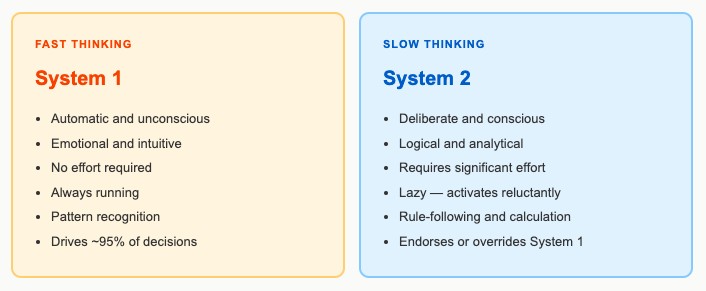
The critical insight is the relationship between them. System 2 does not run continuously — it is cognitively expensive and activates only when System 1 signals that a problem requires deliberate attention. Most of the time, System 2 simply endorses what System 1 has already concluded. This means that the fast, automatic, emotional system governs far more of our behavior than we consciously acknowledge.
My takeaway: Every cognitive bias described in the book is a product of System 1 operating beyond its domain of competence — applying fast, pattern-matching shortcuts to situations that require slow, careful analysis. Understanding the architecture makes every bias more comprehensible and more predictable.
Lesson 02
System 1 is not a flaw — it is what makes human life possible
“Most of what we think and do originates in our System 1, but System 2 takes over when things get difficult.”
One of Kahneman’s most important correctives is the framing of System 1 not as a defective version of System 2 but as an extraordinarily capable, highly specialized system that handles the vast majority of the cognitive load of being human remarkably well.
Reading faces, navigating a conversation, catching a ball, recognizing danger, understanding language, responding emotionally to situations — all of these are System 1 operations of extraordinary sophistication that System 2 could not replicate at the required speed. The problem is not that System 1 exists or that it operates automatically. The problem is that it is also activated in domains — financial decisions, statistical reasoning, long-term planning — where its heuristics systematically produce errors.
My takeaway: Trying to eliminate System 1 thinking is neither possible nor desirable. The goal is to identify the specific domains where System 2 engagement is necessary and build habits and systems that trigger it there — not to conduct all thinking slowly and deliberately.
Read also: The Mental Model That Changed How I See Everything
Lesson 03
Cognitive ease — why familiar feels true and fluent feels right
“A reliable way to make people believe in falsehoods is frequent repetition, because familiarity is not easily distinguished from truth.”
Kahneman introduces the concept of cognitive ease — the subjective experience of processing information smoothly — and its dark side: things that are easy to process feel more true, more valid, and more trustworthy than things that are difficult to process, regardless of their actual accuracy.
This explains why repeated exposure to false information increases its perceived credibility, why clear fonts feel more authoritative than difficult-to-read ones, and why arguments that feel fluent are more persuasive than equally valid arguments that feel effortful. The ease is mistaken for truth-signal.
My takeaway: The most dangerous misinformation is not complex — it is simple, clear, and frequently repeated. When I encounter an idea that feels obviously true and easy to grasp, I now treat that ease as a reason to look more carefully rather than a reason to accept more readily.
Lesson 04
The halo effect — how one trait contaminates your entire evaluation
“If you like the president’s politics, you probably like his voice and his appearance as well. The halo effect is the tendency to like (or dislike) everything about a person.”
The halo effect is System 1’s tendency to generate a global impression of a person or thing from a single salient characteristic, and then use that global impression to fill in all unknown attributes. If someone is physically attractive, they are assumed to be more competent, more trustworthy, and more intelligent — not because there is evidence for these attributes, but because one positive characteristic has infected the overall evaluation.
The practical implication is disturbing: first impressions don’t just influence subsequent impressions — they overwhelm them. Information encountered early dominates information encountered later, because the early information shapes the filter through which everything subsequent is processed.
My takeaway: In hiring, in partnerships, and in evaluating ideas, I now deliberately separate the evaluation of different attributes rather than forming a single global impression. First impressions remain powerful, but making the separation explicit forces at least some resistance to the halo contamination.
Read also: How I Built Multiple Income Streams — Without Quitting My Day Job
Lesson 05
WYSIATI — What You See Is All There Is
“System 1 is radically insensitive to both the quality and the quantity of the information that gives rise to impressions and intuitions.”
WYSIATI is one of Kahneman’s most important concepts. System 1 constructs the best story it can from whatever information is available — and then treats that story as if it were complete. The information you don’t have, the questions you haven’t asked, the evidence that isn’t in front of you — none of it registers as absent. System 1 simply doesn’t see what it doesn’t see.
This explains why confidence is often inversely related to information. Someone with a little information constructs a coherent, confident narrative from it. Someone with a lot of information sees the contradictions, the missing pieces, and the genuine uncertainty — and expresses appropriate doubt. The confident person hasn’t necessarily thought more carefully; they may simply have seen less.
My takeaway: Before any significant judgment or decision, I now actively ask: “What information am I missing here? What questions haven’t I asked? What would I need to see to have a complete picture?” WYSIATI is the mechanism behind most overconfidence — and the antidote is deliberately expanding the frame beyond what’s in view.
Lesson 06
Anchoring — the number that wasn’t asked for shapes you anyway
Kahneman’s treatment of anchoring — covered in detail in our dedicated article on this topic — is one of the most thoroughly researched sections of the book. His key addition to the anchoring literature is the mechanism: anchoring works not just through adjustment from an initial value, but through selective accessibility — the anchor activates information in memory that is consistent with it, biasing the estimation without any conscious deliberation.
This means anchoring operates even when you know it’s happening, even when you explicitly try to correct for it, and even when the anchor is clearly arbitrary. The research consistently shows that awareness reduces the effect somewhat but does not eliminate it.
My takeaway: The only reliable protection against anchoring is forming an independent estimate before encountering the anchor — which requires deliberate advance preparation that most decision contexts don’t provide naturally. Building that preparation into high-stakes processes is the practical response.
Read also: How the First Number You See Controls Every Decision That Follows
Lesson 07
Prospect theory — losses hurt approximately twice as much as equivalent gains feel good
“The aggravation that one experiences in losing a sum of money appears to be greater than the pleasure associated with gaining the same amount.”
Prospect theory — Kahneman and Tversky’s foundational contribution to behavioral economics — describes how people evaluate outcomes relative to reference points rather than in absolute terms, and with an asymmetric emotional weight: the pain of losses is roughly twice the pleasure of equivalent gains.
This asymmetry explains a remarkable range of financial behavior that standard expected utility theory cannot account for: why investors hold losing positions too long, why people take more risk to avoid losses than to secure equivalent gains, and why the framing of options as losses versus gains produces different choices even when the underlying outcomes are mathematically identical.
My takeaway: Prospect theory is not an academic curiosity. It explains the actual mechanics of how I make financial decisions under emotional conditions — and it has been the most practically valuable single concept in the book for improving those decisions.
Lesson 08
The experiencing self vs. the remembering self — two selves, one decision-maker
“The experiencing self is the one that answers the question ‘Does it hurt now?’ The remembering self is the one that answers ‘How was it, on the whole?'”
One of the most philosophically interesting sections of the book distinguishes between two aspects of the self: the experiencing self, which lives through events moment by moment, and the remembering self, which evaluates and records experiences after the fact. The remembering self governs most of our choices — we decide what to repeat and what to avoid based on memories, not on real-time experience.
The problem is that the remembering self is a poor recorder. It applies two rules that distort memory: the peak-end rule (an experience is remembered largely by its most intense moment and its ending, regardless of duration) and duration neglect (how long an experience lasted has almost no effect on how it is remembered). This means we make future choices based on remembered experiences that are systematically biased away from the actual lived experience.
My takeaway: This insight changed how I think about vacations, projects, and relationship dynamics. The experience that feels most intense isn’t always the one most worth having. And the ending matters disproportionately — a good experience with a bad ending is remembered as bad, regardless of how much of it was actually enjoyable.
Read also: How to Learn Anything Deeply — and Know Exactly When You Don’t
Lesson 09
What Kahneman himself concludes — and the limits he acknowledges
“I have not learned to think slowly when a fast answer comes to mind. I have, however, learned to recognize situations where mistakes are likely.”
The most grounding passage in the book is Kahneman’s personal conclusion — written by a man who spent his career studying cognitive biases. He does not claim that studying biases eliminates them. He claims only that familiarity with them can help you recognize the situations where they are most likely to operate.
This is honest, important, and somewhat sobering. The biases are features of System 1 — fast, automatic, running below the threshold of conscious monitoring. Knowing about them doesn’t give you the ability to turn System 1 off. What it gives you is better pattern recognition for the categories of situation where its errors are most costly.
My takeaway: The goal of studying behavioral psychology is not to become unbiased. It is to become better at recognizing when bias is most likely to be operating and building decision processes that create enough friction for System 2 to participate before the decision is made. That is a more modest but more realistic goal — and one that is actually achievable.
My honest assessment — who should read this book
Thinking, Fast and Slow is long, occasionally dense, and covers more ground than most readers retain from a single read. It is not a quick-takeaway book. It rewards multiple readings at different points in your intellectual development, and it becomes more useful as you accumulate more real-world context for the phenomena it describes.
It is essential reading for anyone seriously interested in decision-making, behavioral economics, or cognitive psychology. It is also the best single source for understanding the theoretical architecture beneath dozens of phenomena you may have already encountered piecemeal.
How to read this book effectively
Don’t try to read it all at once. Read one section, then sit with it for a week and notice where the concepts appear in your own thinking and decisions. The book is best absorbed slowly and cross-referenced with real experience rather than consumed as a linear narrative.
Kahneman himself has noted that knowing about a bias does not eliminate it. Read the book to build recognition, not immunity — and use what you learn to design better decision processes, not just to think about thinking.