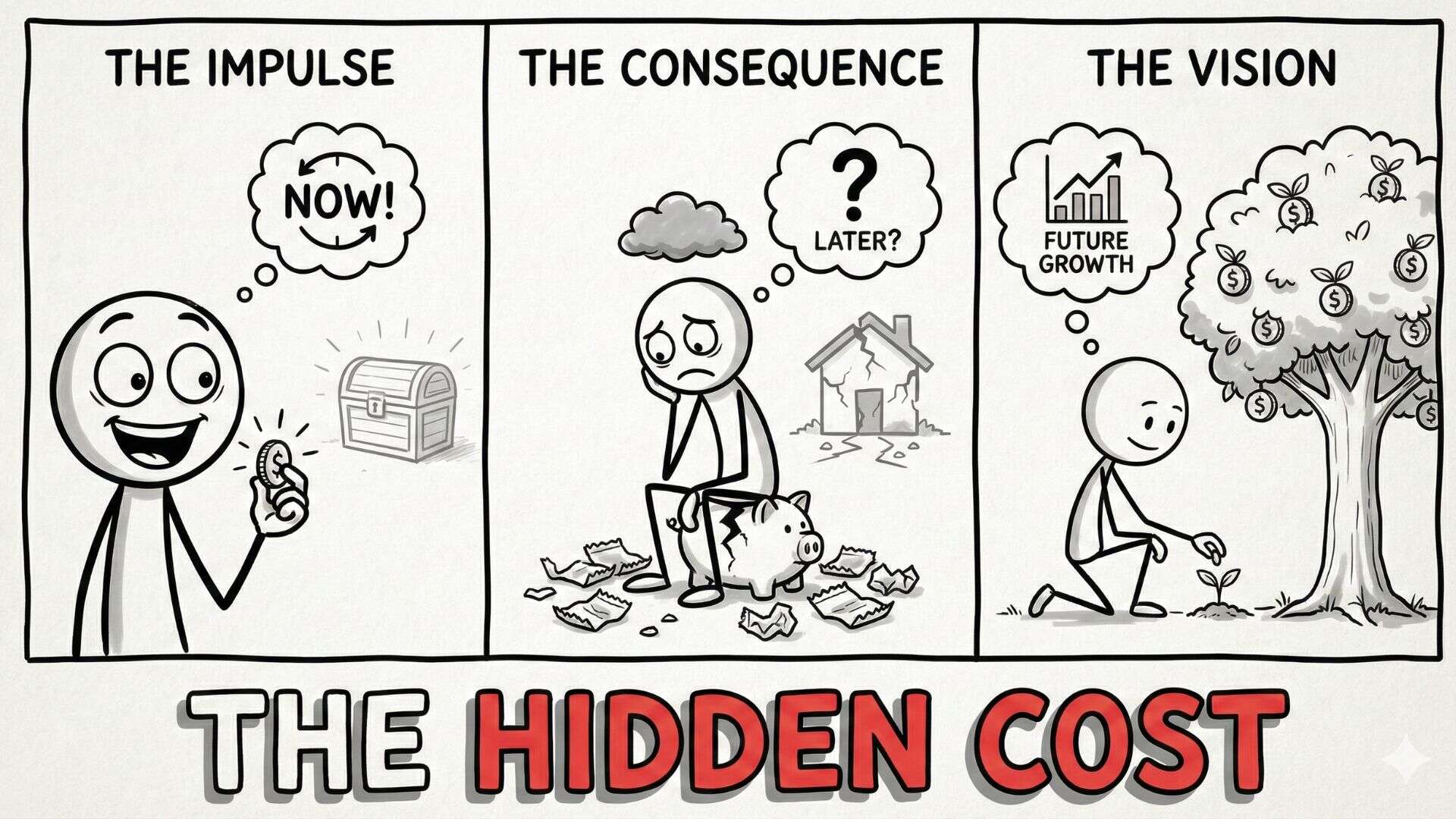
Introduction: Framing the Long-Term Consequences of Impatience
Financial markets, career trajectories, and business outcomes are often interpreted through short-term indicators: quarterly earnings, annual bonuses, recent price movements, or immediate returns on investment. These metrics are visible, measurable, and socially reinforced. Yet the processes that generate durable wealth unfold over extended periods. The tension between short-term measurement and long-term value creation is not incidental; it is structural.
Long-term thinking functions as a financial advantage not because it guarantees superior insight, but because it aligns decision-making with the temporal structure of compounding systems. Wealth accumulation, skill development, institutional resilience, and productive capital formation depend on sustained exposure to processes that produce nonlinear growth. Interrupting these processes prematurely often reduces eventual outcomes disproportionately.
Impatience systematically undermines financial success by compressing evaluation horizons. Decisions that appear rational within narrow time frames frequently degrade long-term results. Despite recurring evidence of this pattern across generations, short-termism persists. This persistence is not merely psychological weakness; it is reinforced by incentive structures, feedback distortions, cultural norms, and cognitive biases.
Understanding why long-term thinking confers advantage requires examining these underlying mechanisms. The objective is not to offer prescriptive tactics, but to clarify why temporal alignment between decisions and systems matters structurally in finance and beyond.
The Core Problem: Time Horizon Misalignment
Time horizon misalignment occurs when the period used to evaluate a decision is shorter than the time required for the underlying system to produce its full effects. In financial contexts, this misalignment is pervasive.
Assets generate value through earnings, innovation, network effects, and reinvestment—processes that unfold over years or decades. Human capital compounds through experience and skill accumulation. Business strategies require time for operational efficiencies, brand equity, and customer relationships to mature.
When individuals evaluate these systems based on short-term performance, they distort decision criteria. Temporary fluctuations are interpreted as structural changes. Volatility is mistaken for risk. Short-term underperformance relative to benchmarks is treated as failure, even when long-term prospects remain intact.
The misalignment is especially consequential in compounding systems. Exponential growth curves appear flat in early stages. The majority of cumulative gains often occur in later periods. If evaluation horizons are shortened, the most valuable segment of the curve is never realized.
For example, consider an investment strategy with positive expected return over decades but substantial interim volatility. An investor who evaluates performance annually may perceive excessive risk and abandon the strategy during downturns. By doing so, the investor truncates exposure to the compounding process that would have produced favorable long-term results.
Time horizon misalignment thus transforms temporary noise into permanent decision errors.
This structural problem extends beyond financial markets. In career development, early years of skill accumulation may yield modest income growth. Evaluating progress solely through immediate compensation may discourage investment in capabilities that compound later. In entrepreneurship, reinvestment in infrastructure may depress short-term profits but enhance long-term resilience. Short evaluation cycles can discourage such investment.
The core issue is not impatience as temperament, but impatience as a systematic mismatch between evaluation periods and system dynamics.
Read also: Mastering The 5 AM Club for Elite Performance and Cognitive Sovereignty
Why the Problem Persists Despite Experience
If long-term thinking consistently produces advantages in compounding systems, why does short-termism remain widespread? Several reinforcing mechanisms explain its persistence.
1. Delayed Feedback and Learning Constraints
Compounding systems produce delayed and nonlinear feedback. Early contributions generate small visible returns. Substantial effects emerge only after extended periods. This delay complicates causal attribution.
Behavioral learning depends on clear, timely feedback. When outcomes are separated from decisions by years, individuals struggle to connect cause and effect. A decision to abandon an investment strategy may appear justified if short-term performance improves thereafter, even if long-term opportunity cost is significant.
Because the negative consequences of impatience often materialize gradually or invisibly, corrective learning is weak. Individuals may experience repeated cycles of short-term decision-making without recognizing cumulative impact.
2. Incentive Structures Favor Short-Term Metrics
Modern institutions frequently embed short-term evaluation intervals into compensation and accountability systems:
- Corporate executives are assessed on quarterly earnings.
- Portfolio managers are compared on annual performance.
- Employees receive bonuses tied to yearly targets.
- Political leaders operate within election cycles.
These structures rationally incentivize short-term optimization. Even decision-makers who understand long-term advantages may prioritize near-term outcomes because their professional survival depends on them.
When incentives reward short-term performance, long-term thinking becomes individually costly, even if collectively beneficial. The misalignment between personal incentives and systemic outcomes perpetuates short-termism.
3. Behavioral Biases: Present Bias and Hyperbolic Discounting
Present bias leads individuals to overweight immediate outcomes relative to future ones. Hyperbolic discounting amplifies this effect by assigning disproportionately lower value to delayed rewards.
In financial contexts, this manifests as preference for immediate gains over larger future returns. The discomfort of short-term losses is often more salient than abstract long-term benefits. Volatility triggers emotional responses that encourage action, even when inaction would be probabilistically superior.
These biases are deeply embedded in cognitive architecture. Awareness alone does not eliminate them.
Read also: How Anchoring Bias Affects Financial Choices
4. Structural Forces That Reward Immediacy
Technological and informational environments amplify short-term signals. Market prices update continuously. Performance dashboards display real-time metrics. Media coverage emphasizes daily fluctuations.
This saturation of immediate data increases cognitive salience of short-term outcomes. Long-term trajectories, which require aggregation and projection, receive less attention.
Cultural narratives further reinforce immediacy. Stories of rapid success attract disproportionate coverage, while gradual accumulation appears unremarkable. The informational ecosystem therefore privileges speed over duration.
Together, these forces create a reinforcing loop: short-term metrics dominate attention; incentives reward short-term results; cognitive biases amplify immediate feedback; cultural norms celebrate rapid outcomes.
Real-World Consequences Across Domains
The impact of time horizon misalignment and impatience can be observed across multiple domains of economic life.
Investing
In capital markets, volatility is visible and frequent. Long-term value creation is gradual and less observable. Investors who react to short-term price fluctuations often convert temporary declines into realized losses by exiting positions prematurely.
Frequent trading, driven by short-term performance comparisons, can erode returns through transaction costs and tax friction. More importantly, it reduces time in market exposure, thereby diminishing the compounding effect of reinvested earnings.
Short-term benchmarking against peers also distorts behavior. Investors may abandon strategies during periods of relative underperformance, even if those strategies have favorable long-term expected returns.
The financial advantage of long-term thinking lies in sustained exposure to productive assets, allowing compounding mechanisms to operate uninterrupted.
Career Development
Professional trajectories exhibit compounding characteristics. Skill accumulation, network formation, and reputation building generate increasing returns over time. Early years may show limited income growth, but later opportunities often depend on accumulated expertise.
Individuals who prioritize immediate salary increases over skill depth may achieve short-term gains while limiting long-term optionality. Conversely, those who invest in complex capabilities often experience nonlinear career acceleration after extended gestation.
Time horizon alignment in career decisions influences not only income but also resilience to industry shifts. Deep expertise and adaptive capacity provide durable advantages.
Entrepreneurship and Business Strategy
Businesses operate within feedback systems that reward reinvestment and learning over time. Infrastructure development, brand equity, and customer loyalty compound gradually.
When firms prioritize short-term earnings targets, they may underinvest in research, employee development, or customer experience. These decisions can improve immediate metrics while weakening long-term competitiveness.
Conversely, excessive tolerance for losses without viable path to profitability represents a different form of misalignment—confusing duration with inevitability. Long-term thinking requires alignment with economic reality, not indefinite deferral of discipline.
Savings and Personal Finance
Savings behavior illustrates the cumulative effect of time horizon decisions. Early contributions to long-term savings vehicles often generate disproportionate outcomes due to extended compounding periods.
Present bias encourages consumption over saving, particularly when future benefits appear abstract. Because the opportunity cost of insufficient saving becomes salient only decades later, corrective feedback is delayed.
In each domain, impatience truncates exposure to compounding systems. Long-term thinking preserves it.
Read also: Why Cash Flow Thinking Beats Net Worth Obsession
A Core Mental Model: Compounding and Delayed Feedback Systems
Compounding is the central mental model underlying the financial advantage of long-term thinking. In a compounding system, returns generate additional returns, producing exponential growth over time.
Exponential growth is counterintuitive. Early stages appear insignificant relative to later stages. The curve’s steepest segment occurs after sustained accumulation. Consequently, the majority of value creation may occur in later periods.
Delayed feedback compounds this counterintuitiveness. Because initial progress is modest, individuals may underestimate the eventual impact of continued participation. Premature exit prevents reaching the phase where growth accelerates.
Long-term thinking aligns with this structure by maintaining exposure through early flat phases. Impatience, by contrast, interrupts the process before exponential effects materialize.
This mental model applies broadly:
- In investing, reinvested earnings amplify future returns.
- In careers, accumulated skills enhance future earning power.
- In business, retained customers increase lifetime value.
- In networks, connections generate additional opportunities.
Understanding compounding clarifies why small early differences in behavior can produce large divergences over decades.
Applying Better Thinking in Practice (Principles, Not Tactics)
Improving temporal alignment requires structural awareness rather than specific prescriptions.
Match evaluation periods to system dynamics.
Assess long-term processes over appropriately long intervals. Short-term metrics may inform but should not dominate judgment.
Design incentives consistent with duration.
Where possible, align compensation and evaluation frameworks with long-term objectives rather than transient outputs.
Distinguish volatility from structural change.
Temporary fluctuations within intact systems do not necessarily warrant reactive adjustments.
Incorporate opportunity cost across time.
Immediate gains often displace future accumulation. Evaluating alternatives requires projecting long-term trajectories.
These principles emphasize alignment rather than technique.
Common Misunderstandings About Patience
Long-term thinking is sometimes misinterpreted in ways that obscure its structural role.
Patience Is Not Passivity
Maintaining long-term orientation does not require ignoring new information. Structural deterioration in fundamentals demands reassessment. The distinction lies between reacting to noise and responding to substantive change.
Long-Term Thinking Does Not Guarantee Success
Compounding increases probability of favorable outcomes but does not eliminate risk. Economic environments evolve; strategies become obsolete. Temporal alignment improves odds but does not confer certainty.
Recognizing these limits prevents conflating duration with inevitability.
Read also: The Difference Between Volatility and Risk
Connections to Broader Thinking Frameworks
The advantage of long-term thinking intersects with several established decision-making concepts.
Second-Order Effects.
Short-term actions often have delayed consequences. Selling assets during downturns may relieve immediate anxiety but sacrifice future gains.
Incentive Design.
Structures that reward long-term value creation reduce pressure for immediate performance.
Opportunity Cost.
Immediate consumption or short-term gains carry hidden costs in foregone compounding.
Path Dependency.
Early decisions shape future options. Sustained reinvestment expands optionality; premature extraction constrains it.
These frameworks reinforce the importance of temporal perspective in strategic reasoning.
Conclusion: Reframing Financial Success as a Time-Based System
Long-term thinking constitutes a financial advantage because it aligns decision-making with the temporal structure of compounding systems. Wealth accumulation, skill development, and institutional resilience depend on sustained participation in processes that generate nonlinear growth.
Impatience undermines these outcomes by compressing evaluation horizons and privileging immediate metrics. Despite repeated historical evidence of the benefits of duration, short-termism persists due to delayed feedback, incentive misalignment, cognitive biases, and cultural reinforcement of immediacy.
Financial success, understood analytically, is less a function of forecasting precision and more a function of temporal discipline. Aligning decisions with the time scale of underlying systems does not guarantee favorable results, but it reduces systematic error caused by premature interruption of compounding processes.
In environments saturated with short-term signals, the capacity to reason across extended horizons becomes a structural edge. Long-term thinking is not merely a preference; it is an alignment with the mechanics of how value accumulates over time.