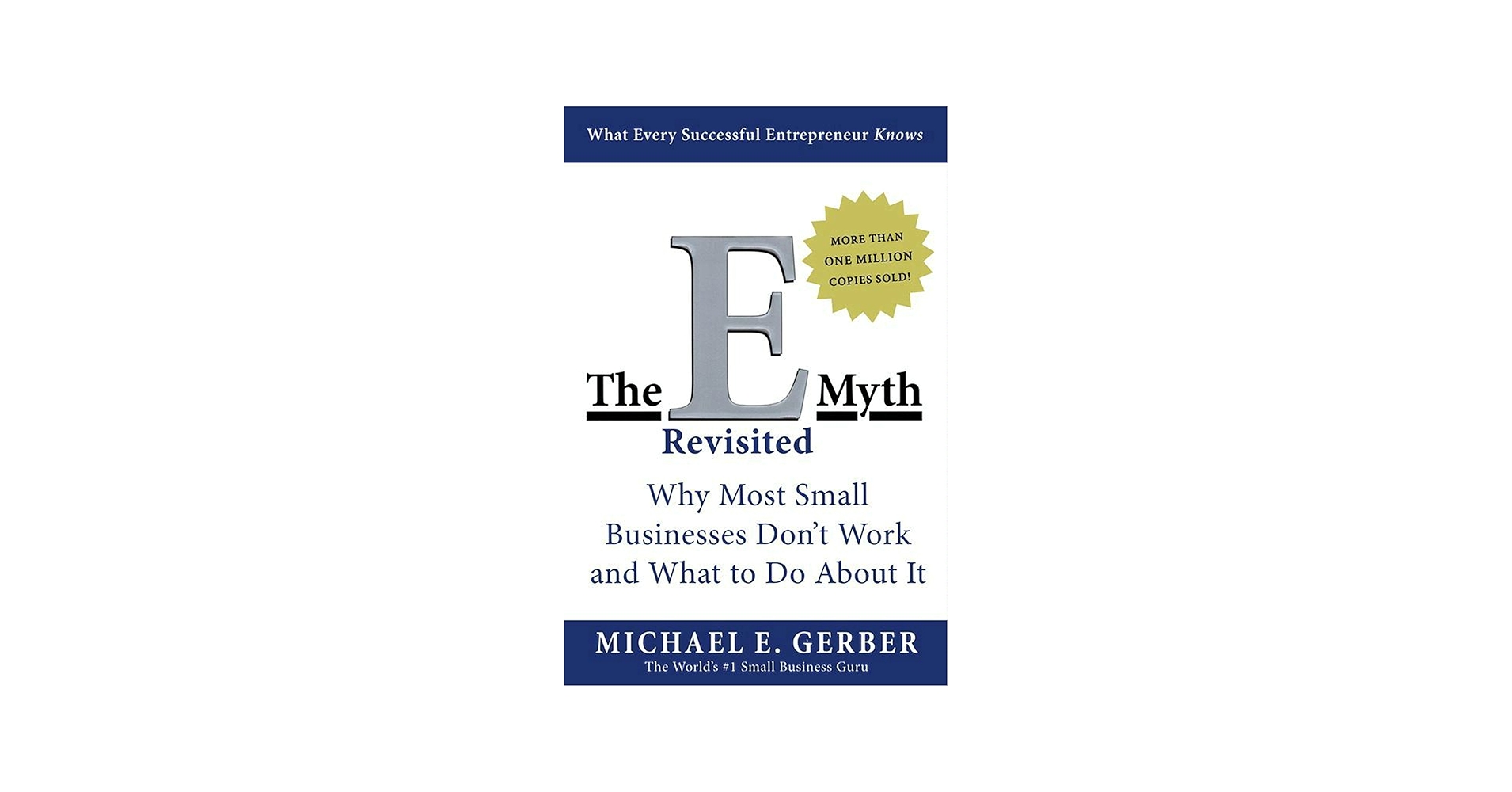
1. THE SNAPSHOT (Strategic Overview)
If you are a founder currently logging 80-hour weeks only to watch your bank balance stagnate and your passion erode, you are not an entrepreneur. You are a technician having an “entrepreneurial seizure.” This snapshot serves as a high-level diagnostic for your survival. Michael Gerber’s The E-Myth Revisited is not a business book; it is a clinical intervention. Use the summary below to determine if you are building an asset or merely a high-stress, low-paying job that will eventually consume you.
Quick Summary Box
| Metric | Rating/Verdict |
| Star Rating | 5/5 (The Ultimate Small Business Bible) |
| One-Sentence Verdict | A high-impact intervention for founders who must stop being the “doer” and start being the architect of a replicable money machine. |
| Best For | Freelancers, service providers, and small business owners trapped in the “technician’s nightmare.” |
| Difficulty | Easy to read, difficult to implement—it requires a total psychological surrender of control. |
| Call to Action | Get the Book on Amazon |
To understand why your business feels like a trap, we must first analyze the fatal assumption that dooms 96% of all small businesses within a decade.
——————————————————————————–
2. INTRODUCTION: The Fatal Assumption and the Birth of the E-Myth
The “E-Myth” is the romanticized delusion that small businesses are started by entrepreneurs seeking profit and taking risks. The reality is far grimmer. Most businesses are started by Technicians—the baker, the mechanic, the programmer—who suffer an “entrepreneurial seizure.” They decide they no longer want to work for a boss, so they start a business.
This leads to the Fatal Assumption: “If you understand the technical work of a business, you understand a business that does that work.”
This is a lie. Knowing how to bake a pie is a technical skill; knowing how to build a business that sells pies is a strategic discipline. This assumption is the primary driver of the staggering failure rates: 40% fail in year one, 80% fail by year five, and 80% of the survivors fail in the second five. By year ten, 96% of independent businesses are gone.
Look at Sarah’s Pie Shop. Sarah loved the craft of baking, but after three years, she was the ghost of her own future. Starting at 3:00 AM and finishing at 10:00 PM, she was buried in debt and drowning in “the technician’s nightmare.” She no longer loved pies; she hated them. Her refusal to lead and her insistence on being the only one who could “do it right” wasn’t dedication—Gerber calls it self-indulgence and greed. She was so busy doing the work that she was greedy with her time, refusing to invest in the leadership and systems the business actually required to survive.
To escape this, you must confront the three warring personalities currently fighting for control of your brain.
Read also: Why Financial Education Changes Behavior
——————————————————————————–
3. The Three Personalities of an Entrepreneur: A Psychological Conflict
A business is a direct reflection of its owner. If your business is in chaos, it’s because you are psychologically lopsided. You are likely making promises your “Manager” can’t keep and doing work your “Entrepreneur” never envisioned.
The Entrepreneur
The Entrepreneur is the visionary living in the future. They are the catalyst for change, asking “what if?” and “if-when?” They crave control of the present so they can focus on their dreams. Without the Entrepreneur, there is no innovation and no “Future Work.”
The Manager
The Manager is the pragmatist who craves order and turns chaos into harmony. They live in the past, organizing the rows and cleaning up the mess the Entrepreneur leaves behind. Without the Manager, there is no predictability.
The Technician
The Technician is the doer. Their credo is: “If you want it done right, do it yourself.” They live in the present and view “thinking” as a distraction from “doing.” They reduce all ideas to methodology.
The Skinny Guy vs. The Fat Guy To understand the conflict, imagine deciding to go on a diet. On Saturday, your “Skinny Guy” (the Entrepreneur) is in charge, throwing away the junk food and buying running shoes. But by Thursday morning, it’s raining and cold. Your “Fat Guy” (the Technician) wakes up. He doesn’t want to run; he wants a ham sandwich. You fail because you think you are one person, but you are a committee that can’t agree on the mission. In most small businesses, the Technician is a tyrant, occupying 70% of the owner’s mind, leaving the business visionless and disorganized.
Read also: A Comprehensive Summary of “The Book on Rental Property Investing” by Brandon Turner
——————————————————————————–
4. The Three Phases of Business Growth: From Infancy to Maturity
Businesses, like people, must evolve. If they don’t, they atrophy.
- Infancy (The Master Juggler): The owner and the business are one. If you leave for a week, the business vanishes. Like Sarah, you work 14-hour days until the “seizure” wears off and you realize you’ve simply created a lower-paying, higher-stress job for yourself.
- Adolescence (The Crisis of Help): This begins when you hire “Harry” or “Elizabeth” because the balls are starting to drop. Most owners commit Management by Abdication: they dump the tasks they hate on an employee and run away. When the employee inevitably fails because there is no system, the owner “gets small again” (fires everyone) or “goes for broke” until the business explodes.
- Maturity (The Entrepreneurial Perspective): Maturity is not a stage you reach over time; it is a perspective you hold from day one. A mature company is built as a model of a business that works. Like Tom Watson at IBM, you must act like a great company long before you become one. You don’t “do business”; you “build one.”
——————————————————————————–
5. The Turn-Key Revolution: The Franchise Prototype
The solution to the E-Myth is the Business Format Franchise. This represents a shift from selling a product to selling a business model.
Ray Kroc’s genius with McDonald’s wasn’t the hamburger; it was the “money machine.” He applied Henry Ford’s Model T philosophy to the service industry. He viewed the business as a prototype of a mass-producible product. Just as a Model T was built with interchangeable parts, Kroc built a business with interchangeable systems.
This is the Franchise Prototype. It is a systems-dependent model, not a people-dependent one. By engineering every detail—exactly where the pickles are placed and how long the fries stay in the bin—Kroc ensured that the system ran the business and the people simply ran the system. The proof is in the data: while 80% of independent businesses fail, 75% of Business Format Franchises succeed.
Read also: The Psychology of Holding vs Selling Assets
——————————————————————————–
6. The Business Development Program: Working ON Your Business, Not IN It
To move into Maturity, you must stop doing tactical work and start doing strategic work. The Business Development Program is your roadmap for building a prototype that works without you:
- Primary Aim: The vision for your life. The business is a tool to serve your life, not the other way around.
- Strategic Objective: The standards the business must meet (e.g., revenue targets, geographic reach).
- Organizational Strategy: Designing the structure before hiring. You must define the “Box” (the role) before you put a person in it, avoiding the trap of depending on a “Harry.”
- Management Strategy: The system through which the business produces a predictable result.
- People Strategy: Creating a culture where people want to follow the system because it provides them with mastery.
- Marketing Strategy: Focusing on the customer’s unconscious needs.
- Systems Strategy: The documentation and SOPs that act as the “precision instruments” of your business.
Documentation is the only path to liberation. Without written systems, you don’t own a business; you own a job where you are the only one who knows the “secret sauce.”
——————————————————————————–
7. Addressing the “Corporate” Barrier for Creatives and Freelancers
Creative technicians often resist systems, fearing they will kill the “art” of the work. This is a fallacy. Systems do not kill creativity; they provide the cleared space where creativity can flourish. By systematizing the mundane—the “doing, doing, doing”—you free your mind to focus on “Future Work”: the high-level dreaming and designing that actually moves the needle. Sarah eventually realized that by letting go of the baking herself and building a system that could bake to her standard, she finally achieved the freedom she sought.
Read also: Why Simplicity Wins in Personal Finance
——————————————————————————–
8. Strategic Pros and Cons
| Pros | Cons |
| Paradigm-Shifting Insight: Provides a brutal, necessary wake-up call regarding the technician’s trap. | Repetitive Narrative: The running dialogue with Sarah can feel slow for those wanting pure data. |
| Operational Framework: The 7 Strategies offer a concrete engineering map for a business. | Emotional Toll: Requires a painful surrender of the “hero” ego and the need for total control. |
| Replicability: Teaches how to build a business that is an asset, not just a job. | System Rigidity: Can feel “over-corporate” for founders who prefer an informal, “lifestyle” culture. |
——————————————————————————–
9. CONCLUSION: The Business as a Mirror
Gerber’s core thesis is unyielding: “Your business is nothing more than a distinct reflection of who you are.” If your business is a chaotic mess of dropped balls and midnight shifts, it is because you are behaving like a technician and refusing to lead.
The ultimate goal of this journey is not just a bigger bank account; it is freedom. By building a business that is a “model of a business that works,” you create an entity that serves your life rather than consumes it.
——————————————————————————–
10. CALL TO ACTION
Fire yourself from the technical work. Your business cannot grow if you are the bottleneck. Start building your systems today so that your business can eventually run without you.