

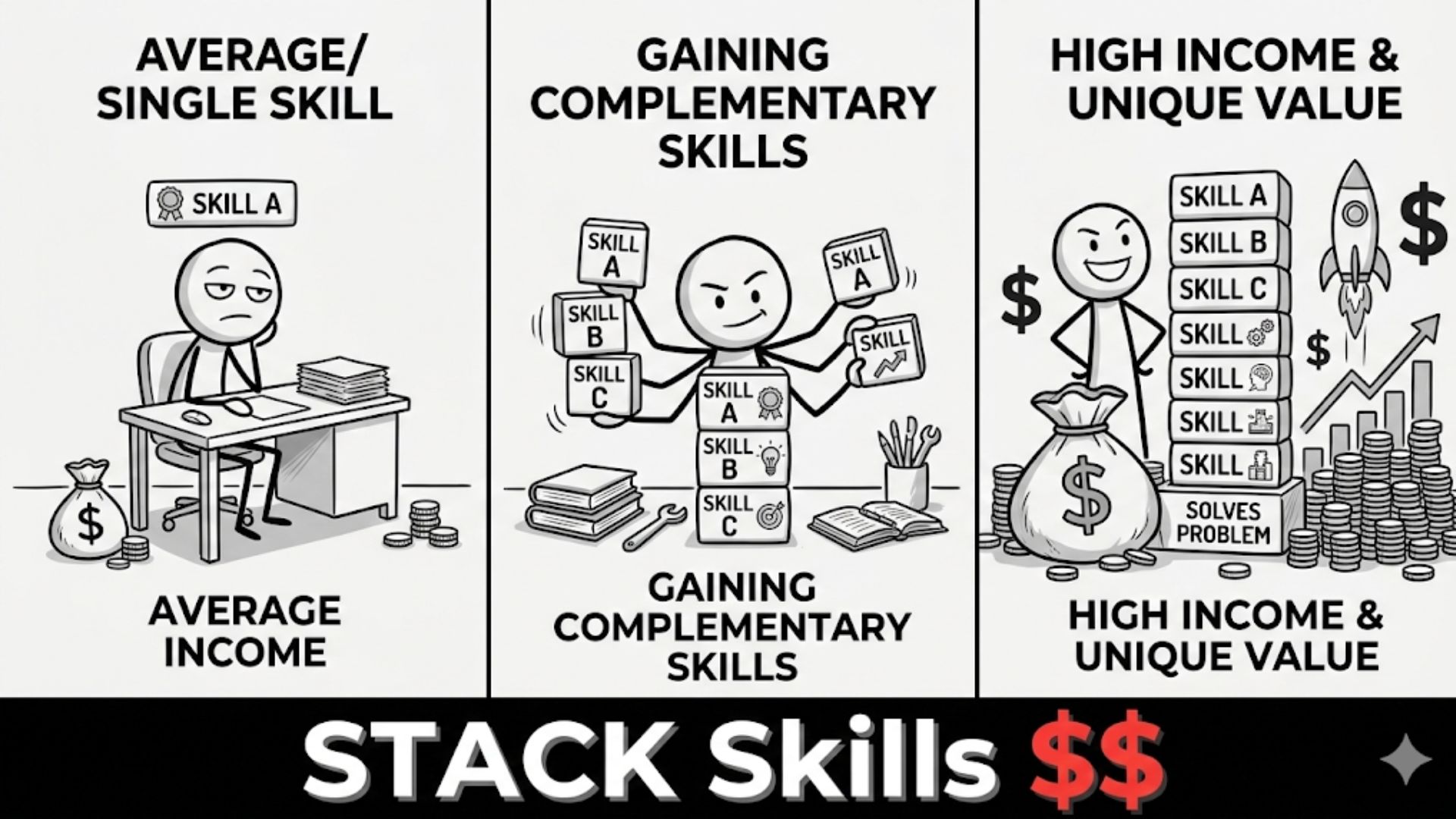
Section 1: Direct Answer (Featured Snippet Target)
Skill stacking is a strategic career leverage model that involves combining multiple, complementary competencies to create a unique and rare professional profile. Unlike traditional specialization, which seeks to reach the top 1% of a single field, skill stacking focuses on reaching the top 20% to 25% in several disparate but synergistic domains. This approach increases income potential by moving an individual from a commoditized labor market into a “one-of-one” category where pricing power is significantly higher.
The economic mechanism driving this growth is combinatorial scarcity: while the supply of deep specialists in a single field is relatively high, the supply of individuals who can bridge high-value gaps—such as technical engineering and persuasive communication—is exceedingly low. Consequently, skill stacking creates a non-linear income trajectory by allowing professionals to solve complex, high-stakes problems that single-domain experts cannot address.
Section 2: What Is Skill Stacking?
Skill stacking is the intentional accumulation of a diverse set of “high-income skills” that, when combined, produce a value greater than the sum of their individual parts. The concept, popularized in professional strategy circles, suggests that it is mathematically easier and more economically viable to become proficient in several related skills than to become a world-class master in a single one.
Precise Definition
In economic terms, skill stacking is an exercise in Human Capital Diversification. It is the process of building a unique “stack” of competencies that are orthogonal to one another but share a common market application. For instance, a software engineer (core skill) who stacks “product management” (amplifier skill) and “public speaking” (distribution skill) creates a profile that is far rarer and more valuable to an organization than a pure developer.
Read also: Why Modern America Feels Lost Despite Having Everything
Origin and Evolution
The concept evolved as a response to the “commoditization of expertise.” In a globalized and AI-leveraged economy, deep but narrow skills are increasingly susceptible to automation or price suppression via a global talent pool. Skill stacking serves as a defensive and offensive career leverage strategy, ensuring that the professional remains “irreplaceable” by occupying the intersection of multiple high-value domains.
Clarifying Misconceptions
Skill stacking is frequently confused with “generalism” or being a “jack of all trades.” However, the distinction lies in depth and synergy. A generalist has shallow knowledge across many unrelated fields. A skill stacker has “threshold competency” (typically the top 20%) in a specific set of skills that are strategically chosen to amplify one another.
Section 3: Skill Stacking vs Specialization
The debate between specialization and skill stacking is often framed as a binary choice. However, an analytical view suggests that each model serves different market conditions and carries distinct compensation ceilings.
| Feature | Specialization | Skill Stacking |
| Market Goal | Top 1% of a single domain | Top 20-25% of multiple domains |
| Primary Risk | Technological disruption/Automation | Lack of narrative coherence |
| Income Type | Linear/Predictable (Salary-based) | Non-linear/Asymmetric (Leverage-based) |
| Bargaining Power | Based on scarcity of the domain | Based on rarity of the combination |
| Economic Moat | Intellectual depth | Cross-domain synthesis |
| Market Condition | Stable, low-variability environments | Volatile, high-complexity environments |
Resilience to Disruption
Specialization is highly efficient in stable environments where the “problem set” remains constant for decades. However, in a state of rapid technological shift, a specialist faces Path Dependency Risk: if their narrow domain becomes obsolete, their human capital value drops to near zero. Skill stacking provides resilience because the “amplifier skills” (like sales, writing, or management) are transferable and can be re-stacked with new “core skills” as the economy evolves.
Read also: The Blueprint for Permissionless Wealth and Perpetual Peace
Section 4: The Economics Behind Nonlinear Income Growth
To understand how skill stacking increases income potential, one must analyze the supply and demand mechanics of the labor market. Income is not a function of “hard work,” but of the unreplaceability of the service provided.
Combinatorial Advantage and Scarcity
The value of a professional is determined by the intersection of their skills.
In a linear specialization model, the value is additive. In a skill stacking model, the value is multiplicative.
Consider a “Quant” (Quantitative Researcher) in finance. There are thousands of brilliant mathematicians. However, a Quant who also possesses a deep understanding of “Behavioral Psychology” and “Advanced Data Visualization” occupies a market niche where they are one of perhaps fifty individuals globally. This combinatorial scarcity creates massive pricing power.
Economic Moats and Pricing Power
Skill stacking builds an economic moat around an individual’s career. A moat is a structural barrier that prevents competitors from eroding one’s market position. When you are the only person who can translate complex cryptographic concepts (Skill A) into high-converting marketing copy (Skill B) for institutional investors (Skill C), you are no longer competing on price. You are a monopoly of one.
Section 5: Why High Income Skills Combination Outperforms Single Expertise
The synergy between skills is the primary driver of income growth. Some skills do not just add value; they act as multipliers for all other skills in the stack.
Multiplicative Value and Amplifier Skills
Certain skills—often called “Meta-skills”—have a disproportionate impact on income because they increase the “surface area” of your core competency.
- Communication/Persuasion: A brilliant engineer who can sell a vision to a CEO has 10x the leverage of an engineer who cannot.
- Project Management: The ability to organize others’ labor multiplies your own output.
- Data Literacy: The ability to prove the value of your work using data increases your negotiation leverage.
[Image comparing linear growth of a single skill vs exponential combinatorial growth of a skill stack]
Distribution as an Income Multiplier
In the modern economy, “Distribution” (the ability to reach an audience) is perhaps the most potent skill to stack. Whether it is through a LinkedIn following, a technical blog, or public speaking, distribution ensures that your “Core Skill” is visible to the highest-paying bidders. Without a distribution layer, the economic value of your expertise is limited to your immediate employer’s awareness.
Read also: Why Most Investors Underperform the Market
Section 6: The Career Leverage Model
For skill stacking to yield nonlinear income growth, the stack must be constructed with intentionality. We propose a four-layer Career Leverage Model:
- Core Revenue Skill: This is your primary domain (e.g., Coding, Accounting, Design, Legal analysis). It provides the baseline for your market value.
- Amplifier Skill: A skill that increases the efficiency or impact of the core (e.g., Automation, AI prompting, Project management).
- Distribution/Signal Skill: A skill that increases the visibility of your work (e.g., Writing, Marketing, Networking).
- Strategic Thinking Layer: The “executive” function that identifies which problems are worth solving.
Interaction Effects
When these layers interact, they create convexity in income potential. A design professional (Core) who uses AI tools to work 3x faster (Amplifier), writes a popular newsletter on design systems (Distribution), and consults on brand strategy (Strategic) can command fees that are orders of magnitude higher than a standard graphic designer.
Section 7: Does Skill Stacking Increase Salary? (High-Intent Section)
The data-backed answer is yes, but the mechanism depends on your professional context. Skill stacking increases salary and total compensation by altering the Negotiation Leverage of the individual.
For Corporate Employees
In a corporate environment, skill stacking increases “Promotion Velocity.” Employees who can bridge departments—the “Translator” who understands both code and finance—are indispensable during restructuring or rapid growth. They move into “General Manager” or “C-Suite” roles faster because their stack allows them to manage complexity that a specialist cannot.
For Entrepreneurs and Creators
For those outside the traditional salary structure, skill stacking is the only way to scale. A creator who is a “Writer + Videographer + Ad Strategist” can build a multi-million dollar business with minimal headcount. Their income ceiling is removed because they own the entire value chain of their production.
Negotiation Leverage and “Walk-Away” Power
Skill stacking increases your BATNA (Best Alternative to a Negotiated Agreement). Because your skills are diversified, you are not dependent on a single industry or company. This structural “walk-away” power is the ultimate leverage in any salary negotiation.
Read also: How to Cure Excusitis and Unlock Your True Potential
Section 8: Best Skills to Combine for Income Growth
While any combination can add value, specific “High Income Skills Combinations” have historically produced asymmetric returns.
Technical Skill + Persuasion (The “Rainmaker” Stack)
This is the most lucrative stack in the corporate world. The individual who understands the “How” (Technical) and can explain the “Why” (Persuasion) is the person who brings in the revenue. In tech, this is the “Solutions Architect” or “Technical Sales” role.
Finance + Psychology (The “Capital Allocation” Stack)
Investing and business management are 20% math and 80% psychology. Individuals who can analyze a balance sheet but also understand the behavioral biases of a market or a team are exceptionally rare.
Writing + Domain Expertise (The “Authority” Stack)
In a digital-first economy, the person who writes the best in their field is often perceived as the smartest. Stacking “Clear Writing” on top of any “Domain Expertise” (e.g., Medicine, Law, Engineering) allows you to build a personal brand that attracts high-value opportunities passively.
Coding + Business Strategy (The “Builder-Operator” Stack)
The “Indie Hacker” or “Solopreneur” model relies on this. Being able to build the product and understand the unit economics of the market allows for 90% profit margins.
Section 9: Common Mistakes in Skill Stacking
Many professionals attempt income diversification skills without a clear strategy, leading to a “Skill Grazing” effect that yields no economic return.
1. Random Accumulation (The Generalist Trap)
Stacking skills that have no synergy—for example, learning “Baking” while working as a “Cybersecurity Analyst”—does not increase income potential. It is a hobby, not a stack. Skills must be orthogonally relevant.
2. Lack of Narrative Coherence
If the market cannot understand why you have these skills, they will not pay for the combination. You must be able to tell a coherent story about how your “Psychology degree” makes you a “Better Product Designer.”
3. Shallow Competence (The 1% Fallacy)
While you don’t need to be in the top 1%, you must reach the Threshold of Usefulness (typically the top 25%). Having 10% knowledge in five fields is useless. You need enough depth in each to execute professionally.
4. Over-Diversification
Attempting to stack too many skills simultaneously leads to cognitive overload and “The Plateau of Latent Potential.” Focus on mastering one core skill before adding the first amplifier.
Section 10: Strategic Implementation Framework
To implement a skill stacking strategy that results in asymmetric income growth, follow this structured evaluation:
Step 1: Audit Current Economic Skill
Identify your “Core Revenue Skill.” What are you currently paid for? Is this skill being commoditized or automated? What is the current salary ceiling for a specialist in this field?
Step 2: Identify Multiplier Gaps
Look at the most successful people in your industry two levels above you. What skills do they have that you lack? Usually, these are “Amplifier” or “Distribution” skills (e.g., leadership, sales, writing).
Step 3: Map Monetization Pathways
Determine how the new skill will interact with the old. Will it allow you to charge higher hourly rates? Will it allow you to create a product? Will it lead to a specific promotion?
Step 4: Align with Market Demand
Validate your stack against the “Jobs to be Done” in the market. Is there a high-stakes problem that requires this specific combination of skills?
Read also: Why Most Investors Underperform the Market
Section 11: Conclusion
Skill stacking increases income potential by fundamentally changing the individual’s economic position in the labor market. It is a move away from the high-competition, low-margin world of pure specialization toward a “monopoly of one” where rarity and synergy drive pricing power.
In an era of rapid disruption, the most secure and lucrative path is not to bet on a single domain, but to bet on the combinatorial advantage of a well-designed skill stack. Income growth is no longer a linear function of time spent; it is a non-linear function of leverage, rarity, and the ability to solve complex problems through cross-domain expertise. By intentionally designing your human capital architecture, you ensure that your value compounds over time, regardless of technological shifts or market volatility.
5. FAQ Section (Schema-Ready)
What is skill stacking?
Skill stacking is a strategic model of professional development where an individual learns and combines several complementary, high-value skills rather than perfecting just one. The goal is to reach the top 20-25% in three or four synergistic domains (like coding, marketing, and management). This combination creates a rare, “one-of-one” profile that commands a premium because the specific intersection is much harder to find than a single-domain specialist.
Does skill stacking increase salary?
Yes, skill stacking increases salary by significantly improving an individual’s negotiation leverage and unreplaceability. In a corporate setting, “stackers” who can bridge different departments (like tech and sales) move into high-level leadership roles faster. For entrepreneurs, it allows for “Personal Operating Leverage,” where one person can execute the work of three, drastically increasing profit margins and removal of income ceilings.
Skill stacking vs specialization?
Specialization focuses on becoming the top 1% in a narrow field, which is effective in stable environments but vulnerable to automation. Skill stacking focuses on being “very good” in several domains that amplify each other. While specialists are often limited by a linear salary cap, skill stackers enjoy non-linear income growth because they can solve complex, cross-functional problems that a narrow specialist cannot see or address.
How many skills should you stack?
For maximum economic impact, the ideal stack consists of 3 to 4 synergistic skills. A typical successful stack includes one “Core Revenue Skill” (your technical expertise), one “Amplifier Skill” (like AI-leveraged productivity or project management), and one “Distribution Skill” (like writing or public speaking). Attempting to stack too many skills simultaneously leads to “Skill Grazing,” where the individual is too shallow in each to be useful.
What are high income skills to combine?
The most lucrative combinations usually pair a “Hard” technical skill with a “Soft” leverage skill. Examples include: Engineering + Persuasion (Technical Sales), Finance + Psychology (Capital Allocation), Data Science + Storytelling (Strategic Consulting), and Coding + Marketing (SaaS Entrepreneurship). These combinations are valuable because the skills are orthogonal; very few people possess both the analytical and communicative depth to bridge these specific gaps.

