My honest take before you read further: I had read plenty of books about habits before this one. None of them changed my behavior as concretely and durably as Atomic Habits did. Not because the ideas are revolutionary — most of them aren’t — but because James Clear makes them operational in a way that other writers don’t. This summary covers the 7 lessons that landed hardest and what I actually did differently as a result.
| Published | 2018 — Avery / Penguin Random House |
| Pages | 320 |
| Category | Habit Formation / Behavioral Psychology |
| Best for | Anyone who knows what they should do but keeps not doing it |
Why this book is different from every other habits book
The habits genre is crowded. There are dozens of books promising to help you build better routines, break bad behaviors, and optimize your daily life. Most of them share the same fundamental problem: they tell you what to do without giving you a detailed enough picture of why current behavior persists, or a specific enough mechanism for changing it.
Atomic Habits is different in two ways. First, Clear is meticulous about the mechanics — the precise psychological and environmental factors that make habits stick or fail. Second, he is honest about the timescale: real behavioral change is slow, often invisible for long periods, and then suddenly obvious. The book prepares you for that in a way that makes the slow period survivable.
I read it over a weekend and spent the following month making changes. Three years later, most of those changes are still in place. That is not a common outcome for a book in this genre, and it is why this summary focuses on the operational details rather than the headline ideas.
Read also: The Reason You’re Probably Wrong About Something Important Right Now
Lesson 01
Goals are not the point — systems are
“You do not rise to the level of your goals. You fall to the level of your systems.”
This is the foundational reframe of the book, and it is worth sitting with. Every person who failed to achieve a goal had a goal. Goals are not the differentiator. The differentiator is the system of daily behaviors that either produces the outcome or doesn’t.
Clear makes a distinction that I find genuinely clarifying: goals are about the results you want. Systems are about the processes that lead to those results. Goal-setting is useful for identifying a direction. But goal-achievement is almost entirely determined by whether your system — the daily, habitual behaviors you repeat — points in that direction consistently.
The practical implication is significant: instead of asking “how do I achieve this goal?” the better question is “what system, maintained consistently over time, would make this outcome almost inevitable?” Those are different questions that produce different answers.
My application: I stopped tracking goals and started tracking system adherence. Not “did I make progress?” but “did I execute the process?” The outcome follows the process. Tracking the outcome is interesting. Tracking the process is actionable.
Lesson 02
1% better every day compounds into transformation — 1% worse does the same
“Habits are the compound interest of self-improvement.”
Clear presents the mathematics of marginal gains clearly: if you improve by 1% every day for a year, you end up roughly 37 times better than when you started. If you decline by 1% every day, you approach zero. The asymmetry between these two trajectories is enormous over time — and completely invisible in the short term.
This is why habits feel like they’re doing nothing for so long. A 1% improvement in any given day is functionally undetectable. The compounding only becomes visible when you look back across months or years. Clear calls this the “Plateau of Latent Potential” — the long period where effort produces no visible result, and where most people give up, immediately before the curve begins to bend upward.
My application: Understanding the math made the invisible period of a new habit feel purposeful rather than futile. I stopped evaluating new habits on whether they were “working” at 3 weeks and started treating the early invisible period as necessary infrastructure — the compounding that would eventually become visible.
Lesson 03
Identity first: the habit that changes all other habits
“The most effective way to change your habits is to focus not on what you want to achieve, but on who you wish to become.”
This is the lesson I consider the most important in the book — and the most underappreciated. Clear identifies three layers of behavior change: outcomes (what you want), processes (what you do), and identity (who you are). Most habit advice operates at the outcomes layer. Atomic Habits argues for operating at the identity layer.
The distinction is concrete. Two people decide to quit smoking. Someone offers them a cigarette. The first person says “I’m trying to quit.” The second says “I’m not a smoker.” The first person still identifies as a smoker who is resisting. The second has already changed the identity — the behavior is an expression of who they are, not a suppression of who they want to be.
Every habit vote you cast for your desired identity reinforces that identity. Every time you write, you cast a vote for “I am a writer.” Every workout is a vote for “I am someone who takes care of their body.” The identity emerges from the accumulated evidence of consistent small actions.
My application: I rewrote my habit goals as identity statements. Not “I want to read more” but “I am a reader.” Not “I want to write regularly” but “I am a writer.” This shift changed how I experienced the habits — from imposed obligations to expressions of who I already am. The difference in motivation and consistency was noticeable and lasting.
Read also: How I Use a Decision Journal to Make Better Choices
Lesson 04
The Four Laws of Behavior Change — the complete operating system
“The Four Laws of Behavior Change are a simple set of rules we can use to build better habits.”
Clear builds the entire practical architecture of the book around four laws derived from the habit loop (cue → craving → response → reward). Each law corresponds to one stage of the loop and provides a lever for either building a good habit or breaking a bad one.
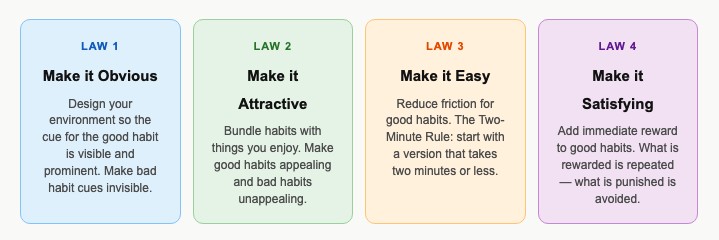
My application: I ran every habit I was trying to build through all four laws explicitly. The bottleneck for most of my failing habits was Law 3 — the good habit was too difficult to start relative to the easier alternative. Reducing that friction, even slightly, was consistently the highest-leverage intervention.
Lesson 05
Habit stacking: the most underused implementation tool
“After I [CURRENT HABIT], I will [NEW HABIT].”
Implementation intentions — specific plans for when and where you will perform a behavior — are one of the most robustly supported interventions in behavioral psychology research. Habit stacking is Clear’s most elegant application of this research.
The formula is simple: identify an existing habit that is already firmly established in your routine. Then attach the new habit directly to it. “After I pour my morning coffee, I will write for 10 minutes.” “After I sit down at my desk, I will open my decision journal.” The existing habit becomes the cue for the new one — leveraging a neural pathway that already exists rather than trying to create a new one from scratch.
My application: I built my entire morning routine using habit stacking chains. Each new behavior was attached to an existing one, creating a sequence that runs almost automatically. The stack has expanded over three years with almost no additional willpower expenditure — because each element triggers the next.
Lesson 06
Environment design beats willpower — every single time
“You don’t have to be the victim of your environment. You can also be the architect of it.”
Clear argues — with substantial research support — that behavior is primarily a function of environment, not character. The person who successfully maintains good habits is not more disciplined or more virtuous than the person who doesn’t. They have, usually, a better-designed environment that makes good behavior easier and bad behavior harder.
This reframe is both humbling and liberating. It means willpower is not the solution — and that is good news, because willpower is a finite and unreliable resource. Environment design is not. A well-designed environment works 24 hours a day without requiring any ongoing effort from you.
Practical examples Clear gives: put the guitar in the middle of the living room, not in the closet. Keep fruit on the counter, not in the refrigerator. Put your phone in a different room before bed. The habit follows the design of the space.
My application: I conducted what I now call an “environment audit” — going through my home and work spaces and asking, for each habit I wanted to build or break, whether the environment was making it easier or harder. The changes I made were mostly small. The effects were disproportionately large.
Read also: Why Smart People Think One Step Further Than Everyone Else
Lesson 07
Never miss twice — the rule that rescues consistency
“Missing once is an accident. Missing twice is the start of a new habit.”
Every habit breaks at some point. Life interrupts. You miss a day. The question is not whether you will miss — you will — but what you do on the day after.
Clear’s rule is simple and surprisingly powerful: never miss twice. One missed day is a disruption. Two missed days is the beginning of the absence becoming the new normal. The second miss is the one that matters — and it is entirely within your control in a way the first miss often isn’t.
He also makes a point that seems counterintuitive until you consider it: showing up and doing a reduced version of the habit on a bad day is more important than optimizing the habit on a good day. A 2-minute workout on the day you’re exhausted maintains the identity and the streak. It keeps the habit alive in a way that skipping entirely — even with the intention of doing a better session tomorrow — does not.
My application: I created “minimum viable” versions of every important habit — the smallest possible version I could execute on a terrible day. For writing: one paragraph. For reading: one page. For exercise: ten minutes of walking. These minimum versions almost never feel satisfying in the moment. But they preserve the identity and the continuity that makes the next full session much more likely to happen.
My honest assessment of this book
Atomic Habits deserves its reputation. It is the most actionable book on behavior change I have read — not because the ideas are new (habit loops and implementation intentions have been in the psychological literature for decades), but because Clear makes them accessible and operational in a way that a reader can apply without a background in behavioral science.
The book’s primary weakness is that it focuses almost entirely on positive habit formation and gives relatively little attention to the environmental and psychological factors — trauma, addiction, chronic stress — that can make the Four Laws insufficient on their own. For straightforward habit goals in a reasonably stable life context, the framework is excellent. For more complex behavioral patterns, it may need to be supplemented.
Who should read this
Anyone who has set a habit goal and failed — not once, but repeatedly — and is willing to consider that the failure was a system problem rather than a character problem. The book will change how you design your environment, how you think about identity, and how you respond to the inevitable breaks in consistency.
That combination, applied patiently, produces durable behavioral change in a way that willpower and motivation alone almost never do.