
The uncomfortable discovery: Three years ago, I started writing down my important decisions before making them — the reasoning, the assumptions, the expected outcome. When I reviewed those entries a year later, I found something I wasn’t expecting: I was making the same kinds of mistakes repeatedly, in different domains, with complete confidence each time. The decision journal didn’t make me smarter. It made my blind spots visible. That turned out to be far more valuable.
Why a decision journal — and what I expected vs. what I found
I started keeping a decision journal for a straightforward reason: I had read about the concept in the context of investment decision-making, where serious practitioners had been using them for decades to combat hindsight bias and improve long-term judgment.
The premise made sense to me. If you never record what you were thinking when you made a decision, you can’t learn from it accurately — because memory is reconstructive and systematically biased toward whatever the outcome was. We remember our reasoning as being better than it was when things go well, and we misremember our confidence as being lower when things go badly. The journal is a record that memory can’t revise.
What I expected to find, reviewing my entries: evidence that I was getting progressively better at making decisions over time.
What I actually found: a remarkably consistent set of cognitive patterns and failure modes that appeared across domains, over years, in decisions I considered completely different from each other. The journal didn’t confirm my growth. It revealed my recurring errors — errors I had been making with full confidence, completely unaware they were errors at all.
That discovery was worth considerably more than the confirmation I was looking for.
Read also: How Small Actions Trigger Massive Change
What a decision journal actually is
A decision journal is a written record of significant decisions — made before the outcome is known — that captures:
- The decision being made and its context
- The options you considered and why you rejected them
- The reasoning behind the choice you made
- Your assumptions about how the situation will develop
- Your confidence level and emotional state at the time
- What you expect to happen — specifically and measurably
The record is then reviewed after the outcome is known — typically 3, 6, or 12 months later — to compare what you actually thought at the time of decision with how things actually unfolded, and with how you remember thinking about it.
The gap between those three things — what you recorded, what happened, and what you remember — is where the learning lives.
“Keeping a decision journal is one of the most powerful things you can do to improve your judgment over time. It forces you to be honest about what you actually thought, rather than what you wish you had thought.”— Shane Parrish, Farnam Street
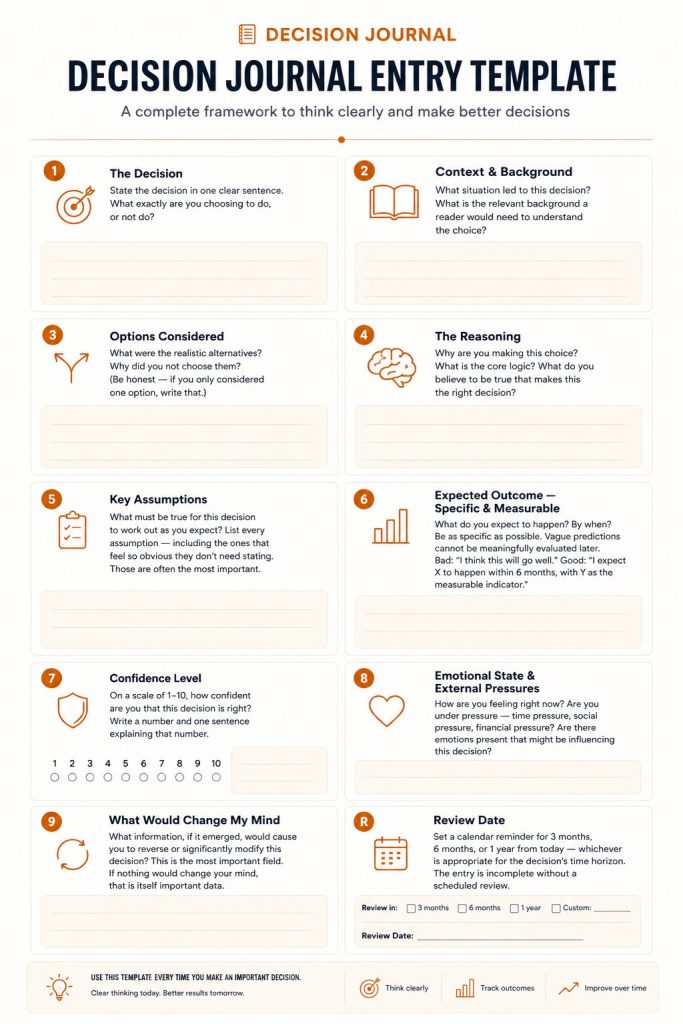
My exact decision journal template — field by field
I tried several formats before settling on this one. The goal is to capture enough information to enable genuine retrospective learning without making the entry so burdensome that you stop doing it. This template takes 10–20 minutes to complete for most decisions.
The review process: where the real value lives
The entry itself is useful — the act of writing forces clarity that the act of thinking alone rarely produces. But the review is where a decision journal becomes genuinely transformative. Here is how I conduct mine.
- Read the original entry cold — before recalling the outcomeIf possible, I try to re-read the entry before reviewing the outcome — to reconstruct what I was actually thinking at the time, without the distorting influence of knowing what happened.
- Write what actually happened — specifically and honestlyRecord the actual outcome in the same level of specificity as the predicted outcome. Not “it went okay” — but the concrete result against the concrete prediction you made.
- Evaluate the quality of the decision — not just the outcomeThis is the critical distinction: a good decision can produce a bad outcome (due to luck or unforeseeable events), and a bad decision can produce a good outcome (also due to luck). The question is not “did it work?” but “was the reasoning sound given what I knew at the time?”
- Identify which assumptions held, which failed, and whyGo through Field 5 — the assumptions — and mark each one. Which were correct? Which were wrong? Which were never tested because the decision went differently than expected? Wrong assumptions are not failures; they are the specific content of your learning.
- Look for patterns across multiple reviewsIndividual entries produce individual lessons. Reviewing multiple entries together is what reveals the deeper patterns — the systematic biases and recurring failure modes that appear across different decisions in different domains.
Read also: The Science of Getting Rich
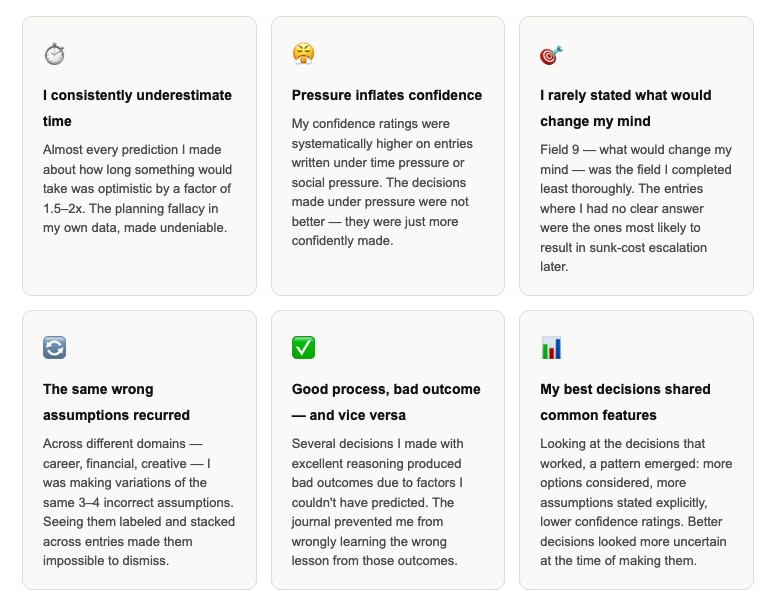
The patterns I found in three years of entries
After three years and approximately 60 significant decision entries, these are the patterns I found most clearly and most consistently in my own thinking.
How to start — without overcomplicating it
The most common failure mode for decision journals is never starting, because the format feels too complicated or the commitment feels too large. Here is the simplest possible version:
Minimum viable decision journal — start here
For any significant decision you make this week, write three things in a notebook or document before you make it:
1. What am I deciding?
2. Why do I think this is right?
3. What do I expect to happen?Then set a reminder 90 days from now to re-read what you wrote. That is the entire system at its minimum. Add fields when you feel ready — but do not wait until you feel ready to start.
The full template I described is the evolved version of that three-field start. I added each field because I discovered a specific gap in what the simpler version was capturing. Your gaps may be different — which means your evolved template may look different from mine. The starting point is the same: write it down before the outcome is known.
Read also: How Better Thinking Leads to Better Outcomes
Conclusion: the goal isn’t to be right — it’s to know why you were wrong
Three years of decision entries have not made me reliably right. They have made me much clearer about the specific ways I am reliably wrong — which turns out to be a more useful and more durable form of knowledge.
I make fewer decisions under high-pressure conditions now, because the journal showed me that my confidence under pressure is not correlated with outcome quality. I state my assumptions more explicitly, because I can see in black and white what happens when I don’t. I have a clearer “what would change my mind” for each significant decision, because I have watched sunk-cost escalation consume decisions where that field was empty.
None of this came from reflection alone. It came from having records that memory couldn’t revise.
If you want to make better decisions, you first need to understand how you actually make decisions — not how you imagine you do, and not how you remember having done. A decision journal is the instrument that makes the difference between those things visible.