In my years of analyzing economic systems, capital allocation, and the trajectories of high-performing individuals, I have observed a recurring structural phenomenon. It is a quiet pattern, often obscured by the noisy narratives of “overnight success” or sudden failure. The pattern is this: many of the most valuable systems in our world—whether in finance, skill acquisition, or institutional reputation—function on nonlinear growth curves. Yet, the vast majority of participants abandon these systems during their early, flatter stages, precisely when the foundation for exponential acceleration is being laid.
Abandonment is rarely the result of a lack of effort. In fact, many of those who quit are among the most industrious. Rather, the failure is one of conceptual mapping. Humans are biologically and culturally conditioned to expect linear returns—where an extra unit of input yields a predictable, proportional unit of output. When we encounter a compounding system, where the early returns are microscopic and the significant rewards are back-loaded, we misinterpret the slow progress as a signal of systemic failure. To understand why we quit is to understand the mathematics of the curve and the cognitive biases that blind us to the power of the long game.
Read also: A Structural Analysis of Time-Based Systems
The Shape of Nonlinear Progress
The systems that define modern success are seldom straight lines. If you walk for an hour, you cover a distance proportional to your effort. This is linear progress. However, if you invest capital, develop a complex skill, or build a professional reputation, you are operating within a compounding system. In these environments, the output of one period becomes the input for the next.
Consider the following domains where this nonlinear geometry is the governing law:
- Compound Interest: In wealth accumulation, the initial years are dominated by the principal. The growth is slow, often masked by inflation or market volatility.
- Skill Development: In high-complexity fields like mathematics, programming, or strategic thinking, the early stages involve internalizing foundational syntax. Visible mastery is minimal until a “critical mass” of mental models is achieved.
- Professional Reputation: Trust compounds. A single year of reliability provides marginal leverage. A decade of consistency, however, creates a “brand” that acts as an automated door-opener, providing opportunities that are disproportionate to any single act of labor.
In each of these examples, the early stage appears stagnant. Because the human brain lacks an intuitive grasp of exponents, we fail to recognize that the stagnation is, in fact, the necessary “loading phase” of a vertical ascent.
The Flat Phase: Where Most People Quit
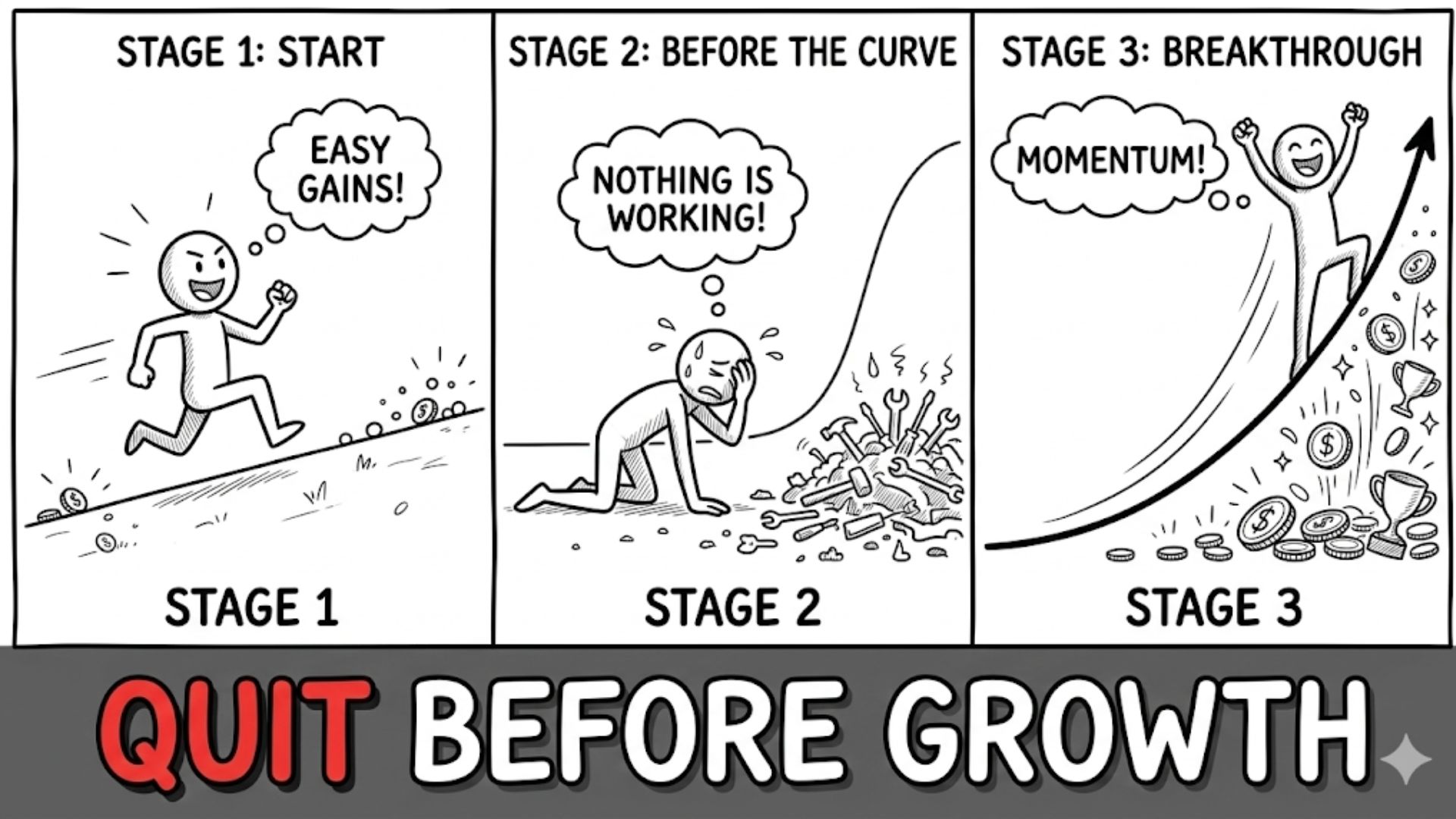
In every nonlinear system, there exists a period of “latent potential”—a duration of time where the effort invested does not seem to match the results produced. This is the flat phase of the curve. It is the most psychologically taxing period of any endeavor because it forces a confrontation between our expectations and our reality.
During this phase, the system is accumulating the variables necessary for compounding. In business building, this might involve refining a product-market fit that currently yields zero revenue. In learning, it might be the repetitive drills that don’t yet feel like mastery. Because we are socialized to value “efficiency,” we view this lack of immediate ROI as an indicator of waste. We assume that if something were going to work, it would have shown more “traction” by now.
This phase is where the majority of “churn” occurs. People quit not because they have failed, but because they have misdiagnosed the timing of the system. They apply a linear yardstick to a nonlinear process, conclude that the “rate of return” is too low, and exit the system to find a path with a steeper initial slope—often unaware that the path they abandoned was just months away from its inflection point.
Read also: Why Acquisition Entrepreneurship Is the Ultimate Business Mental Model
The Mathematics Behind the Curve
To understand why we struggle to persist, we must look at the mathematical structure of exponential growth. Linear growth follows the pattern of $1, 2, 3, 4, 5$. Exponential growth follows the pattern of $1, 2, 4, 8, 16$.
In the exponential sequence, the absolute difference between the first and second steps is only one unit. Between the fourth and fifth steps, the difference is eight units. In the early stages, the “gain” in an exponential system is actually less than in a linear one. If you chose a compounding penny that doubles every day for 30 days, you would be disappointed on day 15 when you only have $163.84. However, by day 30, you have over $5 million.
The human brain did not evolve in an environment where pennies doubled. We evolved in a world of limited resources, where the distance to a water source or the yield of a hunt was roughly linear. Consequently, our “internal simulation” of the future is almost always a straight-line projection of the recent past. When we see a flat curve, our brain projects a flat future. We are structurally incapable of “feeling” the verticality of the curve until we are already on it.
Delayed Feedback and Uncertainty
A primary driver of premature abandonment is the distortion of feedback loops. In high-skill or high-capital environments, there is a significant “time lag” between an action and its ultimate consequence.
In a linear system, the feedback is clear: you dig a hole, the hole gets deeper. In a nonlinear system, the feedback is delayed and noisy. You might study a subject for months without feeling any “smarter” until one day, the disparate pieces of information “click” into a unified mental model.
This delay introduces uncertainty. Because we cannot see the direct link between our effort and the eventual result, we begin to doubt the validity of the strategy itself. Uncertainty is the ultimate energy drain; it makes every hour of work feel heavier. Without the “dopamine hit” of immediate progress, most individuals revert to paths that offer lower terminal value but higher immediate reinforcement.
Read also: A Structural Analysis of Compounding in Life Systems
Social Pressure and Visible Progress
Our social environments are optimized for the visible. In professional hierarchies and social networks, we are rewarded for achievements that are easily measured and immediately apparent. This creates a structural bias against the curve.
If you are five years into a ten-year compounding cycle in your career, you may appear to be “falling behind” a peer who took a path with a high initial salary but no long-term scalability. Social comparison acts as a constant pressure to “do something” or “pivot.” We feel the need to signal progress to our peers, our investors, or our families.
Because the flat phase of a nonlinear curve looks like stagnation, it is often socially indefensible. The person who is quietly building a deep skill set or a long-term investment portfolio often looks “stupid” to the crowd until the moment the curve turns vertical. Most people lack the “inner scorecard”—to use Charlie Munger’s term—to withstand the social cost of looking unsuccessful during the loading phase of a compounding system.
Incentive Systems That Encourage Short-Term Thinking
Institutions are frequently the enemies of nonlinear progress. Most modern incentive structures are designed around short-duration cycles:
- Quarterly Earnings: Public companies are forced to optimize for 90-day windows, which often leads to cutting long-term R&D to “smooth” the current report.
- Annual Performance Reviews: Employees are incentivized to pursue “high-visibility” projects that can be completed within a year, rather than foundational work that may take three years to show value.
- Immediate Metrics: In the digital economy, we optimize for daily active users or click-through rates, which are often “local maxima” that prevent the pursuit of a “global maximum.”
These structures create a “Principal-Agent” problem with our future selves. Our current “managerial” self wants to see a win this year to justify our efforts, even if it comes at the expense of a transformative win five years from now. We are institutionally trained to quit the curve in favor of the staircase.
Read also: The Research-Backed Blueprint for Building Truly Great Companies
Cumulative Advantage and the Acceleration Phase
If one can survive the flat phase, they enter the stage of Cumulative Advantage, often called the Matthew Effect: “to those who have, more will be given.” In this phase, progress is no longer just a result of effort; it is a result of the accumulated mass of the system.
In the acceleration phase, your previous results begin to do the work for you:
- Capital: Your interest earned is now greater than your monthly contributions.
- Reputation: Your existing brand attracts opportunities so you no longer have to hunt for them.
- Knowledge: Your existing mental models make learning new, complex information twice as fast as it was in the beginning.
The tragedy of quitting early is that the individual has already paid the “full price” of the difficult early stages but has forfeited the “discounted” rewards of the late stages. The acceleration phase is where the “arbitrage” of persistence lies.
Examples of Curves in Real Life Systems
To see the curve is to see the underlying architecture of success across disparate fields:
- Writing and Audience Growth: A writer may produce content for years with a negligible following. However, once a “critical mass” of content exists, search engines and social algorithms begin to treat the body of work as an authority, leading to a sudden, vertical spike in reach.
- Intellectual Development: Learning a new language or a complex technical skill follows a “S-curve.” The initial “lexical acquisition” is slow and painful. Only after reaching a threshold of fluency does the ability to communicate compound through use.
- Entrepreneurship: Many startups spend years in “product-market fit” hell. The ones that survive are often those whose founders recognized that the “flatness” was not a sign of a bad product, but a sign of a complex market that required a longer loading phase.
In each case, the terminal value is concentrated in the final 10% of the time horizon.
Read also: Why Career Leverage Dominates Labor Intensity
The Opportunity Cost of Quitting Early
The cost of quitting before the curve is rarely calculated correctly. Most people view quitting as “cutting their losses.” However, in a compounding system, quitting is the ultimate loss because it resets the clock.
If you switch from one promising career path to another every three years because you haven’t seen a “breakthrough,” you end your career with ten “Year 1s” instead of one “Year 10.” You never allow the “exponent” to engage. You are effectively paying the “entry fee” of the flat phase over and over again without ever staying for the performance. Frequent switching is the primary mechanism by which intelligence is converted into mediocrity.
Why Early Success Can Be Misleading
Conversely, we are often seduced by “linear” systems that offer high early rewards. A high-paying entry-level job in a commoditized industry or a speculative investment that “pops” immediately can be a strategic trap.
These systems often lack a compounding engine. They provide a “staircase” of progress—steady, predictable, and visible. Because they satisfy our biological need for immediate feedback and social status, we often abandon “curved” paths (which have higher terminal value) in favor of these linear paths. We choose the comfort of the current high slope over the potential of a future vertical one. This is a failure of Opportunity Cost analysis: we overvalue what we get today and undervalue what we are sacrificing tomorrow.
Psychological Biases That Cause Early Abandonment
Structural persistence is fought on the battlefield of cognitive bias. Several hard-wired tendencies push us to quit:
- Present Bias: The tendency to overvalue immediate rewards and undervalue future ones. The $1,000 today feels more “real” than the $100,000 ten years from now.
- Loss Aversion: The pain of the “wasted” effort in the flat phase is felt more acutely than the joy of the potential future gain.
- Availability Heuristic: We see the “overnight successes” in the news and assume that is the norm. When our own path doesn’t look like that, we conclude we are doing something wrong.
Persistence in a nonlinear system requires an “Inner Scorecard”—the ability to ignore external signals of progress and focus on the internal metrics of systemic health.
Read also: Why the Traditional Accounting Formula Is Killing Your Business
The Strategic Advantage of Understanding the Curve
Understanding the structure of nonlinear progress is, in itself, a competitive moat. In an era of instant gratification and high information velocity, the ability to maintain a long-term time horizon is increasingly rare.
If you know that the first 50% of your effort will likely produce only 5% of your results, you interpret a “slow start” not as failure, but as a statistical requirement. This perspective changes your decision-making under uncertainty. It allows you to:
- Price the “Entry Fee”: You enter a project knowing it will take 5 years to see a return, rather than 5 months.
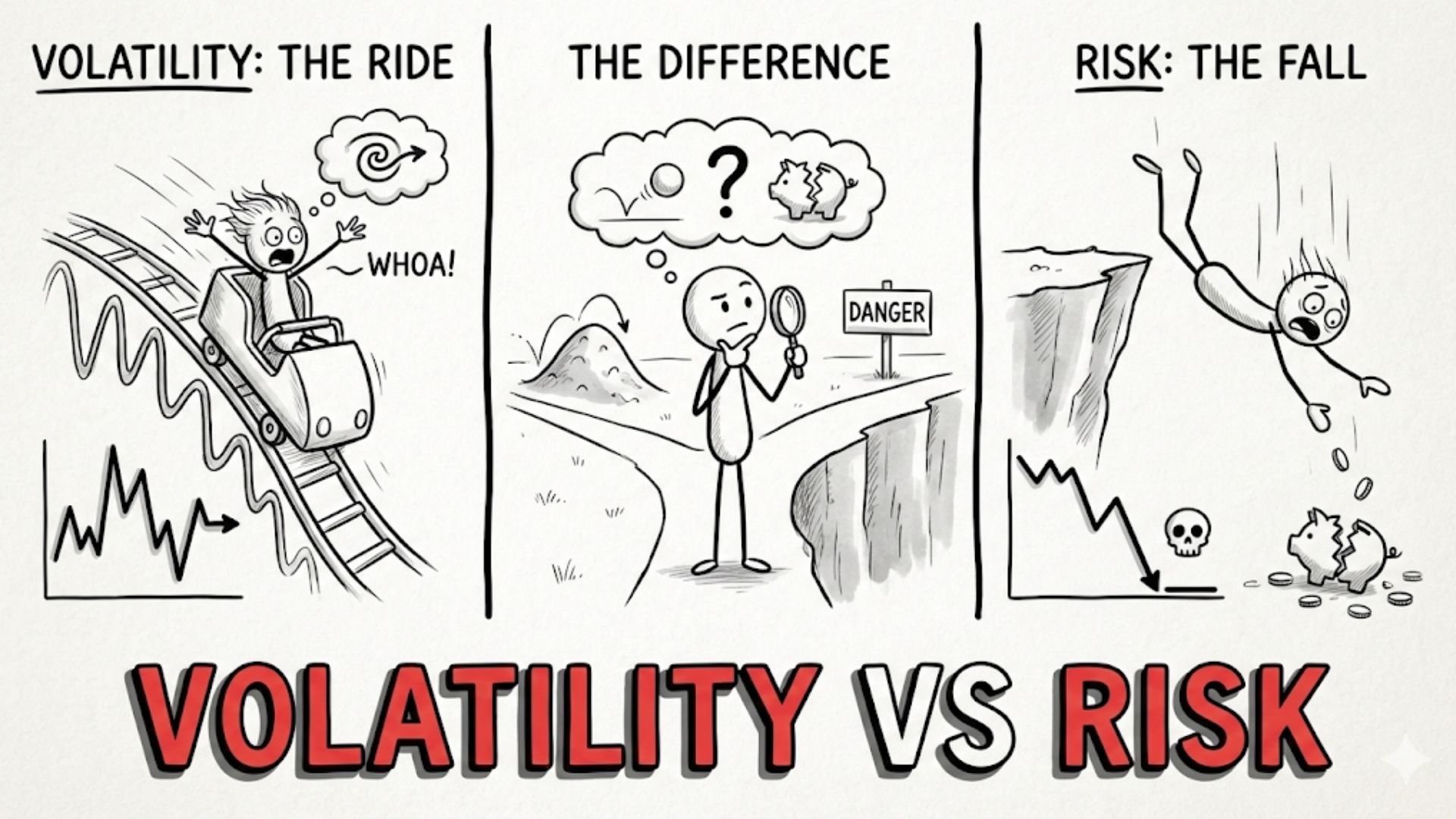
- Filter Feedback: You ignore short-term volatility and focus on whether the underlying “compounding engine” is still intact.
- Arbitrage Impatience: You can outlast competitors who are smarter or better funded but who are beholden to short-term stakeholders.
Conclusion: Persistence in Nonlinear Systems
Many of the most significant achievements in human history—and the most successful individual trajectories—are the result of staying on a curve long after it was “rational” to quit according to linear metrics. After studying these systems for many years, I have come to believe that success is often a function of duration more than intensity.
The “curve” is a fundamental law of the universe. It is the geometry of compounding, and it does not care about our need for immediate validation. Understanding this shape does not make the flat phase any less difficult, but it does make it more meaningful. It allows us to recognize that the quiet, seemingly insignificant progress of today is the necessary prerequisite for the dramatic acceleration of tomorrow. In complex systems, the most valuable assets are not those that grow the fastest at the beginning, but those that are allowed to grow the longest without interruption.
To reach the vertical phase, one must first survive the flat one. The strategic advantage goes to those who can see the curve before it begins to climb.