

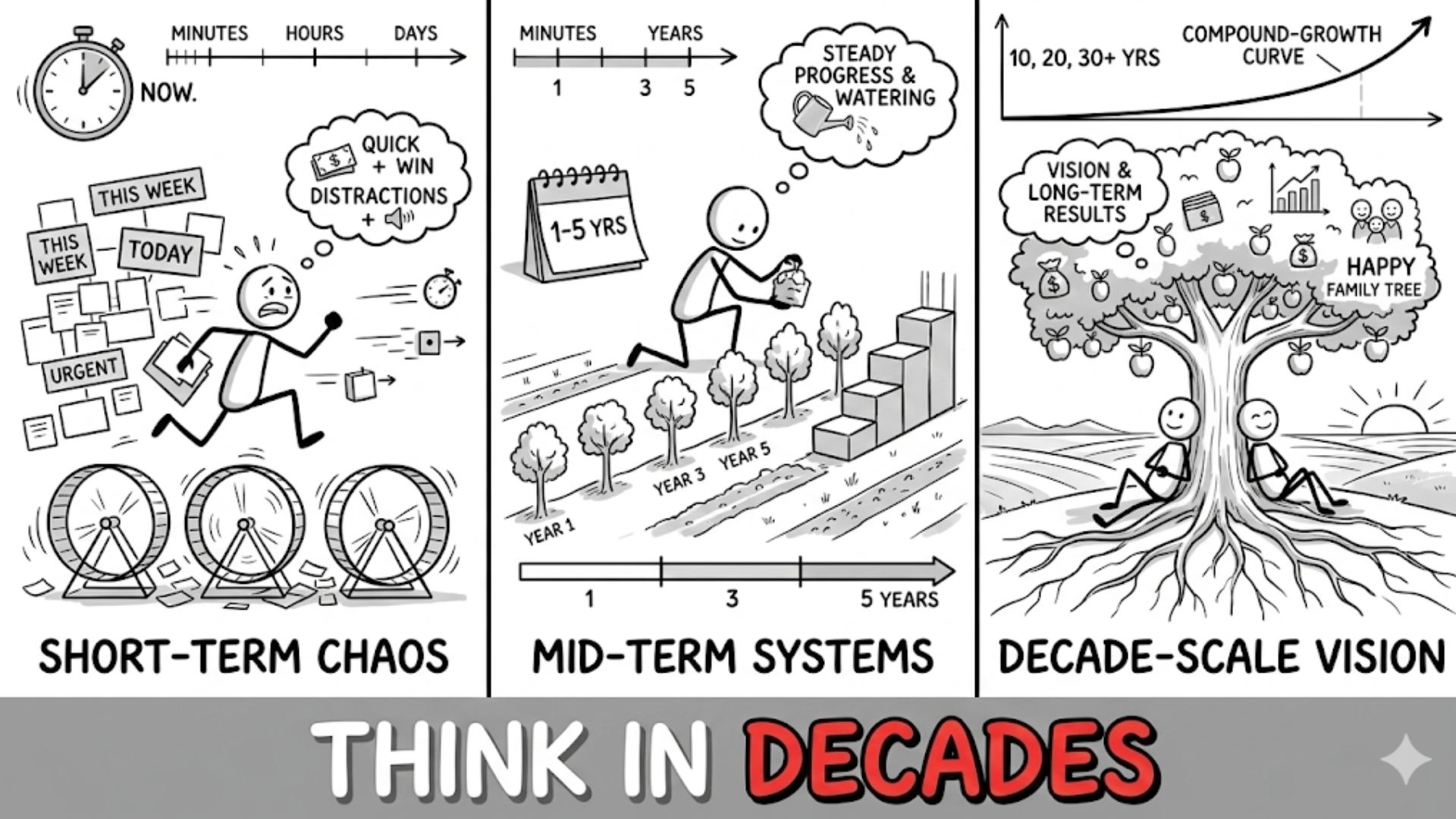
Introduction: The Difference Between Years and Decades
In the modern landscape of professional and economic life, the “year” has become the standard unit of strategic measurement. Corporations obsess over annual reports; individuals set “New Year’s resolutions”; and performance is almost universally codified in twelve-month increments. We have built an entire civilization around the annual cycle, punctuated by even shorter bursts of quarterly earnings and monthly benchmarks. This framework is not accidental; it aligns with the seasonal rhythms of our agrarian past and the reporting requirements of contemporary capital markets.
However, after years spent observing the underlying structures of success in investing, institutional growth, and intellectual development, I have come to believe that the “year” is an inadequate lens for understanding high-magnitude outcomes. The most profound results in human systems—those that involve true mastery, generational wealth, or deep reputational moats—do not function on a 365-day clock. They operate on the scale of decades.
Thinking in decades fundamentally changes one’s internal architecture of decision-making. It shifts the focus from “velocity” (how fast am I moving this month?) to “trajectory” (where will this path terminate in twenty years?). On a one-year horizon, progress often looks like noise, and risk looks like volatility. On a decade-scale horizon, noise cancels out to reveal the signal, and risk is redefined as the failure to stay in the game long enough for compounding to take hold. To understand the strategic power of the long horizon is to recognize that time is not just a medium in which we act, but a structural multiplier that transforms linear effort into geometric results.
Read also: The Research-Backed Blueprint for Building Truly Great Companies
Why Humans Naturally Think Short Term
If the advantages of a decade-long perspective are so analytically clear, one must ask why such thinking remains so rare. The answer is rooted in our biological and evolutionary heritage. The human brain is a product of an environment where the immediate future was the only future that mattered. In a state of nature, the “long term” was a luxury that few could afford; survival depended on the immediate acquisition of calories and the avoidance of proximal threats.
The Present Bias and Temporal Discounting
Behavioral economics identifies this as present bias—the tendency to overvalue immediate rewards while heavily discounting distant ones. From an evolutionary standpoint, a calorie consumed today was infinitely more valuable than a theoretical calorie promised in five years. This “temporal discounting” remains hardwired into our neural circuitry.
When we are faced with a choice between a moderate gain today and a transformative gain in ten years, our limbic system—the seat of emotion and survival instinct—demands the immediate utility. Decade-scale thinking requires the constant, deliberate suppression of these prehistoric impulses by the prefrontal cortex. It is a cognitively taxing exercise in “delayed gratification” that goes against the grain of our hardware. Because most people cannot or will not endure this cognitive load, they default to short-term cycles, leaving the long-term arena significantly less crowded and, therefore, more strategically lucrative.
Read also: Why Career Leverage Dominates Labor Intensity
The Structure of Long-Term Compounding
The primary mathematical reason that decades outperform years is the nature of compounding. In any system where the returns of one period are reinvested into the next, growth is non-linear. The formula for future value, $FV = PV(1 + r)^n$, reveals that the exponent ($n$), representing time, is the most powerful variable in the equation.
Compounding Beyond Finance
While compounding is most frequently discussed in the context of capital markets, its structural logic applies to almost every domain of human capital:
- Intellectual Development: Knowledge is a compounding asset. Every new concept learned provides a “hook” for future information, making subsequent learning faster and more intuitive.
- Reputation: Trust compounds. A person who has been consistently reliable for twenty years does not merely have twenty times the trust of a newcomer; they have a “reputational moat” that allows them to bypass transaction costs that others must pay in full.
- Career Capital: Specialized skills and rare networks take years to cultivate. Once achieved, they provide a level of leverage that is impossible to replicate through short-term intensity.
The difficulty is that compounding is end-loaded. In a twenty-year compounding cycle, the vast majority of the gains occur in the final few years. If an individual or organization operates on a three-year horizon, they are effectively resetting the clock just as the exponential phase is beginning. They pay the “entry fee” of the difficult early years over and over again without ever staying long enough to harvest the terminal value.
Read also: Why the Traditional Accounting Formula Is Killing Your Business
The Flat Early Years of Long-Term Systems
One of the most significant structural barriers to decade-scale thinking is the “flat” early phase of non-linear systems. In the first few years of a new career, a deep learning project, or a brand-building exercise, the relationship between effort and result appears decoupled. You may work with extreme intensity for three years and see only marginal, linear progress.
The Valley of Disappointment
In my observations, this is the “Valley of Disappointment”—the period where the results of your effort lag behind your expectations. Because our brains expect linear progress (a straight line), we interpret the slow start of a compounding curve as a failure.
Most participants quit during this phase. They conclude that the strategy isn’t working, that they lack talent, or that the market is too competitive. They exit the system precisely when they should be doubling down. Thinking in decades allows one to interpret this “flatness” not as failure, but as a structural requirement. It is the “loading phase” where the principal is being built. When you view your life in ten-year blocks, a three-year “plateau” is not a disaster; it is a predictable stage of the journey.
Read also: The Math of Scaling Without Burning Out
Time Horizon Arbitrage
In the financial world, “arbitrage” is the practice of profiting from a price difference between two markets. In strategy, I believe the most powerful form of this is time horizon arbitrage. This is the advantage gained simply by operating on a longer time scale than your competitors.
Outlasting the Competition
If the majority of your peers are optimizing for the next twelve months, they are forced into a specific set of behaviors: they must take fewer risks, they must seek immediate validation, and they must avoid “boring” but foundational work. By extending your horizon to a decade, you can make moves that others cannot justify.
- Patient Investing: You can hold assets through volatility that would force a short-term trader to liquidate.
- Deep Expertise: You can spend years mastering a foundational discipline (like mathematics or classical philosophy) that doesn’t have an immediate “market price” but provides an insurmountable intellectual edge in ten years.
- Long-Term Brand Building: You can prioritize integrity and customer trust over immediate profit, building a “loyalty moat” that a quarterly-focused competitor will eventually find impossible to breach.
Time horizon arbitrage is the ultimate “low-beta” strategy. You don’t have to be twice as smart as everyone else if you are willing to stay in the game five times longer. The duration itself becomes the competitive advantage.
Read also: The Psychological Mechanics of Self-Mastery
Knowledge and Intellectual Capital Over Decades
Expertise is often mistaken for raw intelligence. However, after observing elite practitioners across disparate fields, I have found that true mastery is a function of prolonged immersion. Decade-scale thinking is the prerequisite for moving from “knowledge” to “insight.”
Pattern Recognition and Conceptual Depth
In the first five years of a career, one learns the “syntax” of a field—the rules, the terminology, and the basic procedures. In the second five years, one begins to see the “semantics”—the underlying patterns and causal relationships. It is only in the second or third decade that one achieves the “strategic insight” that allows for rapid, intuitive decision-making in complex environments.
This depth cannot be “crammed.” It requires a compounding base of experience that can only be built through time. A professional who has spent twenty years observing market cycles or technological shifts has a “lattice” of mental models that a newcomer, regardless of their IQ, cannot replicate. This deep intellectual capital is the ultimate uncopyable asset. In an era of rapid information turnover, the person who has mastered the “Lindy” (durable) principles of their field over decades possesses a level of stability that short-term thinkers cannot match.
Read also: A Structural Analysis of Systemic Fragility
Networks and Relationships Over Long Horizons
Social capital is perhaps the most time-dependent asset of all. In the short term, networking is often transactional—a trade of favors or information. In the long term, however, networks evolve into trust ecosystems.
The Compounding of Credibility
Trust is a function of “consistency over time.” A relationship that has survived multiple cycles of success and failure possesses a level of “bandwidth” that a new acquaintance cannot match. After two decades in an industry, an individual’s network becomes an automated system of opportunity. You are no longer “searching” for deals or information; the network, recognizing your long-term presence and reliability, “pulls” opportunities toward you.
This “reputational capital” is the result of thousands of micro-decisions to act with integrity when no one was looking. On a one-year horizon, “cheating” or taking a shortcut might look rational. On a twenty-year horizon, it is catastrophic. Decade-scale thinking forces an individual to treat every interaction as a “repeated game,” where the value of the future relationship far outweighs the value of the current transaction.
Read also: The Strategic Calculus of Long-Term Compounding
Path Dependency and Life Trajectories
Strategic success is as much about the paths you don’t take as the ones you do. This is the principle of path dependency—the idea that our current options are limited and shaped by our previous decisions.
Small Choices and Divergent Outcomes
When viewed in isolation, a single choice—which industry to enter, which skill to learn, which city to live in—appears minor. However, when these choices are projected over decades, they create divergent life trajectories. Decade-scale thinking allows one to evaluate a decision not based on its immediate reward, but on the “path” it opens or closes.
A career path in a declining industry may offer a high starting salary but have a “leverage ceiling” that becomes apparent only in year fifteen. Conversely, an “apprenticeship” in a high-leverage field (like venture capital or software) may pay poorly in the first five years but put you on a trajectory of infinite upside. Thinking in decades forces you to be a “selector of paths” rather than a “hunter of rewards.” It prioritizes the optionality of the future over the utility of the present.
Why Institutions Often Discourage Long-Term Thinking
One must acknowledge that the modern institutional environment is structurally hostile to decade-scale thinking. The incentives of contemporary capitalism are designed to truncate time horizons.
- Quarterly Earnings Cycles: CEOs are judged on 90-day intervals. Even if they know a ten-year investment is the correct move for the company, the pressure to “hit the number” today often forces them to cannibalize the future.
- Annual Performance Reviews: Employees are incentivized to produce “visible wins” within a twelve-month window to justify a raise or promotion. Foundational work that takes three years to show value is often punished.
- Short Incentive Structures: Stock options that vest in four years or political terms that last four years create a “cliff” beyond which the decision-maker no longer cares about the system’s health.
This institutional short-termism creates a “fragility” in our systems. It leads to the externalization of risks and the underfunding of long-term resilience. For the individual, the strategic move is to recognize these institutional pressures and deliberately build “sovereign” systems—personal portfolios, private businesses, or independent learning paths—that are not beholden to these truncated cycles.
Read also: Why Working IN Your Business Is Slowly Destroying It
The Illusion of Rapid Success
We live in a culture that celebrates the “overnight success.” We see the founder who sold a company for a billion dollars or the artist who suddenly became a household name. However, after looking closely at these trajectories, I have found that the “overnight” part is almost always an illusion—a byproduct of our short-term attention spans.
The Iceberg of Accumulation
Success is an iceberg. The visible tip—the breakthrough, the IPO, the award—is supported by a massive submerged base of “unseen” effort. This base is usually built over a decade or more of “quiet accumulation.”
Observers see the inflection point of the curve and mistake it for the start of the journey. They fail to see the ten years of “flat” growth where the individual was building the skills, the network, and the principal. This misunderstanding leads people to look for “hacks” or “shortcuts,” which are effectively attempts to reach the vertical phase of the curve without building the base. In a compounding system, this is mathematically impossible. The “rapid success” we see is merely the terminal phase of a decade-long process finally becoming visible to the public.
Opportunity Cost Across Decades
The concept of opportunity cost—the value of the next best alternative—is often viewed in the short term: “If I buy this coffee, I can’t buy that tea.” But the true power of opportunity cost is only revealed over decades.
The Divergence of Direction
If you spend ten years moving in a consistent direction, you build a “moat” of expertise and reputation. If you spend those same ten years switching industries every two years, you may work just as hard, but you end up with ten “Year 1s” instead of one “Year 10.”
The opportunity cost of “indecision” and “frequent switching” is not just the lost time; it is the lost interest on that time. Strategic durability—the ability to stay in a single domain for decades—is perhaps the most underrated skill in the modern economy. In a world of infinite distraction, the person who can maintain a single focus for twenty years becomes a “monopoly of one” simply because everyone else changed their mind along the way.
Read also: How Skill Stacking Increases Income Potential
Unequal Outcomes in Long-Term Systems
Systems governed by compounding and cumulative advantage (the Matthew Effect) do not produce “fair” or normal distributions. They produce power laws. In these systems, a small number of participants capture a disproportionate share of the total rewards.
The Matthew Effect in Careers
“To those who have, more will be given.” In a decade-scale system, the person who has a slightly better reputation or a slightly deeper skill set in year five gets slightly better opportunities. These opportunities allow them to learn faster and build a bigger network. By year twenty, they aren’t twice as successful as their peers; they are 1,000 times as successful.
This inequality is a structural feature of time-based systems. It is why persistence matters so much. If you exit the system in year four, you never reach the phase where the “accumulated mass” of your career begins to do the work for you. The rewards of a long-term strategy are concentrated at the very end of the time horizon.
Viewing Life Through Decade-Scale Thinking
Adopting a decade-scale perspective changes the “resolution” of your life. It allows you to move from “reactive” decision-making to “architectural” decision-making.
- Interpreting Progress: You stop worrying about a “bad month” or a “slow year.” You ask: “Is the underlying compounding engine still healthy?”
- Interpreting Risk: You realize that the greatest risk is not “volatility” (short-term price movement), but “ruin” (anything that forces you to exit the game).
- Interpreting Opportunity: You stop chasing “get rich quick” schemes and start looking for “Lindy” opportunities—those that have been around for decades and are likely to be around for many more.
This perspective provides a “calmness” that is inaccessible to the short-term thinker. When you are operating on a ten-year clock, the “crises” of the day lose their power. You gain the “structural patience” required to allow the geometry of the world to work in your favor.
Read also: Why Financial Education Changes Behavior
Conclusion: The Strategic Advantage of Long Horizons
In a society increasingly defined by algorithmic speed and shallow attention, the ability to think in decades is a profound competitive advantage. It is not an inspirational slogan; it is a structural insight.
Many of the most meaningful achievements in human life—profound wisdom, generational wealth, and bulletproof reputations—emerge only after extended periods of quiet, steady accumulation. They require a “buy-in” of time that most people are unwilling to pay. By adopting a decade-scale horizon, you align your behavior with the true structure of compounding systems. You move away from the high-competition, low-margin arena of the “now” and into the high-leverage, uncrowded arena of the “future.”
The strategic power of long horizons lies in the simple fact that time multiplies everything it touches. If you are building a healthy system—be it a career, a portfolio, or a mind—the most important thing you can do is get out of your own way and let the clock run. Success, in its most enduring form, is the result of staying on the curve long after everyone else has gone home.

