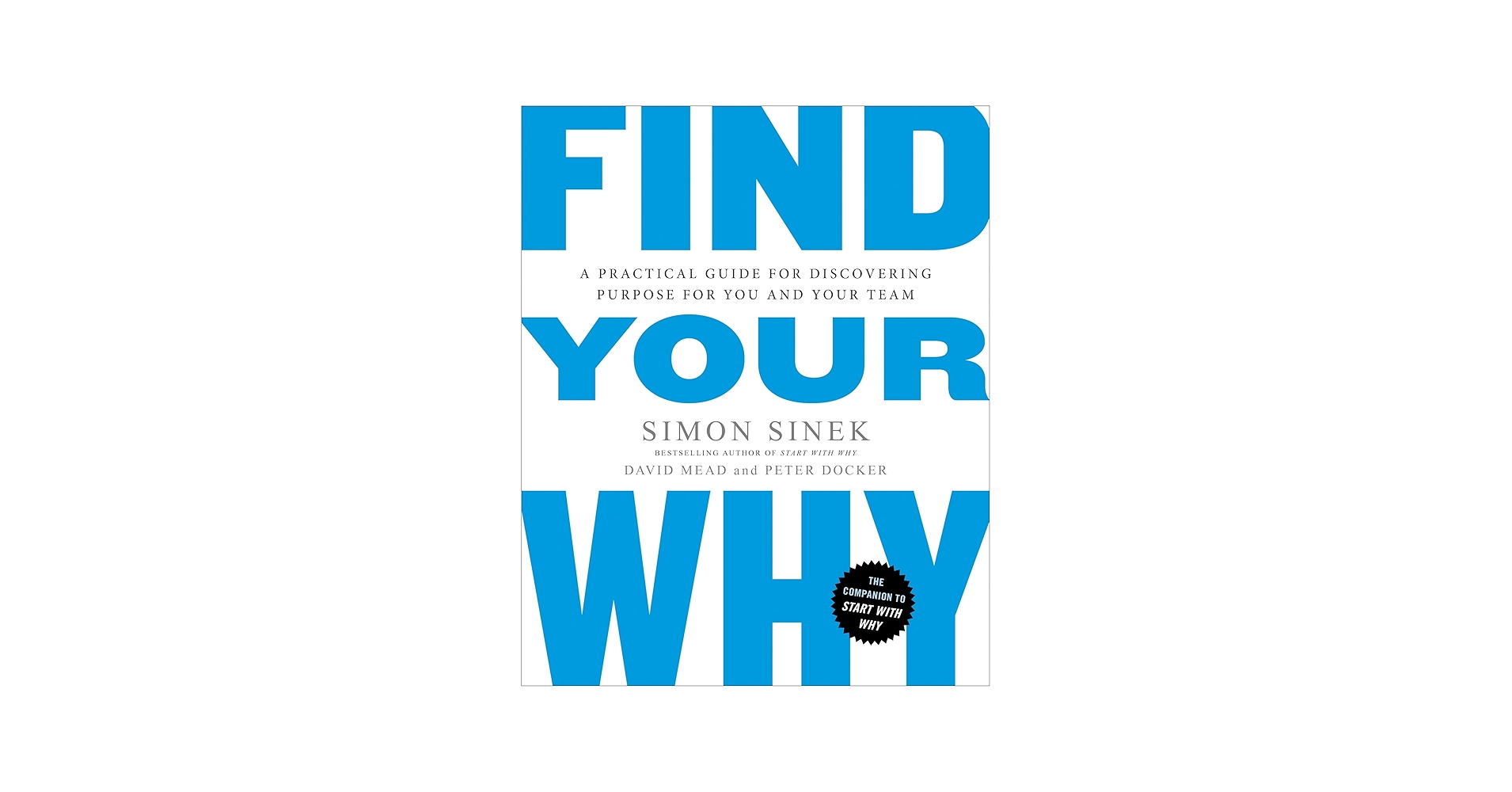
While Start with Why served as a global manifesto for the power of purpose, it left many leaders asking a critical question: “I understand the philosophy, but how do I operationalize it?” Find Your Why is the essential implementation companion, designed to bridge the gap between abstract belief and daily execution. This is not a manifesto; it is a tactical workbook. By shifting the reader’s journey from passive inspiration to disciplined excavation, this framework provides the tools for strategic alignment and organizational clarity.
Quick Snapshot
- Star Rating: 4.5/5 — A high-impact, practical implementation workbook.
- Verdict: If Start With Why introduced the philosophy of purpose, this guide provides the rigorous framework required to articulate and live it.
- Best For: Entrepreneurs, executive leaders, and professionals committed to operationalizing their purpose.
- Difficulty: Conceptually accessible but emotionally demanding to execute effectively.
Understanding the “what” of this snapshot is only the beginning. To truly lead with intent, we must dive into the specific methodology used to translate gut feelings into a strategic compass.
——————————————————————————–
Introduction: From Philosophy to Practice
The most persistent obstacle for leaders is the gap between knowing that “Why” matters and having the language to define it. In this Find Your Why summary, the central takeaway is that purpose is never “invented.” It is discovered. Strategic leaders do not sit in a room and brainstorm what they want their purpose to be; they look backward at their origin stories to identify the “golden thread” that has always been there.
Consider Steve, the Swedish steel salesman. For twenty-three years, Steve sold a commodity. On the surface, his job was transactional. However, through a guided discovery process, Steve realized his work wasn’t about smelting or sales—it was about his personal commitment to using natural resources responsibly for the benefit of humankind. His eyes lit up when he spoke about leaving a safe and healthy planet for his children and future generations.
His “Why” transformed a commodity (pure steel) into a cause (sustainability). Once Steve spoke his vision out loud, it became actionable. This is the heart of the discovery process: identifying patterns in your “peaks and valleys” to uncover a purpose that serves as a decision-making filter for the rest of your life.
Read also: The Strategic Power of Thinking in Decades
——————————————————————————–
The Why Statement Formula: Your Purpose in One Sentence
The final product of the discovery process is a Why Statement—a single sentence that captures your unique contribution and the resulting impact. If a purpose isn’t simple, it won’t be remembered; if it isn’t remembered, it won’t be acted upon.
To [Contribution] so that [Impact].
This formula deconstructs into two strategic pillars:
- Contribution: The “Monday morning” action. This is the consistent, tangible behavior you provide to others.
- Impact: The resulting state or “feeling” you wish to create. This maps directly to the Limbic Brain, the part of our anatomy that lacks language but governs all human decision-making and behavior.
Source Application: Simon Sinek’s personal Why Statement is the gold standard: “To inspire people to do the things that inspire them so that, together, we can change our world.”
- Contribution: To inspire people.
- Impact: Together, we can change our world.
For a leader, this statement is more than a slogan; it is a strategic filter. If a new project or partnership does not allow you to make your contribution or achieve your intended impact, it is a “misfit” and should be rejected.
Read also: The Deep Psychology of Inspiring Leadership and Brand Loyalty
——————————————————————————–
The Individual Why Discovery Process: Panning for Gold
The why discovery process for individuals is a rigorous excavation. You are panning for gold in the river of your past, separating the “debris” of daily tasks from the “nuggets” of true meaning.
Step 1 – Gather Your Stories: The Peaks and Valleys
You must identify at least 10 specific memories from your life, ranging from childhood to yesterday. To find the most potent data, the framework requires selecting the “highest of the highs and the lowest of the lows.” These moments carry the most emotion and offer the clearest clues to your identity.
Step 2 – Work With a Partner: The Biological Necessity
The framework strictly forbids solo discovery. There is a biological reason for this: the Limbic Brain, which houses your Why, has no capacity for language. It is nearly impossible to be objective about your own gut feelings. You need a partner who is innately curious but—crucially—does not know you too well. Spouses and best friends are too close to the data; you need an objective listener who will hear your stories for the first time.
| Role | Strategic Responsibility |
| The Storyteller | Provides raw, specific data; must remain vulnerable and avoid generalities. |
| The Partner | Active listener; identifies recurring themes; asks “What” questions to dig deeper. |
The Todd Story: A man named Todd shared a seemingly minor story about giving all his spare change to a girl at a lemonade stand. While Todd was battling drug addiction and contemplating suicide, this moment “lit his soul on fire.” It was the first time he felt like he mattered. His partner helped him see that his Why was about igniting imaginations so that people could do more with their lives.
Read also: A Visual Guide for First-Time Entrepreneurs
——————————————————————————–
The Team Why Process: Aligning the Tribe
In the context of individual vs team why, every organization is a “Tribe” that requires a common “Nest.” This is the concept of Nested Whys.
The discovery process for teams depends on the leadership structure:
- Founder-led Tribes: The organization’s Why is a direct reflection of the founder’s personal Why and origin story.
- Existing Tribes (Non-Founder): A facilitated workshop extracts the Why by asking members to share stories of “moments they were most proud to be part of this organization.”
A facilitator identifies the common themes in these proudest moments, ensuring the Why is a bottom-up discovery of the team at its natural best, rather than a top-down mandate.
——————————————————————————–
Discovering Your “HOWS”: The Actionable Behaviors
If the Why is the destination, the HOWs are the route. This is where most organizations fail: they use vague nouns as values. Strategic leaders must realize that nouns are not actionable. You cannot “do” a noun; you can only “do” a verb.
Core values and hows must be expressed as actionable behaviors to remain sustainable.
- Weak Value (Noun): Integrity.
- Actionable HOW (Verb): “Always do the right thing even when it is difficult.”
When HOWs are expressed as behaviors, they provide clear standards for hiring, firing, and daily interaction.
Read also: Why Time Is the Most Underrated Competitive Advantage
——————————————————————————–
Critical Analysis: The Discipline of Alignment
The Why Statement is merely a piece of a jigsaw puzzle. Its value lies entirely in the discipline of alignment. To discover your purpose is useless if it does not become the primary filter for your real-world decisions.
Strategic Insights:
- Hiring for Fit: Skills can be taught; Why is intrinsic. Consider Emily, a student who started her interview by stating, “I strive to help people be the best version of themselves.” She spoke from her Limbic Brain, and the connection was so instantaneous that the HR director called her with a job offer before she even got home.
- The Culture Filter: A group of TV executives used their Why to reject a “perfect” candidate because they realized he didn’t believe what the tribe believed.
- Fulfillment vs. Happiness: Happiness is a WHAT-based, temporary result (hitting a goal). Fulfillment is a WHY-based, lasting state. Fulfillment is the sense that your work contributes to something larger than yourself.
——————————————————————————–
Pros & Cons: An Honest Appraisal
| Pros | Cons |
| Repeatable Framework: Provides a systematic, biological approach to purpose. | High Partner Dependency: Success relies on the quality and objectivity of the partner. |
| Strategic Utility: Offers a practical tool for hiring, culture-building, and marketing. | Emotionally Taxing: Requires revisiting “valleys” and high levels of vulnerability. |
| Actionable Outcomes: Moves purpose from “vague feeling” to a linguistic filter. | Time Intensive: The process requires at least 3+ uninterrupted hours. |
——————————————————————————–
Conclusion: The Compass of Origin
Your Why is not a goal; it is a compass. It is your origin story, codified into a tool that allows you to act “with purpose, on purpose.” Finding your Why is the start of an inspiring journey toward the realization that fulfillment is a right, not a privilege. Every one of us is entitled to wake up inspired, feel safe at work, and return home fulfilled by the contribution we’ve made.
Read also: The Hidden Geometry of Long-Term Success
——————————————————————————–
Call to Action: Start Your Discovery Today
Don’t wait for inspiration to strike—excavate it. Follow these how to find your why steps to begin:
- Appoint a Curious Partner: Select an objective listener who doesn’t know your history (avoid spouses or best friends).
- Map Your Peaks and Valleys: Identify 10 specific memories. Focus on the highest highs and lowest lows.
- Execute the 3-Hour Workshop: Block out uninterrupted time in a quiet space. No phones.
- Draft Your Statement: Fill the formula: To [Contribution] so that [Impact].
Resources:
- [Try for FREE Find Your Why]
- Strategic Recommendation: Use a premium journal or a digital whiteboard to map your story timeline before meeting your partner.
The goal is not to cross a finish line; it is to see how many people you can inspire to run with you.