


The uncomfortable truth about a single income: A single source of income, no matter how stable it feels, is a single point of failure. I understood this intellectually for years before I did anything about it. Building additional income streams wasn’t about greed or financial independence fantasies — it was about removing the vulnerability of having everything dependent on one decision made by one employer. This is how I actually did it, and what I wish I had known at the start.
Why I started — and why most people don’t
The motivation was specific: I was laid off. Not dramatically or traumatically — the company restructured, my role was eliminated, and I was given a generous severance package and genuine support from people I respected. But the experience clarified something I had known abstractly for years: my entire financial life depended on one organization’s continued decision that my role was valuable. When they changed their mind, everything was at risk simultaneously.
The severance gave me time. I used some of it to find the next primary role, and the rest to think seriously about how I was going to avoid ever being fully exposed in that way again.
Most people don’t build additional income streams for the same reasons I had delayed: it feels like extra work when you’re already busy, the returns seem speculative compared to the certainty of a salary, and there’s a psychological barrier around the identity of “person who has a job” versus “person who generates income in multiple ways.” That identity shift is real and takes time to complete. It happened for me in the months after the layoff — when being “a person who has a job” was temporarily not available as an identity to hide behind.
Read also: The Simplest Tool I Use to Make Every Tough Decision
The framework I use to think about income diversification
Before describing specific income streams, the mental framework matters more than any specific vehicle. I think about income sources along two dimensions: time investment (how much ongoing effort does this require?) and leverage (does the income scale with effort, or can it grow without proportional effort?).
A consulting engagement is high time investment, low leverage — you earn in direct proportion to hours worked. A digital product is high initial time investment, potentially high leverage — you invest time once and can earn from it repeatedly. Index fund investing is low ongoing time investment, moderate leverage — capital works without your labor once deployed.
The goal is not to maximize any single dimension. It is to build a portfolio of income streams that together provide: immediate income (even if modest), income that grows as skills compound, and income that operates with minimal ongoing effort over time. Those three types work differently and come from different places. Building all three takes years, not months.
The income streams I built — what they are and how long they took
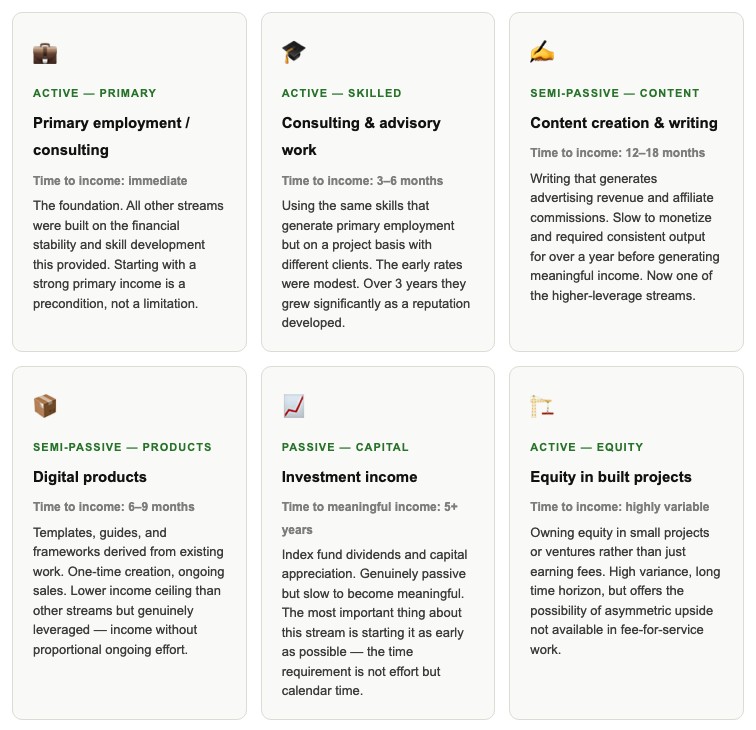
My actual timeline — built in this order, for these reasons
- Y1 Year 1: Stabilize primary income + start investing Secured primary employment and immediately set up automatic investment into index funds. Small amounts, but the habit and the account structure was established. No additional income streams attempted yet — focus was on primary skill development.
- Y2 Year 2: First consulting clients Took on a small number of consulting engagements on the side — directly related to primary skills, which minimized the learning curve. Income was modest. The primary value was learning how to position, price, and deliver work independently.
- Y3 Year 3: First digital products + early content Productized some of the frameworks I had developed through consulting. Created templates and guides. Started writing publicly. Neither generated significant income immediately — but both required skills that were developing toward future income.
- Y4 Year 4: Content monetization begins Writing that had been accumulating for 18 months began generating advertising and affiliate income. Not dramatic — but consistent and growing. The compound effect of content was becoming visible.
- Y5+ Year 5+: Portfolio approach — optimize and add selectively By year five, five distinct income streams were operating. The work shifted from building new streams to optimizing existing ones. New opportunities were evaluated against the portfolio rather than in isolation.
Read also: The Reason You’re Probably Wrong About Something Important Right Now
The principles that guided every decision
🏗️ Build on existing skills — don’t start from zero Every income stream I built was an extension of something I could already do. I didn’t learn an entirely new skill set to generate secondary income — I found new applications and delivery formats for existing capabilities. Starting from zero on a second income stream is a years-long delay most people can’t sustain.
🐢 One stream at a time — fully before starting the next Attempting to build multiple income streams simultaneously produces multiple half-built streams, none of which generate meaningful income. I built each one to a functioning, self-sustaining state before adding the next. This felt slow. It was the right pace.
📊 Primary income first — always Additional income streams are built on the financial foundation of primary income. Every decision that risked primary income to accelerate secondary streams was a mistake. The primary stream funds the time and experimentation that secondary streams require.
⏳ Measure in years, not months No income stream I built produced meaningful income within its first year. Those that did eventually generate significant income required 18–36 months of consistent effort before the returns justified the investment. Anyone promising faster timelines is probably selling something.
The mistakes I made — they were significant
Starting too many things simultaneously. In year two, I attempted to launch consulting, start a podcast, write regularly, and build a digital product at the same time. I made inadequate progress on all four and generated income from none. It took several months to recognize the problem and return to sequential focus.
Underpricing consulting work. The first consulting engagements were priced at roughly 60% of what they should have been — partly from uncertainty about value, partly from the psychological awkwardness of naming a high number for work I was doing “on the side.” This underpricing also positioned me incorrectly with clients who associated price with quality.
Measuring too early. I evaluated new income streams against return-on-investment standards appropriate for mature streams — and concluded they were failing — long before they had had the time to develop. This led to abandoning several initiatives that, had I continued, might have become significant.
Read also: How I Use a Decision Journal to Make Better Choices
A realistic picture: what “passive income” actually requires
⚠️ What the “passive income” content usually omits
The word “passive” in passive income describes the income’s character at maturity — not the effort required to create it. Every genuinely passive income stream I have built required significant active effort during the creation phase: months of writing before content generates advertising revenue, months of product development before a digital product generates sales, years of investing before capital generates meaningful returns.
The passive income content ecosystem disproportionately shows the mature, income-generating phase — not the long, often unprofitable creation phase that precedes it. Having a realistic expectation of that creation phase is the difference between people who build sustainable income streams and people who start and abandon multiple projects without reaching the payoff phase.
The honest picture: building a meaningful diversified income portfolio takes five to seven years of consistent effort, starting from a strong primary income, building one stream at a time, and maintaining patience through long periods where the secondary streams generate more learning than income. The financial outcome at the end of that period is worth the patience. The path is longer than most people are told to expect.
Conclusion: income diversification is risk management, not greed
The frame that made this project feel most coherent to me was not financial independence or early retirement — it was risk management. A single income is a concentrated position. Adding income streams is diversification: reducing the impact of any single source’s disruption on the overall financial picture.
Looked at through that frame, income diversification is not ambitious or unusual. It is the same logic that motivates portfolio diversification in investing — and just as obviously correct once that frame is applied.
Where to start — concretely
Identify the skill you use most in your primary work that has value outside your employer. That skill is the foundation of the first additional income stream worth building. The initial question is not “what income stream should I build?” — it is “what can I already do that others will pay for, outside my current employment arrangement?”
Start there. Build it to functioning before starting the next one. Measure the timeline in years, not months. That is the actual path.

