One question becomes three: When I face a decision I can’t think clearly about, I ask how I’ll feel about it in 10 minutes, 10 months, and 10 years. That’s the entire 10-10-10 framework. It sounds too simple to be useful. Three years of applying it have convinced me it’s one of the most underrated decision tools available.
Where I found this framework — and why I was skeptical
I first encountered the 10-10-10 framework in Suzy Welch’s book of the same name, published in 2009. I picked it up expecting a self-help book dressed in business language. The framework itself — three questions about three time horizons — seemed almost insultingly simple for a full-length book.
I tried it anyway on a decision I was stuck on at the time: whether to turn down a well-paying contract to pursue a project that paid almost nothing but interested me enormously. I had been going in circles for two weeks. I ran the 10-10-10 in about fifteen minutes.
In 10 minutes, I would feel relieved to take the contract. Safe.
In 10 months, I would feel frustrated — I would have traded the interesting project for financial security I didn’t actually need, and I would have spent most of those months knowing I had made the comfortable choice rather than the right one.
In 10 years, the contract would be a footnote. The project — if I did it and it worked — would likely be something I still thought about and built on.
The decision that had felt genuinely difficult for two weeks clarified in fifteen minutes. Not because the framework was magic, but because it changed the angle of the question — from “what should I do?” to “how will each option feel from different points in time?” Those are meaningfully different questions, and they produce meaningfully different answers.
What the 10-10-10 framework actually is
The 10-10-10 framework is a structured decision-making tool that asks you to evaluate any significant choice from three distinct temporal perspectives:
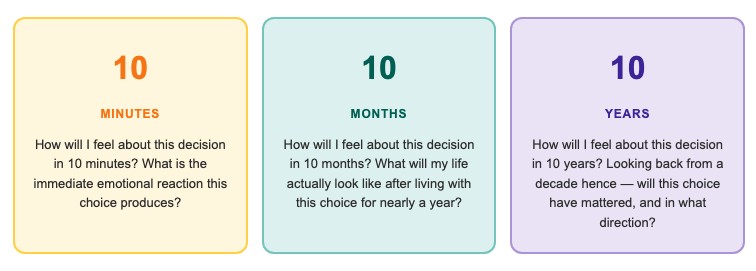
The framework does not tell you which time horizon should dominate. That depends on the nature of the decision and what matters to you. But it forces all three perspectives to be present simultaneously — which is not the natural default. Under pressure or emotion, most decisions are made from the 10-minute perspective. The 10-10-10 framework makes the other two perspectives visible and comparable.
Why it works: the temporal perspective shift
The framework’s power comes from a well-established psychological phenomenon: our emotional response to a situation is heavily influenced by temporal distance. When a decision is immediate, the emotions surrounding it are vivid and intense — fear, excitement, anxiety, desire. When we mentally project ourselves into the future, those emotions tend to recede, and we evaluate the decision more clearly and more in line with our actual values.
Psychologists call this temporal self-appraisal — the tendency to judge our future selves and future situations more rationally than our present ones. The 10-10-10 framework deliberately activates this more rational future perspective while the present emotional reality is also visible.
“10-10-10 works because it takes away time’s power to distort. By forcing you to look at three different moments simultaneously, it wrests you from the grip of the present.”— Suzy Welch, 10-10-10
The 10-minute question acknowledges the emotion. The 10-month question introduces the medium-term consequences. The 10-year question activates the perspective of your future self — the self whose values and priorities have had time to become clearer, and who will have to live with whatever you decide today.
A worked example — a real decision I ran through it
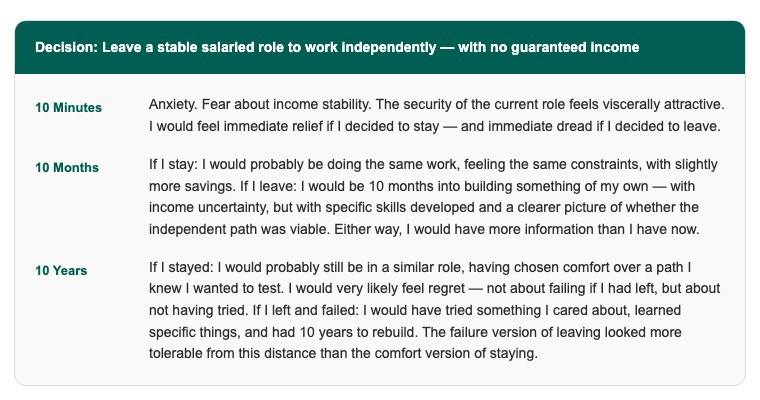
The 10-year view made the decision clear — not because it was easy, but because it revealed which regret I could live with. Failing at something I tried felt more acceptable at a 10-year distance than never having tried something I cared about. The 10-minute view had been dominating my thinking. The framework made it one of three data points rather than the only one.
What it’s best for — and where it falls short
Where 10-10-10 works best
The framework is most powerful for decisions where immediate emotion and long-term values are in conflict — where the comfortable short-term choice and the right long-term choice diverge. Career transitions, relationship decisions, financial commitments with long horizons, and any choice where fear or excitement is distorting the present-moment evaluation.
It is also valuable for decisions involving regret — choices where the likely outcome of deciding one way is tolerable regret, and the likely outcome of deciding the other way is intolerable regret. The 10-year view surfaces that distinction very clearly.
Where it falls short
The framework is less useful for decisions that are primarily analytical rather than emotional — choices that require detailed financial modeling, technical assessment, or expert knowledge rather than a temporal perspective shift. It also struggles with decisions that have genuinely unpredictable 10-year implications, where any 10-year projection is more imagination than analysis.
It is a tool for clarifying values and emotional perspective, not for doing financial or strategic analysis. The two can complement each other — but they should not be confused.
How to use it: step by step
- State the decision clearly in one sentence Write down exactly what you’re deciding. Vague decisions produce vague 10-10-10 answers. Be specific about the choice you are actually facing, not a softer version of it.
- Answer the 10-minute question honestly How do you feel right now, in the immediate emotional reality of this decision? What is the most prominent feeling — fear, excitement, relief, dread? Don’t edit. The 10-minute answer is the emotional reality you’re making decisions from by default.
- Project yourself 10 months forward — specifically Imagine it is 10 months from now. What is your actual daily life like under each option? Not a vague “things will be fine” — a specific picture of what your work, relationships, finances, and sense of self look like 10 months into living with this choice.
- Project yourself 10 years forward — and include failure The 10-year view is most clarifying when you include both the success scenario and the failure scenario. “If I try this and it works, how do I feel in 10 years? If I try this and it fails, how do I feel in 10 years?” Both answers matter — and often, the failure scenario at 10 years is much less catastrophic than the fear of it at 10 minutes.
- Notice where the three views diverge and why If all three views point the same direction, the decision is probably clear. If they diverge — especially if the 10-minute view conflicts with the 10-year view — that divergence is the information. It tells you that short-term emotion and long-term values are in conflict, which is precisely when the framework is most useful.
Variations I’ve found useful
The original framework uses 10 minutes, 10 months, and 10 years. I have found it useful to adjust the intervals based on the decision’s natural time horizon.
For career decisions with longer feedback loops, I sometimes use 10 minutes, 10 months, and 20 years. For shorter-term decisions — whether to have a difficult conversation, whether to take a weekend trip, whether to say yes to a commitment — I use 10 minutes, 10 weeks, and 10 months.
The specific intervals are less important than the underlying principle: evaluate from the immediate, medium-term, and long-term perspectives simultaneously. The numbers are a trigger for the three perspectives, not a precise requirement.
When to use this framework
Any time you notice that you’ve been going in circles on a decision — thinking about it repeatedly without reaching clarity — try the 10-10-10. The circularity is usually a sign that the 10-minute emotional reality is dominating and preventing the longer-term perspectives from being fully present.
The framework does not remove the emotion. It gives the emotion its proper weight — one data point among three — rather than allowing it to function as the only data point.