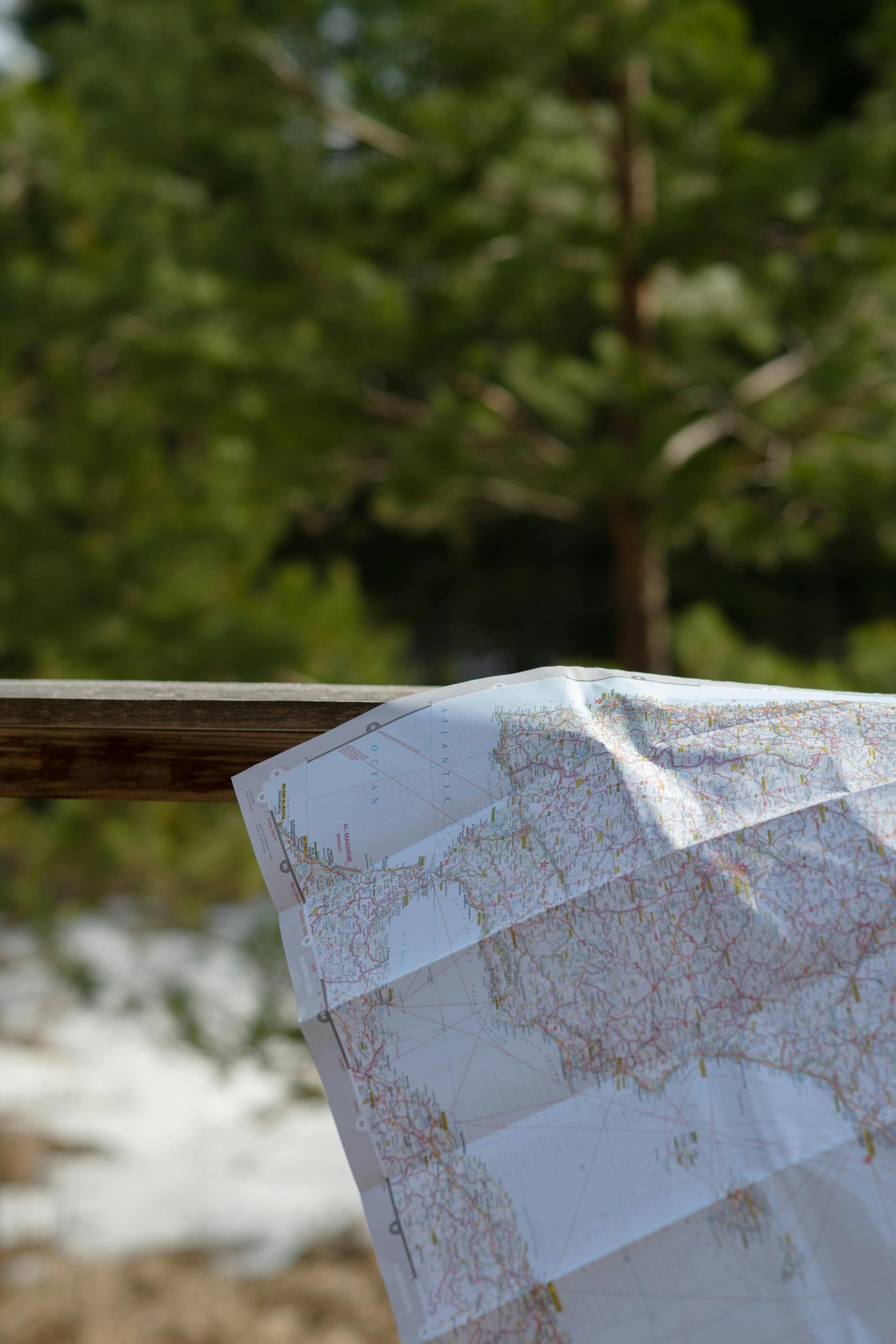
The insight in five words: “The map is not the territory” means that our representations of reality — our beliefs, models, theories, and frameworks — are not reality itself. They are simplifications. They are useful, often essential, but always incomplete. Understanding this distinction is one of the most consequential shifts in thinking I have ever made — because it changes how you hold every belief you have.
The origin of the phrase — and why it matters
The phrase “the map is not the territory” comes from Alfred Korzybski, a Polish-American philosopher and engineer who published it in his 1933 work Science and Sanity. Korzybski was concerned with the ways that language and abstraction — the primary tools of human thought — inevitably distort the reality they attempt to describe.
His argument was that human beings are uniquely vulnerable to confusing their representations of reality with reality itself. Animals respond to the territory directly. Humans respond to maps — mental models, language, symbols, theories, and frameworks — and then mistake those maps for the territory they describe.
“A map is not the territory it represents, but if correct, it has a similar structure to the territory, which accounts for its usefulness.”— Alfred Korzybski, Science and Sanity, 1933
The insight was picked up by mathematicians, philosophers, and cognitive scientists, and has since become one of the most important concepts in systems thinking, epistemology, and the study of how beliefs form and persist. Charlie Munger included it in his mental models framework. It appears in NLP, organizational learning, and virtually every serious discussion of how human beings model and mismodel the world around them.
The reason it has persisted across so many domains is that it captures something genuinely important: the mechanism by which smart, careful people reason from accurate premises and arrive at wrong conclusions — because the map they’re using is outdated, incomplete, or simply wrong in a region they didn’t check.
Read also: How I Built Multiple Income Streams — Without Quitting My Day Job
What maps and territories actually are
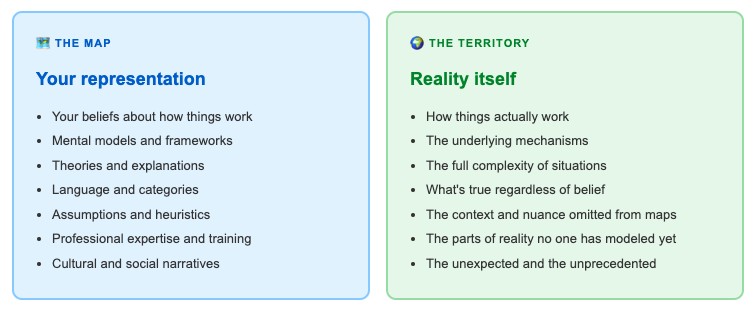
The critical point is that maps are not bad or wrong in any absolute sense. They are necessary. Without maps — without simplifications, models, and frameworks — human cognition would be overwhelmed by the complexity of reality. Maps are what make knowledge portable, teachable, and useful.
The problem is not that we have maps. It is that we forget they are maps. We begin to treat them as if they were the territory — as if our model of how something works is the same as how it actually works. At that point, the map stops being useful and starts being a source of error.
The maps we use every day — and their limits
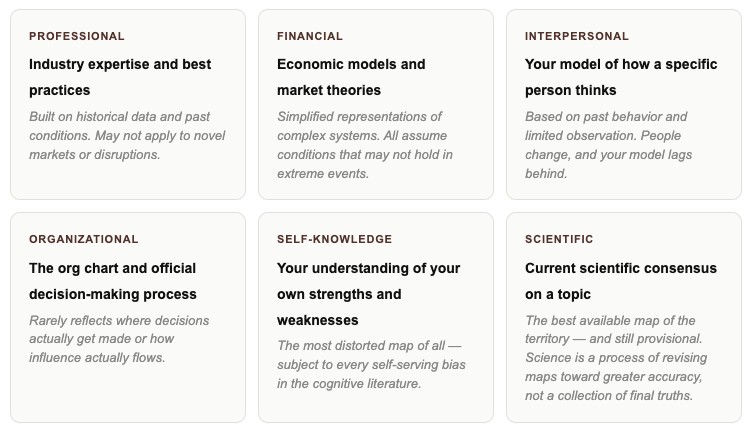
How maps fail — the four ways models break down
- The map is outdatedMaps are created at a point in time. The territory changes. A business model that worked five years ago, a management approach that worked at a smaller scale, a relationship dynamic that developed under different circumstances — all of these can become wrong not because they were ever false, but because the territory shifted while the map stayed fixed.
- The map is applied outside its domainEvery map was built for a specific territory. Applying it to an adjacent but different territory produces errors. Economic models built for stable periods fail during crises. Leadership frameworks built for one culture fail in another. The map is right — but for a different place.
- The map has blank spaces treated as empty spacesOld maps famously wrote “here be dragons” in unexplored regions. More dangerous is treating the unknown regions as if they were simply absent — as if the map’s limits were the territory’s limits. The model’s failure to describe something doesn’t mean that something doesn’t exist.
- The map is mistaken for the territoryThe most dangerous failure: when a representation is treated as reality rather than as a representation. The word “recession” is not a recession — it is a label for a pattern. The strategy document is not the business — it is a model of it. Reacting to the map as if it were the territory produces decisions that would make sense in the map world and fail in the real one.
Read also: How the First Number You See Controls Every Decision That Follows
How this model changed a significant decision of mine
Several years ago I was evaluating a business partnership. I had a clear mental model of my potential partner: capable, aligned on values, trustworthy based on our previous interactions. I had accumulated considerable evidence for this model over two years of occasional collaboration.
The map was good. The problem was I was treating it as complete. I had not tested it in conditions of genuine stress — of financial pressure, of conflicting incentives, of decisions where our interests weren’t aligned. My map of my partner had been built entirely from low-stakes, high-alignment interactions. It had no data from the conditions that actually mattered for a formal partnership.
When I finally examined the map carefully — when I asked “what is this model built on, and what conditions hasn’t it been tested in?” — the gaps became obvious. I spent several months deliberately creating low-stakes situations that more closely resembled the high-stakes partnership conditions. What I learned in those months was significantly different from what my existing map had suggested.
The partnership did not proceed. The decision was made based on the updated map — not the one I had when I started the evaluation. The outcome, in retrospect, was clearly right. The process of questioning the map was what made it possible.
How to hold maps more lightly — in practice
- Label your beliefs as models, not factsInternally and in conversation, practice saying “my model of this is…” rather than “this is…” The linguistic shift is small. The cognitive shift it represents is significant. A model can be updated. A fact resists update. Labeling beliefs as models keeps them permeable to new information.
- Ask: what is this map based on, and when was it last updated?For any belief or model you’re about to act on, ask where it came from and how current it is. Is this model built on direct observation or on inherited assumption? Was it formed under conditions that still apply? When did you last check it against the actual territory?
- Actively look for where your map and the territory divergeSeek out the evidence that doesn’t fit your model — the counterexamples, the edge cases, the people who think differently. The places where your map and the territory diverge are where the most important learning lives. The places where they agree confirm what you already know.
- Before high-stakes decisions: test the map under realistic conditionsHigh-stakes decisions based on untested maps are the most dangerous combination. Where possible, find ways to test the key assumptions of your model in lower-stakes conditions before committing to the full decision. The test is not just about the outcome — it is about revealing where the map and territory diverge.
The most important skill: updating your maps
If holding maps lightly is the cognitive disposition, updating them is the practical skill. And updating maps is harder than it sounds — because existing maps shape how new information is interpreted. Information that fits the map is incorporated naturally. Information that contradicts the map is often explained away, reinterpreted, or discounted without conscious awareness.
The Bayesian approach to belief updating — treating beliefs as probabilities that shift in response to evidence — is the technically correct answer. But the more practically accessible version is simpler: when you encounter evidence that your map is wrong in a specific place, update that part of the map explicitly. Write it down. State the old model and the new model. Note what evidence prompted the change.
This practice — explicit, documented map updates — does two things. It makes the update more deliberate and more durable than the unconscious kind. And it creates a record of how your models have evolved over time, which is itself valuable information about how your thinking works and where it most often goes wrong.
Read also: How to Learn Anything Deeply — and Know Exactly When You Don’t
Conclusion: all models are wrong — some are useful
The statistician George Box famously wrote: “All models are wrong, but some are useful.” This is the practical resolution of the map/territory distinction. You cannot have a perfect map — any map that matched the territory in every detail would be as complex and unusable as the territory itself. The goal is not a perfect map. It is a map that is useful for the territory you’re navigating, held with appropriate humility about where it might be incomplete or wrong.
The mental model I have found most helpful from this principle: after every significant decision, ask whether the map I used was adequate for the territory I was navigating. Not whether the outcome was good — outcomes are partly luck. But whether the model of reality I operated from was a reasonable representation of the actual situation.
That question, asked consistently, is one of the most powerful learning practices I know. It keeps the maps provisional. It keeps the learning continuous. And it prevents the most dangerous error of all: treating a map — however good — as if it were the territory.
The question to ask about any strongly held belief
“What is this belief based on? Under what conditions was this map built? And when did I last check it against the actual territory?”
These three questions don’t require you to abandon your beliefs. They require you to hold them as maps — as useful simplifications that could be improved — rather than as territory. That difference, applied consistently, changes the quality of every decision that follows from them.