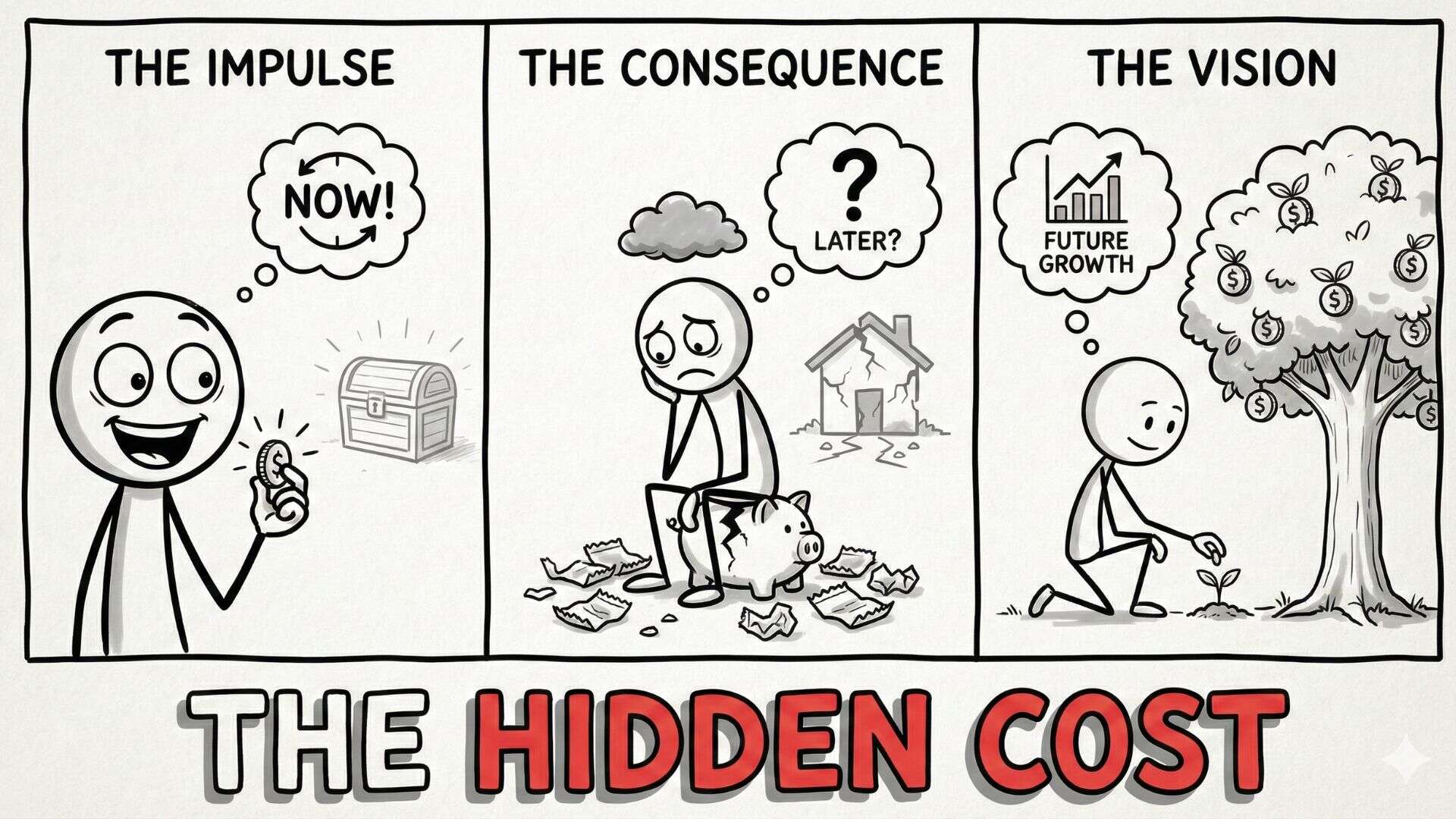
The bias that warps your risk perception daily: After a plane crash, people drive instead of fly — even though driving is statistically far more dangerous. After seeing a news story about a local crime, people feel less safe — even if crime rates are declining. The availability heuristic is the reason. We judge probability by how easily examples come to mind. And what comes to mind easily is not what is actually most common — it is what is most vivid, recent, and emotionally charged.
The night I made a terrible financial decision based on a news story
In 2020, during one of the most turbulent weeks in financial markets I had experienced, I watched a two-hour documentary about the 2008 financial crisis. It was vivid, dramatic, and deeply unsettling — full of first-person accounts of financial ruin, abandoned housing developments, and investment banks collapsing overnight.
The next morning, I made changes to my investment portfolio that I had not been considering the day before. I moved a significant portion of assets into cash. I sold positions I had held for years with unchanged fundamentals. I made decisions, in short, that were driven not by any new analysis of current conditions but by the vividness of what I had watched the night before.
The documentary had filled my working memory with vivid images and emotionally charged accounts of financial catastrophe. Those images were highly available. And my brain — operating on the availability heuristic — interpreted that availability as probability signal. Because I could so easily recall the feeling of financial collapse, financial collapse felt imminent.
It wasn’t. The specific conditions of 2008 were not present in 2020 in the ways the pattern-matching felt like they were. The moves I made cost me significant returns over the following eighteen months. The cause was not new information — it was the availability heuristic running at full power after two hours of unusually vivid input.
What the availability heuristic actually is
The availability heuristic was identified and named by Kahneman and Tversky in their foundational 1973 paper, “Availability: A Heuristic for Judging Frequency and Probability.” Their core finding: people estimate the frequency or probability of an event by how easily examples of it come to mind — by its cognitive availability.
“People assess the frequency of a class or the probability of an event by the ease with which instances or occurrences can be brought to mind.”— Kahneman & Tversky, 1973
In many situations, this works well as a shortcut. If you can easily recall examples of something, it is often because it is genuinely common. But the heuristic fails — sometimes dramatically — when the ease of recall is driven not by actual frequency but by factors that have nothing to do with how often something occurs: vividness, emotional intensity, recency, media coverage, personal experience, and narrative salience.
Why our brains use it — and why it usually works
The availability heuristic is not a bug in human cognition. It is a reasonable shortcut in an environment where the most common events are also the ones most frequently encountered and most easily recalled from memory. If you can think of many examples of X, you probably live in an environment where X is genuinely common. For most of human evolutionary history, in local, stable communities with limited information flow, this correlation between memory availability and actual frequency was reliable enough to be useful.
The problem is that we now live in a fundamentally different information environment. News media, social media, and global communication networks systematically expose us to the most unusual, dramatic, and emotionally charged events from anywhere on earth. These events become highly available in memory not because they are common but because they are selected precisely for being uncommon, dramatic, and compelling. The heuristic is calibrated for a village; we’re running it in a global news feed.
How it distorts risk perception specifically
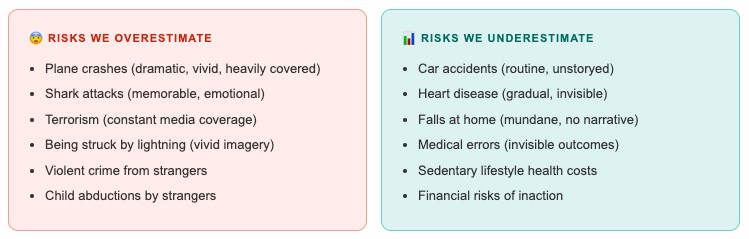
The pattern is consistent: dramatic, newsworthy, visually vivid risks are overestimated. Mundane, chronic, statistically significant but narratively uninteresting risks are underestimated. The availability heuristic is the mechanism — and news media and social media amplify it by specifically selecting for the dramatic and the vivid.
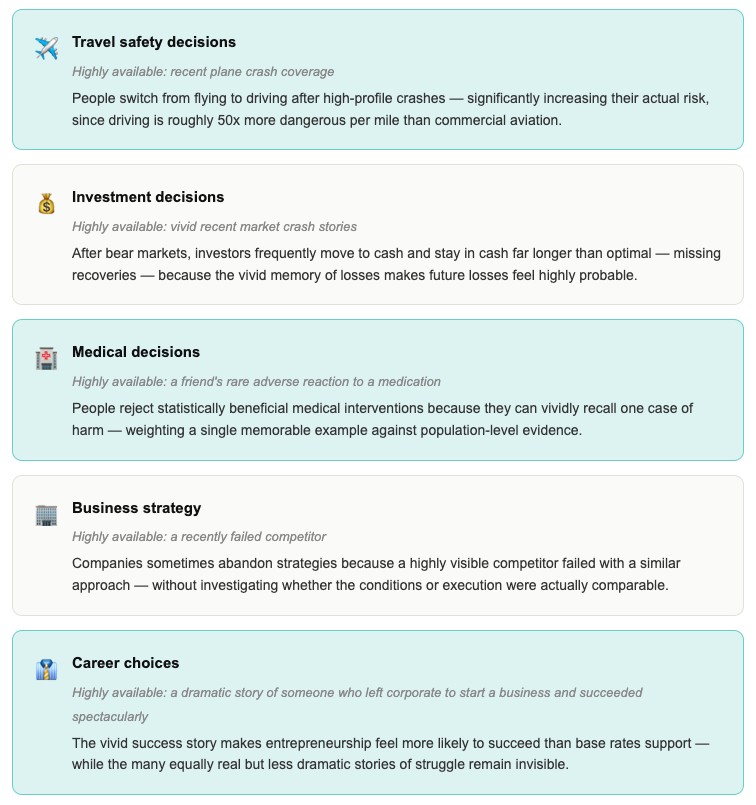
Where it shows up in everyday decisions
Why news media is an availability heuristic machine
News media does not select for frequency — it selects for novelty, drama, and emotional impact. These selection criteria are precisely the factors that make events highly available in memory. A plane crash that kills 200 people receives vastly more coverage than the hundreds of thousands of deaths from preventable chronic disease that occur every year. A single terrorist attack receives more coverage than the millions of routine road accidents that cause comparable cumulative harm.
This is not a conspiracy or deliberate misinformation — it is a structural feature of how information markets work. Dramatic events are more engaging and more widely shared than statistical realities. But the result, for consumers of that media, is a systematically distorted picture of what is actually dangerous, likely, and worth worrying about.
The person who consumes a great deal of news does not necessarily have a more accurate model of reality than someone who consumes less. They may have a model that is more detailed in some areas — and more distorted in others, specifically the areas where dramatic coverage drives availability without being proportional to actual frequency.
How to correct for it — practically
- Ask: am I reasoning from statistics or from vivid examples? When forming a probability judgment, identify whether your estimate is based on actual frequency data or on the examples that come most easily to mind. If it’s the latter, treat it as a starting point requiring verification rather than a conclusion.
- Seek base rates before forming risk estimates For any significant risk decision — investment, health, safety, career — look up the actual statistical frequency before relying on what feels probable. Base rates are almost always more accurate than availability-driven intuition, and they are almost always less dramatic.
- Apply a cooling-off period after vivid emotional content Any decision made immediately after consuming dramatic news, a vivid documentary, or a highly emotional conversation should be deferred until the availability effect has had time to diminish. The feeling of urgency produced by vivid content is not the same as actual urgency — and the decision made in its grip is rarely the decision you’d make with a day’s distance.
- Notice what risks you’re NOT thinking about If a dramatic risk feels very salient, ask what risks you are simultaneously ignoring because they are mundane and statistically quiet. The chronic, invisible risks — sedentary lifestyle, inadequate savings, declining relationships — are often more significant than the vivid ones dominating attention.
- Calibrate your media diet to its actual effect on your decision-making This is not an argument against staying informed. It is an argument for noticing the specific effect that high-volume, high-drama news consumption has on your risk perception and decision quality — and adjusting accordingly. More information is not always more accurate information.
Conclusion: frequency in memory is not frequency in reality
The availability heuristic is one of the most pervasive and consequential cognitive biases in everyday life because it operates on the information environment we’ve all voluntarily constructed around ourselves. Every news source we follow, every social media feed we scroll, every documentary we watch is shaping the availability distribution in our memory — and therefore shaping what feels probable and what feels distant.
The person who watches a lot of dramatic crime coverage does not live in a more dangerous world. They live in a world that feels more dangerous — which produces many of the same behavioral effects as actually living in one.
The question to ask after any vivid or disturbing content
“Is this changing my estimate of how common this is? And if so, is that change based on new statistical information — or just on how vividly this has been presented to me?”
Those two questions do not eliminate the availability heuristic. But they create enough cognitive distance between the vivid input and the probability judgment to allow for a more accurate estimate to form. That gap is where better decisions live.