The most honest test of understanding: Can you explain it to a child? Not summarize it — explain the actual mechanism, from scratch, in plain language a twelve-year-old could follow. The Feynman Technique is built around that test. I’ve used it for four years, and it remains the single most reliable method I know to distinguish genuine understanding from the convincing illusion of it.
Richard Feynman and the origin of the technique
Richard Feynman was a Nobel Prize-winning physicist widely considered one of the most brilliant scientific minds of the twentieth century — known not only for his contributions to quantum electrodynamics but for his extraordinary ability to explain complex ideas without jargon.
Feynman reportedly kept a notebook labeled “Things I Don’t Know” — not a record of ignorance to be embarrassed about, but a working list of concepts he intended to understand properly. His method was consistent: explain the concept from scratch, in the simplest possible language, until he could do so completely and without technical terms. Wherever he stumbled, he went back to the source material.
“If you can’t explain something in simple terms, you don’t understand it. The best way to learn is to teach.”— Richard Feynman
The technique as a named method was popularized later through the mental models community, but its roots are in Feynman’s own documented approach. The core insight is deceptively simple: explanation is a test of understanding, and the test is harder than it looks.
Read also: How I Finally Overcame Procrastination — After Years of Failing To
The illusion of knowing — why most learning is shallower than it feels
The most dangerous state in learning is the one that feels like understanding but isn’t. You’ve read about something, you can follow an explanation, you recognize the terminology. It feels like knowing. But recognition is not understanding. You can recognize a word without being able to define it. You can follow a mathematical proof without being able to reconstruct it. You can read about a psychological concept and feel fluent — until someone asks you to explain it from scratch, at which point you discover that what you have is a collection of terms and general impressions, not a functional model of the mechanism.
This gap — between the feeling of understanding and the reality of it — is exactly what the Feynman Technique exposes. It is not a study technique in the conventional sense. It is a diagnostic tool that measures the distance between what you think you know and what you actually know. And it measures that distance with the one thing that cannot be faked: explanation.
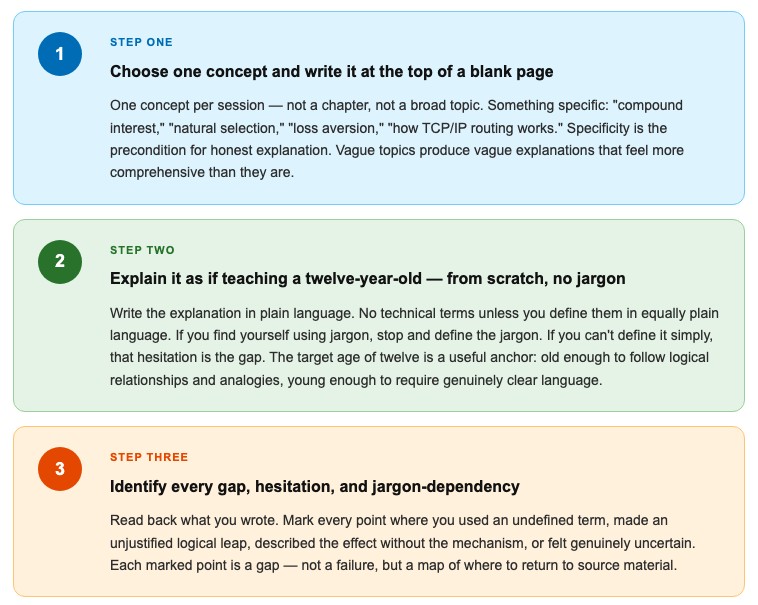
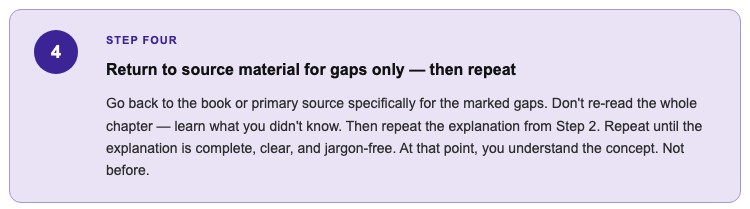
The four steps — in precise detail
Reading your gaps — what the technique actually reveals
The most valuable output of the Feynman Technique is not the final clean explanation. It is the marked-up draft full of hesitations and undefined terms. That document is a precise map of the difference between your felt understanding and your actual understanding — and it is almost always surprising.
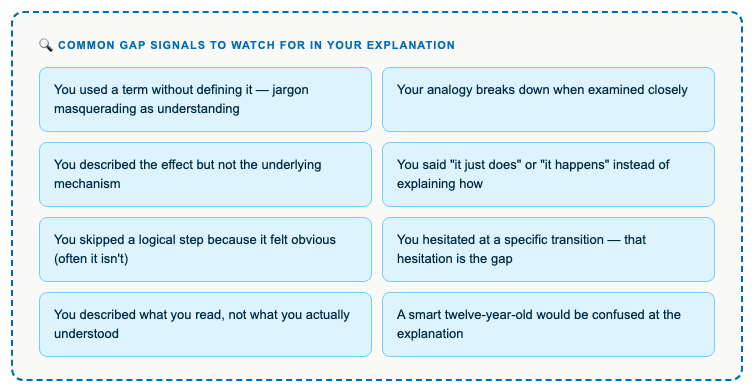
I have run this technique on concepts I was confident I understood thoroughly and found significant gaps every single time. Those gaps are not embarrassing — they are informative. They tell you precisely where your model of the concept is incomplete, which is information you could not get from reading alone.
Read also: Why Incompetence Feels Like Confidence — and What to Do About It
How I apply it across different domains
Feynman vs. other learning methods
Versus re-reading: Re-reading builds familiarity, not understanding. The material becomes easier to process — but that ease is recognition, not comprehension. The Feynman Technique requires active production of understanding, which is categorically different.
Versus highlighting: Highlighting selects important information. The Feynman Technique tests whether you’ve understood it. These are complementary — highlight during reading, Feynman after reading — but highlighting alone produces a well-annotated book, not necessarily a well-understood one.
Versus spaced repetition: Spaced repetition is a retention system — it keeps information accessible over time. The Feynman Technique is a comprehension system — it ensures information was genuinely understood before retention is attempted. Both are valuable, in that order.
The mistakes people make when using this
Using the source material while explaining. The explanation must be from memory. Looking at the book while writing defeats the diagnostic purpose entirely. Close the source before beginning Step 2.
Allowing jargon to stand unexplained. The most common failure mode is writing technical terms without being able to define them in plain language. If a twelve-year-old would ask “what’s that?” — you have to answer it.
Treating the first attempt as complete. The first explanation is always a diagnostic, not a finished product. Its purpose is to generate a document that Step 3 can read critically. If the first attempt feels perfect, you probably haven’t been honest enough about the gaps.
Applying it to too many things at once. The technique is cognitively demanding. One concept per session, done thoroughly, produces genuine understanding. Five simultaneous attempts produce five mediocre diagnostics.
Read also: The Hidden Price Tag on Every Decision You Make
Conclusion: understanding is the ability to explain
Feynman’s deepest contribution to learning may not have been any specific scientific insight — it was the operational definition of understanding he embodied and taught. Understanding is not familiarity, recognition, or the ability to follow an explanation. It is the ability to construct one.
The gap between reading about something and understanding it is enormous — and almost invisible until you attempt the blank-page explanation. At that moment, the gap becomes precisely visible in every hesitation, every undefined term, every mechanism you can only describe from the outside.
Those gaps are the map. The explanation that emerges after you’ve filled them is evidence of a different, deeper relationship with the idea than any amount of re-reading produces.
Start here — right now
Pick one concept you believe you understand well. Open a blank notebook page. Write it at the top. Set a 15-minute timer and write a complete explanation as if for a smart twelve-year-old.
Read what you wrote. Mark every hesitation and every piece of undefined jargon. What remains marked is not what you don’t know — it is specifically what to learn next. That specificity is more valuable than any amount of general re-reading.