

The price you never see: Every decision has two costs. The one you pay, and the one you don’t — the best option you gave up. That invisible cost is opportunity cost. Most people calculate the first and ignore the second. Understanding opportunity cost properly is one of the most practically useful shifts in thinking I have ever made.
The career decision that introduced me to opportunity cost
Several years ago I turned down a job offer to stay in my current role. The decision felt straightforward — I liked my work, I valued my relationships there, and the new offer, while appealing in some ways, didn’t feel compelling enough to uproot everything.
What I didn’t do was calculate the full cost of staying. I calculated the cost of leaving — the disruption, the uncertainty, the relationships I’d be giving up. I didn’t calculate the cost of not leaving — the salary growth I wouldn’t access, the skills I wouldn’t develop, the career trajectory I was implicitly choosing not to pursue.
Two years later, a colleague who had taken a similar offer elsewhere was earning 40% more, working on projects I’d have found genuinely interesting, and had developed a professional network I hadn’t built. The job I had “chosen to keep” had cost me something concrete — I just hadn’t accounted for it at the time.
That experience introduced me, practically and expensively, to opportunity cost. Not as an economics textbook concept but as a real force in real decisions.
What opportunity cost actually means — and what it doesn’t
Opportunity cost is the value of the best alternative you give up when you make a choice. It is not the average of all alternatives, or the sum of all alternatives — it is specifically the best option you could have chosen instead.
“The cost of something is what you give up to get it. Decision-making requires you to account for the value of the next best alternative foregone.”— N. Gregory Mankiw, Principles of Economics
This definition has a crucial implication: opportunity cost is not a feeling of regret or a philosophical question about roads not taken. It is a concrete calculation. Every decision you make has a calculable opportunity cost — it is the value of the specific best alternative you didn’t choose.
What opportunity cost is not: it is not every possible thing you could have done with your time or money. It is not the sum of regrets. It is the single best alternative — the specific next-best option — evaluated as honestly as possible at the time of the decision.
Where opportunity cost hides in everyday decisions
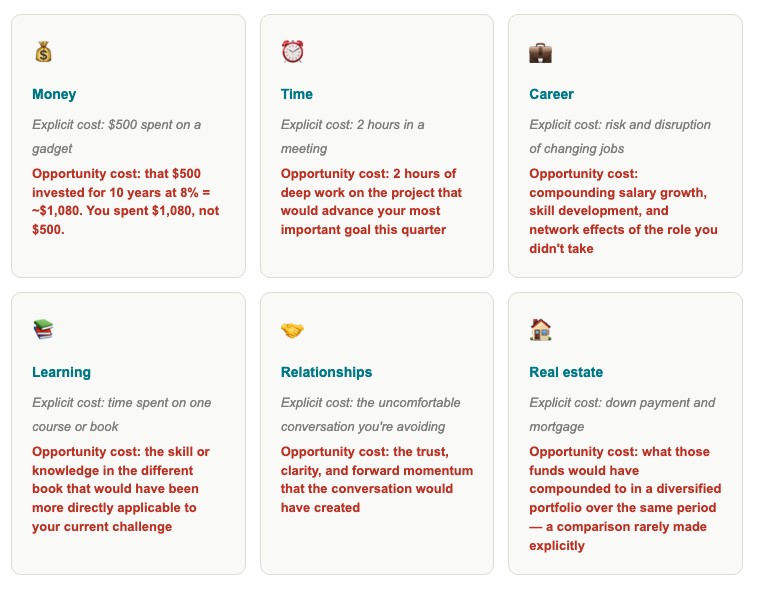
The most underpriced resource: opportunity cost of time
Money is the domain where people most naturally think about opportunity cost — even if imprecisely. Time is the domain where opportunity cost is most systematically underweighted, and where the implications are most significant.
Time is the only resource that is both finite and non-renewable. You cannot earn more of it, borrow it, or make it up later. Every hour committed to one thing is an hour unavailable for everything else. The opportunity cost of time is therefore always the value of the best alternative use of that specific hour — which is often considerably higher than we estimate.
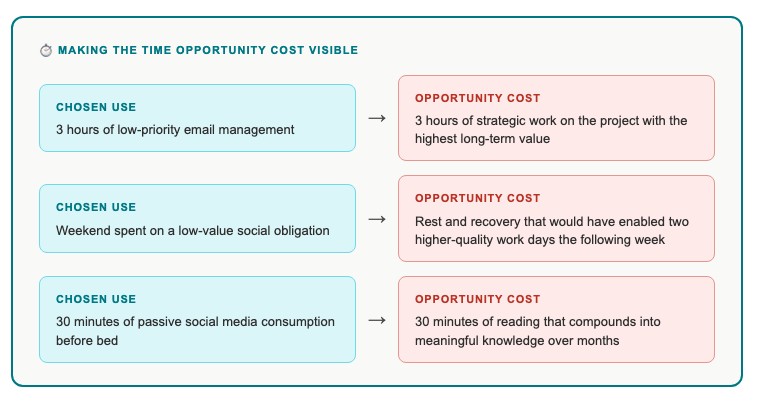
Warren Buffett famously protects his schedule with unusual ferocity — declining almost all speaking requests, meetings, and commitments that aren’t directly connected to his highest-value activities. This is not antisocial behavior; it is an explicit recognition that the opportunity cost of a single hour of distraction from his highest-value work is very high. The same arithmetic applies to anyone whose time has meaningful value — which is everyone.
How opportunity cost changed my approach to investing
The most concrete domain where I now apply opportunity cost thinking is capital allocation. Before this mental model was active in my thinking, I evaluated investments mostly in absolute terms — does this investment make money? After understanding opportunity cost, I evaluate investments in relative terms: is this investment the best use of this capital compared to the next best alternative?
The shift changes which investments look attractive. A savings account paying 2% looks fine in absolute terms — you’re earning something. But if the opportunity cost is an index fund that has historically returned 7-9% annually, you’re not earning 2%. You’re effectively losing 5-7% in opportunity cost terms, every year, compounding.
Similarly, holding cash during a bull market is not “safe.” It has an explicit opportunity cost in foregone returns. The opportunity cost calculation doesn’t tell you whether to hold cash or not — sometimes you should — but it makes the cost of that decision visible, which is the minimum requirement for making it consciously.
A framework for calculating opportunity cost before deciding
- Name the decision explicitly What exactly are you choosing? State the specific choice — not “should I spend money on X” but “should I spend $Y on X over the next Z months.” Vague decisions produce vague opportunity cost calculations.
- Identify the realistic next-best alternative Not every possible alternative — the single most valuable thing you could do with the same resource (time, money, attention, energy) if you didn’t make this choice. Be specific. Vague alternatives like “something better” are not useful.
- Value the next-best alternative honestly What is the alternative actually worth to you? In money, in time saved, in opportunity created, in wellbeing. This valuation is often the hardest step — and the most important — because it forces you to be specific about what you’re giving up rather than leaving it as an uncomfortable abstraction.
- Compare — including the hidden price The true cost of Option A is its explicit price plus its opportunity cost — the value of Option B that you won’t be able to pursue if you choose A. Only when both costs are visible can you make an informed comparison.
- Make the choice — then move on Opportunity cost thinking is for before the decision, not after. Once the choice is made, continuing to calculate opportunity cost becomes regret — which is neither useful nor accurate, since you can’t know how the alternative would have actually unfolded. Calculate before deciding. Commit fully after deciding.
The limits — when not to over-apply this concept
Opportunity cost thinking is powerful but has real limits. Applied obsessively, it produces paralysis — every option looks worse when you’re constantly calculating what you’re giving up. At some point, a decision needs to be made and committed to, and the opportunity cost calculation needs to stop.
It is also most useful for significant, recurring, or long-duration decisions — where the forgone alternative has meaningful value. For small, one-off, or genuinely equivalent choices, spending significant cognitive energy on opportunity cost calculation is itself a cost not worth paying.
The goal is to make the hidden price visible for decisions where it’s large enough to matter — not to apply economic rigor to every hour of every day. That level of optimization is both impossible and miserable.
Conclusion: every yes is a no to everything else
The most important reframe opportunity cost offers is this: saying yes to something is not just an affirmation of what you’re choosing. It is a no to every alternative — including the best one you’re giving up.
That reframe changes how you evaluate both the things you’re agreeing to and the things you’re declining. A commitment that seemed free — a meeting you accepted, a project you took on, money you spent — has a real price in forgone alternatives. Making that price visible doesn’t mean refusing everything. It means choosing more deliberately and with a fuller accounting of what each choice actually costs.
This week’s practice
For any significant decision you face this week — how to spend Saturday afternoon, whether to take on a new project, how to allocate a discretionary budget — identify the single best alternative before deciding. Put a specific value on it. Then compare.
The calculation will feel uncomfortable at first. That discomfort is the sound of a cost you’ve been ignoring becoming visible.