The bias you use every day without noticing: The first number you encounter in any negotiation, purchase, or estimate becomes a reference point that shapes every judgment you make afterward — whether that number is accurate, relevant, or completely arbitrary. Anchoring bias is one of the most powerful, most consistent, and most practically important cognitive biases in existence. Here is how it works, where it shows up, and how to stop letting it run your decisions.
The salary negotiation that taught me about anchoring
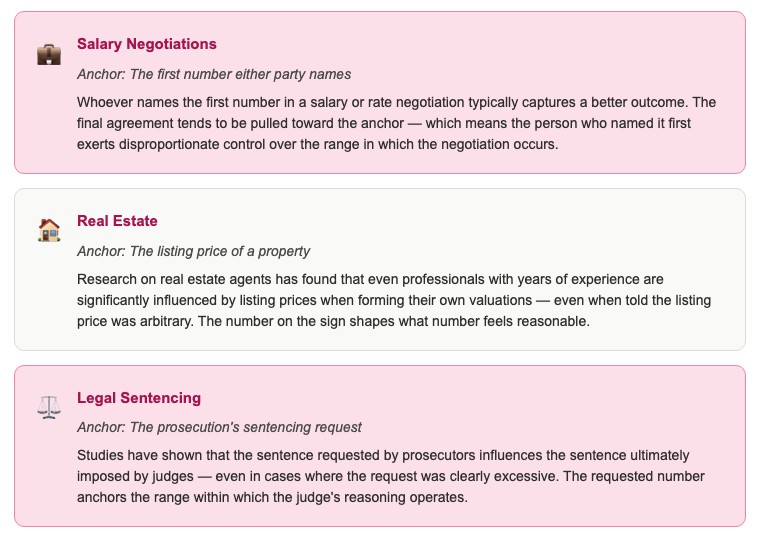
Several years ago I was negotiating a consulting rate with a new client. I had a number in mind that I considered fair and well-reasoned based on market rates and the scope of the work. The client opened the negotiation by naming a number — significantly lower than what I intended to propose.
I knew immediately that their number was below market. I had done the research. I had a clear sense of what the engagement was worth. And yet, when I made my counter-proposal, I found myself naming a number that was lower than the one I had planned — closer to their anchor than to my own carefully considered starting point.
I hadn’t consciously decided to adjust downward. Their number had simply become the reference frame that my own proposal was made in relation to. Instead of proposing my number, I was proposing a “reasonable” deviation from theirs — and that deviation was smaller than my actual position justified.
I settled for significantly less than I had intended to. Not because I was outargued, not because they made a compelling case for the lower number, but because they had set the anchor and I had failed to escape it.
Read also: 7 Lessons From a World-Class Poker Player About Making Decisions Under Uncertainty
What the research actually shows
Anchoring bias was first formally identified by Amos Tversky and Daniel Kahneman in 1974 as part of their landmark paper on heuristics and biases. Their original experiments demonstrated that people’s numerical estimates are strongly influenced by initial values — even when those values are clearly arbitrary.
“People make estimates by starting from an initial value that is adjusted to yield the final answer. Adjustments are typically insufficient. Different starting points yield different estimates, which are biased toward the initial values.”— Kahneman & Tversky, 1974
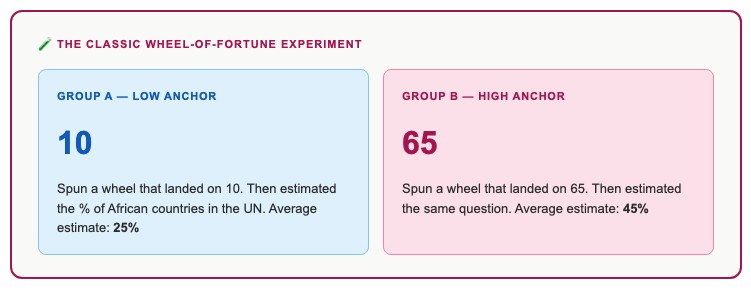
In one classic demonstration, participants were asked to spin a wheel of fortune (rigged to land on either 10 or 65) and then estimate the percentage of African countries in the United Nations. Those who spun 65 gave estimates averaging 45%. Those who spun 10 gave estimates averaging 25%. The wheel number was completely unrelated to the question — yet it produced a 20-percentage-point difference in average estimates.
The finding has been replicated hundreds of times across domains — price estimates, legal judgments, medical diagnoses, real estate valuations, salary negotiations, and charitable donations. Anchoring is one of the most robust effects in behavioral psychology. It works on experts as well as novices. It works even when people are explicitly told the anchor is random. And it works in high-stakes, financially consequential contexts where you would expect careful reasoning to dominate.
How anchoring works in the brain
The mechanism behind anchoring operates through two distinct pathways. The first is adjustment: we take the anchor as a starting point and adjust away from it. The problem is that adjustments are systematically insufficient — we stop adjusting once we reach a value that seems plausible, which is almost always still biased toward the original anchor.
The second mechanism is selective accessibility: the anchor activates related information in memory. A high anchor makes high-range information more cognitively available, which biases the estimation process toward the high end without requiring any conscious deliberation. This happens automatically and below the threshold of awareness, which is part of what makes anchoring so difficult to defend against through conscious intent alone.
Where anchoring shows up in everyday life
How businesses use anchoring deliberately
Once you understand anchoring, you begin to see it deployed intentionally everywhere in commercial environments. It is not accidental — it is a designed feature of pricing, negotiation, and persuasion strategy.
The “premium” pricing tier in subscription services serves partly as an anchor. Its primary function is not to sell the premium tier — it is to make the mid-tier feel reasonable by comparison. The $99/month plan feels more accessible next to the $199/month plan than it would next to the $49/month plan.
Luxury retailers price one conspicuously expensive item prominently in their window displays. The purpose is not to sell that item — it is to recalibrate what price feels normal inside the store. If you’ve just seen a $3,000 bag, $400 feels modest.
Car dealerships begin negotiations from the sticker price and move down, rather than beginning from the minimum acceptable price and building up. The direction of adjustment matters: starting high and conceding downward produces a better outcome for the seller than starting at the target and defending it.
Read also: How I Think About Risk — And Why Most People’s Mental Model Is Quietly Costing Them
How to defend against anchoring — and use it strategically
- Form your own estimate before encountering any anchorBefore entering any negotiation, before asking for a price, before looking at a listing — form your own independent estimate of what the right number is. Write it down. Then encounter the anchor. The pre-formed estimate is much harder to dislodge than one formed in the presence of the anchor.
- Name the anchor explicitly and consider its sourceWhen you notice an anchor — “they opened with $80,000,” “the listing says $1.2M” — name it explicitly and ask: where did this number come from, and why should it constrain my thinking? Often the answer is that it shouldn’t. Making the anchor conscious reduces its automatic influence.
- Generate a counter-anchor deliberatelyResearch shows that generating an extreme counter-anchor — deliberately thinking of a number in the opposite direction — reduces the influence of the original anchor. The counter-anchor doesn’t become the new starting point; it expands the psychological range and produces a more accurate estimate.
- In negotiations: set the anchor first when you have a strong positionThe anchoring research is clear: the first number in a negotiation shapes the outcome. If your research supports a strong position, name your number first and set the anchor. If you’re less confident in your position, be cautious — a weak anchor you set first can be as constraining as one set by the other party.
- Use precise anchors rather than round numbersResearch by Malia Mason at Columbia found that precise anchors (e.g., $47,800 rather than $48,000) are more effective because they imply that the number was carefully calculated rather than chosen arbitrarily. The precision signals that there is a specific reason for the number — which makes it harder to dismiss.
The rule I follow in every negotiation
Before any negotiation of significance, I write down my target number, my walk-away number, and my opening number — all independently derived from research, not from any number the other party has shared. These become my reference points. The other party’s opening number gets logged but does not replace my pre-formed anchors.
This does not eliminate anchoring’s influence — the research suggests nothing fully does. But it substantially reduces the gap between where I end up and where I intended to be.