Introduction: Framing the Long-Term Consequences of Impatience
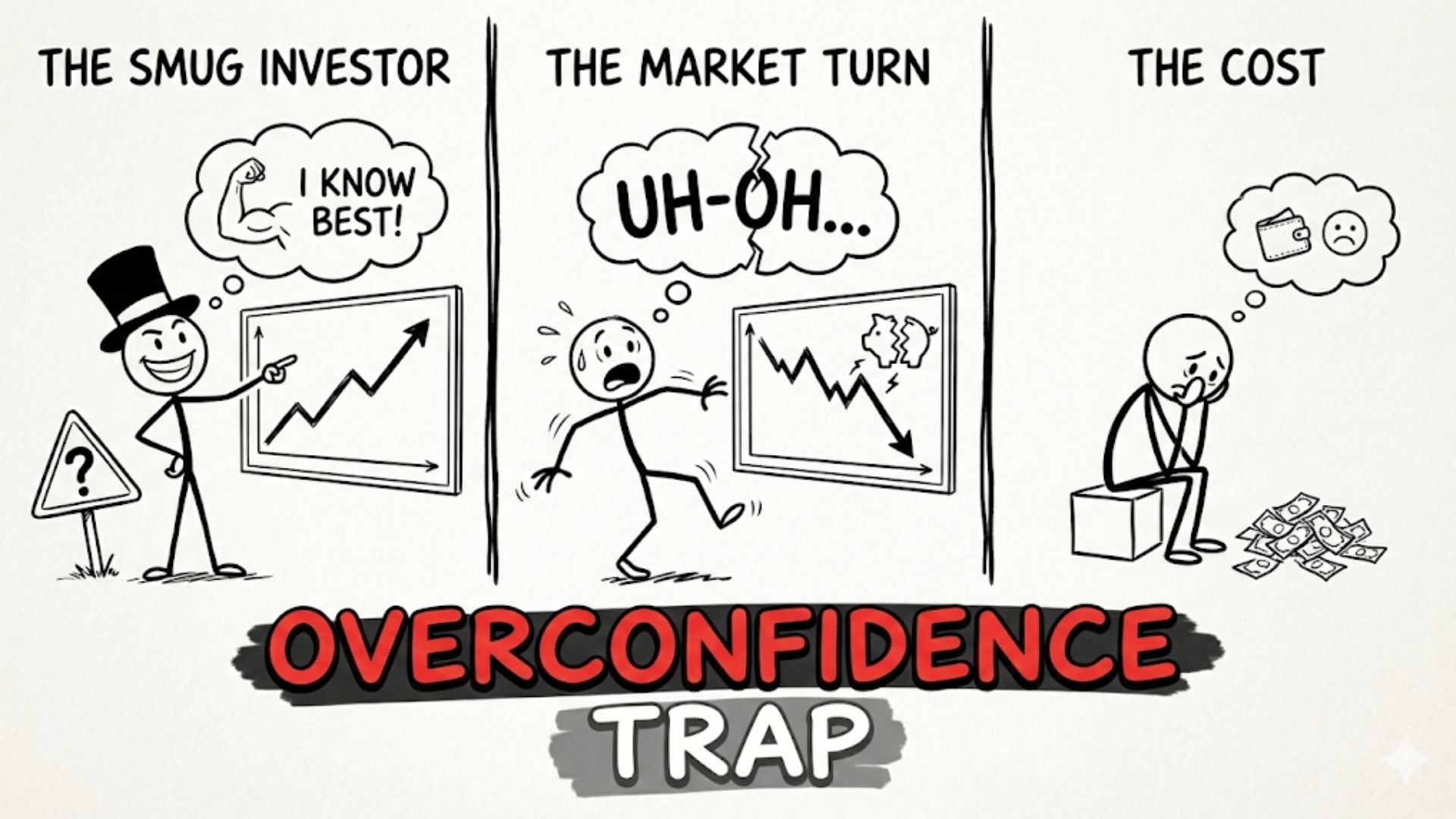
Overconfidence occupies a paradoxical position in financial decision-making. On one hand, markets reward informed risk-taking and independent judgment. On the other, excessive confidence in one’s predictive ability consistently correlates with underperformance. The cost of overconfidence in investing is rarely immediate or obvious. It accumulates gradually, often disguised as skill, and becomes visible only over extended time horizons.
At its core, overconfidence interacts with impatience. Investors who believe they possess superior insight frequently shorten their evaluation horizons. They trade more actively, adjust portfolios in response to short-term signals, and assume that superior judgment can overcome structural uncertainty. This compression of time horizons disrupts exposure to compounding systems that require duration to generate meaningful outcomes.
Despite decades of empirical research documenting overconfidence and its effects, the pattern persists across generations and market cycles. The persistence suggests structural reinforcement rather than mere ignorance. Incentive systems reward visible short-term wins. Cultural narratives celebrate decisive action. Immediate feedback from price movements encourages attribution of success to skill rather than luck.
Understanding the cost of overconfidence requires examining how it distorts time horizons, interacts with compounding mechanisms, and persists within institutional and cultural frameworks. The issue is not that confidence is inherently detrimental. Rather, it becomes costly when it leads to temporal misalignment between decision processes and the systems that generate long-term wealth.
Read also: How Fear and Greed Drive Market Cycles
The Core Problem: Time Horizon Misalignment
Time horizon misalignment occurs when investors evaluate decisions over intervals shorter than the maturation period of the underlying assets. Overconfidence intensifies this misalignment.
Financial markets are probabilistic systems characterized by uncertainty, competition, and noise. Productive assets generate value over years through earnings growth, innovation, and reinvestment. However, short-term price movements are influenced by sentiment, liquidity flows, and macroeconomic variables.
Overconfident investors tend to believe they can predict or interpret short-term movements with precision. This belief encourages frequent trading, tactical allocation shifts, and attempts to time market cycles. Each of these behaviors implicitly assumes that short-term forecasts meaningfully improve long-term outcomes.
Yet the majority of wealth accumulation in markets arises from sustained exposure to compounding returns. Interrupting exposure through frequent repositioning reduces time in system. Because compounding is nonlinear, small reductions in duration can materially affect terminal wealth.
Overconfidence thus converts volatility into action. Instead of tolerating interim fluctuations as part of a long-term process, investors respond to them as signals demanding intervention. The evaluation horizon narrows to weeks, months, or quarters rather than decades.
The structural error is not simply miscalculation. It is the assumption that skill can consistently exploit short-term variation in systems dominated by randomness and competition. When this assumption shortens time horizons, compounding is disrupted.
Time horizon misalignment also manifests in portfolio concentration. Overconfident investors may concentrate capital in a limited number of positions, believing in superior information. While concentration can increase returns when correct, it also amplifies exposure to idiosyncratic risk. The long-term advantage of diversification—reducing the probability of catastrophic loss—is often underweighted relative to perceived informational edge.
In this way, overconfidence reshapes risk perception. The focus shifts from preserving exposure to compounding systems to maximizing immediate alpha generation.
Read also: A Masterclass on Graham and Dodd’s “Security Analysis”
Why the Problem Persists Despite Experience
The enduring prevalence of overconfidence in investing suggests reinforcing mechanisms beyond simple cognitive error. Several structural and psychological forces contribute to its persistence.
1. Delayed and Noisy Feedback
Financial markets provide rapid feedback in the form of price changes, but this feedback is noisy. Short-term gains may reflect randomness rather than skill. Losses may reflect temporary volatility rather than flawed analysis.
Because feedback is ambiguous, investors can selectively attribute positive outcomes to skill and negative outcomes to external factors. This attribution bias sustains overconfidence even when long-term results do not justify it.
Furthermore, the full cost of frequent trading or concentration may only become evident over extended horizons. Underperformance relative to a passive benchmark can accumulate gradually, masked by intermittent successes.
Delayed recognition of cumulative cost weakens corrective learning.
2. Incentive Structures Reward Activity
Institutional environments often reward visible action over disciplined inactivity. Fund managers are evaluated on recent performance. Financial media highlights active trading strategies. Brokerage platforms profit from transaction volume.
These incentives encourage engagement and frequent decision-making. Inactivity, even when rational, appears passive. Activity signals competence and responsiveness.
For professionals whose compensation depends on perceived skill, demonstrating decisiveness may carry reputational benefits, even if it increases long-term risk.
3. Cultural Narratives of Exceptionalism
Cultural narratives frequently celebrate individual genius and market-beating performance. Stories of exceptional investors receive disproportionate attention relative to statistical realities. This visibility can distort perception of base rates.
When rare success stories dominate discourse, individuals may overestimate the probability of achieving similar outcomes. Overconfidence is reinforced by survivorship bias: unsuccessful attempts receive less attention.
This narrative environment sustains belief in superior predictive ability, even when evidence suggests that consistent outperformance is rare.
4. Cognitive Biases: Illusion of Control and Confirmation Bias
Overconfidence is closely linked to the illusion of control—the tendency to overestimate one’s influence over outcomes. Financial markets, with abundant data and complex models, create the appearance of controllability.
Confirmation bias further entrenches confidence. Investors seek information supporting existing views and discount contradictory evidence. This selective attention reinforces conviction, even in the absence of objective validation.
Present bias also interacts with overconfidence. Immediate gains reinforce belief in skill, while future risks are discounted. The psychological reward of short-term success outweighs abstract long-term considerations.
These biases, embedded in cognitive architecture, are not easily neutralized by awareness alone.
Read also: Financial Freedom From $2.26 to $1.25 Million in 5 Years
Real-World Consequences Across Domains
The cost of overconfidence extends beyond portfolio performance. Its influence can be observed across multiple economic domains.
Investing
Empirical research consistently finds that higher trading frequency correlates with lower net returns for individual investors. Transaction costs, tax friction, and timing errors erode performance. Overconfidence contributes to this pattern by increasing trading activity.
Portfolio concentration driven by strong conviction can lead to substantial drawdowns. While concentrated bets occasionally yield outsized gains, they also elevate probability of severe loss, particularly when based on incomplete information.
Moreover, overconfident investors may underestimate tail risks—low-probability, high-impact events. By assuming predictive competence, they may ignore the distribution of possible outcomes, focusing instead on expected value without sufficient attention to variance.
The cumulative effect is reduced long-term wealth relative to strategies that emphasize duration, diversification, and probabilistic humility.
Career Development
Overconfidence influences professional decision-making. Individuals who overestimate their forecasting ability may pursue high-risk opportunities without adequate contingency planning. While risk-taking can be productive, miscalibration increases probability of adverse outcomes.
In career contexts, impatience may lead to frequent job changes in pursuit of rapid advancement. While mobility can accelerate growth, excessive turnover may hinder deep skill accumulation and network development.
The long-term advantage of compounding expertise often depends on sustained engagement within domains. Overconfidence in short-term opportunity evaluation can disrupt this process.
Entrepreneurship and Business Strategy
Entrepreneurs frequently exhibit high confidence in their ventures. While confidence can motivate persistence, excessive certainty can distort risk assessment and capital allocation.
Overconfident founders may underestimate competitive threats, overestimate market demand, or delay strategic pivots. In corporate settings, executive overconfidence can lead to aggressive acquisitions, excessive leverage, or expansion beyond core competencies.
These decisions often appear justified in optimistic scenarios but may amplify downside risk. When evaluation focuses on short-term growth metrics rather than long-term resilience, structural vulnerabilities accumulate.
Savings and Personal Finance
At the household level, overconfidence in future income growth can reduce precautionary savings. Individuals may assume continued career success or market returns, underweighting adverse scenarios.
This miscalibration interacts with present bias, encouraging consumption today based on optimistic forecasts. The eventual cost becomes apparent only when unexpected shocks occur.
Across these domains, overconfidence compresses time horizons and elevates risk exposure.
Read also: How an Insignificant Ape Conquered the World
A Core Mental Model: Compounding and Delayed Feedback Systems
Compounding provides a useful framework for understanding the structural cost of overconfidence.
In compounding systems, consistent, moderate returns over long durations often outperform intermittent high returns punctuated by losses. The stability of the process matters more than the magnitude of occasional gains.
Overconfidence increases variance. Frequent trading, concentrated positions, and leveraged bets introduce volatility that can interrupt compounding. Because losses compound negatively, large drawdowns require disproportionate gains to recover.
Delayed feedback complicates perception. The benefit of stable, disciplined strategies may appear modest initially, while high-variance strategies may produce early gains. Over time, however, the nonlinear nature of compounding magnifies small differences in return consistency.
Patience, in this context, is not passive. It is alignment with the mathematics of exponential growth. Overconfidence disrupts this alignment by prioritizing short-term alpha generation over sustained exposure.
Understanding compounding clarifies why modest but consistent returns often dominate more dramatic but volatile approaches over extended horizons.
Applying Better Thinking in Practice (Principles, Not Tactics)
Addressing overconfidence requires structural awareness rather than specific trading prescriptions.
Emphasize probabilistic reasoning.
Financial outcomes should be evaluated in terms of distributions, not single-point forecasts.
Align evaluation horizons with asset horizons.
Assess performance over intervals consistent with the maturation cycle of underlying investments.
Recognize incentive distortions.
Professional environments may reward activity and short-term performance. Awareness of these pressures can inform interpretation of results.
Separate process from outcome.
Short-term success does not necessarily validate decision quality; short-term failure does not necessarily invalidate it.
These principles aim to reduce systematic error arising from temporal misalignment and cognitive bias.
Read also: Why One Index Fund Can Buy Your Freedom
Common Misunderstandings About Patience
Long-term orientation is sometimes misconstrued.
Patience Is Not Avoidance of Risk
Maintaining exposure to compounding systems often requires accepting volatility. Avoiding all risk may prevent participation in growth.
Long-Term Thinking Does Not Ensure Outperformance
Duration improves probability alignment with positive expected returns but does not eliminate uncertainty. Structural change, technological disruption, and macroeconomic shifts can alter trajectories.
The objective is not certainty, but reduction of avoidable error.
Connections to Broader Thinking Frameworks
The cost of overconfidence intersects with several decision-making concepts.
Second-Order Effects.
Frequent trading may generate immediate excitement but erode compounding through costs and timing errors.
Incentive Design.
Compensation tied to short-term performance can amplify overconfidence-driven activity.
Opportunity Cost.
Time spent attempting to exploit short-term inefficiencies may displace disciplined long-term strategies.
Path Dependency.
Early large losses can permanently reduce capital base, limiting future optionality due to compounding mathematics.
These frameworks highlight the structural interplay between confidence, time, and system dynamics.
Read also: Why Modern America Feels Lost Despite Having Everything
Conclusion: Reframing Financial Success as a Time-Based System
Overconfidence in investing carries costs that are often subtle and delayed. By compressing time horizons and encouraging excessive intervention, it disrupts alignment with compounding systems that generate durable wealth.
The persistence of overconfidence reflects delayed feedback, incentive structures favoring activity, cognitive biases, and cultural celebration of exceptionalism. These forces reinforce short-term decision-making even when long-term evidence favors restraint and probabilistic humility.
Financial success, understood structurally, depends less on predictive brilliance and more on sustained exposure to productive systems. Aligning decisions with the temporal mechanics of compounding reduces the likelihood of self-inflicted error.
Overconfidence becomes costly not because confidence is inherently flawed, but because it narrows perspective. When evaluation shifts from decades to quarters, from distributions to forecasts, from process to outcome, the mathematics of compounding are undermined.
Reframing investing as participation in a time-based system clarifies the central advantage of disciplined duration. The challenge is not eliminating confidence, but calibrating it to the probabilistic and temporal realities of financial markets.