

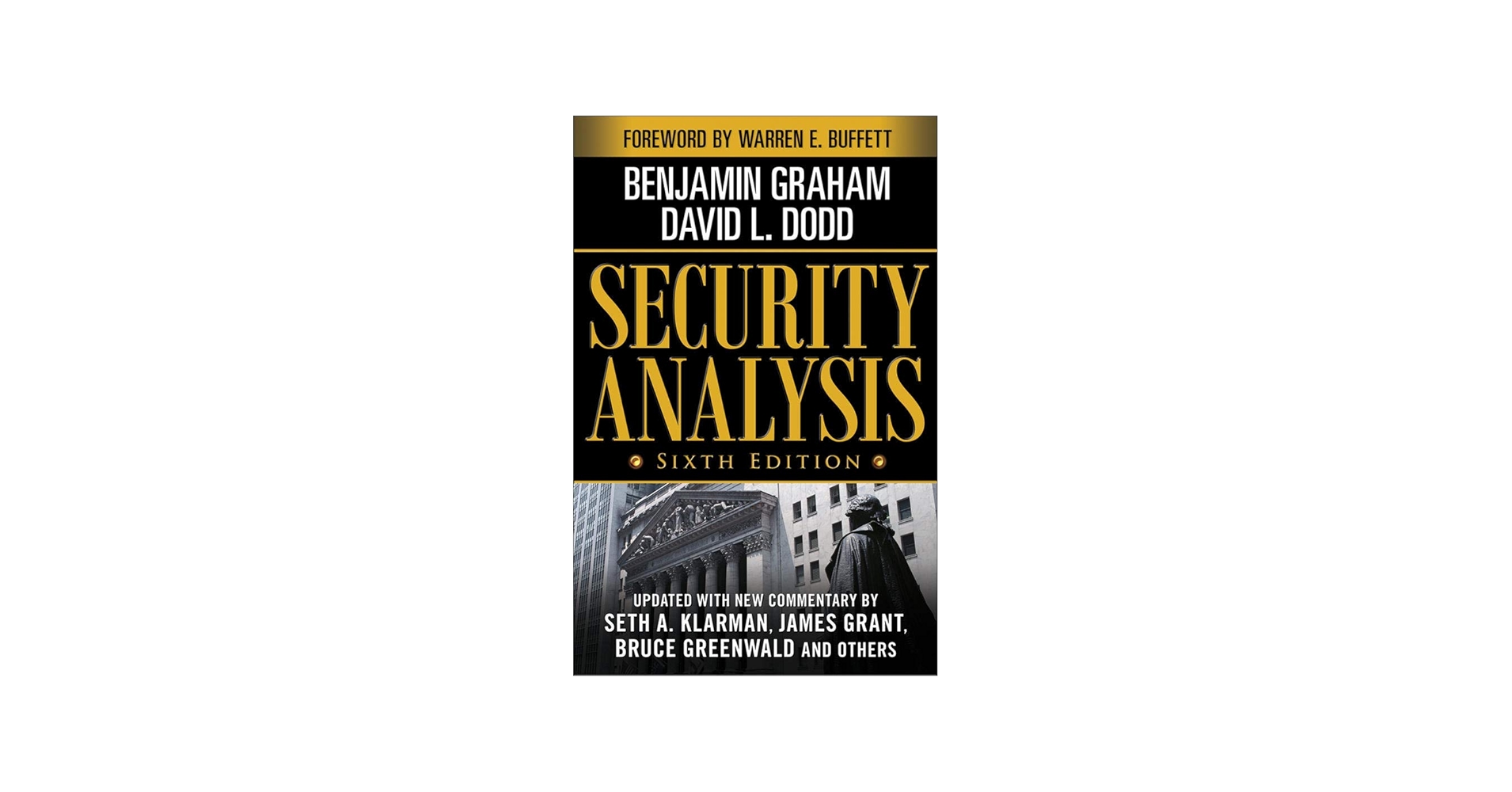
Rating: ★★★★★ (5/5)
Subtitle: The Foundation of Modern Finance
Verdict: The definitive, mathematically rigorous framework that separates investing from gambling.
- Best For: Chartered Financial Analysts, institutional fund managers, and serious students of accounting who reject the ephemeral “noise” of market momentum in favor of intrinsic worth.
- Difficulty Level: High (Requires advanced technical literacy in financial statement analysis and corporate law).
——————————————————————————–
1. INTRODUCTION: THE SCIENTIFIC REVOLUTION OF 1934
In July 1934, when McGraw-Hill published the first edition of Security Analysis, the global financial landscape was defined by the total collapse of the price-to-earnings multiplier and a pervasive disregard for book value. From its 1929 peak to its 1932 trough, the Dow Jones Industrial Average had shed 87% of its value, while national unemployment exceeded 25%. The speculative “casino” culture of the 1920s—driven by insider tips, rumors, and unregulated pools—had been scoured by the Great Depression. Into this vacuum of credibility, Benjamin Graham and David Dodd introduced a scientific revolution: the replacement of intuitive guessing with a structured, technical methodology for the valuation of securities.
Before this seminal text, the concept of “investment” was largely indistinguishable from pure speculation. Market participants functioned as “chart readers” or momentum chasers, treating ticker symbols as tokens rather than fractional interests in living businesses. Graham and Dodd, lecturers at Columbia University, proposed that a security possesses an intrinsic worth independent of its fluctuating market price. While The Intelligent Investor (1949) would later serve as a practical, behavioral guide for the layperson, Security Analysis is the exhaustive, technical blueprint of the profession. Surviving over 75 years of market cycles, it remains the ultimate authority on fundamental analysis, asserting that the financial “weighing machine” eventually corrects the emotional “voting machine” of the marketplace.
——————————————————————————–
2. THE GOLDEN RULE: DECONSTRUCTING INVESTMENT VS. SPECULATION
The opening of the Graham-and-Doddsville philosophy is a strict gatekeeping mechanism. The senior value manager understands that without a clinical definition of “investment,” the practitioner is merely a gambler adopting a professional lexicon. Graham and Dodd established an intellectual boundary that remains non-negotiable for those seeking capital preservation.
“An investment operation is one which, upon thorough analysis, promises safety of principal and an adequate return. Operations not meeting these requirements are speculative.”
To the disciplined analyst, this definition is composed of three indispensable technical pillars:
- Thorough Analysis: This is a mandate for “financial detective work.” It requires a rational, objective study of the business’s underlying assets, earnings power, and competitive advantages. It is the antithesis of acting on news cycles or social media trends; it is the study of the business’s DNA, not the ticker’s movement.
- Safety of Principal: This is Graham’s “prime directive.” Before an analyst considers a potential return, they must quantify the risk of permanent capital loss. Safety does not imply an absence of volatility, but it does mean that the risk of total insolvency or permanent impairment is minimized through rigorous vetting and asset coverage.
- Adequate Return: Graham chose the word “adequate” with clinical precision. It represents a reasonable, satisfactory profit based on the risk assumed—not a “lottery ticket jackpot.” In an era of high-frequency trading and meme-stock frenzies, this word serves as a humble reminder to reject unrealistic projections in favor of historical reality.
If any of these three requirements are absent—if the analysis is cursory, the principal is at high risk, or the return relies on a “greater fool” to pay a higher price—the operation is speculative. The speculator plays the player (the market); the investor plays the game (the business). Once the investor commits to this clinical path, they require a yardstick to measure the delta between price and reality.
Read also: Financial Freedom From $2.26 to $1.25 Million in 5 Years
——————————————————————————–
3. INTRINSIC VALUE & THE MARGIN OF SAFETY
At the technical heart of Security Analysis lies the dichotomy between Price and Value. Price is a daily quote provided by “Mr. Market”—Graham’s personification of the marketplace’s manic-depressive fluctuations. Intrinsic Value, however, is the economic worth of the entity as determined by a rigorous audit of its assets, earnings, and Dividend Yield.
To bridge the gap between price and value, Graham introduced the Margin of Safety. This is the essential “buffer” for error. Graham’s classic analogy involves a bridge: if you calculate that a bridge must carry a 10,000-pound truck, you do not build it to support exactly 10,000 pounds. You build a bridge with a 30,000-pound capacity to account for miscalculations, structural fatigue, or unforeseen weight. In investing, if an analyst calculates a stock’s intrinsic value at $100 per share, they do not purchase it at $95. They wait until Mr. Market’s pessimism offers the security at $60 or $70.
This 30-to-40 discount is the Margin of Safety. It protects the investor from three distinct threats: miscalculations of the future, unforeseen economic disruptions, and the inherent volatility of human psychology. While the market acts as a “voting machine” in the short term—tallying popularity and emotion—it functions as a “weighing machine” in the long term, eventually reflecting the accounting reality of the business’s value. The task of the analyst is to extract this value from the company’s financial bloodline through a skeptical reading of its reports.
——————————————————————————–
4. THE TECHNICAL CORE: ANALYZING FINANCIAL STATEMENTS
For the CFA Senior Fellow, financial statements are not merely reports; they are forensic sites often laden with “misleading artifices.” The objective of the Graham-style audit is to “re-cast” the income statement and balance sheet to reveal the “True Earnings Power” and realistic asset values, stripping away management’s optimistic projections.
The Balance Sheet and the Calculus of Liquidation
Graham placed immense structural weight on the balance sheet, particularly for the Defensive Investor. The analyst must scrutinize Asset Coverage to ensure that the enterprise is not overly reliant on debt. A primary metric is the Current Ratio, which Graham insisted should be at least 2:1. This requirement ensures that the company possesses a liquidity buffer—current assets should be at least double current liabilities—to survive temporary economic shocks without facing insolvency.
The most famous technical strategy in this realm is the Net Current Asset Value (NCAV), or Net-Net approach. The formula is clinical: Current Assets minus Total Liabilities. If a company’s Market Capitalization is lower than its NCAV, the investor is essentially buying the business’s fixed assets (factories, equipment, brands) and all future earnings potential for free. This is the “Cigar Butt” philosophy—finding a discarded business that still has one “puff” of value left. While such opportunities are rare in efficient indices, the logic of buying a dollar’s worth of liquid assets for 50 cents remains the ultimate shield against downside risk.
The Income Statement and True Earnings Power
Graham was notoriously skeptical of single-year earnings, viewing them as “single-quarter illusions.” He instructed analysts to evaluate “True Earnings Power” by analyzing average earnings over a 7-to-10 year cycle. This long-term view smooths out the business cycle and exposes accounting sorcery such as aggressive depreciation policies or the inclusion of non-recurring items (one-time gains from asset sales) into operational profits.
The primary valuation tool here is the Earnings Yield (the inverse of the P/E ratio). Graham often limited his entry price to no more than 15 times the average earnings of the past three years. Furthermore, he suggested a combined constraint: the product of the P/E ratio and the P/B (Price-to-Book) ratio should not exceed 22.5. By adhering to these mathematical ceilings, the analyst avoids the “growth at any price” trap, which frequently leads to overpaying for cyclical peaks. The goal is not to forecast the next superstar industry, but to ensure that the price paid provides a margin of safety even if future growth is merely modest.
Read also: Why “Positive Thinking” Is Making You Miserable
——————————————————————————–
5. THE HIERARCHY OF CAPITAL: FIXED-INCOME CRITERIA
Though often overshadowed by his work on equities, Graham’s approach to fixed income was a masterclass in conservative risk management. He applied a “Safety First” principle to bonds, treating them as the stable anchor for the Defensive Investor. For Graham, the bondholder occupies a privileged position: the interest payment is a contractual obligation, whereas the dividend is merely a contingent reward at the discretion of the board.
The Grahamite analyst demands “Massive Earnings Coverage” before considering a bond issue. This requires that the company’s earnings before interest and taxes (EBIT) cover its interest expenses by a factor that remains stable even in a depression-level scenario. He was dismissive of “high-yield” or junk bonds, arguing that they offer stock-like risk for bond-like limited returns—a mathematically poor trade-off.
The focus in bond analysis is on “Stability before Growth.” Graham prioritized the senior claim of bondholders over the residual claim of stockholders. He advocated for a mechanical rebalancing strategy, often suggesting a 50/50 split between high-quality bonds and diversified stocks. This forced the investor to sell stocks when they became overpriced (increasing the bond weight) and buy them when they were depressed (using bond proceeds). In this hierarchy, fixed income is not a venue for cleverness, but a fortress for capital.
——————————————————————————–
6. CRITICAL ANALYSIS: DOES 1934 MATH WORK IN 2026?
A significant challenge to Graham’s technical rules is the fundamental evolution of the modern economy. In 1934, the economy was asset-heavy, defined by railroads, utilities, and steel mills. In 1975, Intangible Assets (brands, software, intellectual property) comprised just 17% of the assets on the balance sheets of S&P 500 companies. By 2026, that figure exceeds 90%, driven by the domination of software and technology.
This shift complicates “Asset Realism.” A software company requires minimal physical CAPEX and generates high marginal margins, which mathematically justifies a higher P/E ratio. In 2026, a P/E of 25 may indeed be the “new 15” for a high-quality firm with a deep economic moat and software-driven economics. The scarcity of Graham’s “Net-Net” opportunities in modern markets is evident: currently, Nucor (NUE) often stands as one of the few S&P 500 stocks even approaching Graham’s original stringent criteria for a defensive investor.
However, while the tactics (the specific formulas) have evolved, the wisdom (buying value at a discount) is eternal. “Net-Net” strategies that have vanished in the U.S. continue to thrive in less efficient global markets, such as Japan. The modern analyst must adjust their “financial detective work” to account for the reality of intangible-heavy balance sheets, but they must never abandon the requirement of a Margin of Safety. The speed of information has increased, but the irrationality of human nature—and the resulting mispricing of assets—remains a constant.
——————————————————————————–
7. THE GEICO PARADOX: LUCK, PREPARATION, AND CONCENTRATION
The 1948 investment in GEICO (Government Employees Insurance Company) presents a fascinating paradox in Graham’s career. Throughout Security Analysis, Graham advocated for “wide diversification,” suggesting that a conservative manager should seldom invest more than 5% in any one holding. Yet, Graham and his partners broke their own rule, concentrating a massive 25% of their assets into GEICO at a time when its Market Capitalization offered an asymmetric outcome.
This single decision eventually produced profits that exceeded the sum of all other decisions made in a 20-year career of “journeyman efforts.” One of Graham’s $712,500 investments turned into over $400 million in 25 years. This 500-bagger was credited by Graham to “luck,” but with a vital caveat: “Behind the luck… there must usually exist a background of preparation and disciplined capacity.”
The “GEICO Paradox” teaches the analyst that while one “lucky break” can count for more than a lifetime of efforts, that luck is only accessible to the investor who has the judgment and courage to act when a “fat pitch” arrives. Critically, Graham broke his own rule by not selling GEICO when it reached “fair value.” He recognized that a high-quality business could compound value far beyond its initial liquidation price. This evolution—buying great companies at fair prices—would later become the hallmark of his most famous student, Warren Buffett.
Read also: The Blueprint for Permissionless Wealth and Perpetual Peace
——————————————————————————–
8. THE BALANCE SHEET OF THE BOOK: PROS AND CONS
| PROS | CONS |
| Timeless Valuation Logic: The principle of intrinsic value and the margin of safety remains the only mathematically sound defense against market madness. | Dry Academic Tone: The prose is dense, technical, and can be clinically cold, requiring high levels of concentration. |
| Analytical Discipline: Provides a rigorous framework for rejecting market hype and focusing on the “weighing machine” of accounting. | Dense/Hard Difficulty: Requires a deep understanding of 20th-century accounting; the learning curve is steep for non-professionals. |
| Forensic Skepticism: Teaches the reader to “re-cast” financial statements and look for misleading artifices used by management. | Outdated Industry Examples: Many examples focus on railroads and utilities, which differ in capital structure from modern tech firms. |
| Capital Hierarchy: Offers the most thorough text ever written on the technical aspects of bond vetting and senior security rights. | Mathematical Scarcity: Many of Graham’s original “Net-Net” filters yield zero results in highly efficient 21st-century markets. |
——————————————————————————–
9. CONCLUSION: THE TRIUMPH OF THE WEIGHING MACHINE
The core thesis of Security Analysis is that while the market is an emotional “voting machine” in the short term, it is an inescapable “weighing machine” in the long term. The “Intelligent Investor” is the individual who can maintain emotional distance from the manic-depressive outbursts of Mr. Market, treating market fluctuations not as threats, but as transactional opportunities.
Price is what you pay; value is what you get. The speculator chases the former, hoping for a higher bidder; the investor demands the latter, grounded in the clinical reality of earnings power and asset coverage. Benjamin Graham’s work is not a mere collection of outdated formulas; it is an “operating system for financial sanity.” It provides the practitioner with the intellectual and emotional shield necessary to survive the financial madness of any era. By focusing on what is factual—balance sheets and earnings records—over what is emotional, the Graham-and-Dodd disciple ensures their survival in a world that often loses its collective mind.
——————————————————————————–
10. CALL TO ACTION: FROM SPECULATION TO ANALYSIS
Stop guessing. Start analyzing.
For the serious practitioner, the Sixth Edition of Security Analysis is the mandatory starting point. This edition is particularly essential as it includes modern commentary from legendary value investors like Seth Klarman and James Grant. These modern masters provide the “bridge” between the 1930s and the complex, intangible-heavy arena of the 21st century.
Master the bedrock. Apply the Margin of Safety. And remember: the most important factor in your investment success is not your IQ, but your discipline. As Graham noted, the investor’s chief problem—and even his worst enemy—is likely to be himself. Conquer that enemy through the clinical precision of Graham and Dodd.

