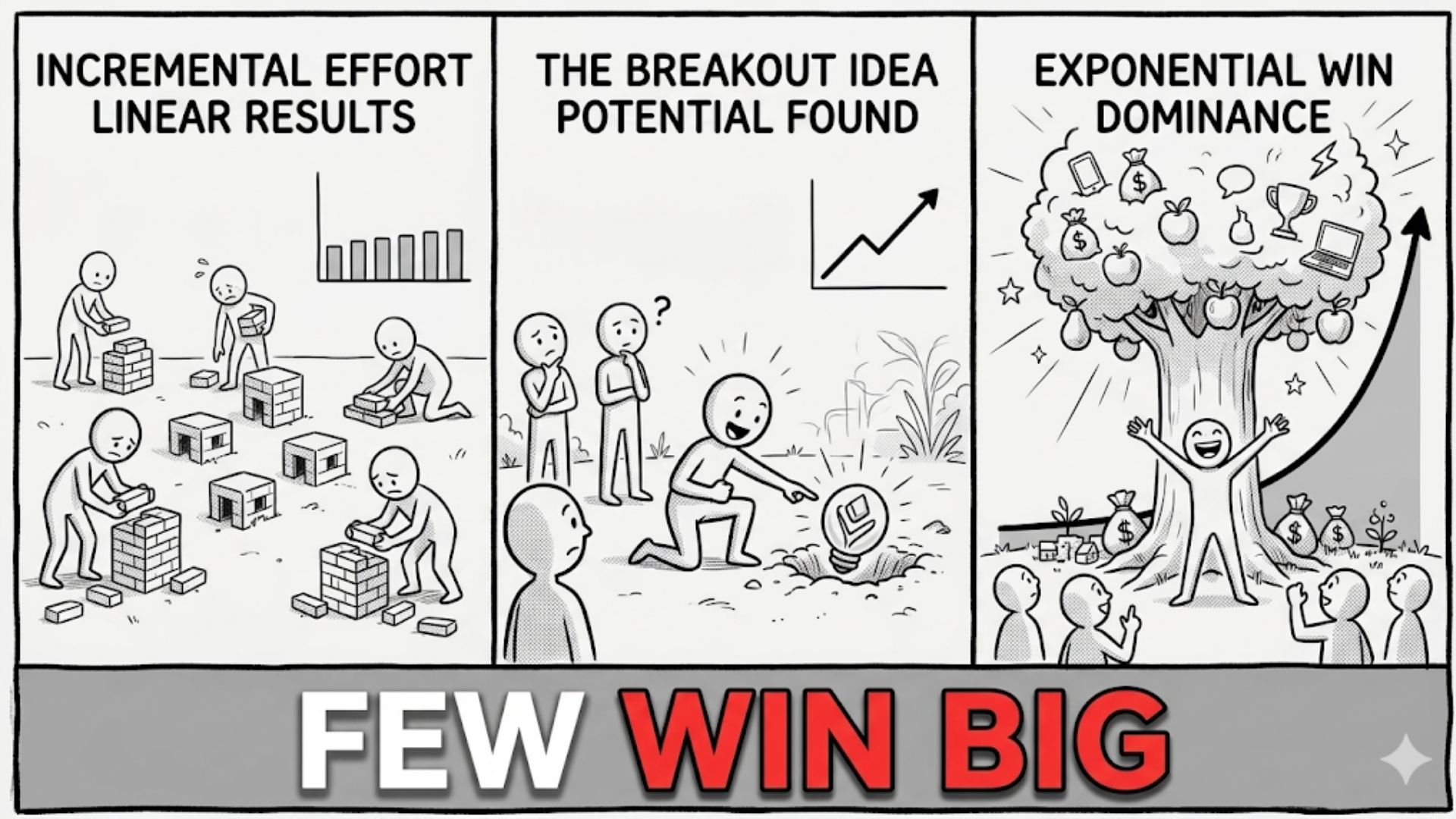
Introduction: Uneven Outcomes in Innovation
In the common discourse of economic development and corporate strategy, innovation is frequently portrayed as a steady, incremental progression of improvements—a linear march toward efficiency. We speak of “productivity growth” or “technological advancement” as aggregate metrics, implying a Gaussian distribution where most efforts contribute a modest, average amount to the whole. This perspective suggests that if an organization or a nation simply increases its R&D budget by a fixed percentage, it should expect a proportional and predictable increase in output.
However, a rigorous systems analysis of historical discovery and economic impact reveals a fundamentally different structural reality. Innovation is not a normal distribution; it is a power-law phenomenon. Across scientific research, technological breakthroughs, and entrepreneurial ventures, outcomes are characterized by extreme skewness. A negligible fraction of innovations—the “head” of the distribution—accounts for a disproportionately large share of total economic value, societal transformation, and technological utility.
Whether we examine the patent citations of the 20th century, the venture capital returns of the 21st, or the fundamental scientific papers that underpin modern physics, we find that a small minority of events generates the vast majority of the impact. This pattern is not an anomaly or a failure of the system; it is a native feature of how probabilistic discovery and non-linear growth interact. To understand the “Innovation Power Law” is to recognize that the mechanics of discovery are architected to produce extreme outliers. In this essay, I will analyze the structural features—from asymmetric payoffs to cumulative advantage—that ensure innovation systems remain characterized by profound disparity.
Read also: Why Winning in Business Is the Wrong Goal
The Mathematics of Power-Law Distributions
To analyze innovation systems, we must first define the mathematical framework of the power law. Unlike a normal distribution (the “bell curve”), where most data points cluster around a central mean and extreme outliers are statistically impossible, a power-law distribution describes a relationship where a relative change in one quantity results in a proportional relative change in another, regardless of the initial size of those quantities.
In an innovation context, this means that while the “average” patent or “average” startup has nearly zero impact, the outliers—the transistors, the internet protocols, the mRNA vaccines—possess an impact that is orders of magnitude greater than the rest of the distribution combined. The system is fundamentally non-ergodic; the aggregate performance is dominated by the rare few rather than the typical many.
The Pareto Principle in Innovation
This mathematical reality is often colloquially expressed as the Pareto Principle, or the 80/20 rule. In 1896, Vilfredo Pareto observed that 80% of the land in Italy was owned by 20% of the population. In innovation ecosystems, this skewness is often even more extreme, frequently resembling a 90/10 or 99/1 rule.
- Scientific Discoveries: A tiny percentage of researchers produces the papers that garner the vast majority of citations, forming the conceptual bedrock for entire industries.
- Startup Success Rates: In venture capital, it is well-documented that approximately 1% to 5% of investments generate the entirety of a fund’s returns, while the remaining 95% either fail or merely return capital.
- Technological Breakthroughs: The history of computing is not a story of thousands of equal contributors, but a series of “step-function” changes driven by a handful of architectural shifts (e.g., von Neumann architecture, graphical user interfaces).
The Pareto Principle is the signature of a system where success is not independent but is instead linked through feedback loops and asymmetric rewards. When we observe these “80/20” patterns, we are seeing the structural fingerprint of a power-law system at work.
Read also: Why Experimentation Functions as the Primary Engine of Innovation
Experimentation and Probabilistic Discovery
The primary driver of the innovation power law is the nature of discovery itself. Innovation is an exploratory search across a high-dimensional and largely invisible landscape of possibilities. Because the “correct” path is unknown, the system must rely on repeated experimentation.
Every experiment is a “probe” into the unknown. From a probabilistic standpoint, if the probability of a transformative discovery (p) is very low, the system must maximize the number of trials (n) to increase the likelihood of success. This is a stochastic process where the “failures” are not waste; they are the necessary cost of traversing the search space.
However, because the rewards for finding a “peak” in this landscape are so vast, the system encourages a high volume of trials even when the individual probability of success is microscopic. This leads to a distribution where thousands of experiments produce nothing, but because the number of trials is so large, a few eventually collide with an outlier. The power law emerges because the “distance” between a failed experiment and a successful one is not linear, but logarithmic.
Asymmetric Payoffs in Innovation
The economics of innovation are governed by asymmetric payoff structures. In most linear professions, the relationship between input and output is symmetric: if you work an extra hour, you receive a proportional increment of pay. Innovation, however, is a convex activity. The “downside” of an experiment is limited (usually the time or capital spent on the trial), but the “upside” is uncapped.
Consider the development of a new pharmaceutical compound. The cost to test a single molecule is high, but finite. If the molecule fails, the loss is capped at the cost of the trial. If the molecule succeeds in treating a major disease, the value created is measured in billions of dollars and millions of lives saved.
This asymmetry—limited loss, unlimited gain—is what allows the power law to function. It justifies the “waste” of the 99% of experiments that fail. The system is not optimized for a high “batting average” (percentage of successes), but for a high “slugging percentage” (total impact of successes). This structural convexity ensures that the few innovations that do “work” dominate the total value of the system.
Read also: My Journey Through the Timeless Art of Connection
Cumulative Advantage in Innovation Systems
Once a breakthrough occurs, it is subjected to the mechanism of cumulative advantage, often called the Matthew Effect: “To those who have, more will be given.” In innovation, success acts as a signal that attracts more success.
When an innovation shows initial promise, it triggers a positive feedback loop:
- Talent Attraction: Top-tier engineers and scientists gravitate toward the breakthrough project.
- Capital Concentration: Investors move resources away from unproven trials and toward the successful outlier.
- Institutional Support: Regulators and incumbents adapt to the new standard, reinforcing its dominance.
This feedback loop ensures that the breakthrough does not just stay ahead; it accelerates. The early lead provided by the breakthrough creates a “gap” between it and the rest of the field that becomes impossible to bridge. Cumulative advantage transforms a small initial lead into a terminal power-law dominance, as the system reinvests its gains into the “winner,” further starving the “tail” of resources.
Network Effects and Amplification
In modern innovation, the power law is further amplified by network effects. Many technologies increase in value as the number of users or compatible systems increases. This creates a non-linear scaling mechanism.
When a technology—such as a social protocol, an operating system, or a communication standard—crosses a critical threshold of adoption, it enters a phase of exponential growth. Because the utility of the technology is tied to its network density, the “winner” of the network competition captures nearly the entire market.
This “Winner-Take-Most” dynamic is a primary reason why digital and platform-based innovations show such extreme power-law distributions. The network acts as a multiplier of impact; a small advantage in early adoption compounds through the network until the resulting innovation is orders of magnitude larger than its closest competitor.
Time and the Accumulation of Breakthroughs
The power law is also a function of time and duration. Discovery is a cumulative process where new experiments build on the “successful” outcomes of the past. Over long time horizons, the “Law of Large Numbers” ensures that a system that persists in experimenting will eventually encounter extreme outliers.
However, the “time to discovery” is unpredictable. A system might spend decades in a “flat” phase with no major breakthroughs before hitting a cluster of transformative events. This temporal skewness means that innovation impact is not just uneven across space (individuals and firms) but also across time (historical eras). The history of technology is characterized by long periods of stagnation punctuated by “punctuated equilibria”—short bursts of extreme innovation that define the trajectory for the next century.
Read also: The Neuroscience Behind How I Rewired My Habits
Why Humans Misinterpret Innovation Patterns
Despite the structural evidence of power-law dynamics, human intuition remains stubbornly Gaussian. Our cognitive architecture is optimized for a world of linear trade-offs, leading to several persistent biases:
- Survivorship Bias: We study the “successes” (the head of the power law) and try to reverse-engineer their “secrets,” ignoring the thousands of failures that used the exact same strategies. We mistake the outcome for a reproducible process.
- Hindsight Bias: After a breakthrough occurs, we construct a narrative that makes it seem inevitable. We ignore the probabilistic nature of the discovery and the high degree of randomness involved in its timing.
- Narrative Bias: We prefer a story of “heroic genius” over a story of “statistical search.” It is more comforting to believe that success is a result of vision rather than a result of being the lucky survivor in a high-variance system.
These biases lead policymakers and executives to over-manage innovation, trying to “pick winners” rather than building the high-trial-rate ecosystems that allow winners to emerge statistically.
Innovation Clusters and Ecosystems
If innovation is a probabilistic search, then the probability of success is a function of interaction density. This explains why innovation is not spread evenly across the globe but is concentrated in specific geographic “clusters” (e.g., Silicon Valley, Shenzhen, Kendall Square).
A cluster is a high-collision environment. It maximizes the rate at which talent, capital, and ideas “bump” into each other. Each collision is a micro-experiment. By increasing the density of these collisions, a cluster raises the baseline ” n” of the system.
Furthermore, clusters facilitate Collaborative Experimentation. When one firm in a cluster fails, the talent and knowledge from that failure are immediately reabsorbed into the next experiment. This local “recycling” of resources reduces the cost of trials and increases the overall velocity of the discovery engine. The power law is amplified here because the cluster acts as a massive “multiplexer,” taking a thousand individual trials and turning them into a single, high-probability search for the next outlier.
Read also: The Timeless Blueprint for Character and Leadership
Institutional Incentives and Innovation Dynamics
The structure of an innovation system is ultimately determined by its institutional architecture. Systems that produce power-law breakthroughs are those that align their incentives with the mechanics of probabilistic search.
- Tolerance for Failure: For the power law to function, the system must allow for the “long tail” of failures. If an institution punishes failure, rational actors will only propose “safe,” linear experiments, effectively cutting off the possibility of an outlier.
- Openness to Exploration: Rigid, top-down hierarchies are “prediction-heavy.” They attempt to dictate the path of discovery. Conversely, decentralized systems are “exploration-heavy.” They allow for a wider variation of trials, which is necessary to encounter a truly non-linear result.
Institutional “fragility”—the inability to absorb the cost of failed experiments—is the primary killer of innovation. Organizations that optimize for “efficiency” (low variance) are structurally incapable of producing breakthroughs (high variance).
Unequal Outcomes as a Structural Feature
It is critical to recognize that the uneven distribution of innovation outcomes is not a “bug” that can be “fixed” through better management. It is a structural feature of any system governed by non-linear discovery.
If we want the benefits of the extreme outliers (the antibiotics, the microchips), we must accept the existence of the long tail of failures. You cannot have the “head” of the power law without the “tail.” The disparity between the “breakthrough” and the “average” is the price of the asymmetric search.
Inequality in innovation impact is a sign that the system is functioning correctly—that it is searching a wide enough space to find the truly rare and transformative ideas. A system with “even” outcomes is a system that has stopped searching and is merely refining the status quo.
Viewing Innovation Through Power-Law Systems
Shifting our perspective from Gaussian to power-law logic fundamentally changes how we understand progress. We move away from a “deterministic” view of technology and toward a “probabilistic” one.
We realize that:
- Success is often a function of duration. The most “innovative” entities are often just those that stayed in the game long enough to collide with a tail event.
- Optionality is more valuable than prediction. Building a system that can capture a breakthrough is better than trying to forecast one.
- The “average” is irrelevant. The health of an innovation system is measured by the magnitude of its best outcome, not the performance of its median participant.
Read also: Why You Don’t Need a $100,000 Degree to Understand Business
Conclusion: The Structural Logic of Innovation Disparity
In the final analysis, innovation systems are engines for the generation and capture of extreme outliers. They are governed by the inexorable logic of the power law—a mathematical pattern shaped by the interaction of probabilistic experimentation, asymmetric payoffs, and cumulative advantage.
The profound disparity between the “breakthrough” and the “rest” is not a sign of systemic unfairness, but of systemic search. Innovation requires the courage to be “wrong” thousands of times in the hope of being “right” in a way that changes the world. The power law is the structural signature of that search. By accepting this geometry, we move closer to an intellectually rigorous understanding of how our world is actually transformed: not through the steady accumulation of averages, but through the relentless, high-variance pursuit of the extraordinary.