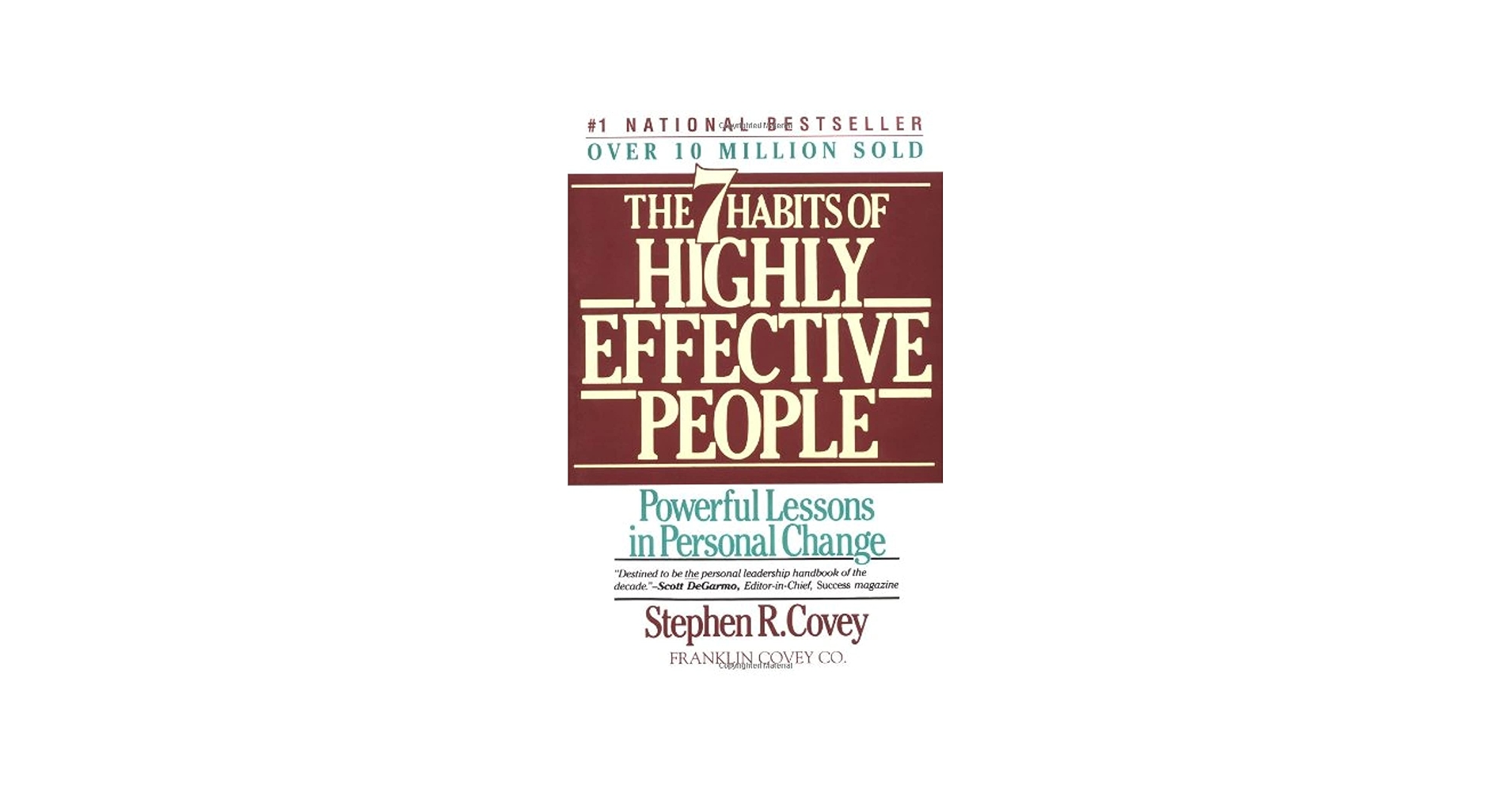
QUICK SNAPSHOT
- Star Rating: 5/5 — A foundational self-development classic.
- Verdict: A principle-centered framework that teaches how to move from dependence to independence and ultimately to interdependence.
- Best For: Leaders, professionals, parents, and anyone seeking deeper personal growth.
- Difficulty: Medium (requires honest self-reflection).
——————————————————————————–
1. The Foundation: Character vs. Personality Ethic
In our modern era, we are often seduced by the “Personality Ethic”—a superficial toolkit of social image consciousness, communication techniques, and “quick-fix” strategies. While these skills may provide short-term social mileage, they are mere “social aspirin” that leave underlying chronic problems to fester. As David Starr Jordan once observed, “There is no real excellence in all this world which can be separated from right living.” To achieve enduring effectiveness, we must return to the Character Ethic, which is rooted in universal, self-evident truths like integrity, humility, and justice.
Real change is an Inside-Out process. It begins with the “Primary Greatness” of our own motives and character. This journey is governed by the “Law of the Harvest”: we only reap what we sow, and there are no shortcuts. This growth occurs along a Maturity Continuum, a sequential path that cannot be inverted:
- Dependence (The Paradigm of You): “You take care of me; I blame you for the results.”
- Independence (The Paradigm of I): “I am responsible; I can choose.” While the modern world enthrones independence, it is not the ultimate goal.
- Interdependence (The Paradigm of We): “We can cooperate; we can combine our talents to create something greater.”
Before we can achieve the Public Victory of working with others, we must first achieve the Private Victory over ourselves.
Read also: A Probabilistic Analysis of Success
2. The Power of the Paradigm Shift
Our behavior is governed by Paradigms—the mental maps through which we interpret the world. However, the map is not the territory; it is simply a subjective explanation of it. If you are lost in Chicago but have a map of Detroit, no amount of positive thinking will get you to your destination. You simply have the wrong map.
The subjectivity of these maps is proven by the “young lady/old lady” exercise, where two people can look at the same black lines and see entirely different women. This proves that we see the world not as it is, but as we are. To change our lives, we must experience a Paradigm Shift.
Consider the “Subway Story”: A man and his loud, rambunctious children entered a quiet subway car. The father sat oblivious while his children yelled and grabbed people’s papers. Irritated, I asked him to control them. He lifted his gaze and said softly, “Oh, you’re right. I guess I should do something about it. We just came from the hospital where their mother died about an hour ago. I don’t know what to think, and I guess they don’t know how to handle it either.” In that instant, my paradigm shifted. Irritation was replaced by sympathy; behavior changed naturally because the “seeing” changed.
We must align our internal maps with “Lighthouse” Principles—natural laws that cannot be broken. As Frank Koch’s story of the battleship illustrates, when a captain demands a “ship” in the fog change course only to be told, “I’m a seaman second class… you had better change course… I’m a lighthouse,” we realize that we cannot break the law; we can only break ourselves against it.
Read also: Why You Don’t Need a $100,000 Degree to Understand Business
3. Habit 1: Be Proactive (The Principle of Personal Vision)
Proactivity is the realization that between stimulus and response, man has the freedom to choose. This “Response-Ability” is our unique human endowment of self-awareness, imagination, conscience, and independent will. Reactive people are driven by “social weather” and feelings; proactive people are driven by carefully selected values.
The Circles of Focus:
- Circle of Concern: All things we care about but cannot control (the economy, the weather, other people’s mistakes).
- Circle of Influence: Things we can do something about (our character, our skills, our reactions).
Proactive people expand their Circle of Influence by focusing on the “Be’s” (being more patient, being more resourceful) rather than the “Have’s” (if I had a better boss).
| Reactive Language | Proactive Language |
| “There’s nothing I can do.” | “Let’s look at our alternatives.” |
| “He makes me so mad!” | “I control my own feelings.” |
| “I have to do this.” | “I choose to do this.” |
| “If only…” | “I will…” |
4. Habit 2: Begin With the End in Mind (The Principle of Personal Leadership)
All things are created twice: first as a mental creation (leadership), then as a physical creation (management). Leadership determines if the ladder is leaning against the right wall; management is the efficiency with which we climb it.
The Funeral Exercise: Visualize your own funeral three years from today. Hear the soft music, see the faces of loved ones. Now, listen to the four speakers as they describe your life:
- A Family Member: What kind of spouse, parent, or sibling were you?
- A Friend: What was your character like in private?
- A Colleague: What was your professional contribution?
- A Community/Church Member: What service did you provide to others?
Identify the traits you want them to remember. These insights form your Personal Mission Statement, or “Personal Constitution.” It is a changeless core that allows you to navigate a changing world. By breaking your mission into Roles (e.g., Parent, Manager, Individual) and setting specific Goals for each, you avoid the “Activity Trap” of being busy but ineffective.
Read also: A Structural Analysis of Compounding Systems
5. Habit 3: Put First Things First (The Principle of Personal Management)
If Habit 1 is “You are the programmer” and Habit 2 is “Write the program,” Habit 3 is “Run the program.” It is the exercise of independent will to manifest your mission.
The Time Management Matrix:
| Urgent | Not Urgent | |
| Important | Quadrant I (Crises): Deadlines, emergencies, pressing problems. | Quadrant II (Prevention/PC): Building relationships, planning, personal renewal. |
| Not Important | Quadrant III (Deceptions): Interruptions, popular activities, some calls. | Quadrant IV (Waste): Time wasters, busy work, pleasant “escape” activities. |
Effective people starve problems (Quadrant I) and feed opportunities (Quadrant II). To say “yes” to Quadrant II, you must have a “bigger ‘yes’ burning inside” to say “no” to the unimportant.
This requires shifting from “Gofer Delegation” (focusing on methods) to “Stewardship Delegation” (focusing on results). Consider the “Green and Clean” story: I told my son the yard must be “green and clean,” but the methods were his. I was the helper; he was the boss who judged himself.
The Five Areas of Stewardship:
- Desired Results: Clear “what,” not “how.”
- Guidelines: Identify the “quicksand” or failure paths.
- Resources: Human, financial, or technical tools available.
- Accountability: Standards and timing for evaluation.
- Consequences: What happens as a result of the evaluation.
Read also: The Step-by-Step Guide to Discovering Your Purpose
6. The Bridge: The Emotional Bank Account
Interdependence is a choice only independent people can make. The currency of these relationships is the Emotional Bank Account—the level of trust in a relationship.
The Six Major Deposits:
- Understanding the Individual: Making what is important to them as important to you as they are to you.
- Attending to Little Things: In relationships, the little things are the big things.
- Keeping Commitments: Breaking a promise is a massive withdrawal.
- Clarifying Expectations: Conflicting expectations around roles and goals cause the most pain.
- Showing Personal Integrity: Being loyal to those who are absent builds the trust of those present.
- Apologizing Sincerely: “I was wrong” is a major deposit; repeated, insincere apologies are withdrawals.
7. Habits 4, 5, & 6: The Public Victory
Once the “Private Victory” is won, we can achieve synergistic relationships:
- Habit 4: Think Win-Win: A frame of mind and heart that seeks mutual benefit. If we cannot find a solution that benefits both, “Win-Win or No Deal” provides the freedom to walk away with the relationship intact.
- Habit 5: Seek First to Understand, Then to Be Understood: This is the principle of Empathetic Listening. Most people listen with the intent to reply; we must listen with the intent to understand. You must “diagnose before you prescribe.”
- Habit 6: Synergize: Synergy means the whole is greater than the sum of its parts. It is the act of “valuing the differences”—mental, emotional, and psychological—to create “third-way” solutions.
Read also: The Strategic Power of Thinking in Decades
8. Habit 7: Sharpen the Saw (The Principle of Balanced Self-Renewal)
Habit 7 is the principle of P/PC Balance.
- P = Production of desired results (The Golden Eggs).
- PC = Production Capability (The Goose).
If you focus only on the eggs and neglect the goose, you will soon be without the asset that produces them. Renewal must be balanced across Four Dimensions:
- Physical: Exercise, nutrition, stress management.
- Spiritual: Value clarification, meditation, or prayer.
- Mental: Reading, visualizing, planning, and writing.
- Social/Emotional: Service, empathy, and synergy.
Continuous renewal creates an upward spiral of growth, progressively integrating the habits on higher planes of effectiveness.
9. Critical Analysis and Modern Relevance
In an age dominated by the “Social Mirror”—the disjointed, carnival-like reflections of ourselves provided by social media and the “distraction economy”—these principles are more vital than ever. The Character Ethic provides the only “changeless core” that can withstand such environmental turbulence.
| Pros | Cons |
| Timeless Wisdom: Built on universal natural laws. | Conceptually Dense: Requires deep study, not a quick skim. |
| Holistic Framework: Bridges personal and professional life. | Lacks “Quick Fix” Appeal: Demands extreme discipline and willpower. |
| Character-Centric: Antidote to modern superficiality. | The “Long Game”: Results are evolutionary, not instantaneous. |
10. Conclusion and Call to Action
Effectiveness is a habit—the intersection of Knowledge (what to do), Skill (how to do it), and Desire (the motivation to do it). True growth is an upward spiral of making and keeping promises to ourselves and others.
The Final Charge: Stop chasing life hacks. Start building your character from the inside out.
Actionable Step: Begin the 30-Day Test of Proactivity. For the next month, work only in your Circle of Influence. Make small commitments and keep them.
- Be a light, not a judge.
- Be a model, not a critic.
- Be part of the solution, not part of the problem.
Stop chasing life hacks. Start building your character.
——————————————————————————–