Introduction: Opportunity Is Not Evenly Distributed
In the common discourse of meritocracy and professional development, opportunity is often framed as a ubiquitous, if elusive, resource. The prevailing cultural narrative suggests a roughly uniform distribution: that “opportunity knocks” for everyone, and the primary differentiator in life outcomes is the individual’s readiness to answer. This model implies a linear relationship between potential and realization, where opportunities are independent events scattered across a population like rain falling on a field.
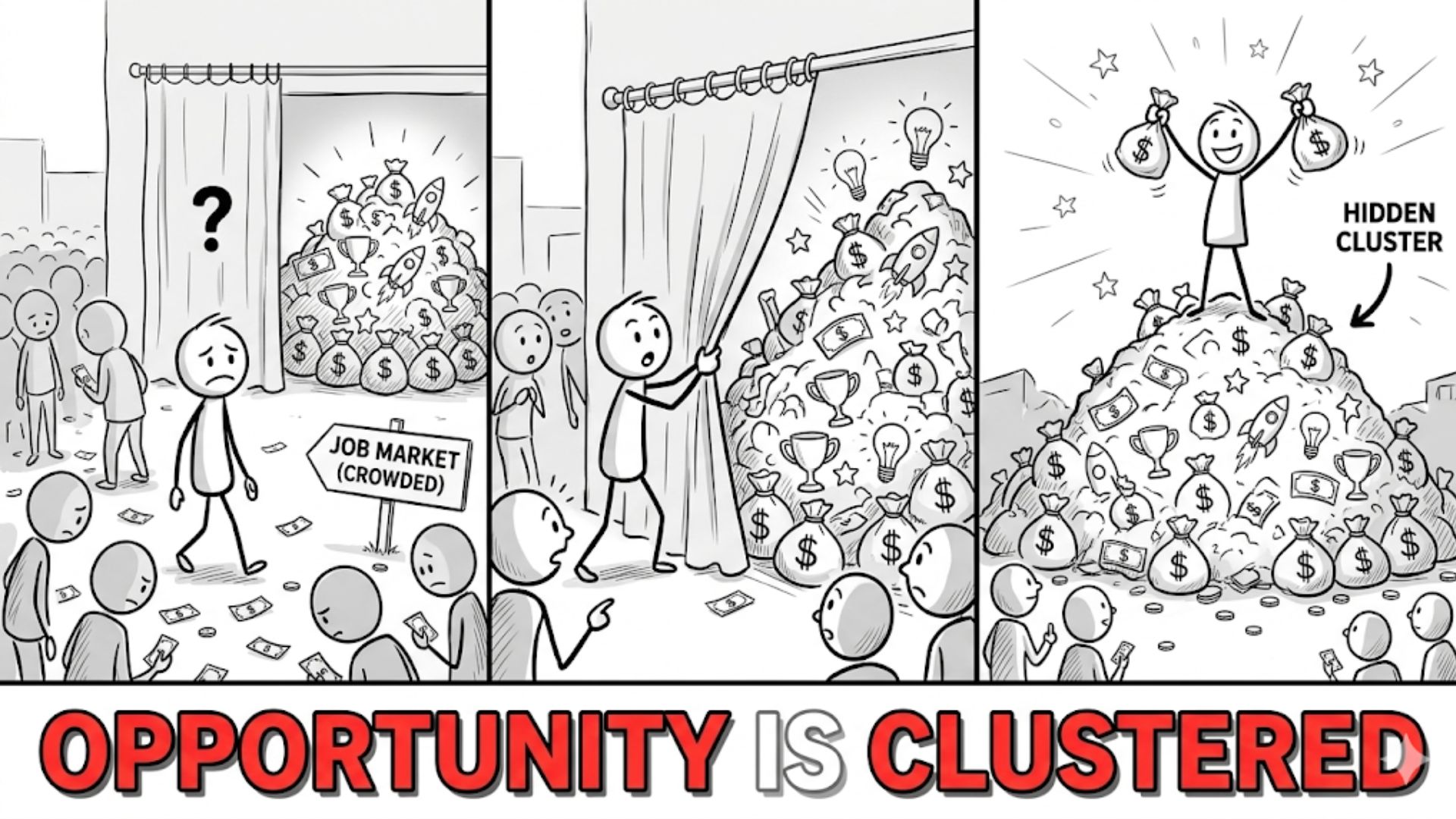
However, a rigorous systems analysis suggests a fundamentally different architecture. When we examine the longitudinal data of careers, wealth accumulation, and institutional growth, we do not find a uniform or even a normal (Gaussian) distribution of opportunity. Instead, we find extreme clustering. Opportunities—defined here as events with a positive expected value that allow for the non-linear advancement of a state—tend to aggregate around specific nodes, environments, and trajectories with remarkable intensity.
Rather than being a series of independent, random occurrences, the arrival of opportunity is a structural product of the system in which an individual is embedded. Opportunity follows a hidden statistical distribution shaped by network topology, exposure frequency, cumulative advantage, and path dependency. To understand why success appears disproportionate, we must move past the anecdotal and look toward the probabilistic structures that determine who encounters opportunity, how often it appears, and why it tends to “flood” certain participants while leaving others in a state of perpetual drought.
Read also: The Timeless Blueprint for Character and Leadership
Why Opportunity Appears Random
At the individual level, the arrival of a transformative opportunity—a key introduction, a sudden market opening, or a unique investment prospect—frequently feels like a “Black Swan” event. It appears unpredictable, idiosyncratic, and disconnected from the immediate past. This perception of randomness is a byproduct of incomplete information and small sample sizes.
In a complex system, the causal chain leading to a specific opportunity is often too dense to map. Because we cannot see the thousands of invisible interactions, informational flows, and prior conditions that made an event possible, we categorize it as “luck.” However, what appears as noise at the micro-scale often reveals itself as a clear signal at the macro-scale. When we aggregate thousands of “lucky” breaks, we observe that they are not distributed randomly. They are statistically predictable within certain parameters.
Understanding the hidden distribution of opportunity requires a shift from deterministic thinking (seeking the specific “why” of one event) to probabilistic thinking (analyzing the “rate” of events within a system). While we cannot predict a specific opportunity, we can analyze the opportunity density of a given environment. The apparent randomness of opportunity is merely a mask for a highly structured, though non-linear, probabilistic engine.
The Role of Probability Distributions
In a standard Gaussian distribution (the “bell curve”), most data points cluster around the mean, and extreme outliers are statistically negligible. If opportunity followed this distribution, we would expect most people to have a similar number of opportunities, with very few people having zero or a thousand.
This structural reality means that inequality is a native feature of the system’s geometry. In a power-law environment, the “average” number of opportunities is a meaningless metric because it is heavily skewed by extreme outliers. The system is architected to produce “winners” who are not just twice as successful as the average, but ten thousand times as successful. This is not necessarily a reflection of a 10,000x difference in talent, but a reflection of the non-linear way the system allocates “shots on goal.”
Read also: Why You Don’t Need a $100,000 Degree to Understand Business
Exposure Frequency and Opportunity Density
The most fundamental driver of opportunity distribution is exposure frequency. In probabilistic terms, an opportunity is a realization of a potential event. The likelihood of that realization occurring is a function of the number of trials conducted.
Consider the “surface area” of a career. An individual working in a closed, low-interaction environment has a very limited surface area for opportunity. Conversely, an individual embedded in a high-velocity ecosystem—such as a major financial hub, a tech cluster, or a vibrant creative industry—is exposed to a much higher “collision rate” of information and people.
Every interaction—a conversation, a shared project, a meeting—is a “trial” in a probabilistic system. While the probability of any single interaction leading to a high-value opportunity is low (p), the cumulative probability of success increases with the number of interactions (n). Environments with high opportunity density do not necessarily have “better” people; they simply have a higher ” $n$.” By increasing the frequency of interactions, these systems ensure that the “Law of Large Numbers” eventually produces the favorable outliers that we characterize as “opportunities.”
Networks as Opportunity Filters
While exposure frequency provides the volume, network structure provides the filter. Information and opportunities do not travel through a vacuum; they travel through the conduits of social and professional topology.
Networks are characterized by “preferential attachment.” In most professional networks, a few central “hubs” are connected to a vast number of other nodes, while most nodes have very few connections. These hubs act as the gatekeepers and accelerators of opportunity. Because they are at the center of the informational flow, they see opportunities first and can distribute them to their immediate neighbors.
This creates a state of informational asymmetry. If you are two or three degrees of separation away from an influential hub, the opportunity has likely been “harvested” or acted upon by the time it reaches you. The hidden distribution of opportunity is therefore mapped directly onto the network’s graph. Those at the center of the graph experience an “opportunity flood,” while those on the periphery experience “opportunity scarcity,” even if they possess the same level of latent ability.
Read also: The Step-by-Step Guide to Discovering Your Purpose
Cumulative Advantage and Opportunity Clustering
The most potent force in creating uneven opportunity distributions is cumulative advantage, popularly known in sociology as the Matthew Effect: “For to everyone who has, more will be given.”
In a compounding system, a small initial advantage does not remain small. It acts as a magnet for future resources. If an individual receives a single high-profile opportunity early in their career—perhaps due to a random encounter or a slight edge in positioning—that success provides three things:
- Credibility (Signal): It signals to the rest of the system that the individual is “vetted.”
- Resources (Capital): It provides the financial or social capital to pursue larger trials.
- Network Access: It moves the individual closer to the central hubs mentioned previously.
This creates a reinforcing feedback loop. The more opportunities an individual successfully navigates, the more the system “presents” them with new ones. Success breeds the exposure to more success. Over time, this results in the clustering of opportunity. We see the same founders getting funded for their fifth startup, even if the fourth failed, while first-time founders struggle for an introductory meeting. The system is not evaluating the individual in isolation; it is responding to the momentum of the cumulative trajectory.
Path Dependency in Opportunity Trajectories
The distribution of opportunity is deeply influenced by path dependency, where the set of current possibilities is limited and shaped by previous events. This is the “branching tree” model of a career or an economy.
An early decision to enter a specific industry, attend a specific institution, or move to a specific city sets the “initial conditions” for the probabilistic engine. Once a path is chosen, the individual is locked into a specific opportunity distribution.
- Geographic Ecosystems: Moving to a “superstar city” (e.g., London, New York, Singapore) increases the baseline interaction frequency, shifting the individual onto a steeper power-law curve.
- Professional Industries: Some industries are “linear” (e.g., traditional manufacturing), where opportunities grow at a steady, predictable rate. Others are “convex” (e.g., venture capital, software), where opportunities have a low floor but an infinite ceiling.
Path dependency explains why two individuals of equal talent can end up in vastly different worlds. One individual’s early path took them into a “sparse” opportunity environment, while the other’s took them into a “dense” one. By the time they realize the difference, the “switching costs” (re-training, moving, re-building networks) are often too high, and the divergence becomes permanent.
Read also: The Strategic Power of Thinking in Decades
Feedback Loops in Opportunity Systems
Feedback loops are the mechanics behind the “rich-get-richer” dynamic of opportunity. In a complex system, these loops can be virtuous or vicious.
Virtuous Loops:
A successful project leads to a higher reputation, which attracts higher-quality collaborators. These collaborators bring in more diverse information, which leads to the identification of an even larger opportunity. This is a positive feedback loop where the output of the process is the input for the next cycle, with a gain of >1.
Vicious Loops (Opportunity Decay):
Conversely, a lack of opportunity leads to “skill atrophy” and a “decaying signal.” If an individual is not seen “doing” things, the network stops presenting them with things to do. The informational flow dries up, and the individual moves further to the periphery of the network.
These loops ensure that the system does not stay in equilibrium. It is always pushing participants toward the extremes—either toward a surplus of opportunity or toward a deficit. This explains why “middle-class” career outcomes are increasingly rare in leveraged industries; the system naturally pushes participants to the “head” or the “tail” of the power law.
The Role of Time in Opportunity Distribution
If opportunity is probabilistic, then time is the greatest multiplier. The Law of Large Numbers requires a sufficient sample size (n) to produce the outlier results we seek.
In my observation of long-term wealth and career dynamics, “duration” is often mistaken for “talent.” An individual who remains in a high-density environment for thirty years has a much higher probability of encountering a “once-in-a-lifetime” opportunity than someone who stays for three.
Time allows for the “compounding of presence.” By simply surviving in a network for a long duration, an individual becomes a “known node.” They are around for more market cycles, more technological shifts, and more organizational turnovers. Each year is a new set of trials. Those who exit the system early due to “impatience” are essentially quitting just before the statistical normalization of the distribution can work in their favor.
Asymmetric Payoff Structures
Not all opportunities are created equal. The hidden distribution of opportunity is further skewed by asymmetry. Many high-value opportunities have a “limited downside” (the cost of failure is small) but an “infinite upside” (the reward for success is transformative).
Examples include:
- Writing/Publishing: The cost is the time to write; the upside is a global audience.
- Seed Investing: The cost is the capital invested; the upside is a 1000x return.
- Networking: The cost is a coffee; the upside is a multi-million dollar partnership.
Individuals and organizations that understand the distribution of opportunity deliberately seek out these asymmetric payoffs. They are “collecting options.” By accumulating a large number of these “cheap” bets, they increase the probability that one of them will eventually hit the “fat tail” of the distribution. This strategy is not about being “right” more often; it is about being “right” in a way that is disproportionately rewarded by the system’s non-linear geometry.
Read also: The Deep Psychology of Inspiring Leadership and Brand Loyalty
Why Humans Misinterpret Opportunity Patterns
Despite the structural reality of these distributions, human cognition is poorly equipped to perceive them. We are subject to several biases that distort our understanding of how opportunity works:
- Survivorship Bias: We study the people at the “head” of the power law and try to reverse-engineer their “habits” or “mindset.” We ignore the thousands of people who had the same habits but were on a different part of the probabilistic curve. We mistake the outcome for the cause.
- Hindsight Bias: After an opportunity is realized, we construct a narrative that makes it seem inevitable. We say, “I knew that industry was going to explode,” ignoring the fact that we were also betting on three other industries that failed.
- The Narrative Fallacy: We prefer a “hero’s journey” story where the individual creates their own opportunity through sheer will. This is more emotionally satisfying than acknowledging that the individual was a beneficiary of a high-collision-rate environment and positive path dependency.
These biases lead people to focus on “tactics” (how to be better) rather than “positioning” (how to be in a better distribution). They try to “work harder” in a low-density environment rather than moving to a high-density one where their existing effort would be multiplied by the system’s probabilistic tail.
Unequal Outcomes in Opportunity Systems
The final result of these interacting forces—networks, exposure, cumulative advantage, and asymmetry—is a state of permanent non-equilibrium.
Inequality in outcomes is not a bug in the system; it is a mathematical consequence of how information and trust are allocated in a world of uncertainty. In any system where success can be reinvested and networks are central to distribution, wealth and opportunity will concentrate. Small differences in early exposure—which could be as simple as being in the right room at the right time—are amplified by the power of the exponent into massive disparities in long-term results.
Recognizing this does not mean fatalism. It means understanding that the “merit” of an individual is often a secondary variable to the “slope” of the opportunity curve they are on. A “B-player” in a high-density, power-law environment will often outperform an “A-player” in a sparse, linear one.
Viewing Opportunity as a Distribution
Moving from a deterministic to a probabilistic view of life changes how one interprets the world. We stop looking for “the answer” and start looking for “the distribution.”
- Careers are not ladders; they are portfolios of options. The goal is to maximize the number of high-convexity trials you can perform per unit of time.
- Entrepreneurship is not a gamble; it is an exercise in surviving until the outlier occurs. The primary risk is not “failure,” but “exit”—leaving the game before the Law of Large Numbers can deliver the win.
- Investing is not about “picking winners”; it is about being exposed to the tail. The most successful investors are those who own the entire distribution of a high-growth sector, knowing that 90% of the value will come from 1% of the companies.
When we view opportunity as a distribution, “luck” becomes a manageable variable. We cannot control the individual event, but we can control our “residency” within the statistical curves that produce them.
Read also: Why Time Is the Most Underrated Competitive Advantage
Conclusion: The Structural Logic of Opportunity
The uneven distribution of opportunity is one of the most powerful, yet hidden, forces shaping human civilization. It is the result of a complex interplay between the geometry of our networks and the mathematics of our interactions. Opportunities cluster because the system is designed to reward momentum and minimize transaction costs through trust and reputation.
For the systems thinker, the analytical insight is clear: opportunity is not something you “find”; it is something you “inhabit.” It is the structural logic of the environment, amplified by time and cumulative advantage. By understanding the roles of power-law dynamics, exposure frequency, and path dependency, we can move beyond the motivational clichés and begin to see the world for what it is—a series of overlapping probability distributions where the most significant rewards go to those who have the structural discipline to position themselves where the “unseen” potential is most likely to become a visible reality.