

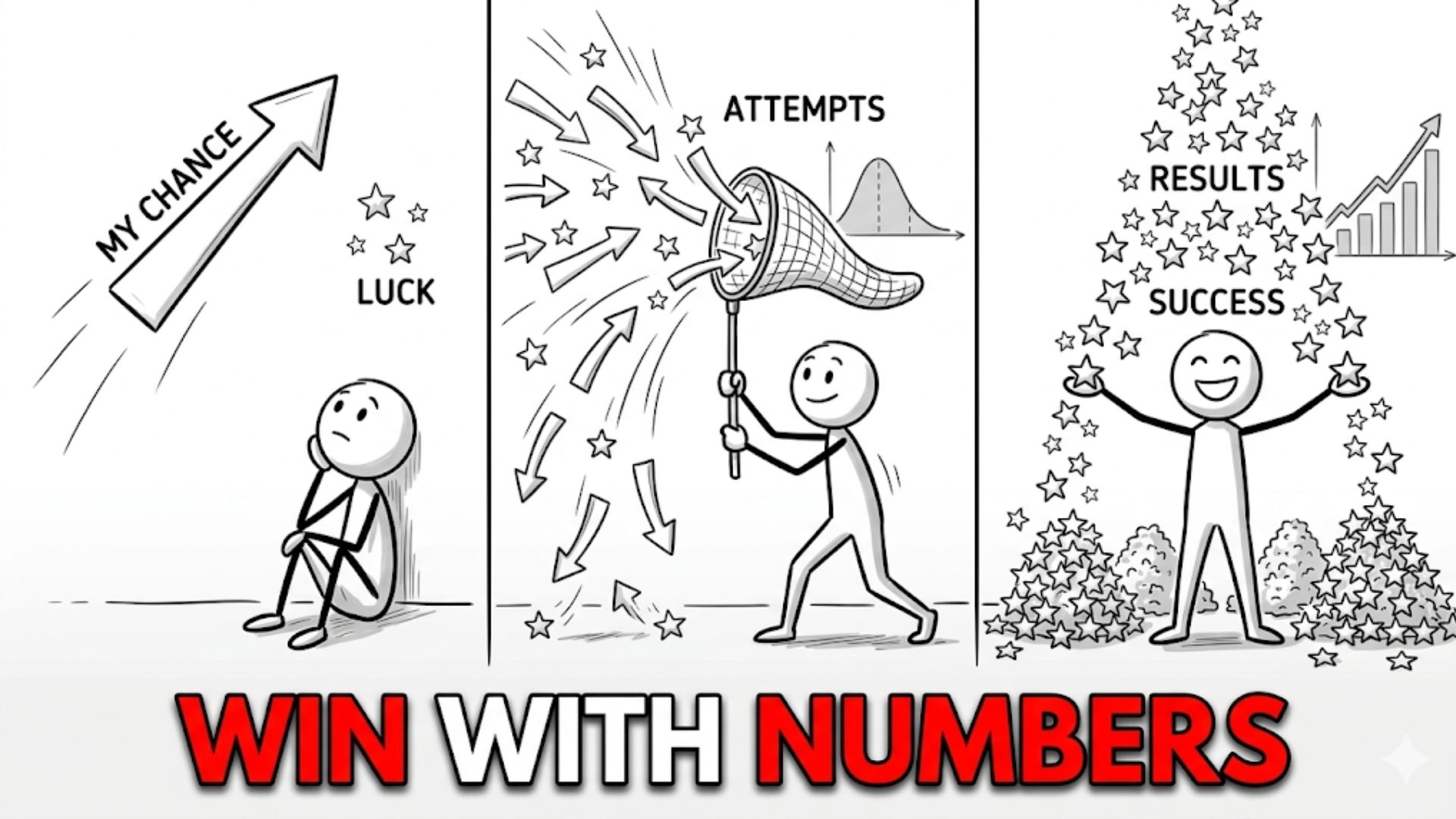
Introduction: Opportunity as a Pattern Rather Than an Event
In the dominant cultural narratives of professional and economic life, opportunity is frequently depicted as a singular, transformative event—a “lucky break,” a timely introduction, or a sudden market shift that changes a trajectory forever. These moments are described in deterministic terms, as if they were a collision between individual talent and a specific, external catalyst. However, when we strip away the narrative layers of hindsight and survivorship bias, a different structural reality emerges.
After years of studying decision-making systems, I have come to view opportunity not as a series of isolated anecdotes, but as a statistical phenomenon. It is a probabilistic outcome generated by participation in complex systems. When viewed through this lens, the arrival of a “breakthrough” is rarely a random bolt from the blue. Instead, it is the result of repeated exposure to environments with favorable probability distributions. To understand opportunity is to understand the mechanics of variance, exposure frequency, network density, and cumulative advantage. It is to move from a view of life as a series of distinct choices toward a view of life as a residency within a statistical system where the goal is to optimize the surface area of the “unseen” potential.
Read also: The Hidden Geometry of Long-Term Success
The Misconception of Singular Breakthroughs
The human brain is fundamentally a storytelling engine. We are biologically predisposed to seek linear cause-and-effect relationships to explain the world around us. In professional biographies and retrospective analyses, this manifests as “Narrative Bias”—the tendency to condense a decades-long probabilistic process into a few defining moments of decision.
By focusing on the “singular breakthrough,” we ignore the vast quantity of failed or mediocre trials that preceded it. We see the founder who met their lead investor at a random coffee shop, but we do not see the three hundred previous meetings that resulted in nothing. We interpret the coffee shop meeting as the “cause” of the success, but in statistical terms, that meeting was merely one realization in a high-variance system. The actual cause was the decision to remain in a high-exposure state where the probability of such a meeting, while low per trial, became high over a large enough sample size. This misconception leads many to wait for a “moment” of opportunity, rather than building the structural conditions that make such moments statistically likely to occur.
Opportunity as a Probabilistic System
If we define an opportunity as a favorable event with a non-zero probability of occurrence, then professional life can be modeled as a stochastic process. Opportunities emerge from repeated participation in environments where interactions are frequent and the “payoff” is skewed toward the positive.
Consider the following domains:
- Professional Networking: Each interaction is a trial. The probability of any single conversation leading to a career-defining partnership is low ($p < 0.01$). However, the more trials ($n$) conducted in a high-quality network, the higher the probability that at least one such event will occur.
- Entrepreneurial Experimentation: A startup is a series of probes into a market. Most fail. The statistical goal is not to “guarantee” success on Trial 1, but to survive enough trials to encounter a market-product fit.
- Creative Production: In fields like writing or research, the “hit” is a statistical outlier. The more volume an individual produces, the more likely they are to capture the tail of the distribution where the most significant rewards reside.
The frequency of opportunity is thus a function of the system’s underlying probability distribution and the participant’s rate of interaction. Success is less about “finding” an opportunity and more about “dwelling” in a state of high-exposure density.
Read also: A Structural Analysis of Nonlinear Progress
The Law of Large Numbers in Opportunity Exposure
In probability theory, the Law of Large Numbers (LLN) states that as the number of trials increases, the average of the results obtained from those trials should be close to the expected value.
In the context of opportunity, this principle suggests that the “luck” of an individual tends to normalize over time as the sample size of their interactions grows. An individual who performs 1,000 “trials”—whether those are job applications, sales calls, or investment pitches—is far more likely to experience the expected value of the system than someone who performs only ten.
The strategic advantage of duration is that it allows the LLN to mitigate the effects of short-term bad luck. If a system has a 5% success rate, a person who only tries five times has a high probability of experiencing zero successes. However, as n approaches infinity, the outcome becomes increasingly predictable. Individuals who are described as “lucky” are often simply those who have maintained a high rate of n over a long duration, allowing them to capture the “average” opportunity density of the system, which is far higher than the zero outcomes experienced by those who exited the system prematurely.
Variance and Uneven Outcomes
While the Law of Large Numbers suggests a normalization toward the mean, variance explains why the distribution of success remains so skewed. In a probabilistic system, outcomes are not distributed evenly across the population. Even if everyone has the same probability of success, randomness ensures that some individuals will experience a “cluster” of opportunities early on, while others will experience long droughts.
This variance is often misinterpreted as a difference in talent or worth. However, in any large-scale system, there will be “statistical outliers”—people who, through pure stochastic processes, encounter ten high-value opportunities in a row. Because we tend to ignore the “unlucky” outliers (survivorship bias), we assume that the “lucky” outliers must possess some hidden quality. In reality, their success may simply be a data point in the tail of a standard distribution. Understanding variance is essential for maintaining a neutral perspective on outcomes; it reminds us that while we can influence the probability of opportunity through exposure, we cannot control the timing of the realization.
Read also: Why Acquisition Entrepreneurship Is the Ultimate Business Mental Model
Networks as Opportunity Multipliers
If opportunity is a function of exposure, then networks are the primary mechanism for expanding that exposure. In systems theory, a network increases the number of potential connections between nodes. From a statistical perspective, a network is a “surface area multiplier.”
A dense professional network increases the likelihood of encountering “non-redundant” information—the kind of information that creates asymmetric advantage. When an individual is part of a large, diverse network, they are effectively “listening” to a wider range of the system’s probabilistic events. They hear about a job opening before it is posted; they are introduced to a partner before a deal is signed.
The probability of encountering a high-value opportunity in isolation is $p$. The probability of encountering it within a network of 1,000 people is $1 – (1-p)^{1000}$. Even if $p$ is extremely small, the network effect ensures that the probability of someone in the network encountering the opportunity approaches $1$. Being a central node in such a network increases the probability that you will be the “recipient” of that encounter.
Optionality and Asymmetric Payoffs
Nassim Nicholas Taleb has argued that in uncertain systems, optionality—the right, but not the obligation, to take an action—is more valuable than knowledge. Opportunity is fundamentally an “option.” It is a possibility that you can choose to exercise or ignore.
The statistical secret to outsized success is seeking environments with asymmetric payoff structures. These are situations where the “downside” (the cost of the trial) is small and capped, but the “upside” (the potential opportunity) is large and uncapped.
- Linear System: You work an hour, you get $50. The payoff is symmetric and predictable. There is no optionality.
- Optionality System: You write a blog post. The cost is two hours of time (capped downside). The potential upside is that it goes viral and leads to a book deal (uncapped upside).
By populating one’s life with these asymmetric “bets,” one is essentially buying a large quantity of “cheap” options. Most of these options will expire worthless (the blog post won’t be read, the introduction won’t lead to a deal). However, because the upside is so vast, a single successful realization can compensate for thousands of failures. Opportunity, therefore, is the result of collecting as many low-cost, high-upside options as possible.
Path Dependency in Opportunity Systems
Opportunities are not independent events; they are path-dependent. This means that the probability of encountering an opportunity today is heavily influenced by the opportunities you encountered (and exercised) yesterday.
This creates a “fan-out” effect. A single early-career opportunity—getting an internship at a specific firm or meeting a specific mentor—alters the future probability landscape. It moves you from one “distribution” to another. For example, being at an elite university does not “guarantee” a job, but it moves the student into a probability distribution where the “frequency of interaction” with top-tier employers is an order of magnitude higher than it is for a student at a non-elite university.
Each opportunity exercised creates a new set of “neighboring possibilities.” This is the “adjacent possible” (a concept from Stuart Kauffman). Every successful interaction expands the network and the reputation, which in turn increases the probability of even more valuable interactions in the next period. Opportunity is thus a compounding asset: the more you have, the easier it is to get more.
Read also: A Structural Analysis of Compounding in Life Systems
Feedback Loops in Opportunity Access
Path dependency is driven by reinforcing feedback loops. In a probabilistic system, success acts as a “signal” that attracts more opportunities.
Consider the “Reputation Loop”:
- Trial: An individual takes an opportunity and succeeds.
- Signal: Their reputation for competence increases.
- Exposure: Because of their reputation, they are invited to more high-stakes interactions (the “Matthew Effect”).
- Probability: The number of high-value trials increases, raising the probability of the next success.
This loop explains why the distribution of opportunity is so uneven. Those who are already “successful” are presented with more opportunities than they can handle, while those at the bottom of the distribution must struggle for even a single high-quality trial. This is not a moral failure of the system, but a structural consequence of how “signals” are used to allocate scarce attention in a high-variance world.
The Role of Time in Opportunity Accumulation
If opportunity is a function of interaction frequency, then time is the greatest multiplier. The longer one remains engaged in a system, the more interactions they accrue, and the more likely they are to reach the “tail” of the distribution where the most valuable events occur.
Time allows for the “compounding of presence.” By staying in an industry or a city for twenty years, you become a “default node” in the network. You have been around for enough trials to have experienced the “Law of Large Numbers” multiple times. In my observations, the difference between the “lucky” and the “unlucky” is often just a matter of duration. Many people exit a high-opportunity system because they experienced a short-term run of bad luck (variance), unaware that if they had stayed for another five years, the statistical normalization would have likely produced a favorable result.
Read also: The Research-Backed Blueprint for Building Truly Great Companies
Why Humans Misinterpret Randomness
The statistical nature of opportunity is difficult to perceive because of several hard-wired cognitive biases.
Hindsight Bias and Narrative Bias
After an event occurs, we look back and construct a story that makes the event seem inevitable. We say, “I got that job because I was the most qualified,” rather than saying, “I got that job because I was one of ten qualified people who happened to be in the room that day, and the interviewer happened to be in a good mood.” By removing the randomness, we fail to learn the actual lesson: that being “in the room” was the primary variable we could control.
Survivorship Bias
We study the “winners” and ignore the “losers” who took the same risks and followed the same strategies but experienced a different realization of the probability distribution. This leads to the “Heroic Founder” myth, where we attribute success to “vision” rather than to the fact that the founder happened to be the one survivor out of a thousand similar “bets.”
The Clustering Illusion
We see “clusters” of success and assume they are the result of some causal factor, when in fact, clusters are a natural feature of random distributions. Just as a coin flipped 100 times will likely produce a sequence of five heads in a row at some point, a career will likely produce a cluster of opportunities at some point. We mistake the cluster for a “peak in talent,” rather than a “peak in variance.”
Unequal Outcomes in Probabilistic Systems
The structural reality of probability is that it produces uneven distributions. In any system governed by compounding, network effects, and path dependency, the outcomes will follow a Power Law (the 80/20 rule).
In an opportunity-rich system, a small number of people will capture the vast majority of the high-value “encounters.” This is because their early “wins” (path dependency) and their central network positions (exposure frequency) create a “winner-take-all” dynamic. Even if everyone has the same initial “talent,” the statistical mechanics of the system ensure that wealth, influence, and opportunity will concentrate at the top. This is the Matthew Effect: “to those who have, more will be given.” Recognizing this as a statistical law rather than a personal failing allows for a more analytical approach to navigating professional life.
Viewing Opportunity Through a Statistical Lens
When we view opportunity through a statistical lens, our strategic priorities shift. We move away from the high-stress pursuit of “perfection” and toward the high-leverage pursuit of “exposure.”
- Instead of “the perfect job,” we seek “the highest-exposure environment”—the city or the industry where the interaction frequency is highest.
- Instead of “working harder” in a linear system, we seek “higher optionality”—activities with asymmetric payoffs.
- Instead of “isolated excellence,” we seek “network density”—becoming a connector who is exposed to the maximum amount of informational flow.
This perspective reframes “failure” as a “low-cost trial.” If you know that your success rate is 10%, then a failure is not a setback; it is a necessary data point that brings you one step closer to the inevitable 10th trial where the probability favors you. It removes the emotional weight of the “no” and replaces it with the analytical coldness of the sample size.
Conclusion: Opportunity as a Distribution of Possibilities
In the final analysis, the “big break” is a myth of the linear mind. Success in complex, modern systems is the structural result of duration, density, and exposure. Opportunities are not rare jewels waiting to be found; they are the “statistical exhaust” of a life spent in high-interaction environments.
By understanding the probabilistic nature of opportunity, we can move past the motivational clichés and focus on the actual mechanics of success. We recognize that our primary task is to manage our exposure to variance—minimizing the downside of our failures while maximizing our “surface area” for the positive outliers. Opportunity is a distribution, not a destination. It belongs to those who stay on the field, collect the options, and allow the Law of Large Numbers to do its work. In a world defined by uncertainty, the ultimate competitive advantage is not knowing the future, but building a life that is statistically prepared for it.

