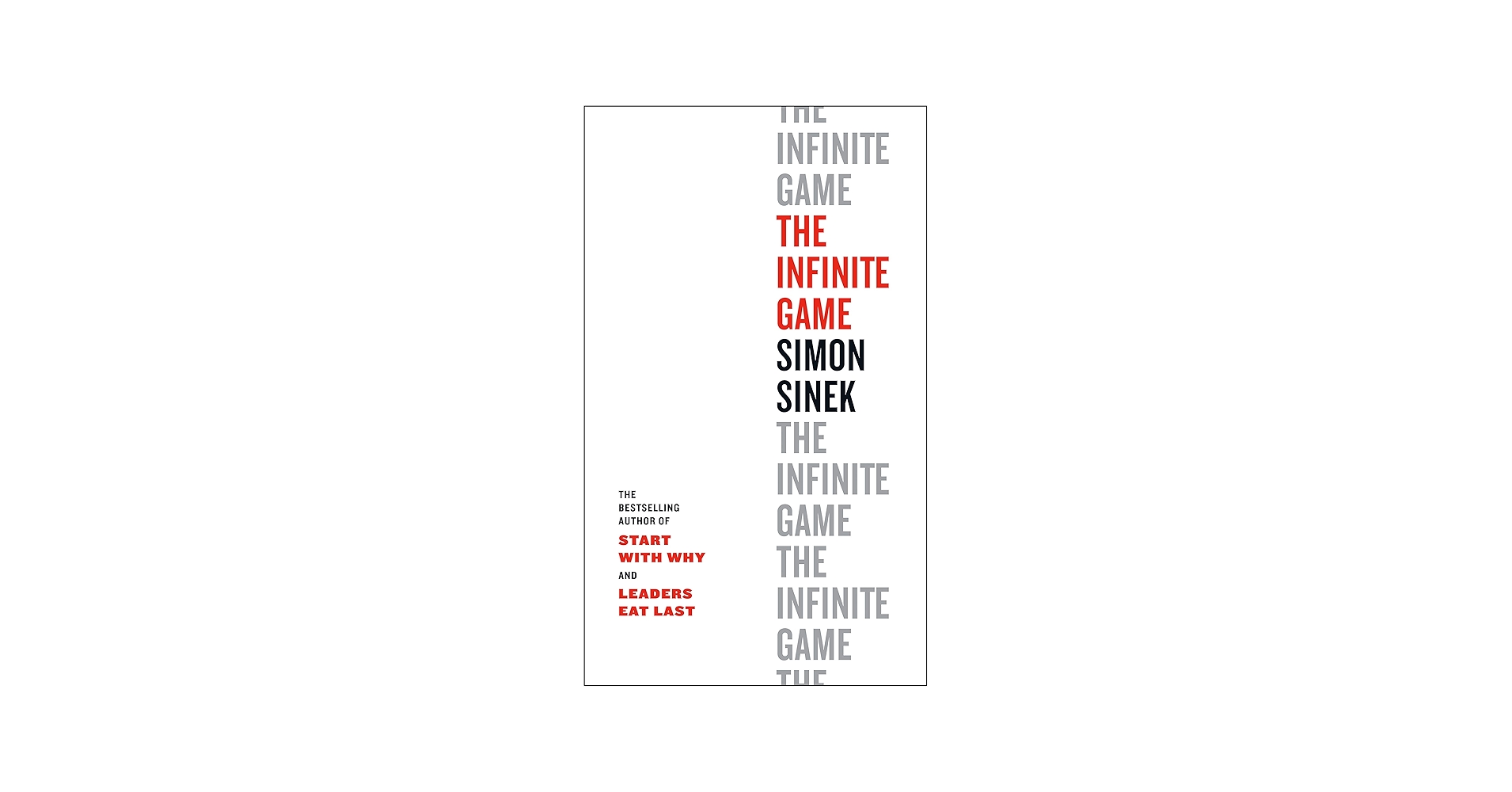
THE SNAPSHOT
| Attribute | Detail |
| Star Rating | 4.8 / 5 |
| One-Sentence Verdict | Business is an infinite game with no finish line; the objective is not to “win,” but to build an organization resilient enough to stay in the game forever. |
| Target Audience | • CEOs and Executive Leadership • Founders and Entrepreneurs • Middle Managers and Team Leads • Long-term Value Investors |
| Difficulty Level | Easy to read but mentally challenging; it requires a total deconstruction of the “winning” mindset. |
Modern leadership is facing a strategic crisis of the soul. We are using a finite playbook for an infinite game, and it is leading to the systemic rot of our most valued institutions.
——————————————————————————–
INTRODUCTION: THE FATAL FLAW OF MODERN LEADERSHIP
In the 21st century, the traditional obsession with “winning” has become a strategic liability. I see it across every boardroom: leaders fixated on being “number one” or “dominating the market.” But here is the cold, analytical reality: in a game with no finish line, the concept of winning is a logical fallacy.
Take British Airways, which long marketed itself as “the world’s favorite airline.” When Virgin Atlantic challenged this, the Advertising Standards Authority found that BA simply carried the most international passengers. They didn’t have the “most preferred” product; they simply had the most expansive operation. This is the absurdity of finite metrics—they are easily cherry-picked to manufacture a “win” that doesn’t actually exist. In business, there are no winners; there are only those who have the will and resources to keep playing, and those who drop out.
Finite vs. Infinite Games: A Strategic Comparison
| Finite Games | Infinite Games |
| Known Players: Easily identifiable (e.g., specific teams in a league). | Known & Unknown Players: New players can join at any time. |
| Fixed Rules: Referees enforce agreed-upon boundaries. | Changing Rules: No exact rules; players operate by convention or law. |
| Agreed-Upon Objectives: A clear goal that, when reached, ends the game. | Perpetuation: The objective is to keep the game going. |
| Clear Winners/Losers: Defined by score, speed, or strength (e.g., Football). | No Winners/Losers: Only those who drop out when they lack will or resources. |
Recognizing the game you are in is the first step toward true leadership resilience. If you apply finite rules to an infinite contest, trust declines, cooperation evaporates, and innovation stagnates.
Read also: Why Experimentation Functions as the Primary Engine of Innovation
——————————————————————————–
THE 5 ESSENTIAL PRACTICES OF AN INFINITE MINDSET
Adopting an infinite mindset is the “operating system” for any organization seeking to survive its leaders. These are not optional “perks”; they are the requirements for long-term health.
3.1 Advance a Just Cause
A Just Cause is a specific vision of a future state that does not yet exist—a state so appealing that people are willing to make sacrifices to reach it. It must be affirmative, optimistic, and service-oriented.
Consider Nikolai Vavilov, who dedicated his life to a seed bank to end world hunger. During the Siege of Leningrad, his team of scientists protected those seeds while facing starvation. Nine of them died of hunger while surrounded by tons of edible seeds and potatoes.
The Strategic “So What?”: Why does this matter to you? A Just Cause is the only force capable of overriding the biological instinct for self-preservation. Just as those scientists refused to eat the “seed corn” of humanity, an infinite leader must protect the “seed corn” of innovation and R&D during a market downturn, rather than sacrificing the future for a quarterly metric.
3.2 Build Trusting Teams
High performance is a byproduct of trust, not the other way around. On the Shell URSA oil rig, Rick Fox transformed a “tough-guy” culture into a “Trusting Team.” The result was an 84% decline in accidents and 43% outperformance of industry benchmarks.
The Analytical Reality: Trust is not just a “feeling”—it is a data-transmission strategy. In a “tough-guy” culture, information flow is strangled because people are afraid to admit mistakes. On the URSA rig, trust allowed for the free flow of critical data: “I’m not sure how to read this meter” or “I need help.” Trust ensures that the most vital information reaches the people who need it most.
The Navy SEALs Performance vs. Trust Matrix reinforces this:
- High Performance / Low Trust: This is the “Toxic Leader”—or as the SEALs call them, the “asshole.” They avoid them at all costs.
- Medium Performance / High Trust: This is the “Ideal Teammate.”
The SEALs (and the best business leaders) prioritize trust over raw technical competence. I would rather have a medium performer I can trust with “my money or my wife” than a high performer who only cares about their own career trajectory.
3.3 Study Worthy Rivals
In the Infinite Game, we do not have “competitors” to beat; we have Worthy Rivals. A rival is another player whose strengths reveal your weaknesses, forcing you to improve.
Look at Apple vs. Microsoft. At a Microsoft summit, presenters spent 100% of their time talking about “beating Apple.” At an Apple summit, 100% of their time was spent on “helping teachers teach.” When the Zune HD was released, Apple didn’t panic even though it was arguably a better product than the iPod. They weren’t trying to outdo Microsoft; they were trying to outdo themselves.
3.4 Prepare for Existential Flexibility
Existential Flexibility is the capacity to initiate a radical disruption of your own successful business model to better advance a Just Cause.
Victorinox, the maker of the Swiss Army knife, faced an existential threat after 9/11 when knives were banned from carry-on luggage. Instead of defensive layoffs, their “generation-based” thinking allowed them to pivot into watches, travel gear, and fragrances. They doubled their revenue by being willing to transform themselves to stay in the game.
3.5 Demonstrate the Courage to Lead
Infinite leadership is difficult because it defies the chemical “dopamine hit” of finite wins. The addiction to the quarterly win is a chemical dependency that is killing your culture. It takes immense courage to resist investor pressure and prioritize the long-term “will” of your people over the short-term “resources” of the market.
Read also: My Journey Through the Timeless Art of Connection
——————————————————————————–
THE QUAGMIRE: THE DANGERS OF FINITE THINKING
When finite leadership is applied to an infinite game, it creates systemic rot. Microsoft under Steve Ballmer is the cautionary tale. Ballmer focused on “13 years of profit,” but the culture became a mess of silos. Innovation stalled because managers were rewarded for “strangling” ideas that threatened the status quo.
This rot is fueled by the philosophy of Shareholder Primacy (Milton Friedman), which argues that the sole purpose of business is to make money for owners. Contrast this with Consumer Primacy (Adam Smith), where the producer’s interest is attended to only to promote the consumer’s interest. When we gutted the Glass-Steagall Act in the 1980s and 90s, we removed the protections that had prevented market instability. The result? Three major crashes in quick succession: 1987, 2000, and 2008.
Symptoms of Finite Rot:
- Obsession with arbitrary short-term metrics.
- Declining trust and cooperation (Information Silos).
- Stagnation of innovation (Risk Aversion).
- Employees in “Self-Preservation Mode” (Hoarding information and hiding mistakes).
——————————————————————————–
CRITICAL ANALYSIS: IS THE INFINITE MINDSET REALISTIC?
Critics argue that in today’s cutthroat capital markets, an infinite mindset is a luxury. I argue it is a necessity. An infinite mindset does not reject profit; it recognizes that Profit is Fuel, not the destination. You don’t buy a car just to buy gas; you buy gas to take the car somewhere.
Will vs. Resources: Finite leaders see “Will” (morale, trust, commitment) as an expense to be managed or cut. Infinite leaders see Will as a renewable resource that generates Fuel. When Will is strong, employees offer “discretionary effort”—they innovate and solve problems because they want the company to survive them.
The “So What?” is in the data. Organizations that focus on purpose and trust (like Apple or Costco) see retention rates around 90%, compared to the retail average of 20%. By focusing on the infinite, these companies ironically achieve superior long-term financial performance.
Read also: The Neuroscience Behind How I Rewired My Habits
——————————————————————————–
PROS AND CONS
Pros:
- Provides a profound paradigm shift from transactional to transformational leadership.
- Focuses on human-centric resilience, essential in a disruptive economy.
- Offers a clear framework for building deep loyalty among employees and customers.
Cons:
- Highly conceptual; may feel abstract to leaders accustomed to purely tactical execution.
- Repetitive for those already familiar with Sinek’s Start With Why, though it provides the necessary “How” to that “Why.”
——————————————————————————–
CONCLUSION: CHOOSING FULFILLMENT OVER VICTORY
We do not choose the rules of the game of business—it is infinite by nature. However, we can choose how we play. You can choose the path to Victory—which is finite, adrenaline-fueled, and ends quickly—or you can choose the path to Fulfillment.
The path to Victory ends when you reach the finish line and the crowd goes home. The path to Fulfillment is a journey where the goal is to outlast your leaders and inspire the next generation to carry on. When you embrace an infinite mindset, you don’t just build a stronger company; you build a life worth living.
Stop trying to “win” and start trying to “outlast.”
[Buy The Infinite Game Book on Amazon]
What is your Just Cause? Share your vision and let’s begin the journey toward a more resilient future.