

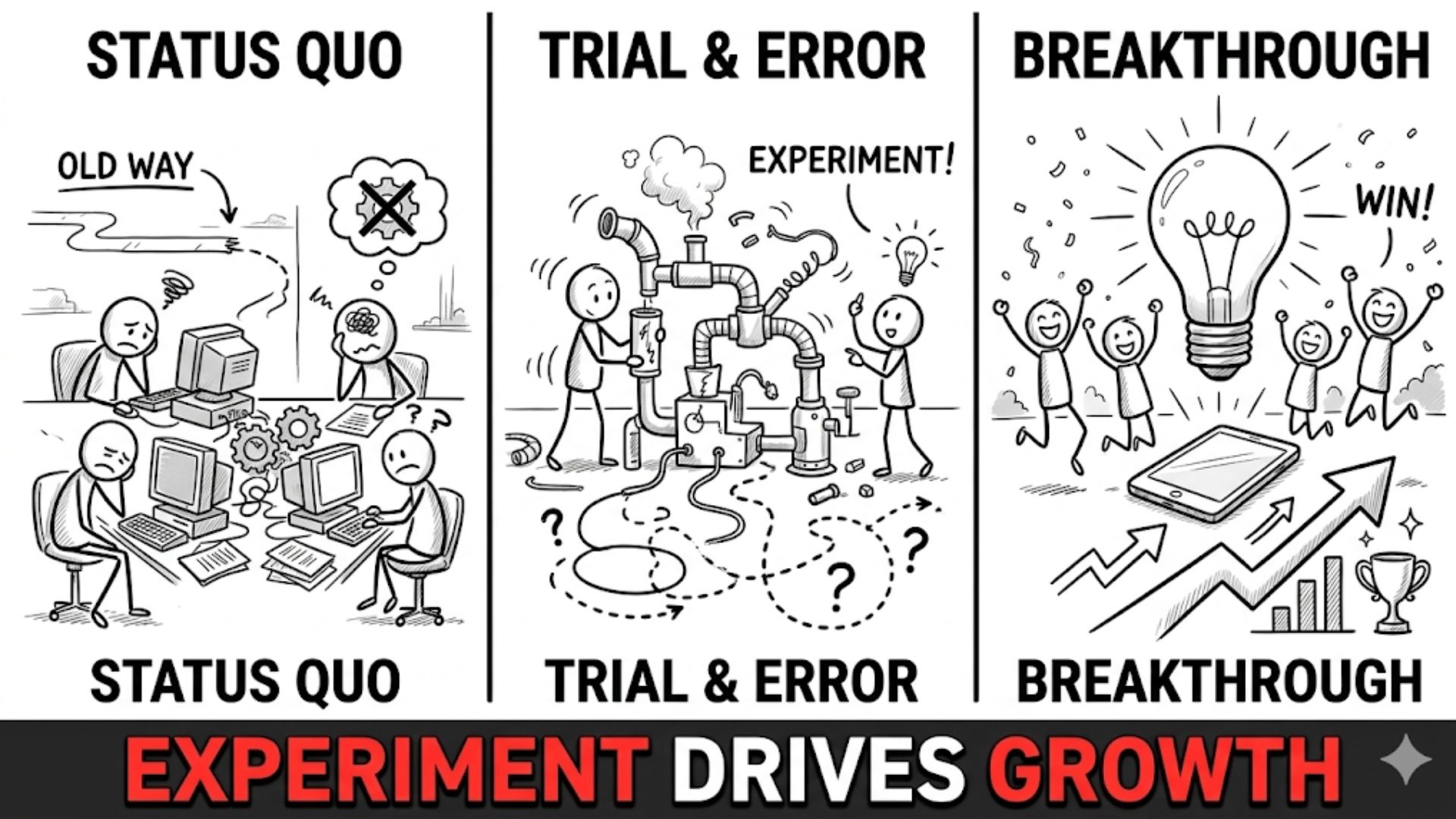
Introduction: Innovation as a Discovery Process
In the prevalent narratives of modern industry and academia, innovation is frequently portrayed as the culmination of strategic foresight, rigorous planning, or the sudden clarity of individual genius. We are socialized to view the trajectory of progress as a linear ascent, where a visionary “sees” the future and then executes a plan to bring that future into existence. This perspective is deeply rooted in the enlightenment tradition of rationalism, which suggests that if we possess sufficient data and computational power, the next breakthrough is merely a matter of logical deduction.
However, a longitudinal analysis of scientific, technological, and economic history suggests a fundamentally different structural reality. When one examines the emergence of transformative technologies—from the advent of the steam engine and the discovery of penicillin to the development of the transistor and contemporary machine learning architectures—the pattern is rarely one of precise prediction. Instead, these breakthroughs are almost universally the product of iterative experimentation within highly uncertain environments.
Innovation is more accurately modeled not as a planning process, but as a discovery process. It is a stochastic search across a vast, multidimensional landscape of possibilities. In this landscape, the “correct” path is obscured by the complexity of interacting variables and the inherent unpredictability of human behavior and material science. Consequently, the primary determinant of a system’s innovative capacity is not the quality of its predictions, but the volume and velocity of its experiments. This essay will explore the structural mechanisms that make experimentation the fundamental engine of progress in uncertain systems, arguing that the rate of innovation is a direct function of a system’s ability to perform, fail, and learn from repeated trials.
Read also: My Journey Through the Timeless Art of Connection
The Limits of Predictive Planning
The reliance on predictive planning in innovation assumes that the future is “computable”—that we can map the causal chains of a new technology before it exists. In systems theory, this is a fallacy of reductionism. Complex systems, such as the global economy or the frontier of biotechnology, are characterized by emergent properties: outcomes that cannot be predicted by looking at the individual components in isolation.
Consider the development of the internet. While its creators understood the packet-switching protocols they were designing, they could not have predicted the emergence of social media, the gig economy, or the decentralization of global finance. These outcomes resulted from the interaction of the technology with billions of human agents, each with their own incentives and behaviors.
Because the search space for innovation is so vast and the variables so interconnected, the “error bars” on any long-term prediction are so wide as to make the prediction strategically useless. In environments of high uncertainty, the more one relies on a single, deterministic plan, the more fragile the innovation system becomes. If the initial assumptions are wrong—and in a complex system, they almost certainly will be—the entire project collapses. Experimentation serves as the structural antidote to this fragility. It replaces the “big bet” on a single prediction with a “portfolio of trials” that can adapt to the shifting terrain of reality.
Experimentation as a Probabilistic Search
If innovation is a search across an unknown landscape, then every experiment is a “probe” designed to return a data point. From a probabilistic perspective, the goal of an innovation system is to maximize the likelihood of encountering a high-value outlier—the “breakthrough.”
The relationship between experimentation and discovery can be expressed as a function of the number of trials (n) and the probability of success per trial (p). If we define P(S) as the probability of at least one significant discovery, the relationship is:
P(S) = 1 – (1 – p)^n
Even if p (the probability of success for any single experiment) is infinitesimally small, as n (the number of trials) increases, P(S) approaches 1. This is the Law of Large Numbers applied to innovation.
Structural innovation, therefore, is less about “being right” and more about “increasing n.” The more experiments a system can perform per unit of time and capital, the more likely it is to hit the “tail” of the distribution where the transformative ideas reside. This is why decentralized markets often outperform centralized command economies in innovation; a market allows for thousands of simultaneous, independent experiments (n), whereas a centralized bureau is usually limited to a few, highly vetted plans.
Read also: The Economics of Optionality
Variation and Selection in Innovation Systems
The mechanics of innovation bear a striking resemblance to the Darwinian process of biological evolution. In both systems, progress is achieved through the interaction of three structural forces: variation, selection, and retention.
- Variation: Experimentation is the primary generator of variation within an innovation system. By trying different combinations of materials, code, or business models, researchers and entrepreneurs create a “population” of diverse ideas.
- Selection: The environment—whether it is the laws of physics, the feedback of a laboratory, or the competition of the marketplace—acts as the selector. It “kills off” the experiments that do not work and preserves the ones that do.
- Retention: The successful outcomes are codified into institutional knowledge, patents, or software, forming the base for the next generation of variation.
In this framework, “failure” is not a waste of resources; it is a vital signal. A failed experiment provides the system with the information that a specific path is a dead end, allowing it to reallocate resources to more promising areas. An innovation system that suppresses failure effectively suppresses variation, thereby halting the evolutionary process of progress.
Asymmetric Payoffs in Discovery
The economic logic of experimentation is driven by asymmetric payoff structures. In most innovation-driven fields, the “downside” of an experiment is limited (usually the cost of the trial), while the “upside” is uncapped.
This is a convex payoff profile. If you are looking for a new drug, 99 experiments might cost $1 million each and return zero. However, the 100th experiment might discover a compound that generates $10 billion in value. The “success” does not just compensate for the “failures”; it renders them statistically irrelevant.
Innovation systems thrive when the cost of a “trial” is low relative to the potential “reward.” This is why software has seen more rapid innovation than nuclear energy in recent decades; the “cost per experiment” in software is near zero, allowing for a massive n. In nuclear energy, the cost per experiment is in the billions, which reduces n and, consequently, the rate of discovery. The strategic objective of any innovation policy should be the reduction of the “cost per trial” to enable a higher frequency of probabilistic search.
Read also: The Neuroscience Behind How I Rewired My Habits
Feedback Loops and Iterative Improvement
Experimentation is rarely a “one-off” event. It is an iterative process where the results of one trial inform the parameters of the next. This creates a reinforcing feedback loop that gradually narrows the search space toward a viable solution.
In engineering, this is often described as the OODA loop (Observe, Orient, Decide, Act). Each experiment allows the system to “Observe” the reality of the material or market, “Orient” its internal models based on that reality, “Decide” on a new hypothesis, and “Act” by performing the next trial.
The speed of this loop—the “iteration velocity”—is often more important than the initial starting point. A system that starts with a mediocre idea but iterates quickly will almost always surpass a system that starts with a “brilliant” idea but iterates slowly. This is because the fast-iterating system is “learning” from the environment at a higher frequency, allowing it to correct its errors and exploit new information in real-time.
Optionality and Innovation
The systems thinker Nassim Nicholas Taleb has argued that innovation is a product of optionality. An “option” is the right, but not the obligation, to take an action. Experimentation is the process of “buying” these options.
When an organization performs many small experiments, it is essentially creating a portfolio of call options on the future. Most of these options will expire worthless (the experiments fail). However, by having many options open, the organization is “exposed” to the positive volatility of the world. When a “Black Swan” event—an unexpected discovery or a sudden market shift—occurs, the organization with the most “options” in that area is the one that can capture the upside.
Optionality allows a system to be “antifragile”—it actually benefits from disorder and uncertainty. Instead of trying to resist change through rigid planning, the innovative system uses experimentation to “surf” the waves of uncertainty, knowing that the more the world changes, the more valuable its diverse portfolio of exploratory paths becomes.
Network Effects and Collaborative Experimentation
Innovation is seldom an isolated event; it is a network phenomenon. The probability of discovery is amplified when multiple agents are experimenting in a shared environment and sharing the results of their trials.
This is the “spillover effect” of knowledge. When a researcher in a hub like Kendall Square or Shenzhen fails in a specific way, the “lesson” of that failure often permeates the local ecosystem through informal networks, papers, or labor mobility. This reduces the cost of trials for everyone else in the network, as they no longer need to repeat the same “failed” experiment.
Collaboration and open-source models accelerate innovation by turning the entire world into a laboratory. Instead of a single firm performing n experiments, a global network performs n x 1,000. This collective search is far more powerful than any individual entity’s predictive capacity. The “intelligence” of the system is distributed across the nodes, and the rate of progress is determined by the “liquidity” of information—how easily the results of experiments can flow from one node to another.
Read also: A Structural Analysis of Probabilistic Systems
Why Innovation Clusters Emerge
The existence of innovation clusters—Silicon Valley for software, Basel for pharmaceuticals, Hollywood for media—is a direct consequence of the structural need for high experimentation density.
These clusters serve as high-collision environments. They maximize the “interaction frequency” between capital, talent, and ideas. In a dense cluster, the “cost per trial” is lower because the infrastructure for experimentation (specialized labs, legal expertise, venture capital) is already in place. Furthermore, the “signal-to-noise ratio” is higher because the network is constantly filtering for the most successful experiments.
Innovation clusters are effectively “probability machines.” They do not produce breakthroughs because the people there are inherently “smarter,” but because the density of the network allows for a higher n per square mile. The cluster is an ecosystem that has optimized for variation and selection, creating a self-reinforcing loop that attracts more “experimenters,” further increasing the n and the probability of the next breakthrough.
Institutional Incentives and Experimentation
Despite the clear structural advantages of experimentation, many institutions are built on incentives that actively discourage it. Bureaucracies, both corporate and governmental, often prioritize predictability and efficiency over discovery.
- Risk Aversion: In many organizations, the “cost of a failed experiment” is not just the capital lost, but the reputational damage to the individual. If failure is punished, rational actors will only propose experiments with a high probability of success (p). This leads to “incrementalism”—minor improvements on existing ideas—and prevents the system from searching the “tails” where the true innovation lies.
- Short Performance Cycles: Quarterly earnings reports and annual reviews force a focus on “exploitation” (maximizing the current model) rather than “exploration” (finding the next model).
- The Planning Fallacy: Institutions often reward those who present the most “certain” plan, regardless of whether that certainty is grounded in reality. This creates a “theatrical” environment of prediction that masks the lack of actual exploratory search.
For an institution to be innovative, it must decouple the “incentive for effort” from the “outcome of the experiment.” It must treat the performing of the trial as the valuable act, regardless of whether the result is a “success” or a “failure.”
Read also: The Timeless Blueprint for Character and Leadership
Behavioral Biases Against Experimentation
The structural barriers to experimentation are reinforced by deep-seated psychological biases. Human cognition is not “built” for probabilistic search; it is built for social signaling and the avoidance of immediate loss.
- Loss Aversion: The pain of losing $1 million on a “failed” experiment is felt twice as acutely as the joy of a $1 million “gain.” This leads individuals to avoid the “trials” necessary for long-term growth.
- The Need for Closure: Ambiguity is cognitively exhausting. Most people would rather have a “wrong” plan than “no” plan. This pushes organizations toward deterministic strategies that feel comfortable but are structurally fragile.
- Hindsight Bias: After an experiment succeeds, we look back and say, “It was obvious.” This reinforces the “prediction myth” and makes us forget that the discovery was actually the result of a lucky outlier in a sea of failed trials.
Overcoming these biases requires a “cultural architecture” that celebrates curiosity and intellectual humility. It requires the recognition that in an uncertain world, the phrase “I don’t know, let’s test it” is the most scientifically and economically rigorous position one can take.
Uneven Outcomes in Innovation Systems
Because innovation is a power-law process driven by asymmetric payoffs, the outcomes are highly unequal. A few successful experiments—the “hits”—account for the vast majority of the economic value and societal impact.
This inequality is not a failure of the system; it is a feature of its geometry. If you have 1,000 experiments searching for a solution, and only one finds it, that one experiment possesses the total value of the “solution.” This “winner-take-most” dynamic is why innovation-driven economies (like the modern US or parts of East Asia) show such high levels of wealth concentration and geographic clustering.
The system is designed to “harvest” the outliers. For the individual or the firm, this means that the only way to achieve outsized success is to be “on the field” when the outlier occurs. This requires staying power—the ability to survive the 99 failures so that you are still present for the one success. Strategic duration and the avoidance of “ruin” are the primary requirements for capturing the non-linear rewards of the innovation system.
Read also: Why You Don’t Need a $100,000 Degree to Understand Business
Viewing Innovation Through Probabilistic Systems
When we view innovation through the lens of probabilistic systems, many of the mysteries of technological progress become easier to explain.
We stop asking, “Why was Steve Jobs so smart?” and start asking, “What were the properties of the ecosystem that allowed Jobs to perform so many high-leverage experiments?” We move from a “Great Man” theory of history to a “Great System” theory.
We realize that the “breakthrough” is not the cause of progress, but the exhaust of the experimental engine. If you have a system with:
- High variation (many different ideas being tested)
- High interaction (ideas colliding in a network)
- Low cost of failure (allowing for many trials)
- Asymmetric payoffs (rewarding the outliers)
Then innovation is no longer a mystery; it is an inevitable statistical outcome. The “brilliance” of the innovator is often their ability to sustain a higher rate of trials and a higher level of optionality than their competitors, allowing them to eventually collide with the “random” discovery that the rest of the world calls “vision.”
Conclusion: Innovation as Structured Exploration
The structural engine of human progress is not the map, but the compass. In the vast, uncertain terrain of the future, prediction is a weak tool that often leads to fragility and incrementalism. The most robust and successful systems—be they biological, economic, or technological—are those that recognize the primacy of experimentation.
Innovation is a probabilistic search process. It requires a commitment to variation, a tolerance for failure, and an architectural openness to the unexpected. By increasing the number of experiments, reducing the cost of trials, and maximizing the flow of information through networks, we can expand the range of possible discoveries.
The strategic insight for the systems thinker is clear: to accelerate innovation, one must stop trying to “see” the future and start trying to “touch” as much of it as possible. We do this through the relentless, iterative, and often messy process of experimentation. The breakthroughs we celebrate in hindsight are merely the terminal points of a long, statistical journey through the unknown. The future does not belong to those with the best plans, but to those with the most experiments.

