Introduction: The Advantage That Rarely Gets Mentioned
In the myriad of post-mortems and strategic analyses I have conducted over the years—ranging from the collapse of established financial institutions to the non-linear ascent of “overnight” successes—there is a visible bias toward the immediate. When we dissect success, we gravitate toward tangible, high-status variables: the IQ of the founder, the volume of venture capital deployed, the proprietary nature of the technology, or the density of a professional network. These factors are legible; they can be measured, benchmarked, and presented in a pitch deck.
However, after decades spent observing how systems evolve over twenty- and thirty-year horizons, I have come to believe that we are systematically ignoring the most potent multiplier in the equation: time.
Time is not merely a background variable or a passive medium in which events occur. In complex systems, time functions as a structural competitive advantage. It is the silent engine of compounding, the prerequisite for trust, and the natural filter that removes the majority of one’s competition. Individuals and organizations that possess the structural and psychological capacity to operate with longer time horizons—what I call “strategic duration”—frequently outperform peers who are objectively more talented, better funded, or more “intelligent” by conventional metrics. In many domains, the ultimate strategic edge is simply the ability to stay in the game longer than anyone else.
Read also: Why Working IN Your Business Is Slowly Destroying It
Why Humans Underestimate Time
The systemic underestimation of time is not a failure of education, but a byproduct of our biological architecture. Human cognition is fundamentally optimized for the “now.” In an ancestral environment, the immediate feedback loop of survival—securing food, avoiding predators—was the primary driver of reproductive success. We did not evolve to calculate the terminal value of a thirty-year compounding curve.
The Present Bias and Temporal Discounting
Behavioral economics identifies this as present bias—the tendency to overvalue immediate rewards at the expense of much larger, future ones. When we are presented with a choice between a moderate gain today and a significant gain in five years, the limbic system’s demand for immediate utility often overrides the prefrontal cortex’s analytical preference for long-term growth.
This is further exacerbated by hyperbolic discounting, where the perceived value of a reward drops precipitously as the delay increases. Because the early stages of any long-term endeavor (investing, skill acquisition, or brand building) are characterized by high effort and low visible output, the human mind perceives the “cost” as real and the “reward” as abstract. Consequently, most participants exit the system precisely at the moment when the “interest” on their effort is beginning to accrue.
Read also: Why Financial Education Changes Behavior
Compounding Requires Time
The mathematical reality of compounding is that its power is “back-loaded.” In the formula for future value, $FV = PV(1 + r)^n$, the exponent ($n$)—representing time—is the most significant variable. Yet, because the initial growth is a percentage of a small base, it remains beneath the threshold of visibility for a substantial portion of the duration.
The Invisibility of Early Compounding
Consider the accumulation of knowledge. In the first three years of learning a complex discipline—be it quantitative finance or molecular biology—the practitioner is essentially building a “lattice of mental models.” To an outside observer, and often to the practitioner themselves, there is little to show for the effort. There are no breakthroughs, only the slow, arduous work of internalizing syntax and foundational principles.
However, compounding is occurring in the background. Each new piece of information is easier to retain because it has more “hooks” to attach to. Eventually, the practitioner reaches a tipping point where their ability to synthesize new information and recognize patterns becomes non-linear. They appear “brilliant,” but the brilliance is merely the terminal phase of a decade-long compounding process that most people abandoned in year three.
The Hidden Curve of Long-Term Progress
Most high-value trajectories in business and careers do not follow a linear path. They follow a curve. This “Hidden Geometry of Success” means that the relationship between input and output is decoupled for long periods.
The Plateau of Latent Potential
In the early stages, the curve is almost indistinguishable from a flat line. I have observed many founders who spent five years in a “plateau of latent potential,” refining a product or a distribution model with zero market recognition. To the short-term observer, these individuals were failing.
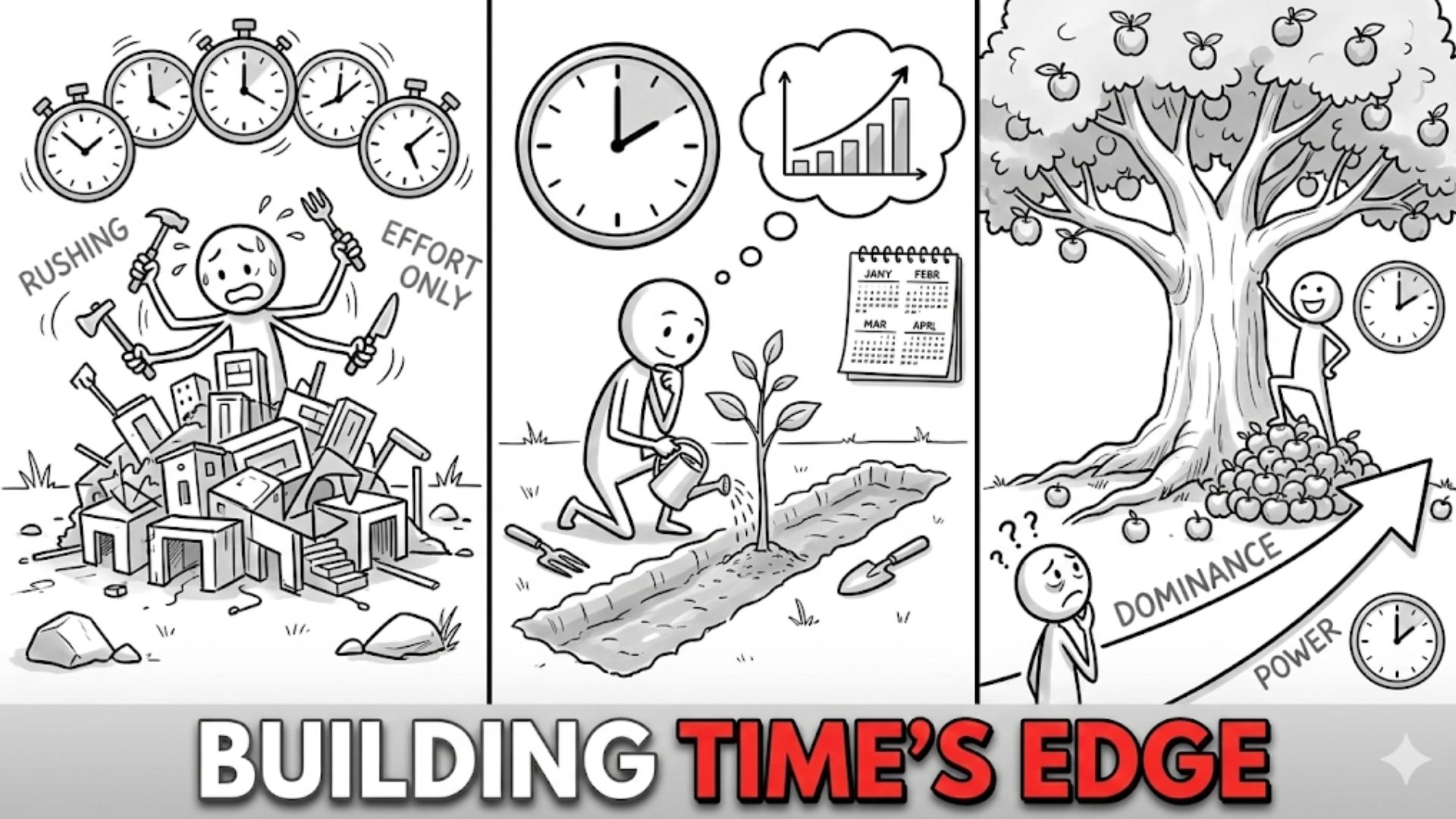
But for those who understand the curve, this period is a structural requirement. It is the phase where the “cost of entry” is paid. Success in these systems is not a staircase; it is an explosion that occurs after a long period of invisible preparation. Those who remain in the system long enough to reach the “knee” of the curve capture a disproportionate share of the total rewards, precisely because the flat phase acted as a filter that removed their less-patient competitors.
Read also: The Psychology of Holding vs Selling Assets
Time Horizon as a Strategic Edge
Strategic duration creates a “time arbitrage.” It allows an individual or an organization to make decisions that are objectively superior but appear sub-optimal or even irrational to those on shorter horizons.
Patient Capital and Brand Integrity
In the corporate world, an organization with a ten-year time horizon can invest in R&D or employee retention programs that a company beholden to quarterly earnings cannot. A long-term brand can afford to lose money on a transaction to preserve its reputation for integrity. To a short-term thinker, this is a “loss.” To a long-term strategist, this is the purchase of a compounding asset: trust.
By extending the time horizon, you effectively change the rules of the game. You are no longer competing on “speed” or “intensity”—domains where others can easily match you—but on “duration,” a domain where almost everyone is structurally or psychologically compromised.
Learning and Experience Compound Over Time
Intelligence is often overrated; pattern recognition is underrated. The latter is a function of time.
Deep Expertise and the “Lindy Effect”
In my observations of elite professionals, what is often mistaken for “innate talent” is actually the result of deep exposure. After twenty years in a field, an individual has seen enough market cycles, technological shifts, and institutional failures to develop an “intuitive” grasp of the system. This is the Lindy Effect applied to human capital: the idea that the longer a piece of knowledge or a skill has remained relevant, the longer it is likely to stay relevant.
Someone who has been in the game for thirty years possesses a “lattice” of historical data points that a newcomer, regardless of their IQ, cannot replicate. They understand not just “what” works, but “why” it works across different contexts. This deep intuition creates an intellectual moat. The newcomer is forced to think from first principles (which is high-effort), while the long-term participant can think in patterns (which is high-leverage).
Read also: Why Simplicity Wins in Personal Finance
Reputation and Trust Systems
Reputation is the “equity” of a career, and trust is the “currency” of high-stakes environments. Neither can be manufactured quickly; both require time as a primary ingredient.
The Trust Premium
In high-velocity markets, transaction costs are high because parties must engage in extensive due diligence to protect themselves from bad actors. However, in “long-term networks,” where participants have known each other for decades, the transaction costs drop to near zero. A deal can be closed on a handshake because the reputational cost of betrayal is higher than the potential gain of the fraud.
A reputation for reliability and integrity takes twenty years to build and five minutes to destroy. This asymmetry is why time is such a powerful filter. Most people, under short-term pressure, will eventually “harvest” their reputation for a quick gain. Those who refuse to do so—who prioritize their “long-term brand” over immediate utility—become the most valuable nodes in their ecosystem. They are the only people who can be trusted with the most sensitive and high-leverage opportunities.
Opportunity Access Through Time
Success is often a function of “surface area for luck.” The longer you stay in a field, the more likely you are to be in the “room where it happens” when a Black Swan event—a transformative opportunity—occurs.
The Ecosystem Effect
High-value opportunities are rarely distributed through open markets; they are distributed through “closed loops” of long-term participants. I have seen countless examples where the “best” opportunities (in venture capital, high-level advisory, or strategic partnerships) were given to a participant not because they were the most qualified, but because they were the most persistent.
By simply remaining active and credible in an ecosystem for a decade or more, an individual becomes a “default node.” They are the person who everyone knows, and consequently, they are the first person people call when a high-stakes problem arises. This access is not a result of “networking” in the superficial sense; it is a result of duration.
Read also: How Loss Aversion Impacts Portfolio Decisions
The Opportunity Cost of Short-Term Thinking
The cost of impatience is not just a lack of progress; it is the total destruction of the compounding clock.
The Reset Mechanism
Every time an individual switches industries because they aren’t “finding success,” or every time an investor “chans” their strategy because they had a bad quarter, they are resetting their compounding exponent back to zero. They are paying the “entry fee” of the flat phase over and over again without ever staying long enough to reap the geometric rewards.
Consistency is the ultimate competitive advantage because it is so rare. Most people are “optimizing” their way into mediocrity by constantly chasing the highest immediate return. They fail to realize that the 7% return compounded for thirty years is infinitely more powerful than the 30% return that they abandoned after eighteen months.
Why Institutions Often Encourage Short-Term Behavior
We must acknowledge that most people operate in environments that are structurally designed to punish long-term thinking. This is the Principal-Agent Problem at a temporal scale.
The Measurement Trap
Public companies are judged on ninety-day cycles. Managers are judged on annual reviews. These short performance cycles create a “perverse incentive”: the agent (the employee or the CEO) is rewarded for hitting a short-term target, even if it degrades the long-term health of the institution (the principal).
For example, a CEO might cut R&D or employee training to “smooth” an earnings report and trigger a bonus. The “cost” of this decision won’t be felt for five years—long after the CEO has moved on to their next role. This institutional churn ensures that “time” is never allowed to function as an advantage. Consequently, the individual or the private firm that is not beholden to these cycles has a massive, structural “arbitrage” opportunity.
Read also: The Cost of Overconfidence in Investing
The Uneven Outcomes of Time-Based Systems
Systems governed by compounding and cumulative advantage do not produce “fair” or “normal” distributions. They produce Power Laws.
The Winner-Take-Most Dynamic
In many domains—wealth, media reach, academic citations—the top 1% of participants capture 50% or more of the total rewards. This is often seen as a failure of the system, but from a structural perspective, it is the natural result of time-based compounding.
The individual who has been compounding their skills and reputation for thirty years is not 1.5 times better than the person with twenty years; they may be ten times more valuable because they have reached the “vertical” phase of the curve. Time amplifies small differences in talent and effort into massive disparities in outcome. This is why “staying in the game” is the most important prerequisite for extreme success.
Time as a Strategic Filter
Perhaps the most elegant way to view time is as a “Natural Filter.”
The Persistence Arb
In the early stages of any difficult endeavor, there is a high density of participants. However, as time passes, people exit the system for a variety of reasons:
- Impatience: They didn’t see results quickly enough.
- Uncertainty: They lost faith in the strategy.
- Social Pressure: Their peers appeared to be moving faster on other paths.
- Biological/Life Events: They lacked the structural “cushion” to stay in the game.
By the time you reach year ten or fifteen of a specific path, the vast majority of your initial competition has disappeared. You don’t necessarily have to “beat” them; you simply have to outlast them. Success, in this sense, is an “endurance sport.” The prize goes to the last person standing, not the first person to start.
Read also: Why Long-Term Thinking Is a Financial Advantage
Long-Term Thinking as a Strategic Mindset
Viewing decisions through a long-term lens fundamentally changes one’s internal “valuation model.” It moves you away from “transactional” thinking and toward “systemic” thinking.
Interpreting Risk and Progress
On a one-year horizon, volatility (the ups and downs) looks like “risk.” On a twenty-year horizon, volatility is just “noise,” and the only true risk is permanent impairment of capital (being forced to exit the game).
Similarly, long-term thinkers interpret “progress” differently. They don’t look for a spike in the chart; they look for the health of the underlying “compounding engine.” Is the reputation still intact? Is the knowledge base still growing? Is the network still deepening? If the answer is “Yes,” the short-term lack of results is irrelevant. The mathematics of time ensures that the results will eventually arrive, and they will be disproportionate.
Conclusion: Time as a Multiplier of Advantage
In my years of studying the mechanics of success, I have found that while talent, intelligence, and capital are important, they are ultimately linear variables. Time is an exponential variable.
A person with moderate talent but a thirty-year time horizon will almost always end up in a better position than a person with extreme talent who resets their clock every three years. Time amplifies every other advantage you possess. It deepens your expertise, solidifies your reputation, expands your network, and multiplies your capital.
The structural beauty of time as a competitive advantage is that it is “fair” but “difficult.” Everyone has the same amount of it, but very few have the structural discipline or the psychological independence to use it effectively. In a world of increasing information velocity and short-term distraction, the ability to think in decades is the ultimate strategic edge. It is not an inspirational slogan; it is a mathematical certainty. Those who understand how time interacts with compounding systems do not just win; they win at a scale that is incomprehensible to those who are still optimizing for the next ninety days.