- Star Rating: 4.5/5
- The Verdict: A punchy, two-step formula to pick winning stocks without an MBA, designed to exploit the “madness” of the stock market.
- Best For: Beginners, Lazy Investors, and System-Based Traders.
- Difficulty: Very Easy.
- Buy the Book: The Little Book that Beats the Market
If you have ever felt like the stock market is a “secret club” reserved for guys in expensive suits and PhDs in astrophysics, you aren’t alone. Most people approach investing by chasing hot tips from a neighbor or blindly trusting “middlemen” who drain their wealth through 2% management fees. This high-level summary is your strategic starting point for escaping that cycle. For the “Lazy Investor,” this is the escape hatch from the “dynamite factory” of blind stock picking. We aren’t here to gamble; we are here to use a systematic approach that turns Wall Street’s volatility into your greatest advantage.
Many are skeptical of “magic” solutions in finance—and they should be. But when the solution comes from Joel Greenblatt, a man whose firm, Gotham Capital, produced 40% annual returns for twenty years, it’s time to stop squinting and start reading.
——————————————————————————–
INTRODUCTION: The Hook (Can a Formula Really Beat the Pros?)
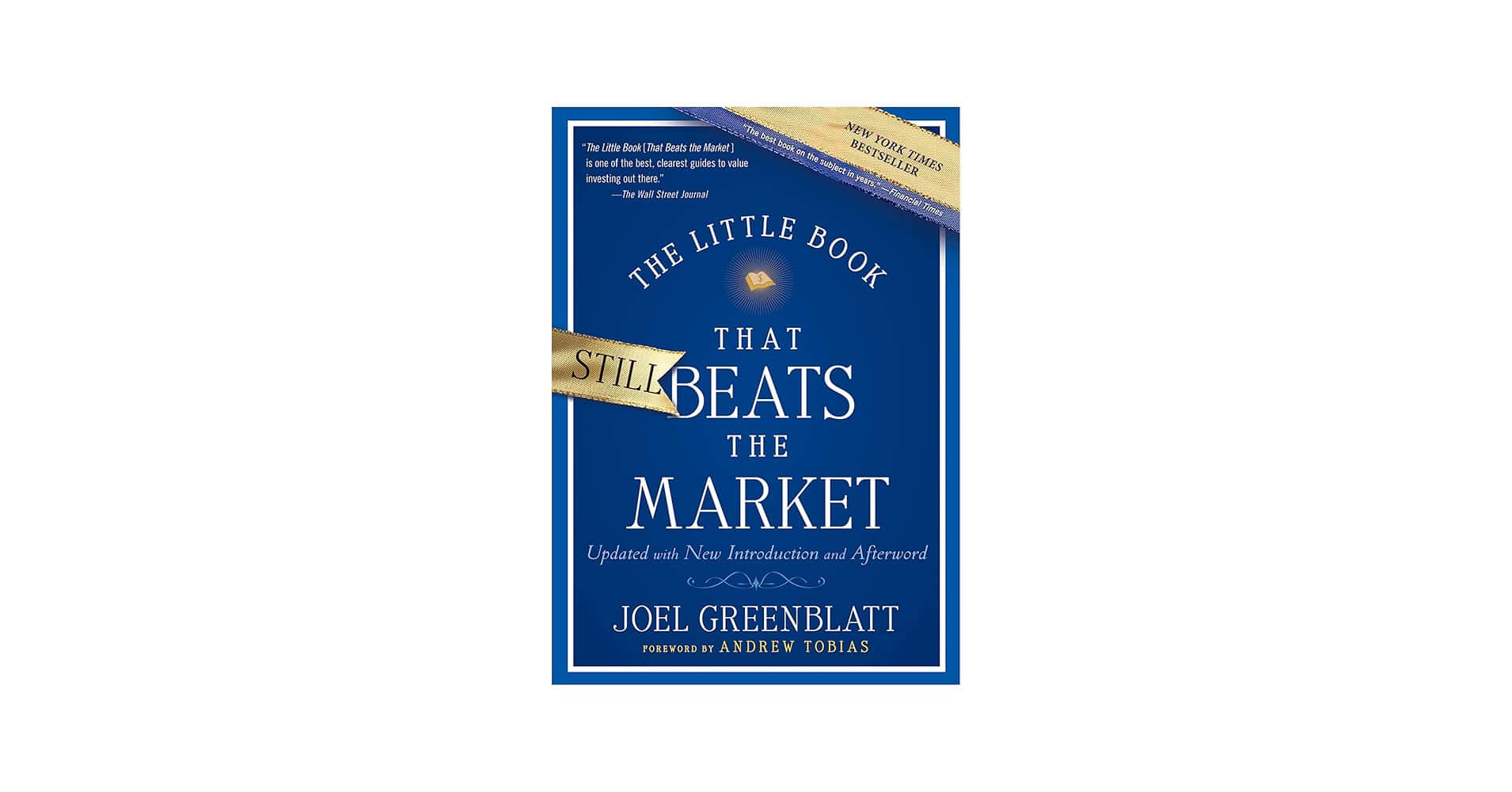
Can a simple formula really beat the smartest minds on Wall Street? Most people think investing requires a crystal ball or a supercomputer. Joel Greenblatt disagrees. He wrote The Little Book That Beats the Market as a jargon-free guide for his children, proving that the principles of wealth aren’t complex—they just require discipline.
Greenblatt’s motivation was radical honesty: he knew that most professional money managers fail to beat the market averages. He wanted to give his kids a “gift that keeps on giving”—the ability to make money for themselves. His strategy isn’t based on luck; it’s based on the “madness of the markets.”
Consider the price of Amazon. In a single year, its price fluctuated between $1,377 and $2,012—a 50% difference. Did the actual value of the company’s warehouses and technology change by half in twelve months? Of course not. The same happened with Gap, America’s fashion giant. In one year, you could have bought Gap for as low as $18 per share or as high as $31—a swing of more than 70%. Did Gap sell 70% more clothes in the month it was $31 than the month it was $18? No. The market was simply overreacting to short-term noise.
Greenblatt argues that “choosing individual stocks without any idea of what you’re looking for is like running through a dynamite factory with a burning match.” You might survive, but you’re still an idiot. The Joel Greenblatt strategy is designed to replace emotional “voting” with systematic “weighing.”
Read too: The Essays of Warren Buffett Summary: Timeless Wisdom from the Oracle of Omaha
A Lesson in Chasing Weather Balloons
Before we dive into the math, let’s talk about a lesson in saving. When Greenblatt was a kid, he wasted his money on things like imitation dog vomit and whoopee cushions from the Johnson Smith catalog. His biggest “investment” was a 10-foot-tall, 30-foot-round weather balloon.
He and his brother managed to inflate it by reversing the airflow on a vacuum cleaner. The problem? The balloon was bigger than their front door. They eventually squeezed it outside, but they forgot a basic law of physics: hot air rises. They had filled the balloon with warm air from inside the house. They spent the next four minutes chasing a giant balloon down the street until it popped on a tree.
The lesson? Saving money is the first step, but the second step is not chasing “balloons” that pop the moment they hit the real world. You need a strategy that keeps your money on the ground and growing.
——————————————————————————–
THE MAGIC FORMULA EXPLAINED
The core of Magic Formula Investing explained boils down to a single, elegant thesis: Buying above-average companies at below-average prices. To do this, the formula ranks companies based on two primary factors: Return on Capital (ROC) and Earnings Yield.
Factor 1: High Return on Capital (ROC) – Buying “Good” Companies
The first step is identifying a “good” business. To explain this to a fifth-grader (or a confused adult), Greenblatt uses the “Jason’s Gum Shop” analogy. Jason is a sixth-grader who sells gum at school. He buys a pack for $0.25 (containing five sticks) and sells each stick for $0.25. That’s $1.25 in sales for a 0.25 investment—a **1.00** pure profit per pack.
Greenblatt’s son, Matt (whom he calls “Ben” in the book), did the math: If Jason sells four packs a day, that’s $4.00 a day, 20.00 a week, and over **700** a school year. When Greenblatt asked Matt how much he’d pay to buy half of Jason’s business for the next six years, Matt realized that paying 1,500** now to get **1,500 back over six years was a “no way” deal.
In the corporate world, we look at Return on Capital (ROC)—or for beginners, Return on Assets (ROA)—to see how much profit a company generates compared to the cost of its “store.” If it costs Jason $400,000 to build a chain of professional gum shops, and those shops generate $200,000 in annual profit, his Return on Capital is 50%.
Compare that to “Just Broccoli,” a chain run by a guy named Jimbo. Jimbo also spends $400,000 to build a store, but he only makes $10,000 in profit. Jimbo’s ROC is a pathetic 2.5%. If a 10-year U.S. Government bond pays you 6% for doing nothing, Jimbo is literally throwing money away by building stores. The Magic Formula ranks companies to find the Jasons and avoid the Jimbos.
Factor 2: High Earnings Yield – Buying them at “Cheap” Prices
A great business is a bad investment if you pay too much for it. This is where Earnings Yield comes in. Think of this as the “sale price” of a company’s profits. Greenblatt uses the “Swedish Merchant” analogy to simplify this.
Imagine your friend owns “The Swedish Merchant,” a shop that made 100,000** in profit last year. If your friend wants to sell you the shop for **1,000,000, your Earnings Yield is 10% ($100k / $1M). This is also known as a P/E ratio of 10 (Price/Earnings). Essentially, it will take you 10 years to get your initial investment back in profits.
Now, what if the price for that same 100,000** in profit was **2,000,000? Your Earnings Yield drops to 5%, and your P/E ratio jumps to 20. It would now take 20 years to pay yourself back.
The Joel Greenblatt strategy looks for companies with the highest Earnings Yield. If the government gives you a “risk-free” 6% on a bond, you should never buy a business that yields only 5%. You want the highest yield possible for the lowest price.
——————————————————————————–
STEP-BY-STEP: HOW TO USE THE MAGIC FORMULA
You don’t need a team of analysts to run this. In fact, managing this yourself avoids the “middleman” drain. Why pay a 2% fee to a fund manager who is just as likely to panic as you are? Here is the seven-step process:
- Establish Market Cap Restrictions: Go to magicformulainvesting.com. For most individual investors, a minimum market cap of 50 million** is the starting point. However, to “raise the bar” and ensure you are buying more stable, liquid companies, you can set the limit to **200 million or higher.
- Exclude Utilities and Financials: The formula doesn’t work for banks or power companies because their balance sheets are weird (lots of debt and different accounting for “capital”).
- Rank by ROC: The system looks at the remaining thousands of stocks and ranks them from 1 to 3,500 based on their Return on Capital (using ROA as a reliable proxy for beginners).
- Rank by Earnings Yield: The same companies are then ranked based on how “cheap” they are.
- Combine Ranks: The formula adds the two ranks. If a company is 200th in ROC and 100th in Earnings Yield, its score is 300. We want the lowest combined scores—these are our “Good and Cheap” winners.
- Portfolio Construction: Don’t buy all at once. Buy 5 to 7 of the top-ranked stocks every few months until you own a diversified portfolio of 20 to 30 stocks.
- The Rebalancing Rule (The Tax Loophole): Hold each stock for exactly one year. To be “actionable” and tax-efficient: sell your “losers” a few days before the one-year mark (to claim a short-term tax loss) and sell your “winners” a few days after the one-year mark (to qualify for lower long-term capital gains tax).
——————————————————————————–
DOES IT STILL WORK IN 2026?
Critics often worry about “Value Traps” or a “Tech-Heavy” market. They think the “Magic” has worn off. But value investing for beginners is timeless because human emotion is timeless. Greenblatt uses Benjamin Graham’s “Voting Machine vs. Weighing Machine” analogy: In the short term, the market is a popularity contest (a voting machine). In the long term, it is a scale that measures actual profit (a weighing machine).
We must be honest about “EEAT” (Experience, Expertise, Authoritativeness, and Trustworthiness): the formula’s returns are “lumpy.” Source data shows the formula underperforms the market in 5 out of 12 months and fails to beat the averages in 1 out of every 4 years. There have even been periods where it underperformed for three years in a row. This “lumpiness” is exactly why it keeps working—it scares away the impatient people, leaving the bargains for those of us who stay disciplined.
The Psychology of Sticking With It
Greenblatt tells the story of the “Smartest Money Manager I Know.” This manager had a brilliant, disciplined system that produced incredible long-term results. However, during a few years of underperformance, his clients panicked. They pulled their money at exactly the wrong time. Only four original clients remained to see the strategy eventually trounce the market.
Most investors fail because they lack the “bones” to stay through 2-3 years of red numbers. To succeed, you have to believe in the logic deep in your soul. If you buy a 1,000** bill for **500, you shouldn’t care if the neighbors think it’s only worth $400 today. Eventually, the “Weighing Machine” will show the truth.
——————————————————————————–
PROS AND CONS
| Pros | Cons |
| Removes Emotion: Stops you from panic-selling or chasing “hot” tips. | Lumpy Returns: Can underperform the market for 2-3 years at a time. |
| Low Time Commitment: Requires only about 2 hours of work per year. | Tax Implications: High turnover means you must be diligent about the “One-Year Rule.” |
| Proven Track Record: Historically tested at 30.8% annual returns vs. the S&P 500’s 12.3%. | Requires “Peter Pan” Belief: You must have faith in the system even when it’s “unpopular.” |
| Margin of Safety: Buying at a discount protects you from “Mr. Market’s” mood swings. | Psychological Stress: Watching “Magic” stocks drop while others rise is mentally taxing. |
The Margin of Safety is your ultimate defensive strategy. If you estimate a stock is worth $70 and buy it at $37, you have a massive cushion. Even if your estimates are slightly off, that gap protects you from losing your shirt.
——————————————————————————–
AUDIENCE FILTRATION: WHO SHOULD AVOID THIS?
Simplicity is the ultimate sophistication, but it isn’t for everyone. You should skip this strategy if you fall into these categories:
- The Get-Rich-Quick Chaser: This formula builds wealth over years and decades. If you are looking for a “10x” return by next Tuesday, go to a casino.
- The Emotionally Volatile: If you will stay awake at night because your portfolio is down 10% while the market is up, the psychological toll will lead you to quit at the worst possible time.
- The MBA-Over-Complicator: Some people believe that if a strategy isn’t complex, it can’t be sophisticated. They would rather use a failed, complex prediction model than accept that 2+2=4.
——————————————————————————–
CONCLUSION: WHY SIMPLE BEATS COMPLEX
The stock market is essentially a crazy business partner named Mr. Market. Every day, he offers to buy your share of a business or sell you his. Some days he’s manic and asks for a fortune; other days he’s depressed and offers you 1,000** bills for **500.
The Magic Formula and the Margin of Safety are your tools to survive this madness. By focusing on High Return on Capital and High Earnings Yield, you are systematically buying the best businesses at the best prices. You don’t need to be a genius; you just need to be disciplined enough to let the “Weighing Machine” of the market eventually get the price right.
——————————————————————————–
CALL TO ACTION
Stop reading and start doing. The market won’t wait for you to feel “ready.”
- Step 1: Buy The Little Book That Beats the Market on Amazon to fully grasp the psychology behind the math.
- Step 2: Visit magicformulainvesting.com tonight. Run your first screen. Look at the names.
- Step 3: Commit to the “One Year Rule.”
Your future self—the one who isn’t chasing weather balloons down the street—will thank you.