


Ancient philosophy, practical outcomes: I came to Stoicism during a particularly difficult professional period — not because I was looking for philosophy, but because nothing else I was trying was working. I found a 2,000-year-old operating system for difficult circumstances. This article is about what I actually took from it, what I discarded, and the five specific practices I still use daily.
How I encountered Stoicism — and why I was skeptical
I first encountered Stoicism through Ryan Holiday’s The Obstacle Is the Way, which I picked up during a period when a project I had invested heavily in was collapsing in slow motion. I was not looking for ancient Greek philosophy. I was looking for something that would help me function while watching something I had built fall apart.
My initial skepticism was professional: Stoicism felt like resignation dressed up as wisdom. The idea that you should accept what you cannot change seemed, on first encounter, like a sophisticated rationalization for passivity. I nearly put the book down.
What kept me reading was the realization that I had misunderstood the central argument. Stoicism is not about accepting outcomes passively. It is about distinguishing with precision between what you can and cannot influence — and then applying every available effort to the former while releasing the psychological energy wasted on the latter. That distinction changed my relationship with the situation I was in more effectively than anything else I tried.
Read also: Why Knowing What You Don’t Know Is the Smartest Thing You Can Do
The core Stoic idea that changed everything
The Stoics identified a simple but powerful distinction that underlies almost all of their practical philosophy: the difference between things that are “up to us” (eph’ hēmin in Epictetus’s Greek) and things that are “not up to us.”
“Some things are in our control and others not. Things in our control are opinion, pursuit, desire, aversion, and, in a word, whatever are our own actions. Things not in our control are body, reputation, command, and, in one word, whatever are not our own actions.”— Epictetus, Enchiridion
The practical consequence of this distinction is significant: if you direct your effort and emotional investment primarily toward things outside your control — outcomes, other people’s behavior, reputation, external events — you will experience perpetual frustration, because these things resist your control regardless of effort. If you direct the same effort and investment toward things within your control — your response, your judgment, your preparation, your values — you are operating in a domain where your agency is genuine.
This is not the same as not caring about outcomes. The Stoics cared deeply about outcomes. They simply distinguished between the effort applied to achieving them (within your control) and the attachment to the result itself (not within your control). That distinction, applied consistently, transforms the relationship with both adversity and uncertainty.
The dichotomy of control — the most practical framework in philosophy
Your judgments
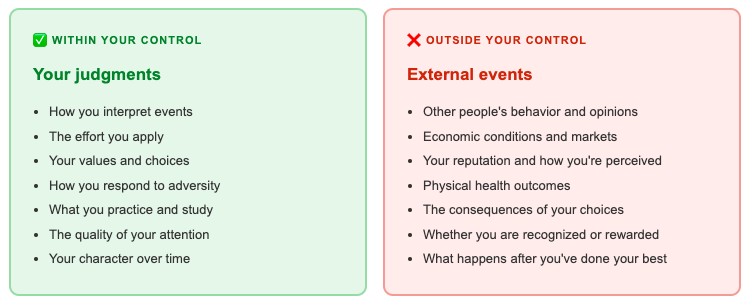
The Stoic prescription is not to ignore external events — but to hold them “indifferently”: to take intelligent action toward good outcomes while releasing the emotional attachment to those outcomes as if they were within your full control. This is a difficult practice. It is also genuinely useful in the way that few philosophical positions are.
Read also: What I Learned After Getting It Badly Wrong
Practice 01
The morning audit — setting the day’s direction before the day sets it for you
“When you wake up in the morning, tell yourself: the people I deal with today will be meddling, ungrateful, arrogant, dishonest, jealous and surly.” — Marcus Aurelius, Meditations
Marcus Aurelius began each day with a deliberate mental rehearsal — not pessimistic, but preparatory. He thought through the challenges the day might present, not to dread them but to be neither surprised nor destabilized when they arrived. I have adapted this into a five-minute morning practice: I identify one thing I expect to be difficult today, apply the dichotomy of control to it (what is and isn’t within my control about it), and decide in advance how I intend to respond.
This practice has almost entirely eliminated the reactive emotional responses that used to derail my first hour of work. Not because the difficult things stopped happening — they didn’t — but because I had already decided how I would respond to them before they required a response. Decision quality improves dramatically when it isn’t made under conditions of surprise and emotional activation.
Practice 02
Negative visualization — deliberately imagining loss to appreciate what you have
“Begin at once to live, and count each separate day as a separate life.” — Seneca, Letters
Negative visualization (premeditatio malorum) is the Stoic practice of deliberately imagining the loss or absence of things you currently have — relationships, health, work, possessions — not to cultivate fear but to counter the hedonic adaptation that makes familiarity breed indifference.
In practical terms: I occasionally take five minutes to sit with the thought of losing something I currently take for granted — the ability to work, a relationship I value, a capability I rely on. This is uncomfortable in exactly the way the practice intends. The result is a genuine, non-performed sense of appreciation for what is currently present, and a corresponding reduction in the ambient dissatisfaction that comes from chasing what isn’t.
This is also, not coincidentally, the same cognitive structure as the premortem and the 10-10-10 framework I use in decision-making — deliberately imagining negative futures to make better choices in the present.
Practice 03
The view from above — scaling perspective when things feel catastrophic
“How small a part of the boundless and immeasurable time is assigned to every man.” — Marcus Aurelius, Meditations
When a situation feels overwhelming, the Stoics recommended a deliberate exercise of scaling perspective: mentally zooming out from the immediate moment to the week, the year, the decade, and the span of a human life. Not to minimize what is real, but to place it in a context that the immediate emotional experience systematically obscures.
I use this practice most often when I’ve made a mistake that is costing me something — money, reputation, a relationship. In the immediate aftermath, mistakes feel permanent and defining. The view from above practice asks: will this matter in ten years? In twenty? The honest answer is almost always either no, or yes in a much smaller and more manageable way than the immediate experience suggests.
This is not denial. It is temporal recalibration — deliberately engaging the longer time horizon that the immediate emotional response has temporarily made invisible.
Practice 04
Voluntary discomfort — deliberately choosing small hardships to build resilience
“Set aside a certain number of days during which you shall be content with the scantiest and cheapest fare. This is not the same as fasting, but something far more useful.” — Seneca, Letters
The Stoics practiced deliberate, occasional voluntary discomfort — fasting, sleeping on hard surfaces, going without heat or cold — not as asceticism but as a specific training method. The goal was to discover, in low-stakes conditions, that the feared discomfort was survivable and less terrible than the imagination of it. This reduces the fear’s power over decision-making in high-stakes situations.
My version of this is more modest: I occasionally take cold showers when I want hot ones, skip meals when I’m mildly hungry, or deliberately choose the harder physical option when an easier one is available. The specific discomforts are minor. The psychological effect — the repeated discovery that what I’m avoiding is less terrible than the avoidance behavior suggests — is disproportionately significant.
This practice also directly addresses procrastination. Most procrastination is the avoidance of anticipated discomfort. Voluntary discomfort practice builds a specific kind of evidence: that the anticipated discomfort, when actually experienced, is rarely as bad as feared.
Practice 05
The evening review — honest accounting without self-punishment
“I will keep constant watch over myself and — most usefully — will put each day up for review.” — Seneca, On Anger
Seneca’s evening review was a practice of honest daily accounting — not to produce guilt but to produce learning. He would ask himself three questions before sleep: Where did I fall short? Where did I act well? What would I do differently?
The Stoic framing differs from typical self-improvement journaling in one important way: the review is evaluative but not punitive. Seneca describes it as a judge conducting an inquiry rather than a prosecutor making accusations. The purpose is calibration, not condemnation.
I keep a brief evening log — three to five lines, not a full journal entry — that answers these questions specifically. The practice takes four minutes. The effect on behavioral consistency over time has been more significant than any other single habit I’ve maintained.
My honest assessment — what Stoicism doesn’t solve
Stoicism is not a complete answer to the full range of human experience. I want to be honest about its limits alongside its genuine value.
Stoicism is excellent for managing adversity, reducing reactive emotional behavior, building consistency of character, and developing a long-term perspective on short-term setbacks. It is less useful — and can even be actively harmful — as a response to genuine grief, trauma, or clinical mental health challenges. The Stoic injunction to “not be troubled” by things outside your control can, applied without discernment, become a rationalization for emotional suppression rather than processing.
The Stoics were also writing in a specific social context — almost entirely men of privilege in the ancient world — and some of their prescriptions about acceptance carry implicit assumptions about what is and isn’t changeable that deserve scrutiny when applied to systemic injustices rather than personal adversity.
These are real limitations. They don’t eliminate the genuine practical value of the dichotomy of control, the negative visualization practice, or the daily review. But they are important context for treating Stoicism as one useful tool among many rather than a complete philosophy of life.
Read also: Why Vivid Events Feel More Probable Than They Actually Are
Conclusion: philosophy as a tool, not an identity
The most useful reframe I have found for Stoicism is to treat it as a toolkit rather than an identity. I am not a Stoic. I use specific Stoic practices because they work, in the same way I use specific decision frameworks because they work and specific learning techniques because they work.
The five practices I’ve described — morning audit, negative visualization, view from above, voluntary discomfort, and evening review — are what survived my own testing across several years and different circumstances. Some Stoic ideas I’ve read didn’t survive that testing. These did, consistently and repeatedly, producing measurable changes in how I handle adversity, how I make decisions under pressure, and how I relate to outcomes I can’t control.
Start here — the single most accessible Stoic practice
The next time something frustrating or disappointing happens, pause before responding and ask one question: “Is this within my control or outside it?” If it is outside your control, ask: “What is within my control about how I respond to it?”
That two-question pause is the entire Stoic dichotomy of control in practice. It takes about fifteen seconds. In my experience, it produces a meaningfully better response in about 70% of the situations where I’ve applied it — and it gets more reliable with repetition.

