The question that cuts through indecision: In 1994, Jeff Bezos was a senior vice president at a hedge fund. He had a well-paying, secure career. He was also considering leaving it to start an online bookstore — an idea most rational people around him considered a bad bet. To make the decision, he developed a framework so simple it fits in two sentences: project yourself to age 80, and ask which choice you would regret more. That framework changed his life. It has also changed several significant decisions of mine.
How Bezos described it — in his own words
In a 2001 interview that has since become widely referenced in decision-making circles, Jeff Bezos described the framework he used to decide to leave his stable Wall Street career to found Amazon:
“I wanted to project myself forward to age 80 and say, ‘Okay, now I’m looking back on my life. I want to have minimized the number of regrets I have.’ And I knew that when I was 80, I was not going to regret having tried this. I was not going to regret trying to participate in this thing called the internet that I thought was going to be a really big deal. I knew that if I failed I wouldn’t regret that, but I knew the one thing I might regret is not ever having tried.”— Jeff Bezos, 2001
The framework he describes is disarmingly simple. It does not require modeling expected value, mapping probability distributions, or constructing elaborate decision trees. It requires one cognitive operation: temporal projection. Place your perspective at age 80. Look back at the decision you’re currently facing. Evaluate both options from that vantage point. Choose the option that produces less regret from that perspective.
What makes this framework powerful is not the projection itself — it is which regret it systematically surfaces. And that asymmetry, once understood, changes how you approach every significant choice.
Read also: How Stoicism Changed My Approach to Adversity — And 5 Practices I Still Use Every Day
Why the framework works — the psychology of regret
The effectiveness of the regret minimization framework is grounded in a specific and well-documented asymmetry in how human beings experience regret over long time horizons. The research on this — most compellingly summarized in Daniel Kahneman’s work and in studies by Tom Gilovich and Victoria Medvec — consistently finds the same pattern: in the short term, people regret their actions more than their inactions. Over the long term, people regret their inactions more than their actions.
The short-term regret of action is vivid and immediate: “I took a risk and it didn’t work out.” The long-term regret of inaction is a quieter, more persistent ache: “I never tried.” The action regret is associated with a concrete, visible failure. The inaction regret is associated with an entire alternative path of life that was foreclosed — and that counterfactual can grow in the imagination indefinitely.
The regret minimization framework leverages this asymmetry by asking you to evaluate the decision from the vantage point where long-term regret dominates — age 80 — rather than from the present moment where short-term risk is most salient.
The two types of regret — and why one dominates at 80
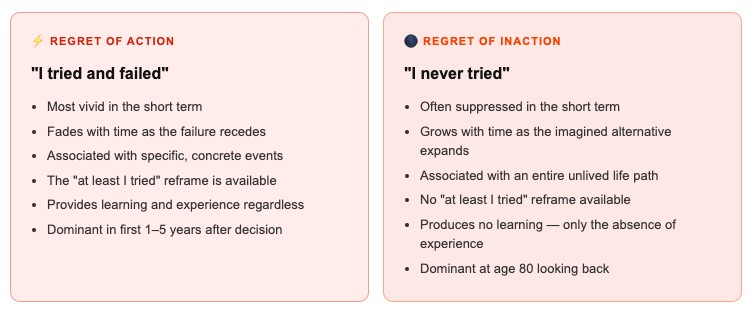
Understanding this asymmetry is the key insight. The framework doesn’t tell you that you should always take risks or always make the bold choice. It tells you that when you evaluate options from the perspective of your 80-year-old self, the fear of failure — which is what produces most short-term risk aversion — recedes significantly, and the cost of not having tried becomes much more salient.
Read also: Why Knowing What You Don’t Know Is the Smartest Thing You Can Do
How to apply the framework — step by step
- State the decision clearly and specifically Write it down in one sentence. “Should I leave my current role to start this business?” “Should I move to a new city for this opportunity?” “Should I pursue this relationship seriously?” The clearer the decision, the more specific and useful the projection will be.
- Project yourself to age 80 — vividly and specifically This is not a casual thought experiment. Spend two to three minutes genuinely imagining yourself at 80. Where are you? Who is with you? What does your life look like? The more specific the projection, the more reliable the regret assessment it produces. A vague 80-year-old self produces a vague answer.
- Evaluate Option A from that vantage point “If I take Option A — if I stay, if I don’t try, if I choose the safe path — how does my 80-year-old self feel about that?” Write the answer honestly. Don’t edit for what you think you should feel. What does the actual projection produce?
- Evaluate Option B from the same vantage point “If I take Option B — if I go, if I try, if I take the risk — and it fails completely, how does my 80-year-old self feel about having tried?” Note: include the failure scenario explicitly. The framework is not asking which option will succeed — it is asking which failure you can live with better from the perspective of a full life.
- Choose the option that produces less regret from 80 The answer is often clearer from this vantage point than from the present. If it isn’t — if both options produce similar regret levels from 80 — the decision may not be as consequential as it currently feels, or it may require a different framework to resolve.
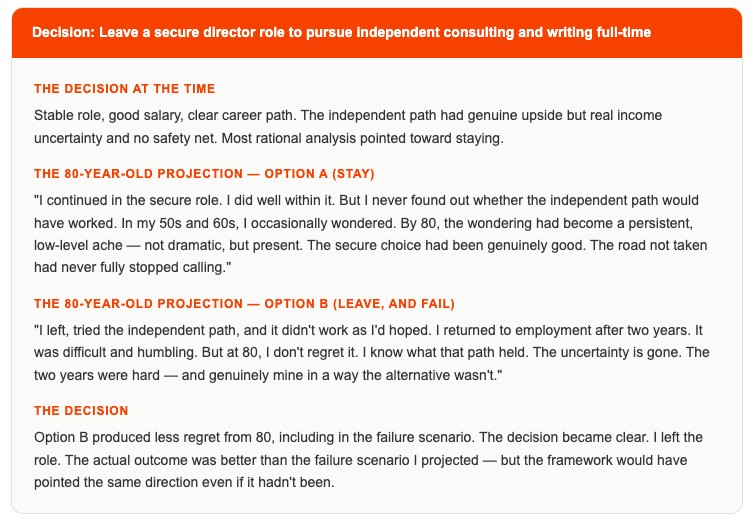
A worked example from my own life
When this framework works best — and when it doesn’t
Best for: Significant, relatively irreversible decisions with long time horizons — career pivots, geographic moves, relationship commitments, entrepreneurial ventures, educational choices. The framework is specifically calibrated for decisions where the primary risk is regret over a lifetime, not technical analysis of near-term probabilities.
Less useful for: Decisions that are highly reversible or short time horizon. If the downside is fully recoverable within a year, the 80-year-old projection may not add much that a simpler framework wouldn’t provide. Also less useful for decisions that are primarily analytical — investment valuations, operational choices, technical decisions — where the relevant framework is expected value and risk/reward analysis, not temporal projection of regret.
The framework can also be misused to rationalize impulsive choices by invoking the 80-year-old self selectively. “My 80-year-old self would regret not buying this expensive car” is not the kind of decision the framework was designed for. It is most powerful for the genuinely life-shaping choices where the primary constraint is fear rather than legitimate analytical uncertainty.
How I combine it with other decision tools
The regret minimization framework addresses the emotional and values dimension of a decision. It tells you, from the right temporal vantage point, which option aligns with what you most care about.
Before acting on that insight, I combine it with the practical risk assessment I described in the article on risk thinking: is the downside reversible? Is the asymmetry favorable? And I run the 10-10-10 framework alongside it for additional temporal perspective — the regret minimization framework focuses on the 10-year view, while 10-10-10 adds the immediate and medium-term lenses.
The combination produces a more complete picture than any single framework provides: values clarity from the regret minimization, emotional calibration from 10-10-10, and risk structure from the probability/magnitude/reversibility analysis.
Read also: What I Learned After Getting It Badly Wrong
Conclusion: most regrets are about what you didn’t try
Bezos founded Amazon. The rest is history — though of course the framework could not have guaranteed that. What it gave him was not certainty about the outcome. It gave him clarity about which uncertainty he could live with better at 80: the uncertainty of having tried and failed, or the certainty of having never tried at all.
In my experience applying this framework to significant decisions, the same asymmetry appears consistently. The actions that seemed risky in the present look very different from the vantage point of a completed life. And the inactions that seemed prudent look considerably more costly.
Apply it to one decision you’re currently avoiding
Think of one significant decision you’ve been deferring — something you keep thinking about but haven’t acted on because the risk or uncertainty feels too large.
Project to age 80. Ask both questions. Write down what comes up.
You already know which answer the framework will produce. The question is whether you trust your 80-year-old self’s judgment more than your current fear’s.