The most underrated form of intelligence: Warren Buffett has spent 80 years saying no to investment opportunities in industries he doesn’t understand. He calls it staying within his circle of competence. Charlie Munger has described it as one of the most important mental models in his toolkit. I spent years ignoring this concept and making decisions in domains where I had no real advantage. Here is what I’ve learned about what the circle of competence actually is — and how to use it properly.
The origin of the concept — and what Buffett actually means
Warren Buffett introduced the concept of the circle of competence in his 1996 shareholder letter, in characteristically plain language:
“What an investor needs is the ability to correctly evaluate selected businesses. Note that word ‘selected’: you don’t have to be an expert on every company, or even many. You only have to be able to evaluate companies within your circle of competence. The size of that circle is not very important; knowing its boundaries, however, is vital.”— Warren Buffett, Berkshire Hathaway Shareholder Letter, 1996
The critical phrase is the last one: knowing its boundaries is vital. Buffett is not saying that you should have a large circle of competence — in fact, the letter implies that the size is secondary. The danger he is pointing to is not a small circle but an undefined one. A person who doesn’t know the edges of their knowledge will wander across them confidently and repeatedly, making decisions in domains where they have no genuine advantage while believing they do.
Charlie Munger extends the concept further, applying it beyond investing to decision-making in general. His formulation is typically more direct: “You must know what you don’t know. And once you do know something well, stay in it.”
Read also: 7 Lessons From a World-Class Poker Player About Making Decisions Under Uncertainty
What a circle of competence is — and what it isn’t
A circle of competence is the domain — or set of domains — in which you have developed enough genuine, experience-tested knowledge to make decisions with a real advantage over the average reasoner. It is defined not by what you have read or studied but by what you have directly experienced, tested, and updated through real-world feedback.
This distinction matters enormously. You can have read extensively about neurosurgery without having a circle of competence in neurosurgery. You can have taken courses in financial accounting without having a circle of competence in accounting analysis. The circle of competence is not built through exposure to ideas — it is built through extended application of those ideas in real conditions where feedback is meaningful.
What the circle of competence is not: it is not a statement about intelligence or capability in general. Charlie Munger does not have a small circle of competence because he is not intelligent enough to understand more — he has a deliberately maintained, clearly bounded circle because he understands that operating within it produces better outcomes than operating with the false confidence of shallow knowledge in adjacent domains.
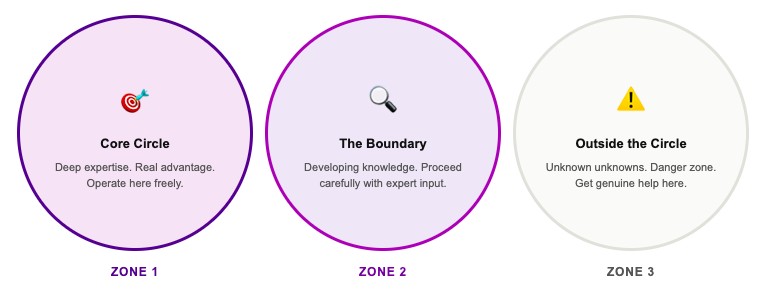
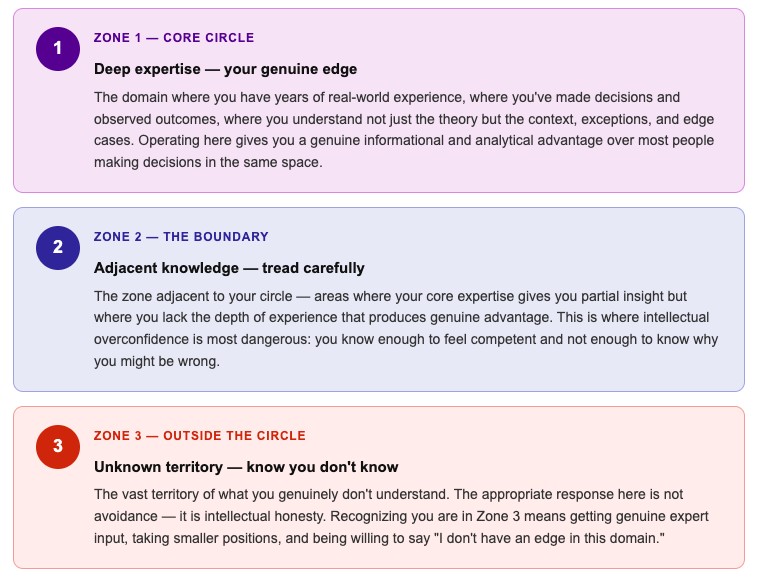
The three zones every decision lives in
How operating outside my circle cost me significantly
Several years into my investing journey, I became confident that I understood the technology sector. I had worked adjacent to tech companies, I understood product development cycles, and I had read extensively about the industry. I made a series of investments in semiconductor companies based on my analysis of their competitive position and demand cycles.
What I discovered, slowly and expensively, was that I understood tech product cycles — but not semiconductor manufacturing economics, not the specific capital intensity dynamics of the fab business, not the supplier relationships and geopolitical dependencies that drive margins. My circle of competence included tech product strategy. It did not include semiconductor industry economics, despite the apparent adjacency.
I had been in Zone 2 — feeling the confidence of Zone 1 knowledge while operating in Zone 3 reality. The outcomes reflected it. The experience taught me to be much more precise about the difference between understanding an industry enough to use its products and understanding it enough to invest in it profitably.
Read also: How I Think About Risk — And Why Most People’s Mental Model Is Quietly Costing Them
How I mapped my own circle of competence
After the semiconductor experience, I sat down and tried to map my circle honestly — not the circle I wished I had, but the one the evidence supported. The process was humbling and clarifying simultaneously.
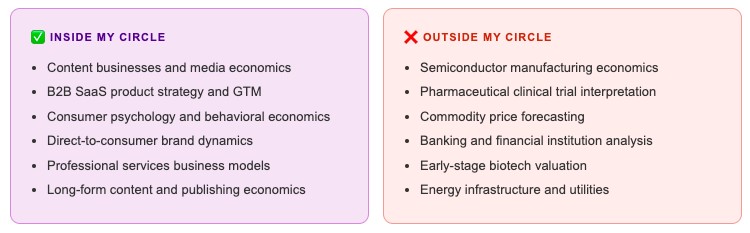
The process of creating this list — specifically the “outside” column — was more valuable than the “inside” column. Knowing where my edge exists is useful. Knowing clearly where it doesn’t exist prevents the expensive errors that come from operating in adjacent terrain with misplaced confidence.
How to expand your circle — and why it takes longer than you think
The circle of competence can be expanded. But the process is slower and more demanding than most people assume — because the circle grows through experience, not through study.
Reading about a new domain extends your theoretical knowledge but does not extend your circle of competence. The circle grows when you make real decisions in a domain, observe the outcomes, update your model, and repeat. This process typically takes years in any domain of meaningful complexity.
The practical implication: if you want to genuinely expand your circle into a new domain, commit to a long time horizon, take small initial positions to generate learning without catastrophic downside, and expect to be wrong frequently in the early years. The errors are not failures — they are the mechanism of circle expansion. But they need to be bounded, or the learning process itself becomes prohibitively expensive.
Read also: The Simplest Tool I Use to Make Every Tough Decision
Applying it across investing, career, and major decisions
- In investing: only analyze companies in industries you genuinely understand Before beginning any investment analysis, ask honestly: do I understand how this industry actually works — not from reading about it, but from having operated in or adjacent to it? If the answer is no, either develop that understanding over years before investing or index in that sector rather than picking individual companies.
- In career: concentrate your highest-leverage efforts inside your circle Career success tends to compound most powerfully within a domain of genuine expertise. Frequently switching domains resets the circle and the advantage it provides. Deepening within a circle — becoming increasingly excellent in a well-defined area — generally produces better long-term outcomes than breadth-first exploration.
- In decisions: calibrate your confidence to your zone Before any significant decision, ask: am I in Zone 1, Zone 2, or Zone 3 here? If Zone 1, proceed with appropriate confidence. If Zone 2, proceed with expert input and smaller commitments. If Zone 3, find someone genuinely in Zone 1 for this domain before committing.
- Say “I don’t know” — and mean it The single most practical habit that flows from the circle of competence is the willingness to say “I don’t have an edge in this domain — I don’t know.” Not as a social performance, but as an honest statement that triggers the appropriate response: getting real expertise rather than acting on confident ignorance.
Conclusion: the size of the circle is less important than knowing its edges
Buffett’s phrase bears repeating: the size of the circle is not very important. Knowing its edges is vital. A person with a small, clearly defined circle of competence — who operates within it consistently and recognizes when they are outside it — will outperform a person with a nominally larger but poorly defined circle who operates in it inconsistently and wanders outside it confidently.
The most dangerous intellectual position is not ignorance. It is the confident ignorance of someone who has read enough about a domain to feel competent and not enough to know why they might be wrong. That is Zone 2 masquerading as Zone 1 — and it produces the most costly errors, precisely because they are made with the most confidence.
The circle of competence is ultimately about intellectual honesty. About knowing the difference between genuine expertise and the feeling of expertise. About building a track record of operating within a defined domain rather than attempting to have confident opinions about everything. That discipline — applied consistently over time — is one of the most durable advantages available to any investor, professional, or decision-maker.
This week’s exercise
Draw two columns on a piece of paper. In the first column, list three domains where you have made real decisions with real stakes and observed real outcomes over at least three years. Those are strong candidates for the inside of your circle.
In the second column, list three domains where you feel confident but where that confidence is based primarily on reading and study rather than direct experience and feedback. Those are the candidates for honest Zone 2 or Zone 3 classification — regardless of how certain they feel.
The gap between those two columns is where the most useful recalibration of your circle begins.