


The most underpracticed financial skill: Salary negotiation is one of the highest-return activities a professional can engage in. A single successful negotiation compounds for years — every future raise, every bonus, every new job offer builds on your current number. For most of my career I avoided it out of discomfort. Here is the framework I eventually built, the scripts I used, and what I wish I had known years earlier.
The negotiation that changed my approach entirely
Several years ago, I was offered a senior role at a company I genuinely wanted to work for. The offer was good — above my current salary, the role was interesting, the team was strong. My instinct was to accept it within 24 hours.
A mentor I respected strongly advised me to negotiate. Not because the offer was unfair — it was fair — but because negotiation is the standard professional expectation, and because the cost of not negotiating is permanent: every future raise and offer would compound from a lower base.
I negotiated. I asked for 15% more than the offer, with a specific case built on market data and the value I was bringing. After one exchange, they met me at 12%. The conversation took twenty minutes and was entirely professional.
That 12% has compounded across four years of raises, two bonus cycles, and eventually set the floor for the next job offer I received. The financial value of that single twenty-minute conversation, over the period that followed, was significant — far more than any single project outcome of the same effort.
Read also: How Jeff Bezos Made the Biggest Decision of His Life — And How I Use It for Mine
Why most people underearn — and it isn’t performance
The research on salary negotiation is consistent: most people do not negotiate, and those who do significantly out-earn those who don’t over their careers. A study by Carnegie Mellon found that people who consistently negotiate their salaries earn over $1 million more over a 45-year career than those who don’t — an outcome that has almost nothing to do with relative performance and everything to do with the willingness to have a specific conversation.
The reasons people don’t negotiate are almost entirely psychological, not rational. Fear of seeming ungrateful. Fear of damaging the relationship. Fear of the offer being rescinded. Fear of hearing no. These fears are understandable and almost universally overestimated. In professional hiring and management contexts, negotiation is expected — and handled with far less emotional weight by the other party than the person avoiding it imagines.
The preparation phase — the most important 80%
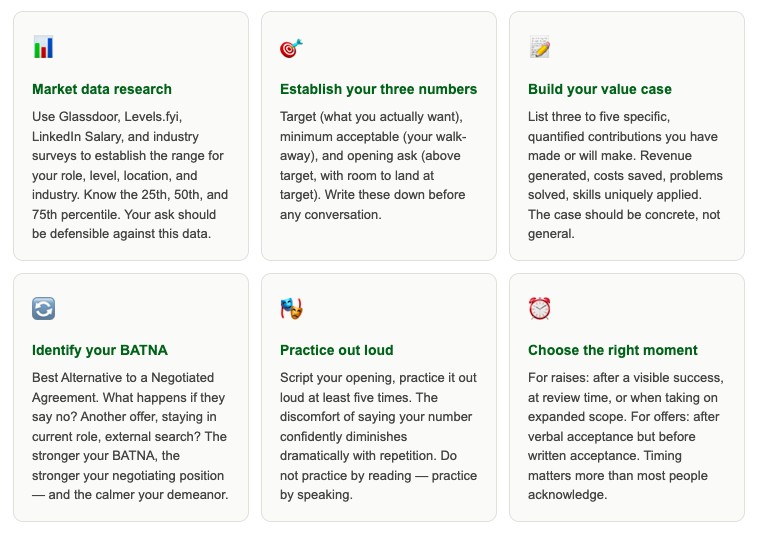
When and how to open the conversation
The timing of a salary conversation significantly affects its outcome. For internal raises, the three strongest timing windows are: immediately following a major visible success (when your value is most salient to your manager), at the beginning of a formal review cycle (when budget discussions are active), and when your scope has genuinely expanded beyond your current title and compensation level.
For external offers, the most important timing principle is to let the employer make the first number. If they ask for your salary expectations before making an offer, respond with a range anchored above your target — never a single number, never “I’m flexible.” The first number sets the anchor, and you want that anchor set as favorably as possible.
Read also: Circle of Competence: Why Knowing What You Don’t Know Is the Smartest Thing You Can Do
The exact scripts I use — and why each word matters
Opening a raise conversation with a current employer
📋 Script — Internal raise request
“I’d like to schedule some time to discuss my compensation. I’ve been here [X time], I’ve contributed [specific accomplishment], and based on my research into market rates for this role at this level, I believe there’s a gap between my current compensation and what the market is paying for this contribution. I’d like to discuss closing that gap.”
Responding to a job offer
📋 Script — Counter-offer on a new role
“Thank you — I’m genuinely excited about this role and the team. Before I respond formally, I want to discuss the compensation. Based on my research and what I’m bringing to this position, I was expecting something in the range of [X to Y]. Is there flexibility to get closer to that range?”
After they say “that’s our maximum budget”
📋 Script — When budget flexibility is claimed to be limited
“I understand there are budget constraints, and I want to make this work. If base salary has a ceiling, is there flexibility in [signing bonus / equity / review timeline / professional development budget]? I’m focused on the total package and happy to discuss the components.”
The specific language in these scripts is not arbitrary. “I’d like to discuss” signals collaboration, not confrontation. “Based on my research” grounds the ask in external data rather than personal need. “Is there flexibility” is a question, not an ultimatum — it invites a collaborative response and is harder to shut down than a direct demand. These distinctions consistently produce better outcomes in practice.
Handling the five most common employer responses
“This is our best offer.” Respond: “I appreciate that. I want to make this work — can we discuss the timeline for a first salary review, or flexibility in [other component]?” This keeps the negotiation open without directly challenging the statement.
“We pay everyone at this level the same.” Respond: “I understand the policy, and I respect it. My research suggests this level of experience and these specific skills are commanding [X] in the market. Can we discuss whether there are any exceptions or additional components?” This acknowledges the constraint without accepting it as final.
“We don’t negotiate.” This is almost never literally true. Respond with silence followed by: “I’d like to understand the process better — is there a formal review at [X months] where compensation is revisited?” Even if the initial offer is fixed, future compensation flexibility often exists.
“What are you currently making?” In many jurisdictions, you are not required to answer this. Respond: “I’d rather focus on what the role is budgeted for and what would make sense for this position specifically. What range were you working with?” This redirects to their budget rather than anchoring from your current number.
Silence after your ask. Do not fill it. The silence after stating your number is the most common place negotiations are lost. State your number or range, and wait. The next person to speak loses negotiating leverage. Wait as long as necessary.
Read also: What I Learned After Getting It Badly Wrong
The mistakes I made — and still see others making
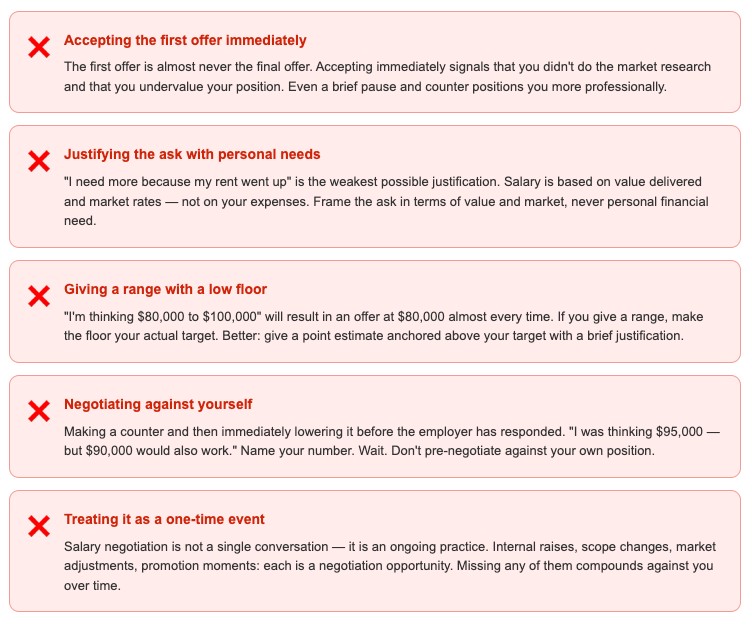
Beyond salary — what else to negotiate
Salary is the most visible compensation component but rarely the only flexible one. When base salary flexibility is genuinely limited, shift attention to: signing bonus (often easier to approve because it’s a one-time cost), equity or long-term incentive plan timing, title (which affects future negotiating leverage and market comparability), remote work flexibility (which has a real financial value), professional development budget, performance review timing (earlier first review creates earlier raise opportunity), and start date flexibility.
Total compensation is the right frame, not base salary alone. The most successful negotiations I’ve been in either started or ended with a comprehensive package discussion that produced value in components the employer had more flexibility on than the base.
Read also: Why Vivid Events Feel More Probable Than They Actually Are
Conclusion: negotiation is not aggression — it is professionalism
The single most useful reframe I’ve found for salary negotiation is this: negotiation is not a confrontation between adversaries. It is a professional conversation between two parties who want the same outcome — a mutually beneficial arrangement — and who both understand that the opening offer is the beginning of that conversation, not the end.
Employers budget for negotiation. Offers are calibrated with room to move. The hiring manager who makes you an offer is not personally offended when you counter — in most professional contexts, they expect it. The expectation of silence on your side is your own discomfort speaking, not the reality of the situation.
The single most important thing to practice before any negotiation
Say your target number out loud, alone, five times. “I am looking for $[X].” Full sentence. Confident tone. No qualifiers.
The discomfort you feel doing this alone is a preview of the discomfort you’ll feel in the actual conversation — and practicing it removes most of that discomfort before the stakes are real. That is the entire preparation in its minimum viable form.

