Cash Flow, Not Cleaning, Sinks Most Cleaning Firms
A cleaning company can be profitable on paper and still go under, because the profit is trapped in unpaid invoices while payroll comes due. Here’s how to protect your cleaning business cash flow.
Here’s a hard truth about service businesses that surprises a lot of cleaning owners: you can be genuinely profitable and still go broke. Not because the work is bad or the contracts are unprofitable, but because of timing — the money you’re owed hasn’t arrived yet, and the money you owe is due now. Payroll doesn’t wait. Suppliers don’t wait. But clients, especially commercial ones, very much do wait to pay. When your profit is tied up in invoices that haven’t been collected while your bills come due, you have a cash flow problem — and cash flow problems, not cleaning problems, are what sink most cleaning firms. Protecting your cleaning business cash flow is as important as winning the work in the first place. Here’s how.
Profit and cash are not the same thing
The crucial concept, and the one that trips people up, is that profit and cash are different. Profit is what you’ve earned — the margin on the work you’ve done. Cash is what’s actually in your account. In a business paid on invoices, these can be wildly out of sync, because there’s a gap — often weeks or a couple of months — between doing the work and getting paid for it.
In commercial cleaning this gap is brutal, because of when your costs fall. You pay your cleaners weekly or biweekly, right after the work is done. But you invoice the client and then wait 30, 60, sometimes 90 days to be paid. So you’ve paid out the biggest cost (labor) long before the revenue arrives. You can have a fat pile of profit on paper, entirely real, and still not have the cash to make this week’s payroll — because that profit is sitting in unpaid invoices. Growing makes it worse, not better: more contracts means more payroll to fund upfront while you wait even longer for a bigger pile of receivables. Fast-growing, profitable cleaning companies fail this way all the time.
The number to watch: what you’re owed
If cash flow is the risk, the number that governs it is your accounts receivable — the total of invoices you’ve issued but not yet collected. This is one of the most important figures in a service business, and one many owners barely look at. It represents real money you’ve earned and are owed, sitting outside your bank account, and it’s the gap between your profit and your cash.
Watching invoiced-versus-collected tells you the truth about your position that revenue alone hides. You might have invoiced a healthy amount this month, but if little of it has been collected, your actual cash situation is tight regardless of how good the revenue looks. Knowing your outstanding receivables — how much is owed, by whom, and how overdue — is what lets you manage cash deliberately instead of being blindsided by a payroll you can’t quite cover despite a “good” month.
Overdue invoices are the silent leak
Within your receivables, the real danger is invoices that have gone overdue — past their payment terms and still unpaid. These are the ones actively hurting you, and they have a tendency to slip through the cracks precisely when you’re busy running crews and winning work. An invoice nobody’s chasing can sit unpaid for months, and the longer it ages, the harder it often becomes to collect.
The fix is unglamorous but transformative: track every invoice with its due date and status, and flag the moment anything goes overdue, with how many days late it is. This turns chasing payments from a vague, easily-deferred chore into a clear, prioritised list — here’s exactly who owes you, how much, and how overdue, so chase the worst first. Systematic follow-up on overdue invoices is one of the highest-return activities in the business, because it converts money you’ve already earned (but might otherwise lose or wait forever for) into actual cash in your account. And chasing confidently, with the exact figures in front of you, is far more effective and professional than a vague, hesitant nudge.
Consistency is the whole game here. Clients who know they’ll be politely but promptly chased tend to pay on time; clients who learn that a slow-paid invoice goes unnoticed will keep paying slowly. A reliable follow-up system quietly trains your clients to pay you better.
The recurring-revenue advantage — if you protect it
Commercial cleaning has one great structural gift: recurring contracts. Unlike businesses that start each month at zero, you have contracted, repeating revenue you can see coming. That predictability is a genuine cash-flow advantage — but only if you actually manage it. Knowing your active contract value per month tells you your baseline income, which helps you plan. And protecting that recurring revenue means never letting a valuable contract lapse unnoticed at renewal — because losing a recurring contract isn’t losing one payment, it’s losing a whole stream. Tracking renewal dates so lucrative contracts don’t quietly expire is part of protecting the cash flow that keeps you alive.
An important note
To be clear: this is about organising and understanding your own numbers — it is not financial, tax, accounting, legal, insurance, or business advice, and it guarantees no result. Any figures are illustrative examples. Commercial cleaning carries real obligations — follow the licensing, bonding, insurance, employment, and health-and-safety requirements that apply where you operate, and consult a qualified professional for tax, payroll, and accounting decisions, including anything to do with credit control and collections.
If you want overdue invoices flagged for you
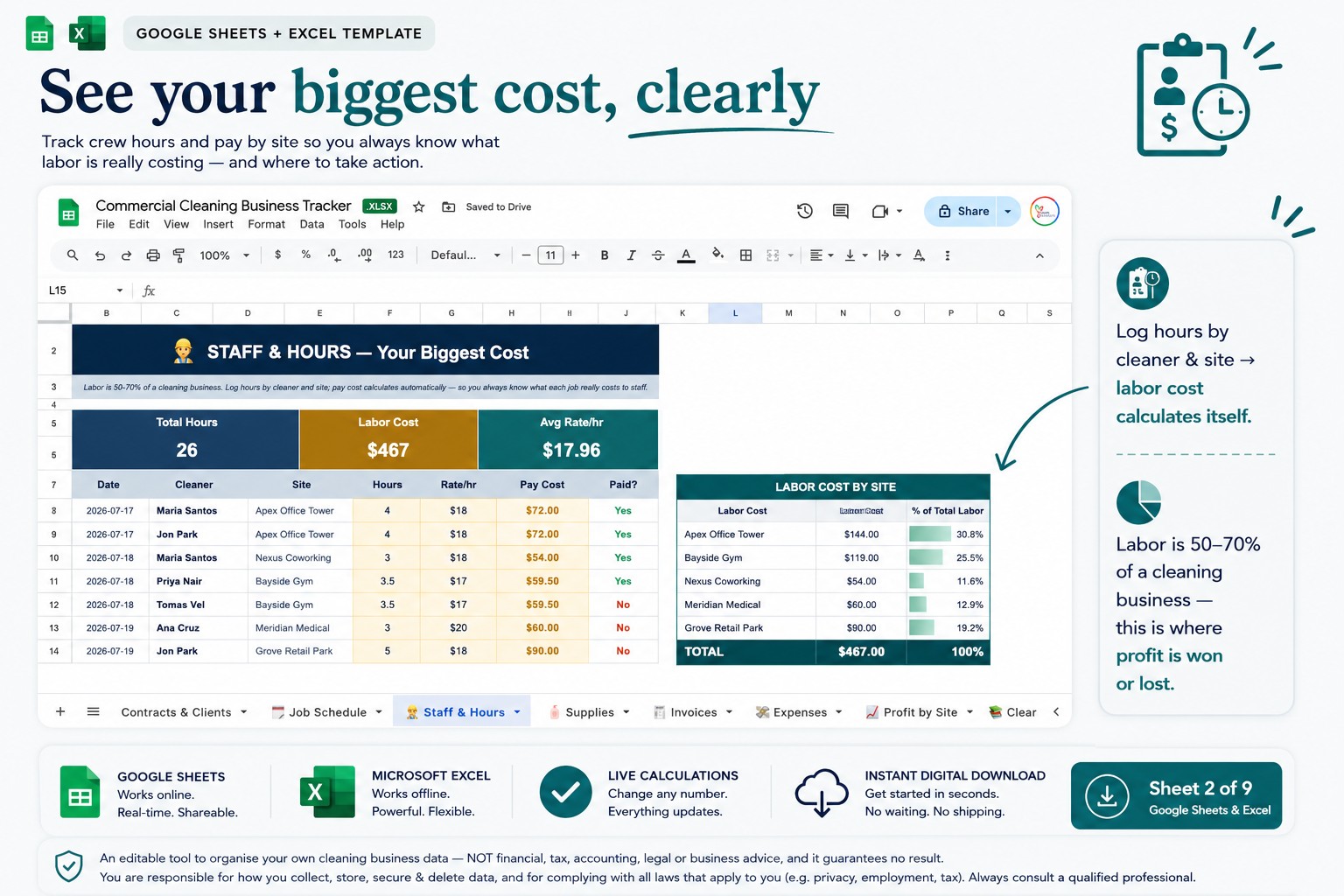
I built invoice tracking with automatic overdue flags into my commercial cleaning business tracker in Google Sheets — every invoice shows its status and flags anything past due with the days late, alongside an invoiced-vs-collected-vs-outstanding view, contract renewal tracking, and per-site profit:
👉 Commercial Cleaning Business Tracker for Google Sheets & Excel
Whether you use mine or build your own, watch your cash as closely as you watch your schedule. Track what you’re owed, chase overdue invoices systematically, and protect your recurring contracts. A cleaning company doesn’t usually fail because it can’t clean — it fails because the money it earned got stuck somewhere between the invoice and the bank while payroll came due. Keep that money moving, and you keep your doors open.
This reflects my own perspective and is an organising tool — not financial, tax, accounting, legal, insurance or business advice, and it guarantees no result; figures are examples, and licensing/bonding/insurance/employment/health-and-safety are your responsibility. Cleaning owners: what’s your system for chasing overdue invoices? Tell me in the comments.