Death by a Thousand Dates: The Renewal That Grounds a Vehicle
One missed renewal can mean a fine, an uninsured vehicle on the road, or a van sitting idle when it should be earning. Here’s why fleet compliance is really a date-tracking problem — and how to solve it.
Running a fleet, even a small one, is death by a thousand dates. An insurance renewal here. An inspection there. A service that was due last month. Registration and tax on several vehicles, all expiring in different weeks. A driver’s licence quietly approaching its expiry. Each date is trivial on its own; together they’re an impossible mental juggling act, and the consequences of dropping one are anything but trivial. Miss a renewal and you’re not looking at a minor slip — you’re looking at a fine, an uninsured or non-compliant vehicle on the road, or a vehicle grounded when it should be out earning. Fleet compliance is, at its heart, a date-tracking problem — and once you see it that way, it becomes solvable. Here’s how.
Why fleets lapse
The reason renewals slip through the cracks isn’t carelessness — it’s structural. Every vehicle carries its own set of recurring obligations (insurance, registration, inspection, tax), each with its own date, and every driver has a licence with its own expiry. Multiply the obligations by the vehicles by the drivers and you have a large, scattered set of future dates with no natural pattern. Holding that in your head, or on a wall calendar and a glovebox full of paperwork, is a recipe for eventually missing one.
And renewals lapse silently. Nothing happens on the expiry date to alert you — the vehicle keeps starting, the van keeps driving. The lapse is invisible until something forces it into view: a fine, a roadside check, an accident where you discover the cover wasn’t valid, or a vehicle pulled off the road for a missed inspection. By then the damage is done. Most fleet owners find out something lapsed only when it’s already too late, which is the worst possible time to find out.
The stakes are higher than a late fee
It’s worth being clear about why this matters more for a fleet than for a personal vehicle. The consequences of a lapsed obligation compound in a business context:
- Legal and financial penalties. A missed renewal can mean fines, and in a business those can be per-vehicle and add up fast.
- An uninsured or non-compliant vehicle on the road. This is the serious one. A lapse in insurance or a required inspection can mean a vehicle operating illegally — a huge liability if anything goes wrong, and a genuine safety and legal exposure.
- A grounded vehicle. A vehicle that can’t legally operate because something lapsed is a vehicle not earning — while still costing you. For a fleet where each vehicle is a revenue-generating asset, downtime from an avoidable compliance lapse is pure loss.
- A driver on a lapsed licence. Letting someone drive on an expired licence is a serious compliance and liability problem that a simple check would have prevented.
None of these is a small “oops.” They’re the kind of thing that costs real money, creates real legal exposure, and occasionally causes real harm. And they’re almost entirely preventable — because the underlying cause is just a date nobody was watching.
The fix: advance warning, automatically
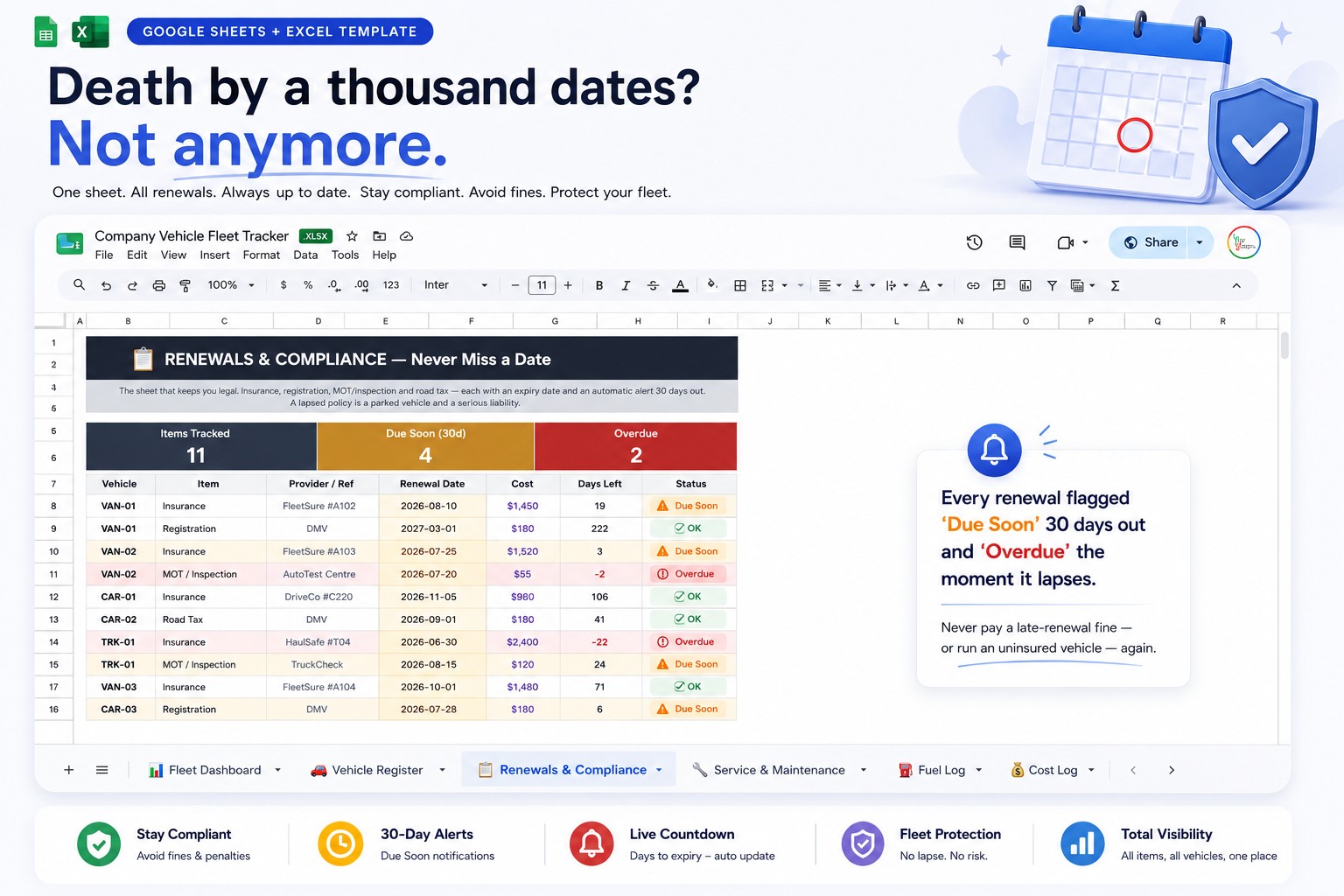
Since the problem is scattered dates that lapse silently, the solution is a system that watches every date and warns you in advance. The two words that matter are “in advance.” Being told a renewal expired yesterday is useless. Being told it expires in 30 days is genuinely useful — enough time to arrange the renewal, book the inspection, sort the insurance, before anything lapses. A sensible approach flags each obligation as “due soon” a month out and “overdue” the moment it passes, with a countdown of days remaining.
The transformation is that you stop relying on memory and start being prompted. Instead of trying to remember dozens of dates across your fleet — and inevitably forgetting one — you have a single view that tells you what needs attention now and what’s coming up. Renewals stop lapsing not because you got more disciplined, but because the system removed the need to remember. That’s the difference between hoping nothing slips and knowing nothing will.
The same logic covers driver licences (flag them before they expire, so nobody drives on a lapsed one) and servicing (log each service with a next-due date so maintenance never quietly slips, which is both a cost and a safety matter).
One place beats a glovebox and a memory
The deeper shift is consolidation. Most small fleets manage compliance across scattered places — a calendar, emails, paperwork in each vehicle, the owner’s memory. Scattered systems are exactly where things fall through cracks, because no single place shows the whole picture. Bringing every vehicle, every renewal, every driver into one register, with the alerts built in, means you can see your entire fleet’s compliance status at a glance. That single source of truth is what turns compliance from a constant low-grade anxiety into something you simply check and manage.
An important note
To be clear, because compliance carries real legal weight: a tracker helps you organise and monitor your renewal dates — it is not legal, financial, tax, accounting, insurance, or compliance advice, and it guarantees no result. Crucially, a tool can’t tell you what your obligations actually are — you are responsible for knowing and meeting all the licensing, insurance, registration, inspection, tax, and health-and-safety requirements that apply to your vehicles and drivers where you operate. Always verify renewal dates with the issuing authority (a spreadsheet reminder is a prompt, not the official record), and consult a qualified professional where appropriate.
If you want the dates watched for you
I built a company vehicle and fleet tracker in Google Sheets that watches all of this — every renewal flagged “due soon” 30 days out and “overdue” once passed, with countdowns, plus service next-due reminders and driver licence-expiry checks, across any size of fleet:
👉 Company Vehicle & Fleet Tracker for Google Sheets & Excel
Whether you use mine or build your own, stop managing your fleet’s compliance from memory and a glovebox. Get every date into one place that warns you before anything lapses. “Death by a thousand dates” only kills you if nothing’s counting them — put a system on the dates, and the fines, the uninsured miles, and the grounded vehicles simply stop happening. Compliant, costed, covered.
This reflects my own perspective and is an organising tool — not legal, financial, insurance or compliance advice, and it guarantees no result; you’re responsible for meeting your actual obligations — always verify dates with the issuing authority. Fleet owners: what’s the closest call you’ve had with a missed renewal? Tell me in the comments.