Your Brain Doesn’t Run on “Should” — So Stop Studying Like It Does
Ordinary study advice assumes you’ll just start the big task and feel motivated by “you should.” ADHD brains don’t work that way. Here’s how studying with ADHD means working with your wiring, not against it.
If you have ADHD, you already know that ordinary study planners don’t fit you. They assume you’ll magically start the big assignment, remember the exam that’s three weeks away, and feel motivated simply because you “should” do the work. But your brain doesn’t run on “should.” It runs on interest, urgency, and dopamine — and when a task feels huge, boring, or far away, it doesn’t just feel unappealing, it becomes genuinely, physically hard to start. That’s not laziness, and it’s not a lack of trying. It’s how ADHD wiring works. The good news is that once you understand the wiring, you can study with it instead of fighting it. Studying with ADHD effectively isn’t about more willpower — it’s about setting things up so your brain can actually engage. Here’s how.
First, this isn’t a character flaw
Before any technique, the most important reframe: the struggle to start a boring or overwhelming task, the exam that snuck up on you, the racing thoughts that won’t settle — these are features of how ADHD brains are wired, not evidence that something is wrong with you as a person. So much shame gets piled onto ADHD students who are trying hard and still struggling, and that shame makes everything worse. It drains the little energy you have and adds a layer of self-criticism on top of an already hard task.
So let go of “why can’t I just do this like everyone else?” Your brain works differently, and different isn’t broken. The goal isn’t to force your brain to be a neurotypical brain; it’s to build a way of studying that fits the brain you actually have. Progress, not perfection. A messy start still counts. Be kind to your brain — it’s doing its best, and so are you.
Why starting is the hard part
Here’s a truth that neurotypical advice completely misses: for ADHD brains, starting is usually the hard part, not finishing. Once you’re in a task, momentum often carries you. But that initial activation — getting from “not doing it” to “doing it” — is where things break down, especially when the task is big or dull.
This is because a large task (“write the essay,” “study for the exam”) is overwhelming to an ADHD brain. It’s vague, it’s huge, and your brain can’t find the handle to grab. Faced with that, the brain does what overwhelmed brains do: it avoids. Not out of laziness, but because the task genuinely doesn’t compute as something you can start right now.
The fix is beautifully simple: shrink the task to its tiniest possible next step. Not “write the essay” but “open the document.” Not “study biology” but “read one paragraph.” A tiny step is small enough that it doesn’t trigger the overwhelm-and-avoid response — it’s so small your brain can’t object to it. And here’s the magic: once you’ve done the tiny step, you’re in. “Open the document” becomes “write one sentence” becomes twenty minutes of actual work, because starting was the barrier and you just cleared it. Making “open the doc” count as a real, legitimate step is one of the most powerful things an ADHD student can do.
Making the far-away feel urgent
ADHD brains run partly on urgency, which is why an exam three weeks away has zero motivational pull — it’s not urgent yet, so your brain files it under “not now” and forgets about it. Then it’s suddenly two days away, urgency floods in, and you’re panicking. This is time blindness: future deadlines don’t feel real until they’re right on top of you.
You can’t force your brain to feel urgency about a distant date, but you can make the distance visible. A countdown — “14 days until the exam” — turns an abstract future date into something concrete and shrinking. And an automatic “start revising by” date does something even smarter: it gives you an earlier, nearer deadline to react to, so you begin in time rather than in a panic. By making a far-off exam visible and giving yourself a closer trigger date, you work around time blindness instead of being ambushed by it. The exam stops appearing out of nowhere, because something was counting down to it the whole time.
Feed the brain some dopamine
The third piece of ADHD wiring is dopamine. ADHD brains are, in a sense, dopamine-seeking — they struggle to engage with tasks that don’t offer a reward, and studying is a classic example of effort now for a payoff that’s distant and abstract (a grade, someday). That’s a hard sell for a brain that runs on immediate reward.
So make the reward immediate and visible. Turning finished tasks and study sessions into points you earn, and letting yourself “spend” those points on real treats you actually want, sounds playful — but it’s genuinely how ADHD motivation works. It makes the invisible payoff of studying visible and immediate, giving your brain the dopamine hit it needs to keep engaging. Similarly, tracking your focus hours so effort becomes visible, countable progress turns invisible work into something your brain can see and feel good about. You’re not bribing yourself for being weak; you’re giving your brain the fuel it actually runs on.
The foundation underneath it all
One last thing that quietly runs your focus: the basics. Sleep, medication (if you take it), movement, and even hydration have an outsized effect on ADHD symptoms. On days when the foundation is shaky, everything is harder — focus, starting, mood. This isn’t about being perfect; it’s about noticing that focus starts before you sit down to study. Gently keeping an eye on those basics is often the difference between a day where the strategies work and a day where nothing does. Be compassionate here too: a bad day on the basics isn’t a failure, just information.
An important, caring note
Please hear this clearly: this is about study strategies and self-organisation designed with ADHD-friendly principles — it is not medical, psychological, therapeutic, or educational advice, it is not a treatment for ADHD or any condition, and it guarantees no result. Tools and techniques can genuinely help, but they don’t replace support from a doctor, psychologist, therapist, or your school, and ADHD is best supported with proper professional guidance. If you’re struggling — with studying or anything else — please reach out to a qualified professional or someone you trust. Asking for help is a strength, never a weakness.
If you want a planner built around your wiring
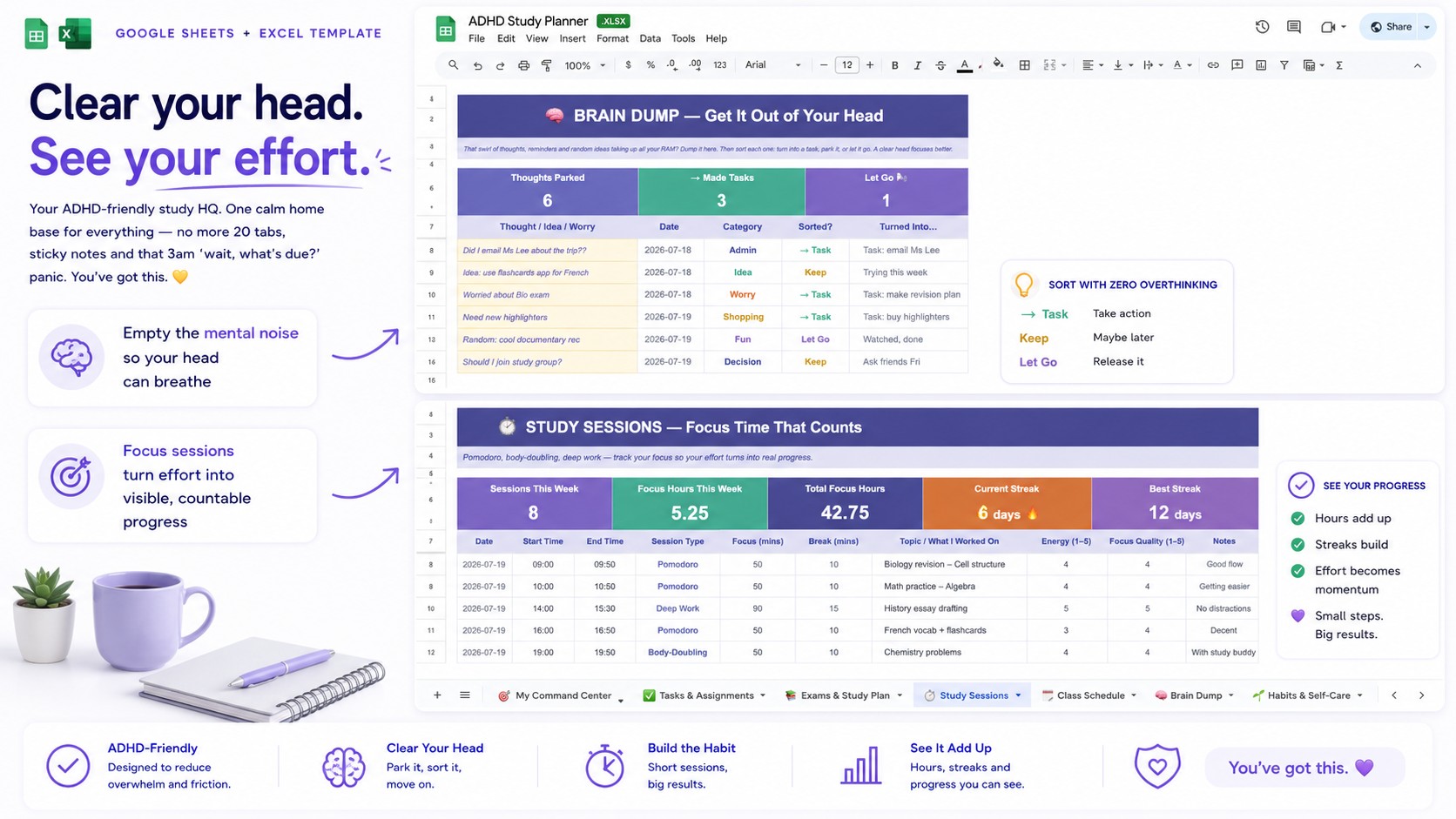
I built an ADHD study planner in Google Sheets designed around exactly these principles — every task breaks down to a tiny next step, exams get countdowns and automatic “revise by” dates, there’s a brain dump for racing thoughts, focus-session tracking, and a dopamine reward shop, all in warm, shame-free language:
👉 ADHD Study Planner for Google Sheets & Excel
Whether you use mine or build your own system, stop trying to study like a brain you don’t have. Shrink tasks to tiny steps, make far-away deadlines visible, feed your brain the dopamine it runs on, and be kind to yourself in the process. Studying with ADHD isn’t about forcing yourself to be someone else — it’s about finally working with the brain you’ve got. And that brain, supported properly, is capable of wonderful things.
This reflects ADHD-friendly study principles and is an organising tool — not medical, psychological, therapeutic or educational advice, not a treatment for any condition, and it guarantees no result. If you’re struggling, please reach out to a qualified professional or someone you trust. What’s the one tiny “next step” that always gets you started? Share it in the comments — someone might need it.