The Exam That Ambushed You: Beating ADHD Time Blindness
With ADHD, the exam three weeks away doesn’t feel real until it’s suddenly two days away. That’s not disorganisation — it’s ADHD time blindness. Here’s how to work around it.
Every ADHD student knows this specific horror. There’s an exam on the calendar. You know it exists. And yet it somehow feels like it’s not really happening — until suddenly it’s two days away, panic floods in, and you’re cramming a month’s worth of revision into a sleepless night. Afterwards you promise yourself you’ll start earlier next time. And next time, the exact same thing happens. This isn’t a character flaw or a failure to organise. It’s ADHD time blindness — a genuine feature of how ADHD brains process time — and once you understand it, you can build around it instead of being ambushed again and again. Here’s how.
What time blindness actually is
Time blindness is the ADHD tendency to struggle with sensing the passage of time and the reality of future events. For many ADHD brains, time isn’t experienced as a smooth line stretching into the future — it’s more like “now” and “not now.” Something happening in three weeks lands firmly in the “not now” category, which the brain treats as roughly equivalent to “not real” and “not my problem yet.”
This is why the far-off exam has no pull on you. It’s not that you don’t care or don’t understand it’s coming — it’s that your brain genuinely doesn’t feel it as imminent or real until it crosses some threshold into “now,” at which point urgency hits all at once. The deadline didn’t sneak up on you because you weren’t paying attention; it snuck up because your brain’s sense of time doesn’t register distant things as approaching. Understanding this matters, because it moves the problem from “I’m bad at planning” to “my brain processes time differently, and I can design around that.”
Why “just start earlier” never works
The standard advice — “just start revising earlier!” — is useless for an ADHD brain, and understanding time blindness explains why. You can’t simply decide to feel the appropriate urgency about a distant deadline, because the lack of urgency isn’t a choice; it’s how your brain is perceiving (or failing to perceive) the time. Telling an ADHD student to start earlier is like telling someone who can’t see a far-off object to just look at it harder. The information isn’t reaching them in a form they can act on.
So the solution isn’t more nagging or more willpower. It’s to change the information — to make the passage of time and the approach of the deadline visible and concrete, so your brain can respond to something it can actually perceive. You work around time blindness by externalising time, not by trying to feel it better.
Countdowns make time visible
The first fix is a countdown. Instead of a static exam date sitting on a calendar (easy to ignore, feels “not now”), a live countdown — “17 days left,” “16 days left” — turns the abstract future into something concrete and visibly shrinking. Each day the number drops, and that ticking-down makes the approach of the exam real in a way a fixed date never does.
This is powerful because it gives your brain the sense of time passing that it doesn’t generate internally. You can see the exam approaching. A visual progress bar does the same thing spatially — watching the bar fill up as the exam nears gives an at-a-glance, felt sense of “this is getting close” that ADHD brains respond to far better than a date on a page. You’re borrowing an external sense of time to replace the internal one that isn’t firing.
The “revise by” date: an earlier trigger
Countdowns help, but there’s an even smarter move: give yourself an automatic “start revising by” date. Here’s the logic. Left to itself, your brain will only feel urgency about the exam when the exam is nearly here — far too late to revise properly. So instead of relying on that late-arriving urgency, you create an earlier deadline: a specific date, calculated to give you enough revision time, by which you need to begin.
This works because it turns “revise for the exam” (a vague, far-off, ignorable task) into “start revising today” (a concrete, present, actionable one) at the right moment. When that “start revising by” date arrives — ideally with a clear “START NOW” flag — you have a near, real deadline to react to, which your urgency-driven brain can actually engage with. You’re essentially manufacturing an earlier moment of urgency, on purpose, at a point where acting on it still leaves you time to succeed. It’s the single most effective trick for beating the last-minute cram cycle, because it moves your “now” panic to a point where it’s still useful.
Clearing the noise so you can begin
One more thing that gets in the way of starting revision: the mental noise. ADHD brains often carry a swirl of stray thoughts, worries, and half-remembered to-dos, and that noise makes it hard to settle into focused study. When your head is full of “don’t forget this” and “what about that,” there’s no room to concentrate.
A brain dump — getting every stray thought out of your head and onto a page — clears that space. Once the thoughts are captured somewhere safe (so you’re not afraid of forgetting them), your mind can let go of them and focus on the task in front of you. You can then sort each dumped thought into something actionable (a task), something to keep, or something to let go of entirely. It’s a simple practice, but for a noisy ADHD brain, emptying the noise is often what makes focused revision possible at all. You can’t concentrate in a cluttered room, and the same is true of a cluttered mind.
An important, caring note
Please note: this is about study strategies designed with ADHD-friendly principles — it is not medical, psychological, therapeutic, or educational advice, it is not a treatment for ADHD or any condition, and it guarantees no result. These techniques can genuinely help, but they don’t replace support from a doctor, psychologist, therapist, or your school. If you’re struggling with your studies or anything else, please reach out to a qualified professional or someone you trust — asking for help is a strength.
If you want time made visible for you
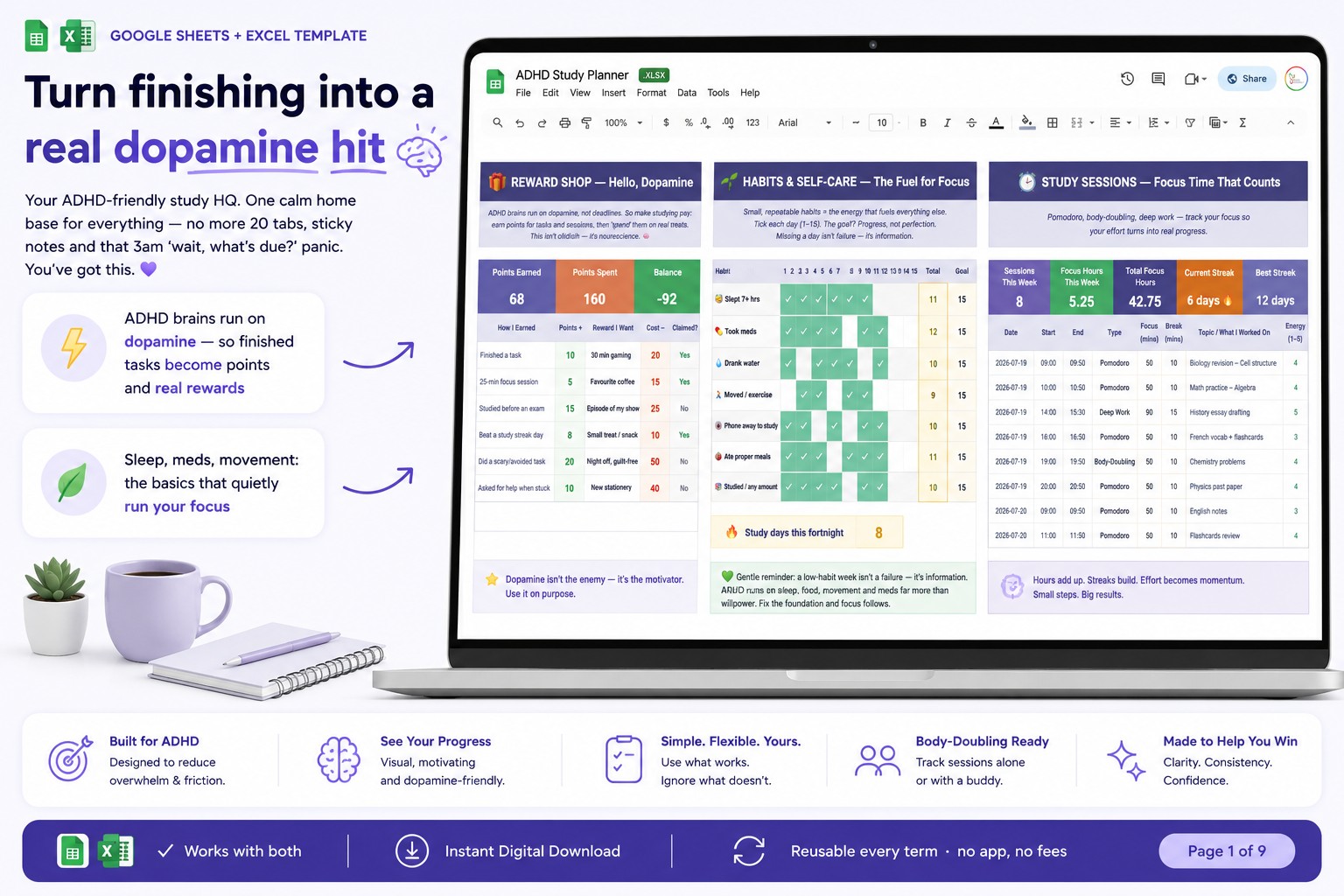
I built exam countdowns, automatic “revise by” dates, and a brain dump into my ADHD study planner in Google Sheets — every exam gets a live countdown, a progress bar, and a “start revising by” date with a START NOW flag, so nothing ambushes you, alongside tiny-next-step task breakdown and focus tracking:
👉 ADHD Study Planner for Google Sheets & Excel
Whether you use mine or build your own, stop blaming yourself for exams that “came out of nowhere.” They came out of nowhere because your brain processes time differently — and that’s something you can design around. Make time visible with countdowns, give yourself an earlier trigger to start, and clear the mental noise so you can focus. Beat the ambush by externalising the very thing your brain can’t feel: the future, quietly approaching. You’ve got this.
This reflects ADHD-friendly study principles and is an organising tool — not medical, psychological, therapeutic or educational advice, not a treatment for any condition, and it guarantees no result. If you’re struggling, please reach out to a qualified professional or someone you trust. What helps you make a far-off deadline feel real? Share it in the comments.