

The ADHD Tax: The Money Your Brain Quietly Costs You
Late fees, missed renewals, forgotten free trials, duplicate purchases — the ADHD tax is real money leaking out because of how your brain handles dates and admin. Here’s what it is, and how to stop paying it.
If you have ADHD, you’ve almost certainly been paying a tax you never signed up for. It doesn’t come from the government — it comes from your own brain, and it’s charged in late fees, missed renewal discounts, forgotten free trials that quietly started billing you, duplicate purchases of things you already owned but couldn’t find, and the premium prices of doing everything at the last minute. This is the ADHD tax: the very real money that executive-function challenges cost you, silently, month after month. It’s not a moral failing or evidence you’re bad with money. It’s a predictable consequence of how ADHD brains handle dates, admin, and follow-through — and once you understand it, you can build a system that stops most of it. Here’s how.
What the ADHD tax actually is
The ADHD tax isn’t one thing; it’s a collection of small, recurring financial leaks that all stem from the same root — difficulty with the boring, time-sensitive admin of adult life. The usual suspects:
- Late fees. A bill you fully intended to pay, that slipped past its due date because the task didn’t feel urgent until it was overdue. The money was there; the remembering wasn’t.
- Forgotten free trials. You signed up for a free trial meaning to cancel before it charged — and then the cancel-by date vanished from your awareness, and you got billed for something you never wanted.
- Missed renewals. Insurance, subscriptions, memberships that auto-renewed at a worse rate, or lapsed and cost you a penalty, because the renewal date came and went unnoticed.
- Duplicate purchases. Buying something you already owned because you couldn’t find it or forgot you had it.
- The last-minute premium. Rush shipping, urgent bookings, premium prices paid because time blindness meant you left it too late for the cheaper option.
Individually, each of these feels like a small, one-off annoyance. Added up across a year, the ADHD tax can be a genuinely significant amount of money — a real, ongoing cost of unmanaged executive-function challenges. Naming it matters, because once you see it as a pattern rather than a series of unrelated slip-ups, you can actually address it.
It’s not carelessness — it’s how the tax gets charged
Here’s the crucial reframe, because ADHD and money come loaded with shame: paying the ADHD tax doesn’t mean you’re careless, irresponsible, or bad with money. In almost every case, you intended to do the right thing — pay the bill, cancel the trial, renew on time. The intention was there. What failed was the specific executive-function machinery of remembering a time-sensitive task and acting on it at the right moment, which is precisely the machinery ADHD affects.
That distinction matters enormously. If the problem were not caring, the solution would be to care more — and people pile shame on themselves trying exactly that, to no effect, because caring was never the issue. The real problem is that these dates and tasks rely on remembering, and remembering scattered future dates is exactly what an ADHD brain struggles with. So the solution isn’t to try harder to remember. It’s to stop relying on remembering — to put the dates into a system that does the remembering for you.
How to stop paying it
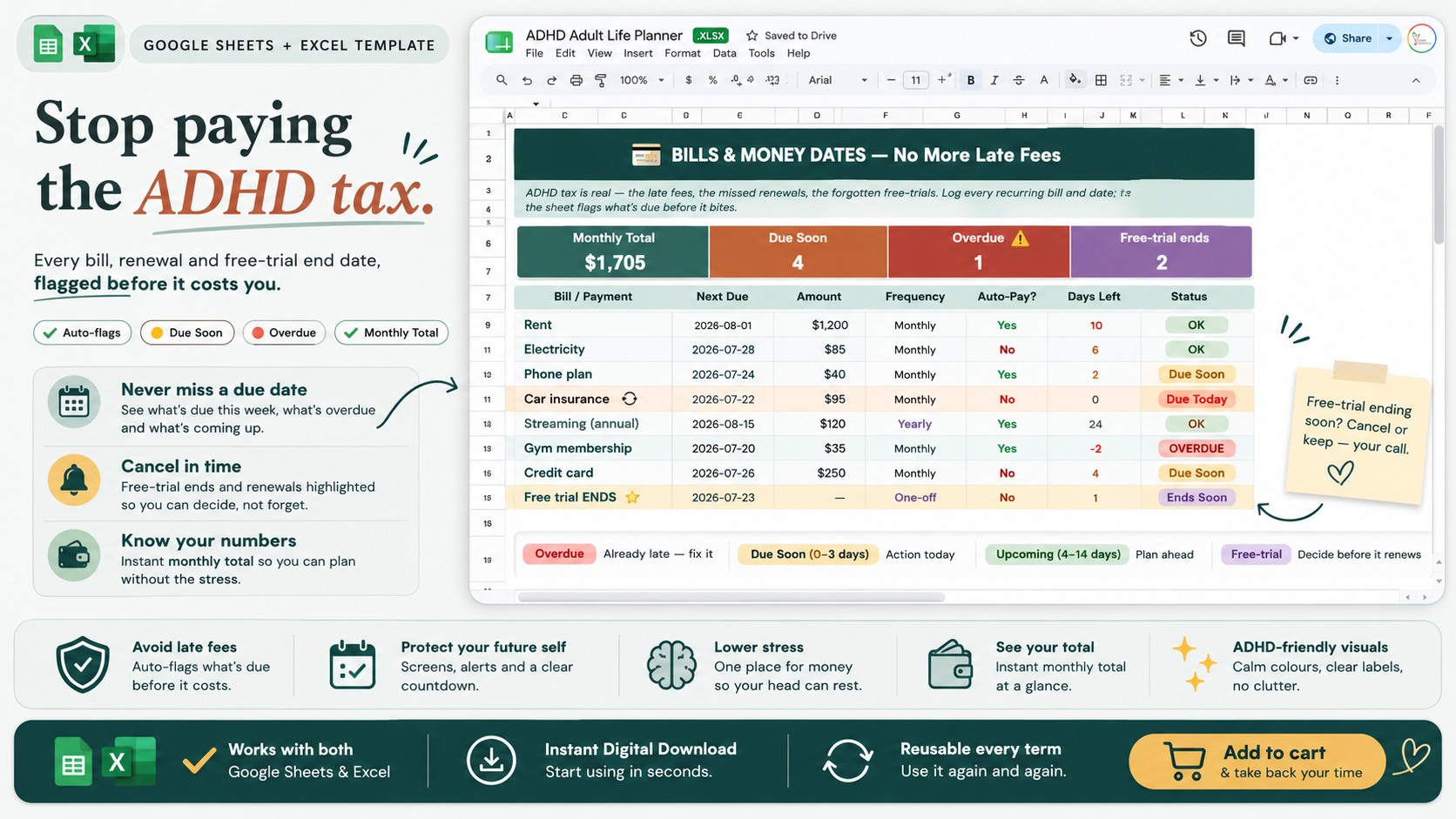
The fix for the ADHD tax is external structure for anything with a date and a cost attached. Instead of holding bills, renewals, and trial end-dates in your head (where they’ll inevitably slip), you capture them somewhere that watches the dates and warns you before they cost you money. The key features:
- Log every bill and its due date, and get flagged when one is approaching — so late fees stop happening not because you got more disciplined, but because you’re prompted in time.
- Track free-trial end dates specifically. The moment you start a trial, log the date it converts to paid. Then you get warned before it charges you, and you can decide deliberately whether to keep or cancel it — instead of being billed by default for forgetting.
- Track renewal dates for insurance, subscriptions, and memberships, so you can shop around or cancel before an auto-renewal locks you in at a worse rate.
- See your recurring outgoings in one place, so you actually know what’s leaving your account each month and can spot subscriptions you’d forgotten you were paying for.
None of this requires you to become a different, more organised person. It just moves the burden of remembering off your brain and onto a system — which is the whole ADHD-friendly principle. The system remembers the dates so you don’t have to, and the ADHD tax, which was always a remembering problem, largely stops being charged.
The money is only half of it
There’s a bonus benefit worth naming: relief. The ADHD tax isn’t only financial — it comes with a running background anxiety (“did I pay that? is something about to charge me? what am I forgetting?”) and a fresh hit of shame every time a late fee or surprise charge lands. When you have a system that reliably catches these dates, that anxiety lifts. You’re not carrying the mental load of tracking it all in your head, and you’re not getting ambushed by charges that trigger self-criticism. The financial saving is real and worth having, but the calm of not living in low-grade money dread might matter even more.
An important, caring note
Please note: this is about organising your own dates and admin with ADHD-friendly principles — it is not medical, psychological, therapeutic, financial, or legal advice, it is not a treatment for ADHD or any condition, and it guarantees no result. A tool can help you stop missing dates, but it doesn’t replace support from a doctor, psychologist, therapist, or financial professional, and ADHD is best supported with proper professional guidance. If you’re struggling — financially or otherwise — please reach out to a qualified professional or someone you trust. Asking for help is a strength.
If you want a system that catches the dates
I built bill, renewal, and free-trial tracking into my ADHD adult life planner in Google Sheets — every money date logged and flagged before it costs you, with your monthly outgoings in one place, alongside do-able task breakdown, appointment countdowns, and an energy tracker:
👉 ADHD Adult Life Planner for Google Sheets & Excel
Whether you use mine or build your own, stop paying the ADHD tax out of shame and start catching it with a system. The late fees, the forgotten trials, the missed renewals — they were never about you not caring. They were about relying on a brain that isn’t built to track scattered dates. Give that job to a system instead, and you’ll keep more of your money and a lot more of your peace of mind. You’re not bad with money. Your brain just needed the right scaffolding.
This reflects ADHD-friendly principles and is an organising tool — not medical, psychological, therapeutic, financial or legal advice, not a treatment for any condition, and it guarantees no result. If you’re struggling, please reach out to a qualified professional or someone you trust. What’s the ADHD-tax charge that stung the most? Share it in the comments — you’re among people who get it.

