

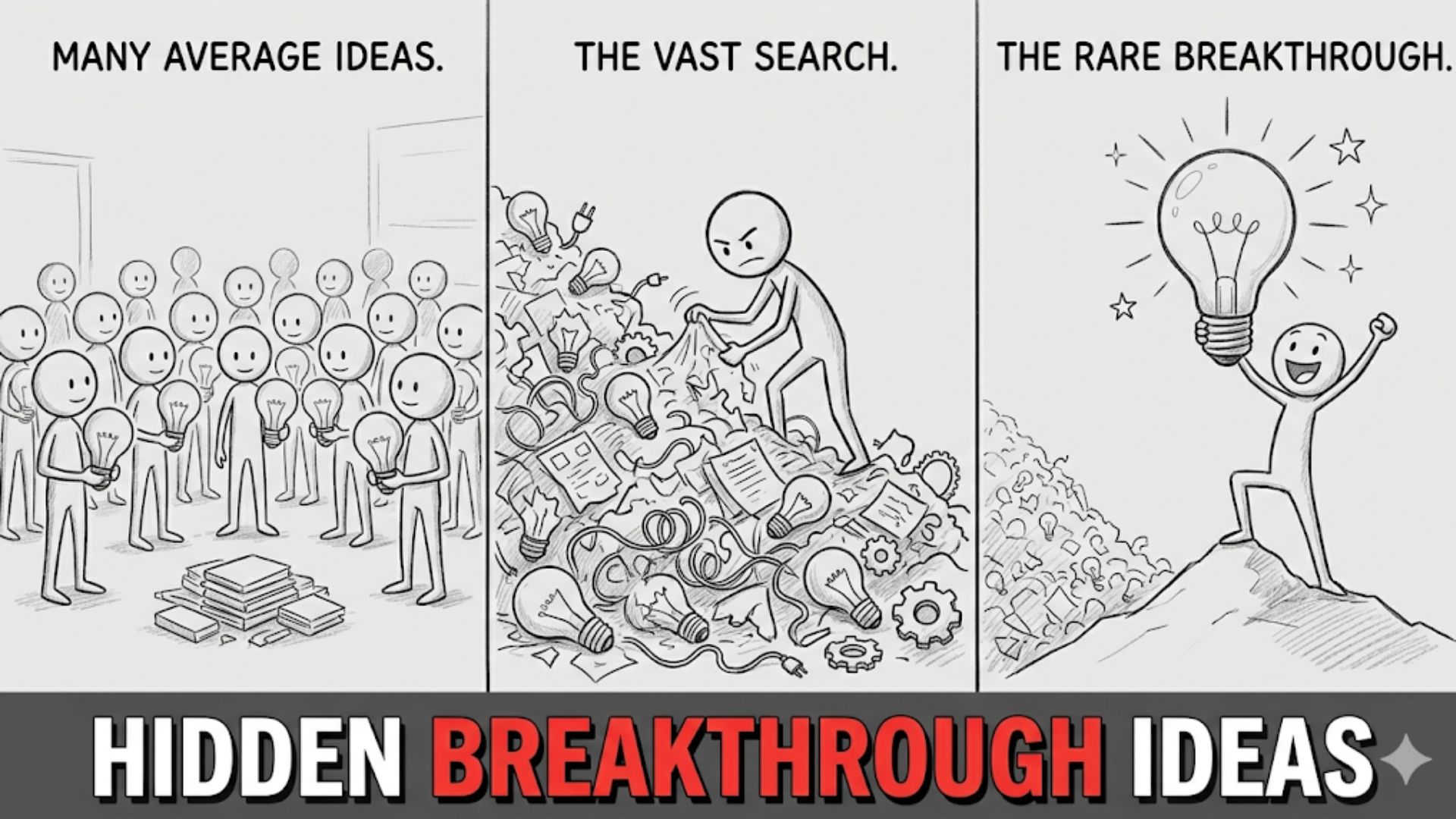
Introduction: Why Breakthrough Ideas Appear Rare
In the study of innovation systems and intellectual history, there is a persistent inclination to view breakthrough ideas as anomalous events—sudden, lightning-like strikes of genius that defy standard explanation. This “Great Man” or “Eureka” narrative serves a cultural purpose, but it obscures the structural reality of how knowledge is actually generated. After years of analyzing the mechanics of discovery across scientific, technological, and economic domains, I have observed that breakthroughs are not isolated deviations from the norm. Rather, they are the predictable, if infrequent, realizations of specific statistical distributions.
Across nearly every field of human endeavor, we see a starkly uneven distribution of impact. In academic research, a microscopic percentage of papers accounts for the vast majority of citations. In technology, a handful of foundational patents drives the lion’s share of economic value. In creative industries, a small number of works defines the aesthetic or commercial landscape for decades. The central question is not why these events are rare—anything at the extreme tail of a distribution is, by definition, rare—but why the distribution of ideas is so profoundly skewed toward a few high-impact outcomes. To answer this, we must move away from the study of the individual mind and toward the study of the systems that govern idea generation, accumulation, and propagation.
Read also: What I Learned About Leading Without Having All the Answers
Linear Effort vs. Nonlinear Discovery
A foundational error in institutional planning and individual expectation is the assumption of linearity. We are socially conditioned to believe that $Input = Output$, or more specifically, that doubling the resources—be it time, capital, or labor—should yield a proportional doubling in the quality of results. In manual labor or routine service, this linear model holds. However, in the realm of intellectual discovery, the relationship between effort and outcome is fundamentally nonlinear.
In discovery-oriented systems, we frequently observe what I term “stagnant effort.” An individual or a research team may spend years in a state of high activity, producing hundreds of incremental papers or prototypes, none of which achieve a significant breakthrough. Conversely, a single insight, often built upon those years of perceived stagnation, can produce a result that is orders of magnitude more valuable than all prior efforts combined. This nonlinearity suggests that breakthrough ideas are not the result of “working harder” in a traditional sense, but of navigating a complex search space where the rewards are concentrated in rare, dense pockets of information.
The Statistical Distribution of Ideas
When we aggregate the outcomes of idea generation, they do not follow the Gaussian “Bell Curve” that we use to describe heights or IQ scores. Instead, they follow power-law distributions, often referred to as Pareto distributions. In a Gaussian system, the average is representative of the whole; in a power-law system, the average is an almost meaningless metric because the distribution is dominated by extreme outliers.
Read also: Structural Mechanisms of Asymmetric Discovery
Probabilistic Discovery and Idea Generation
If we accept that breakthrough ideas are distributed according to a power law, we must view the act of discovery as a probabilistic process. No individual can guarantee a breakthrough on a specific timeline because the “hit rate” for high-impact ideas is structurally low. Therefore, the probability of an individual or an organization generating a breakthrough is a function of the number of “trials” they perform.
Knowledge Accumulation and Idea Formation
Breakthrough ideas do not emerge from a vacuum; they are the result of recombinant innovation. This is the process of taking existing concepts and synthesizing them into novel configurations. In systems thinking, we view knowledge as a cumulative stock. The probability of generating a new idea is contingent upon the size and diversity of the existing stock to which the agent has access.
This can be conceptualized through the “Adjacent Possible,” a term popularized by Stuart Kauffman. At any given point in scientific or technological history, there is a set of first-order discoveries that are reachable from the current state. You cannot invent the microwave oven before you understand radar; you cannot invent the search engine before you have the internet. Each new discovery expands the boundaries of the adjacent possible, increasing the number of potential recombinations. Thus, the distribution of breakthroughs is skewed toward periods or locations where the stock of cumulative knowledge is densest. The more “Lego bricks” of knowledge a system possesses, the more complex and revolutionary the structures it can build.
Cumulative Advantage in Intellectual Systems
The distribution of ideas is further skewed by the principle of cumulative advantage, or the “Matthew Effect,” where “to those who have, more will be given.” In intellectual systems, this means that individuals or institutions that have already produced a breakthrough—or are situated in environments that have—gain access to resources that increase the probability of their next breakthrough.
These resources include:
- Information Flow: Access to “pre-published” ideas and elite networks.
- Capital: Funding for high-risk, high-reward experimentation.
- Social Capital: The benefit of the doubt that allows a thinker to pursue “crazy” ideas for longer periods without censorship.
This creates a self-reinforcing cycle. Success leads to more trials, which, given the probabilistic nature of discovery, leads to a higher likelihood of further success. Consequently, we see a concentration of breakthroughs in specific “hubs”—be they Silicon Valley, 20th-century Vienna, or ancient Athens—where the structural advantages for discovery are most concentrated.
Read also: Why Winning in Business Is the Wrong Goal
Network Effects and Idea Propagation
While an idea may originate in a single mind, its status as a “breakthrough” is a social and systemic designation. An idea only becomes a breakthrough when it propagates through a network and alters the behavior or understanding of other agents. Therefore, the distribution of breakthroughs is inextricably linked to network topology.
Network effects dictate that the value of an intellectual framework increases as more people adopt it. This is a form of Metcalfe’s Law, which states that the value of a network is proportional to the square of the number of its connected users. In the world of ideas, dense networks of communication—where information can be shared, critiqued, and recombined at high speeds—act as accelerators for the discovery process. A breakthrough is more likely to occur in a city or a digital community than in isolation because the network provides a higher “collision rate” between disparate ideas. The uneven distribution of breakthroughs across geography and history is largely a reflection of the uneven density of intellectual networks.
Asymmetric Payoffs in Idea Systems
One of the most critical structural features of breakthrough ideas is their asymmetric payoff structure. Most intellectual efforts are “limited downside, unlimited upside” ventures. The cost of a failed idea is typically the time and resources spent thinking about or testing it. However, the upside of a successful breakthrough is effectively uncapped.
This convexity is what makes the probabilistic search for breakthroughs economically and intellectually viable. If discovery were a linear, symmetric process where every failure cost as much as a success gained, the system would be too fragile to sustain itself. Because a single breakthrough (like the discovery of penicillin or the invention of the transistor) can provide enough societal and economic value to “pay for” millions of failed experiments, the system is incentivized to tolerate high failure rates in exchange for exposure to the tail of the distribution. We must view the “waste” of failed ideas not as inefficiency, but as the “premium” paid to maintain an option on a breakthrough.
Feedback Loops in Knowledge Systems
Feedback loops are the primary mechanism by which certain ideas are amplified while others are marginalized. In a knowledge system, when an idea achieves a certain threshold of validation, it triggers a positive feedback loop. It attracts citations, media attention, and further research. This attention acts as a signal to other agents that this specific area of the search space is “fruitful,” leading to a mass migration of intellectual labor toward that topic.
This process, while efficient for refining a discovery, contributes to the uneven distribution of breakthroughs. It leads to “winner-take-all” dynamics where a single paradigm dominates a field for decades, often at the expense of alternative ideas that may have higher latent potential but failed to trigger an early feedback loop. The “hidden distribution” is thus a map of which ideas successfully captured the system’s attention and triggered the compounding interest of collective effort.
Read also: Why Experimentation Functions as the Primary Engine of Innovation
Time and the Probability of Breakthroughs
Time is the often-overlooked dimension in the distribution of ideas. Because discovery is probabilistic, the likelihood of a breakthrough is highly dependent on the “time at risk”—the duration during which an agent is actively engaged in the search.
Short-termism is the enemy of the power-law distribution. If a research project is evaluated on a one-year cycle, it is effectively forced to stay in the “head” of the distribution, pursuing incremental, “safe” ideas with a high probability of small returns. Breakthroughs require a longer time horizon to allow the Law of Large Numbers to manifest. If we examine the history of Nobel-winning discoveries, we find they are frequently the result of decades of persistent investigation into a single, often unfashionable, problem. The uneven distribution of breakthroughs is, in part, a reflection of the uneven distribution of “strategic patience” across different institutions and cultures.
Why Breakthrough Ideas Seem Sudden
The perception of breakthroughs as “sudden” is an artifact of how the human brain interprets exponential growth and inflection points. For most of its history, a breakthrough idea looks like a failure. It is in the “flat” phase of the compounding curve, where progress is being made but is not yet visible to outside observers.
This is the “iceberg” effect of innovation. The “Aha!” moment is merely the point where the cumulative stock of preparation and experimentation finally crosses the threshold of public legibility. In my analysis, what is described as “sudden insight” is almost always the terminal point of a long-term, stochastic process of error correction. We overlook the “silent” years of accumulation because our narrative-driven minds prefer a clear, dramatic climax over the messy, boring reality of statistical persistence.
Paradigm Shifts and Structural Change
To understand the most extreme breakthroughs, we must look to Thomas Kuhn’s concept of “Paradigm Shifts.” Kuhn argued that most scientific work is “normal science”—the incremental filling-in of details within an existing framework. Breakthroughs, or “revolutionary science,” occur when the current paradigm can no longer account for a growing body of anomalies.
A paradigm shift is a structural reorganization of the entire idea system. It is not just a “new idea”; it is a new “grammar” for thinking. These shifts are rare because the structural inertia of existing intellectual systems is immense. Institutions, textbooks, and funding bodies are all invested in the current paradigm. Consequently, breakthrough ideas that threaten the paradigm are often suppressed or ignored until the weight of evidence becomes catastrophic. This creates a “punctuated equilibrium” in the distribution of ideas—long periods of stability followed by rapid, violent shifts in the intellectual landscape.
Read also: My Journey Through the Timeless Art of Connection
Uneven Outcomes in Idea Systems
The final result of these interacting forces—power laws, cumulative advantage, and feedback loops—is a state of permanent non-equilibrium. Inequality is not a “bug” in the innovation engine; it is the engine itself. If we were to distribute intellectual resources perfectly evenly, we would likely reduce the overall rate of breakthrough discovery because we would prevent the “hubs” of high-collision density from forming.
We must accept that in any system governed by non-rivalrous goods (ideas) and multiplicative growth, the outcomes will be skewed. A small number of individuals, working in a small number of institutions, using a small number of foundational frameworks, will always produce the vast majority of breakthroughs. This analytical insight is crucial for policymakers: the goal should not be to make the outcomes even, but to make the access to the search space as broad as possible, ensuring that the system can capture as many potential “trials” as possible from the widest possible demographic.
Viewing Innovation Through Idea Distributions
By shifting our perspective from the “genius” to the “distribution,” we fundamentally change how we interpret innovation and creativity. We begin to see that “creativity” is not a mystical trait, but a systemic behavior. It is the capacity of an agent to maintain a high volume of trials, tolerate a high rate of failure, and effectively synthesize the cumulative knowledge of their network.
Scientific progress, when viewed through this lens, is a vast, distributed search algorithm. It is an “Evolutionary Search” across an informational landscape. Each researcher is a probe, and each paper is a data point. The “breakthroughs” are simply the points where the search algorithm found a “global maximum”—a peak in the landscape of utility or understanding. This probabilistic view removes the emotional and ideological baggage from discovery, allowing for a more rigorous, neutral analysis of how we can optimize our systems to increase the frequency of high-impact events.
Read also: The Neuroscience Behind How I Rewired My Habits
Conclusion: The Structural Nature of Breakthrough Ideas
The hidden distribution of breakthrough ideas is not a mystery, but a manifestation of the mathematical laws that govern complex, cumulative systems. Breakthroughs are rare because they reside in the extreme tail of a power-law distribution; they are unevenly distributed because of cumulative advantage and network density; and they are difficult to predict because they are the result of a stochastic, recombinant process that is sensitive to initial conditions and path dependency.
To understand breakthroughs, we must study the structure of the “search” rather than the personality of the “searcher.” We must recognize that high-impact ideas are the emergent properties of systems that encourage high-volume experimentation, long-term persistence, and the free exchange of knowledge. The uneven distribution of success is a structural signature of the non-linear way in which human knowledge compounds over time. While we cannot command a breakthrough to occur, we can architect systems that are structurally aligned with the laws of discovery—systems that maximize the probability of colliding with the extraordinary.

