1. QUICK SNAPSHOT
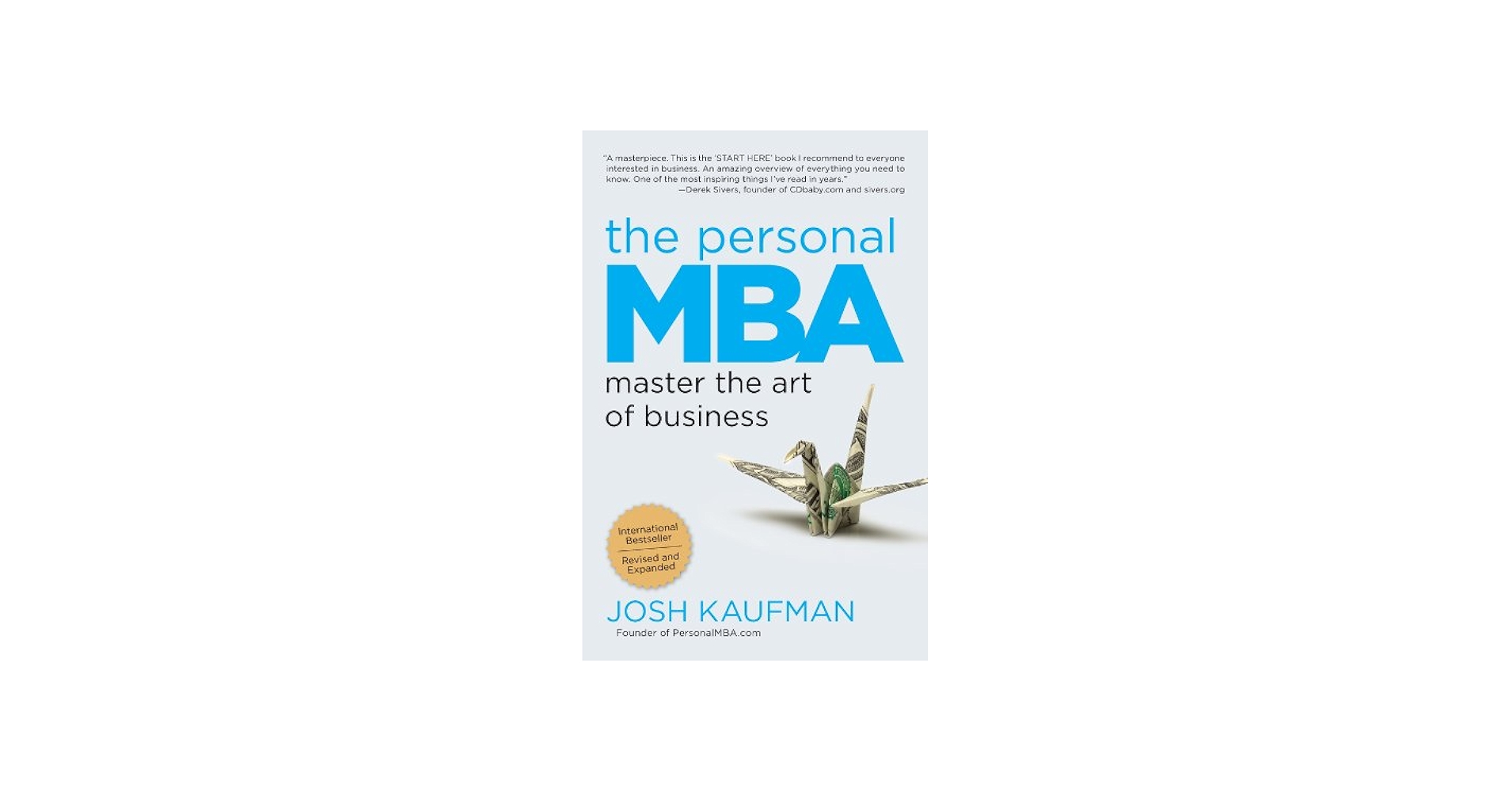
The Personal MBA: Master the Art of Business
- Star Rating: 5/5 – The ultimate business knowledge reference and the definitive “operating manual” for anyone seeking a self-taught MBA.
- Verdict: Josh Kaufman successfully dismantles the myth that business is a complex, academic mystery accessible only through elite institutions. He proves that business is a repeatable system of value creation, human psychology, and systems thinking that can be mastered through self-directed study and real-world application.
- Best For: Entrepreneurs, freelancers, independent professionals, and anyone considering an expensive traditional MBA who wants a faster, more effective path to mastery.
- Difficulty: Medium – While the writing is incredibly clear and accessible, the book is concept-dense, requiring active reflection and a willingness to apply mental models to your own ventures.
This snapshot serves as the “executive summary” for a profound shift in professional education. In the sections that follow, we will deconstruct the “Iron Laws” and systems that make the $100,000 degree obsolete for the modern, pragmatic business leader.
Read also: A Structural Analysis of Compounding Systems
——————————————————————————–
2. INTRODUCTION: THE ACADEMIC ILLUSION VS. REAL-WORLD MASTERY
For decades, the traditional MBA has been marketed as the only legitimate gateway to the upper echelons of commerce. Institutions like Harvard and Wharton charge six-figure sums for a credential that often relies on outdated case studies and academic gatekeeping. At BuildingTheMind.com, we call this the “Academic Illusion.” This illusion suggests that business is a mysterious, high-level science that can only be understood within the hallowed halls of a university.
The reality is far more clinical and, for the institutions, far more embarrassing. A $100,000 MBA program is less about “Knowledge ROI” and more about high-priced signaling and networking. Professional students spend two years of their life—not to mention the interest on massive student loans—learning how to be corporate functionaries. They study history disguised as strategy, while the actual world of value creation passes them by. Josh Kaufman’s core thesis in The Personal MBA isn’t just a suggestion; it is a proven roadmap: business is a repeatable system of value that can be learned by anyone with the discipline to master its fundamental principles.
Business knowledge is not distinct from common sense; it is common sense applied to complex systems. The academic system thrives by overcomplicating these truths to justify its tuition. However, a systems engineer looks at a business and sees five interrelated parts that must function in harmony. If you can identify a problem, solve it effectively, and do so profitably, you are “in business”—regardless of the letters after your name. The $100,000 degree focuses on specialized silos like advanced accounting for Fortune 500 companies, which is essentially useless to the entrepreneur building a modern, lean vehicle of value.
The self-taught MBA path is built on the realization that everything you need to know about economics, psychology, and systems theory is already available. By mastering business mental models, you gain a strategic advantage over the classroom-bound student: you are learning in the context of the real world. You are building while they are borrowing. This leads us to the “Iron Law” that governs every venture, an inescapable reality that no amount of academic prestige or venture capital can circumvent.
Read also: The Step-by-Step Guide to Discovering Your Purpose
——————————————————————————–
3. THE IRON LAW OF THE MARKET: THE FOUNDATION OF VIABILITY
The single most frequent cause of business failure is building something that nobody wants. No amount of marketing, “hustle,” or expensive branding can save a product that lacks fundamental demand. Kaufman calls this the Iron Law of the Market: a viable business requires a substantial number of potential customers who value your offering enough to pay for it. If the market doesn’t exist, the business cannot exist.
In our framework, market research is not a bureaucratic exercise in data collection; it is an insurance policy against failure. Before you invest a single dollar or an hour of your life, you must determine if the market you are entering is attractive or a dead end. Kaufman provides a scoring system to evaluate market attractiveness. If a market scores below 50 across the following criteria, the data dictates that you should abandon the idea and move on to a more viable opportunity.
Ten Ways to Evaluate a Market
- Urgency: How badly do people need this right now? (e.g., a plumber in a flood vs. a new novel).
- Market Size: Are there enough people who will actively buy this?
- Pricing Potential: What is the highest price a typical purchaser would be willing to pay?
- Cost of Customer Acquisition: How much money and effort does it take to get a new customer?
- Cost of Value Delivery: How much does it cost to produce and deliver the value (both in money and effort)?
- Uniqueness of Offer: How unique is your offer compared to competitors?
- Speed to Market: How quickly can you create something to sell?
- Up-Front Investment: How much do you have to spend before you’re ready to sell?
- Upsell Potential: Are there related products you can sell to the same customers?
- Evergreen Potential: Once the initial offer is created, how much additional work is needed to keep selling?
The “So What?” of this list is simple: if you are entering a market with low urgency, small size, and high acquisition costs, you are fighting an uphill battle that no “MBA-level” strategy can win. Conversely, Kaufman highlights The Hidden Benefits of Competition. The presence of competitors is a positive signal; it proves there is existing market demand. Your job is not to invent a market from scratch, but to refine an offering to serve an existing market better than the incumbents. Once a market is identified, you must master the five-part anatomy of the vehicle you are building to serve it.
Read also: The Strategic Power of Thinking in Decades
——————————————————————————–
4. THE FIVE PARTS OF EVERY BUSINESS: A UNIFIED FIELD THEORY
Josh Kaufman’s most impactful contribution is the distillation of every business—from a local meal prep service to a global tech giant—into five interrelated processes. This is the Josh Kaufman 5 parts of every business framework. If any one of these parts is missing or broken, the business is not a business; it is a hobby or a charity.
Section 4.1: Value Creation
Value creation is the identification of an unmet need and the development of an offer that fulfills it. To succeed here, you must understand Perceived Value. Customers don’t pay for what a product is; they pay for what it does for them.
A high-impact concept here is the Hassle Premium. Many of the most profitable businesses don’t invent new technology; they simply identify a “hassle” and eliminate it. If you can save someone time, stress, or physical effort, you can command a much higher price. This is value creation through friction removal. To build your offer, you must select from the 12 standard forms of value:
- Product: A physical or digital item.
- Service: Providing help or labor for a fee.
- Shared Resource: Access to a high-value asset (e.g., a gym).
- Subscription: Ongoing access to value for a recurring fee.
- Resale: Buying from a wholesaler and selling to a retailer.
- Lease: Temporary use of an asset.
- Agency: Marketing and selling an asset you don’t own for a commission.
- Audience Aggregation: Getting a group’s attention and selling access to that group.
- Loan: Lending money for interest.
- Option: Taking a fee for the right to take a specific action in the future.
- Insurance: Transferring risk for a premium.
- Capital: Providing money in exchange for ownership/equity.
Section 4.2: Marketing
Marketing is the process of attracting attention and creating demand. In the Attention Economy, attention is the rarest and most limited resource. If your “Probable Purchasers” don’t know you exist, you cannot help them. Kaufman proves that unique products and messages—Remarkability—outperform the mundane every time.
Effective marketing isn’t about shouting; it’s about being “remarkable” enough to foster word-of-mouth. You must use a “Hook” to grab attention and align your offer with the consumer’s existing desires, not try to manufacture new ones.
Section 4.3: Sales
Sales is the transition of a prospect into a buyer. It is fundamentally about building trust. You must understand the Pricing Uncertainty Principle: prices are often arbitrary and are heavily influenced by perceptions of value rather than cost.
To sell effectively, you must utilize the Four Pricing Methods:
- Replacement Cost: What would it cost to replace?
- Market Comparison: What are others charging for similar offers?
- Discounted Cash Flow: How much wealth will this generate over time?
- Value Comparison: How much is this worth to the specific buyer? Sales is the process of helping the customer realize that the value they receive is greater than the price they pay.
Section 4.4: Value Delivery
This is where promises are kept. Kaufman emphasizes the Expectation Effect: customer satisfaction is performance minus expectations. If you want a resilient business, you must exceed what you promised.
The gold standard for this is Zappos, which famously surprises customers with faster shipping than promised. This creates “Satisfied Customers,” who Kaufman notes are the best business strategy of all. Failure in value delivery leads to “Negative Referrals,” which can destroy a brand faster than marketing can build it.
Section 4.5: Finance
Finance is the study of the system’s sustainability. It is not just accounting; it is understanding how much “fuel” (cash) the system requires to continue creating value. A business must be profitable to remain viable.
Summary of the Five Parts
| Business Part | Primary Goal | Key Focus | Mental Model Link |
| Value Creation | Value | Identifying unmet needs | Hassle Premium |
| Marketing | Attention | Creating demand | Attention Economy |
| Sales | Trust | Converting leads | Pricing Uncertainty |
| Value Delivery | Satisfaction | Exceeding expectations | Expectation Effect |
| Finance | Sustainability | Profitability | Value Stream Efficiency |
——————————————————————————–
5. HUMAN PSYCHOLOGY: THE OPERATING SYSTEM OF COMMERCE
Business is fundamentally a “humanities” subject. It is the study of human behavior, motivation, and decision-making. To skip business school and still succeed, you must understand the “operating system” of the biological machines running the market: humans.
A core concept in Kaufman’s framework is the Five Core Human Drives. Every successful business hooks into at least one of these:
- Acquire: The desire to obtain physical objects, wealth, and power.
- Bond: The desire to feel valued and loved through relationships.
- Learn: The desire to satisfy curiosity and understand the world.
- Defend: The desire to protect ourselves, our loved ones, and our property.
- Feel: The desire for new sensory experiences and emotional pleasure.
Consider the “meal prep service” example from the source. To be successful, this business doesn’t just sell “food.” It hooks the Feel drive (pleasure of a tasty meal), the Acquire drive (health and time as assets), and the Learn drive (curiosity about new recipes). Furthermore, humans are hardwired for Status Seeking. We seek social standing, and we use our purchases to signal that status to others. If your product enhances a customer’s social standing, you have a massive competitive advantage.
However, the operating system has “bugs” or limitations. We must account for Cognitive Limitations and Loss Aversion.
- Cognitive Limitations: Human attention is scarce. We cannot process every offer. Therefore, your marketing must be remarkable enough to disrupt a prospect’s “preoccupation.”
- Loss Aversion: The pain of losing $100 is far greater than the joy of gaining $100. This is an evolutionary byproduct of the Defend drive. In business, this means prospects are naturally terrified of making a “bad” purchase. Your job in sales is to reduce this perceived risk through trust, social proof, and guarantees.
Read also: The Deep Psychology of Inspiring Leadership and Brand Loyalty
——————————————————————————–
6. SYSTEMS THINKING: FROM CHAOS TO PREDICTABILITY
The most successful entrepreneurs treat their business as a complex system, not a series of tasks. Systems thinking allows you to move from chaos to predictability.
A vital principle to internalize is Gall’s Law: A complex system that works is invariably found to have evolved from a simple system that worked. A complex system designed from scratch never works and cannot be patched up to make it work. This is why you must start with a Minimum Viable Offer (MVO). Do not try to build a complex, multi-layered corporation on day one. Create the simplest version of your value, test it in the real market, and use the Prototype and Iteration Cycle.
To optimize the system, you must map the Value Stream. This is the path from the initial idea to the cash in your bank account. Following the lead of the Toyota Production System, you must analyze every step of this stream to eliminate “waste”—anything that does not add value to the end customer.
By treating the business as a system, you can use Incremental Augmentation—making small, data-driven improvements that minimize risk while enhancing the offering. This engineering-led approach to business is what allows a small team to outperform a bloated, “MBA-heavy” corporation. You are not guessing; you are iterating based on the system’s feedback.
Read also: A Visual Guide for First-Time Entrepreneurs
——————————————————————————–
7. CRITICAL ANALYSIS: THE BOOK VS. THE $100,000 DEGREE
When evaluating The Personal MBA against a traditional degree, we must distinguish between Knowledge ROI and Signaling.
In terms of pure knowledge and actionable principles, Kaufman’s work wins decisively. You can gain the equivalent of a world-class business education for the price of a few dozen books and the time spent applying them. This creates a more resilient entrepreneur who understands the “Unified Field Theory” of business rather than a specialized corporate functionary. The $100k MBA often traps students in a “Debt Trap,” forcing them into high-stress corporate jobs just to pay off the loans, effectively killing their entrepreneurial spirit before they even start.
However, elite universities still hold a monopoly on Credentialing and Networking. If your goal is to work at a legacy institution where the “brand” of your degree matters more than your ability to create value, then the traditional path has utility.
But for the entrepreneur, the independent professional, or the leader in a modern, meritocratic industry, the self-taught MBA path is superior. It allows you to learn while doing. Real business knowledge comes from value creation in the real world, not from case studies in a classroom. You are building equity while the MBA student is building debt.
Read also: Why Time Is the Most Underrated Competitive Advantage
——————————————————————————–
8. PROS & CONS OF THE PERSONAL MBA
| Pros | Cons |
| High Return on Knowledge (ROK): Gain elite-level insights for the cost of a book. | Breadth Over Depth: Covers 200+ concepts; specific niches (like tax law) require extra study. |
| Business Mental Models: Provides timeless principles that won’t go out of style. | Concept Density: Can be overwhelming for casual readers; requires active application. |
| Zero Debt: Avoid the $100k+ “Academic Illusion” price tag. | No Pre-made Network: You must build your own professional relationships from scratch. |
| Practical & Scalable: Focuses on what actually works in the real market. | High Discipline Required: No professors to hold your hand; you are the dean of your own education. |
——————————————————————————–
9. CONCLUSION: BUSINESS IS NOT MAGIC, IT IS A SYSTEM
The central takeaway of The Personal MBA summary is empowering: Business is not magic; it is a learnable, repeatable set of skills. By understanding the five parts of every business—Value Creation, Marketing, Sales, Value Delivery, and Finance—you have a North Star that can guide you through any professional challenge.
You don’t need academic credentials to create value. You need to identify an unmet need, build a solution, get people’s attention, build trust, and deliver on your promises profitably. Whether you are launching a meal prep service or a software conglomerate, these principles remain the same.
True business mastery is found in the relentless application of these systems to the real world. You now have the blueprints. The academic gatekeepers have been bypassed.
——————————————————————————–
10. CALL TO ACTION: SAVE THE TUITION, START BUILDING
The era of the “Academic Illusion” is over. You do not need to wait for permission or a degree to start your journey into business mastery. Study the principles, master the mental models, and—most importantly—begin creating value today.
Save the tuition. Study the principles. Start building.