In the contemporary professional landscape, speed is frequently conflated with competence. Driven by real-time digital feedback, quarterly performance reviews, and the omnipresent “highlight reels” of social media, the modern career architecture is increasingly optimized for visible acceleration. We operate in an era of “compressed time,” where the pressure to achieve immediate results—promotions, salary spikes, or public accolades—often overrides the fundamental mechanics of long-term success.
However, a rigorous analysis of high-trajectory careers suggests that this bias toward speed is often a structural trap. Rapid movement without depth leads to a phenomenon known as “shallow career development,” where an individual gains broad exposure but fails to build the “moats” of expertise and reputation that provide true leverage.
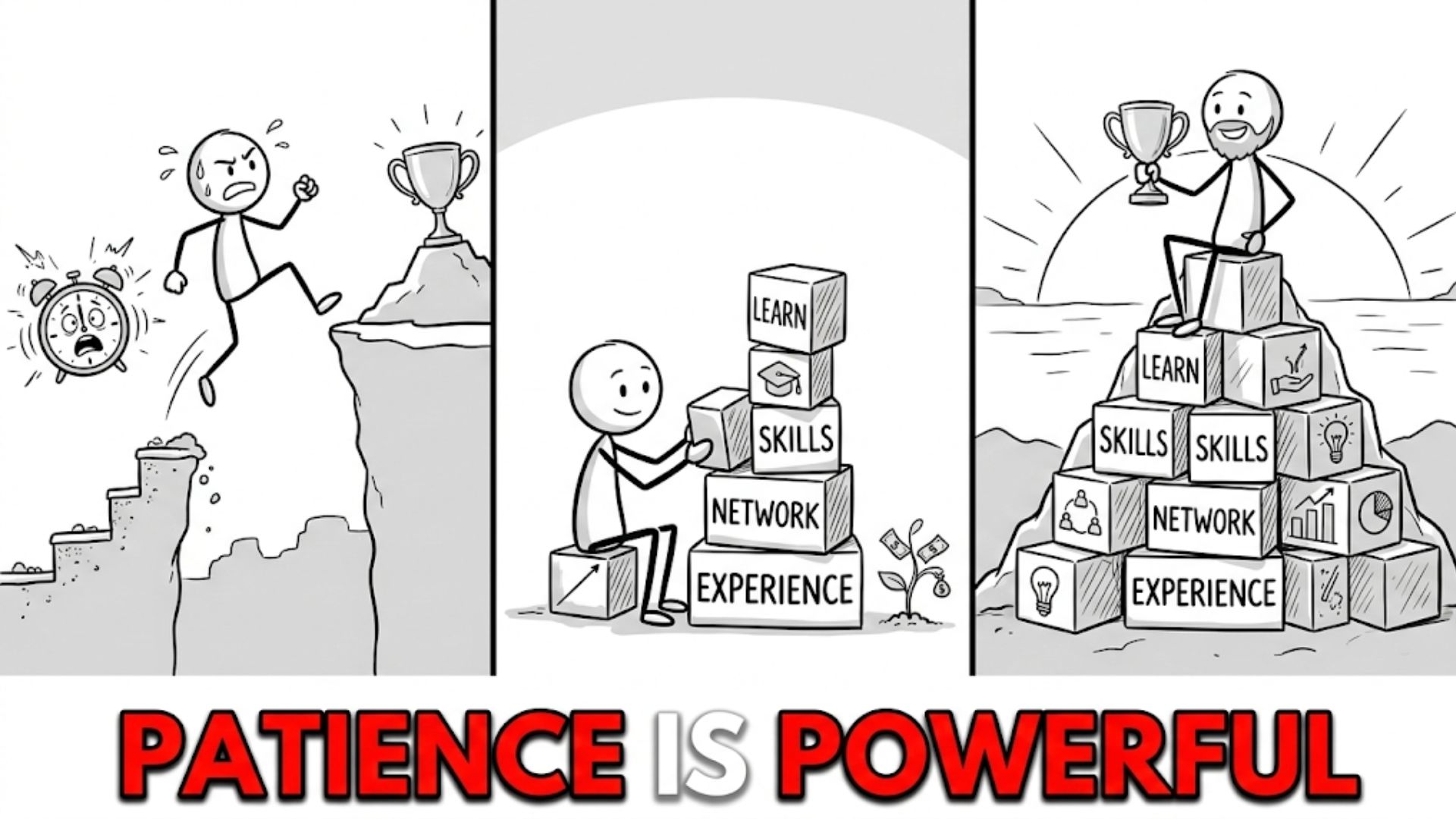
The thesis of this inquiry is that patience is not a passive state of waiting, but a strategic asset—an active, disciplined commitment to the compounding of human and social capital. In a volatile market, the scarcest resource is no longer raw intelligence or information; it is the capacity to maintain a long-term time horizon. Patience, when practiced as a deliberate career strategy, enables a professional to move from linear competition to exponential dominance.
Read also: Why Working IN Your Business Is Slowly Destroying It
1. The Economics of Compounding in Careers
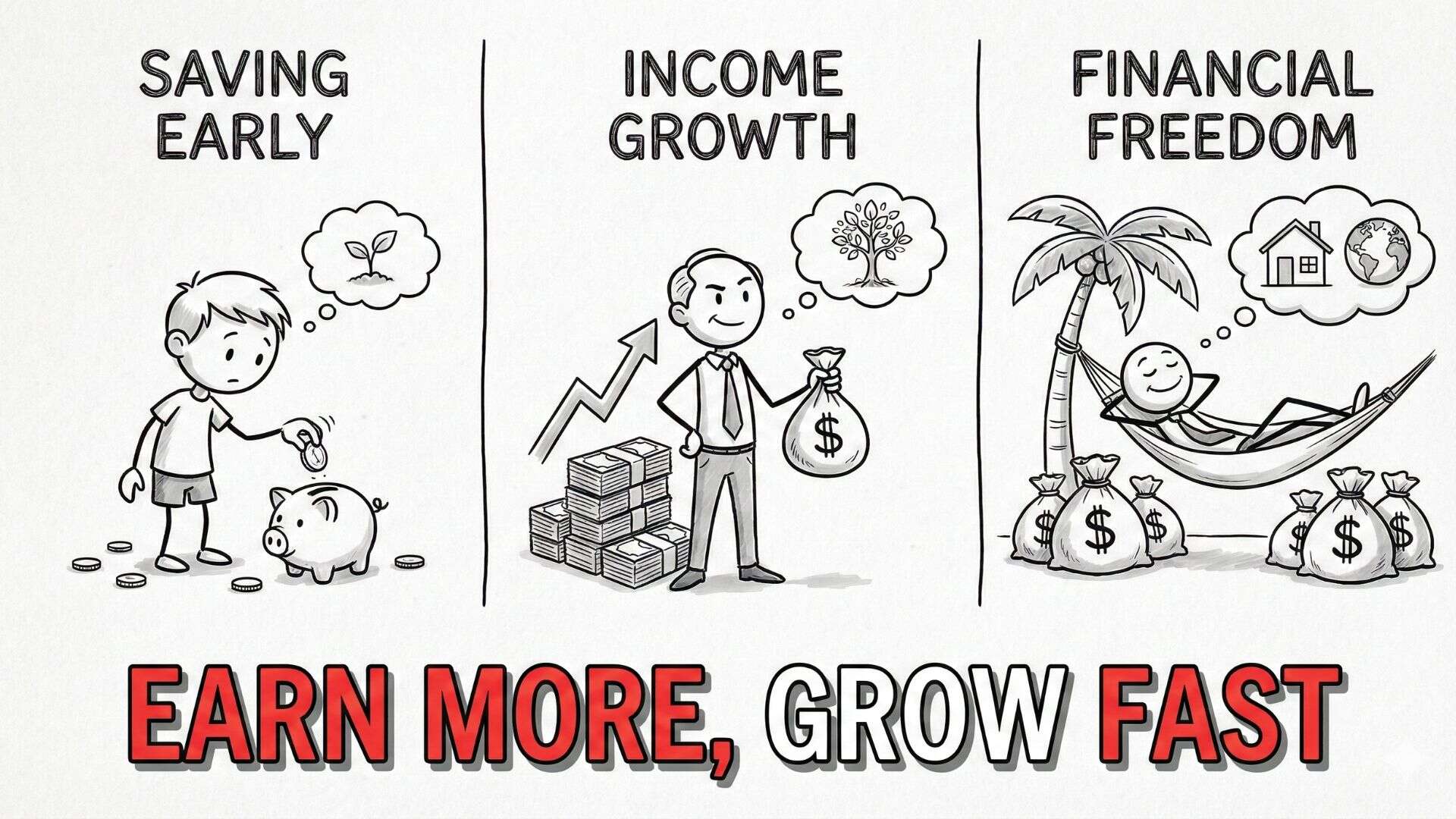
To understand patience as a strategy, we must first deconstruct how “compounding” functions within the context of a career. In finance, compounding is the process where earnings on an asset are reinvested to generate additional earnings over time. In a career, this same geometric progression applies to four primary categories of capital:
Compounding Knowledge
Mastery of a complex field is non-linear. The first 1,000 hours of learning often produce marginal results as the individual struggles with foundational syntax and mental models. However, as the knowledge base grows, new information begins to attach to existing frameworks with increasing efficiency. A patient professional who stays in a domain for a decade develops “integrative complexity”—the ability to see connections that specialists with only two years of experience cannot perceive.
Compounding Trust and Network Effects
Relationships do not scale linearly; they scale through the accumulation of “proof of work.” Every year spent in a specific industry or within a specific network increases the “trust density” of that professional’s profile. A patient career allows for the development of “deep ties”—relationships where the transaction costs are near zero because the trust has been stress-tested over multiple cycles.
Compounding Credibility (Reputation)
Reputation is the market’s perception of your reliability. Consistency over time is the only way to build a high-conviction reputation. When an individual pivots their career every 18 months, the compounding of their reputation is reset. The market perceives them as a “renter” rather than an “owner.” A patient professional, by contrast, becomes synonymous with their domain, allowing them to capture the “brand premium” that comes with long-term presence.
Read also: How Skill Stacking Increases Income Potential
2. Skill Depth vs. Skill Hopping: Time Under Tension
mastered human performance is subject to the principle of “time under tension.” Just as muscle growth requires sustained physical stress over time, cognitive mastery requires sustained focus within a stable domain.
The Neurological Basis of Expertise
Expertise is the result of “myelination”—the physiological thickening of the neural pathways used for a specific task. This process is slow and requires repeated, high-intensity focus (Deep Work). When a professional “skill hops”—moving from data science to marketing to product management in rapid succession—they are effectively preventing the myelination of any single pathway. They remain a perpetual novice, stuck in the “linear” phase of the learning curve where effort is high and output is low.
The Opportunity Cost of Resetting
Every time a professional switches domains, they pay a “switching tax.” This tax includes the loss of domain-specific jargon, the loss of “who knows what” (transactive memory), and the loss of historical context. While “skill stacking” is a valid strategy for increasing income, it requires that each skill in the stack reaches a threshold of utility. Patience ensures that each skill is mastered deeply enough to actually provide multiplicative value when stacked with the next.
3. Reputation as Long-Term Capital: The Signaling of Consistency
In labor economics, Signaling Theory suggests that because employers cannot know an applicant’s true productivity, they rely on “signals” of quality. One of the most potent signals in a high-stakes economy is duration.
Consistency as a Proxy for Quality
Long-term presence in a role or industry signals three things to the market:
- Emotional Stability: The ability to endure the inevitable troughs of a market cycle.
- Competence: The fact that the individual hasn’t been “found out” or terminated over a long period.
- Low Friction: The individual is a “known quantity,” reducing the risk for a potential partner or employer.
The Fragility of Frequent Pivots
Frequent job-hopping or radical career pivots may yield short-term salary bumps (often 10–20%), but they erode the individual’s “reputational capital.” Over a 20-year horizon, the person who stayed and mastered their domain—eventually becoming a “Category of One”—will almost always command a massive premium over the person who optimized for immediate salary increases but remained a commoditized worker.
Read also: Why Financial Education Changes Behavior
4. Decision Quality and Time Horizon
Impatience is the primary driver of poor decision-making. When a professional is “in a hurry,” their cognitive evaluation of opportunities becomes distorted by Short-Termism.
Risk Assessment and Strategic Positioning
A patient professional evaluates an opportunity based on its impact on their terminal wealth and status (where they will be in 20 years). An impatient professional evaluates based on their immediate utility (the next paycheck). This difference in time horizon fundamentally changes the risk-reward calculus. A patient individual can afford to wait for the “fat pitch”—the asymmetric opportunity where the downside is limited but the upside is transformative.
Emotional Regulation and Negotiation Leverage
Impatience is a position of weakness in any negotiation. The party that needs the deal to happen quickly always loses leverage. Patience provides the “power of the walk-away.” By extending their time horizon, a professional can wait for the right role, the right equity split, or the right partnership, rather than settling for a sub-optimal arrangement out of a perceived sense of urgency.
5. Optionality and Asymmetric Outcomes
The ultimate goal of a patient career is the creation of Optionality. In finance, an option gives you the right, but not the obligation, to take an action. In a career, optionality is the result of having such deep capital (skills and reputation) that opportunities come to you.
Access to High-Leverage Opportunities
The most lucrative opportunities in the global economy—founding roles in high-growth startups, board seats, or high-stakes advisory positions—are rarely found on job boards. They are distributed through “closed loops” of trusted professionals. Entrance into these loops requires a minimum “buy-in” of long-term credibility.
Equity vs. Salary
Impatience often forces professionals to optimize for high base salaries. Patience allows an individual to optimize for Equity (Ownership). Because equity compounding takes 7–10 years to realize, only those with strategic patience can participate in the massive wealth creation of the modern economy. The impatient professional trades the “exponential” upside of equity for the “linear” safety of a monthly paycheck.
Read also: The Psychology of Holding vs Selling Assets
6. The Psychology of Impatience: Navigating the Biological Trap
If patience is such a clear strategic advantage, why is it so difficult to practice? The answer lies in our evolutionary biology and the modern environment that exploits it.
Dopamine Cycles and Social Comparison
Our brains are wired to seek immediate rewards (dopamine). In the ancestral environment, securing a resource now was a survival imperative. Today, social media platforms create a “Relative Deprivation” effect: we see a peer’s promotion or a stranger’s entrepreneurial success and feel that we are “falling behind.” This triggers a state of high cortisol and urgency, leading to impulsive career moves that satisfy the emotional need for “progress” but damage the long-term compounding of the career.
Loss Aversion and Urgency Bias
We are biased to feel the “pain” of a missed opportunity (FOMO) more than the potential gain of a future one. This leads to “Shiny Object Syndrome,” where a professional abandons a compounding path to chase a new trend (e.g., jumping from Fintech to AI to Web3 within three years). By the time they reach threshold competency in the new field, the trend has often normalized, and they have lost the “Lindy Effect” of their previous domain.
7. When Patience Becomes Passivity: The Distinction of “Active Patience”
A critical nuance in this analysis is the distinction between Strategic Patience and Complacency (Passivity). Patience is not the absence of action; it is the presence of directed action over a long duration.
Defining Strategic Patience
- Strategic Patience: Sticking with a difficult project because the fundamental thesis of the domain is still valid. It is “Time Under Tension” for a specific goal.
- Passivity/Complacency: Staying in a role because of fear of change, even when there is no growth or compounding occurring.
The Decision Filter
To distinguish between the two, one must use a Growth Audit:
- Is my knowledge compounding? (Am I learning something new and rare?)
- Is my reputation compounding? (Is my “trust density” increasing with key people?)
- Is the “Exit Value” of this role increasing? (If I left today, would I be more valuable than a year ago?)
If the answer to these is “Yes,” but the salary hasn’t moved yet, you are practicing Strategic Patience. If the answer is “No,” you are being passive.
Read also: Why Simplicity Wins in Personal Finance
8. Practical Framework: Practicing Strategic Patience
Strategic patience is a skill that can be developed through specific decision-making frameworks.
The 5-Year Skill Compounding Map
Instead of setting annual goals, map out a 5-year acquisition path for a specific “Skill Stack.” For example, if you are in Finance, your map might look like:
- Year 1-2: Deep technical mastery (CFA/Technical analysis).
- Year 3: Integration of Data Science (Python/SQL).
- Year 4: Development of Leadership and Persuasion skills.
- Year 5: Strategic synthesis and market positioning.
The Reputation Audit
Every six months, identify the 5–10 people whose opinion of your work constitutes your “Reputational Capital.” Ask: “Have I been consistent enough for these people to bet their own reputation on me?”
The Decision Delay Rule
For any major career move (resigning, starting a venture), implement a 30-day “cooling off” period. If the move is based on a long-term strategic shift, the desire will remain. If it is based on a short-term dopamine spike or a reaction to a bad week, the urgency will fade.
9. Case Pattern Analysis: The Four Archetypes of Career Trajectory
Analyzing career outcomes over a 20-year horizon reveals four distinct patterns of behavior:
The Impatient Optimizer
- Behavior: Job-hops every 12–18 months for a 15% salary increase.
- Outcome: High initial earnings, but hits a “ceiling” in middle management. Lacks the deep reputation or specialized expertise to move into the C-suite or high-stakes roles. Eventually becomes “expensive but replaceable.”
The Career Sprinter
- Behavior: Works 100 hours a week for 3 years, then burns out and switches industries entirely.
- Outcome: Resets their compounding clock every 5 years. Ends their career with 20 years of “Year 1” experience in four different fields.
The Long-Term Builder
- Behavior: Stays in a single domain (e.g., Software Architecture or Venture Capital) for 15+ years.
- Outcome: Becomes a “Category of One.” Their reputation precedes them. They no longer “apply” for jobs; opportunities are “architected” around their availability. They capture the majority of the value in their industry.
The Quiet Compounder
- Behavior: Focuses on a specific skill stack (e.g., “Engineering + Product Design + Sales”). Spends early years learning, middle years building, and later years harvesting.
- Outcome: Achieves the highest terminal wealth and professional autonomy. By being patient through the “linear” phases, they reach the “vertical” phase of compounding where their income decouples from their time.
Read also: How Loss Aversion Impacts Portfolio Decisions
10. Conclusion: Patience as Strategic Power
In an economy increasingly defined by algorithmic speed and shallow attention, the ability to wait is a profound competitive advantage. Patience allows a professional to build the “un-fakeable” assets of a modern career: deep expertise, a bulletproof reputation, and high-leverage optionality.
Reframing patience requires moving away from the belief that “more speed equals more success.” Instead, we must understand that career success is a game of duration. The most significant rewards do not accrue to the fastest mover, but to the most durable one. By extending your time horizon, you effectively remove 90% of your competition, as most people lack the structural discipline to stay the course through the “boring” phases of compounding.
In the long run, the “Quiet Compounder” who masters the architecture of time will always outperform the “Impatient Optimizer” who is trapped in the cycle of immediate feedback. Patience is not a sacrifice of the present; it is the strategic purchase of a non-linear future.