Waste Is the Silent Profit Killer in Your Food Business
The over-prepped protein, the spoiled veg, the buns that went stale — it’s food you paid for and never sold. Here’s why food waste tracking is the fastest, cheapest fix for a struggling margin.
If your food cost percentage is running higher than it should, there’s a good chance the culprit isn’t your prices or your recipes — it’s your bin. Waste is one of the biggest and most overlooked drains on a food business’s profit, precisely because it’s invisible in the way that matters: you don’t see it on your sales report, you don’t feel it at the point of sale, you just quietly paid for ingredients that turned into money you’ll never get back. The over-prepped protein, the spoiled vegetables, the buns that went stale — every bit of it is profit thrown away. And here’s the good news buried in that bad news: food waste tracking is usually the single fastest and cheapest way to fix a struggling margin. Here’s why, and how.
Why waste hides so well
Waste is uniquely sneaky compared to other costs. When you underprice a dish, at least the transaction is visible. But waste happens quietly, off to the side, in ways that never show up in your headline numbers:
- It’s not on the sales report. Your takings show what you sold. They say nothing about what you bought, prepped, and binned. So a day with heavy waste and a day with none can show identical sales — the waste is simply absent from the story your sales tell.
- It feels like normal operating cost. You buy ingredients; some don’t get sold; that just feels like “how it goes.” Without deliberately tracking it, waste blends into your general food spend and never gets identified as a distinct, fixable problem.
- Each instance is small. A bit of over-prepped protein here, some spoiled veg there — no single instance feels significant. But they accumulate, service after service, into a serious number.
So waste inflates your food cost percentage from the shadows. Your ingredients cost more than your sales would suggest they should, and if you’re not tracking waste specifically, you’ll blame your prices or your suppliers when the real leak is the food that never made it to a customer.
Why it’s the best problem to have (and fix)
Here’s what makes waste such a rewarding thing to tackle: it’s almost always the cheapest and fastest margin fix available to a food business. Think about the alternatives for improving your food cost. Raising prices risks upsetting customers. Renegotiating with suppliers is slow and only moves the needle so far. Reformulating recipes takes effort and can change the product people love.
Reducing waste, by contrast, is pure upside. Every dollar of waste you eliminate drops almost straight to your bottom line, and cutting it doesn’t require charging customers more, changing your food, or finding new suppliers. It’s found money — profit you’re currently throwing in the bin that you simply stop throwing away. For a business fighting a high food cost percentage, waste is very often the first place to look, because it’s the place where improvement costs you the least.
The key: log it, with the reason
You can’t fix waste you can’t see, which is why tracking is everything. The practice is simple: every time you throw food away, log it — what it was, roughly what it cost, and why it was wasted. That last part, the reason, is where the magic is.
Because waste isn’t random. It happens in patterns, and the reasons reveal them. Track the “why” and you start to see the story: you consistently over-prep a particular item and bin the excess. A specific ingredient keeps spoiling before you use it. A certain dish’s components go stale because it doesn’t sell fast enough. Prep amounts are calibrated for busy days and waste heavily on quiet ones. Each pattern points to a specific, fixable cause — prep less of that item, order the perishable one more often in smaller amounts, rethink that slow dish, adjust prep to expected demand.
This is why owners are so often shocked when they first track waste: the total is bigger than they imagined, and the causes are more concentrated and more preventable than they’d have guessed. A large share of waste usually traces to a handful of specific, correctable habits. Tracking turns a vague “we throw some stuff away” into “we lose this much, mostly to these three causes” — which is a problem you can actually solve.
Preventable vs unavoidable
A useful refinement: distinguish preventable waste from the genuinely unavoidable kind. Some waste is just the nature of food — trim, unsellable ends, the occasional item that spoils despite good handling. That’s a cost of doing business you can minimise but not eliminate. But a lot of waste is preventable: over-prepping, poor rotation, over-ordering perishables, portion drift. Flagging which is which focuses your energy where it pays. You stop worrying about the unavoidable and attack the preventable, which is where the real, recoverable money is.
An important note
To be clear: tracking waste is about understanding and managing your own operation — it is not financial, tax, accounting, legal, food-safety, or business advice, and it guarantees no result. Importantly, how you handle food, including anything related to food safety and hygiene, is governed by regulations you must follow — this is about tracking the cost of waste, not advising on safe food handling. Always follow the licensing, commissary, food-safety, and insurance requirements that apply where you operate, and consult a qualified professional for tax and accounting decisions.
If you want a waste tracker built in
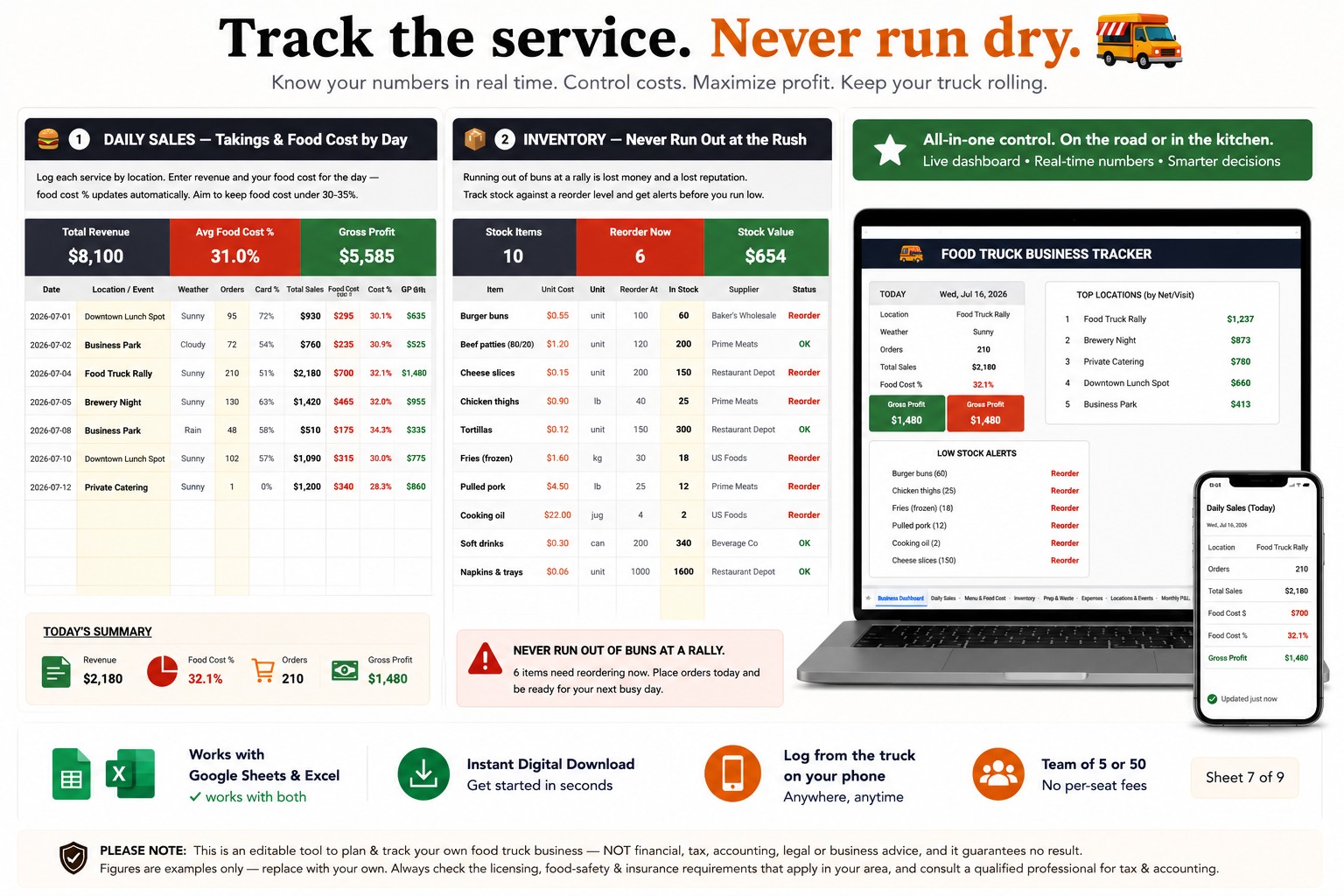
I built a prep and waste tracker into my food truck business tracker in Google Sheets — log each wasted item, its cost, the reason, and whether it was preventable, so the patterns most owners never spot become obvious, alongside food cost % on every dish and a full P&L:
👉 Food Truck Business Tracker for Google Sheets & Excel
Whether you use mine or a notebook by the prep station, start logging what you throw away and why. Waste is the silent profit killer precisely because it’s invisible — so the moment you make it visible, it becomes one of the easiest wins in your whole business. That bin is quietly eating your margin. Track it, find the pattern, and take your profit back.
This reflects my own perspective and is an organising tool — not financial, tax, accounting, legal, food-safety or business advice, and it guarantees no result; follow the food-safety and other requirements that apply where you operate. Food truck owners: what’s the one waste pattern that surprised you most? Tell me in the comments.