Which Market Actually Pays? The Profit-Per-Pitch Question
A packed market can leave you with almost nothing once the pitch fee comes out. Here’s why tracking coffee cart profit per pitch — and pricing every drink for margin — is what actually makes mobile coffee work.
For a mobile coffee business, there are two questions that quietly decide whether you make money, and most owners can’t answer either with confidence. First: which of the markets and events you trade at actually make you money, once everything’s accounted for? Second: is each drink on your menu actually priced to make a profit? A cart can be busy, popular, and beloved, and still barely break even if the answers to those questions are wrong. Getting clear on coffee cart profit — pitch by pitch and drink by drink — is what turns a fun hobby that loses money into a business that works. Here’s how to think about both.
“Busy” is not “profitable”
Here’s the trap that catches so many mobile food and drink businesses. You have a great day at a market — a queue most of the time, cups flying out, the satisfying buzz of a busy pitch. It feels like a success. Then you do the sums that evening and find you made almost nothing, because the pitch fee was high, your costs ate the rest, and the busyness didn’t translate into profit.
The problem is that a mobile business pays to be at each market — a pitch or stall fee — and that fee varies enormously between events. A market with a high fee needs a lot of sales just to cover the cost of being there before you make a penny. So a busy day at an expensive pitch can be less profitable than a quieter day at a cheap one. Judging your success by how busy you were, or even by your takings, is misleading. The only thing that matters is what’s left after the pitch fee and your costs.
Profit per pitch: the number that reshapes your calendar
The fix is to track profit per pitch: for each market or event, take your revenue, subtract the pitch fee, subtract your cost of goods (the coffee, milk, cups you actually used), and see the real profit that pitch generated. Do this consistently and a pattern emerges that will genuinely reshape your business.
Some markets, you’ll discover, are quietly excellent — good sales, reasonable fee, strong profit. Others are a lot of effort for very little, or even lose money once everything’s counted. This is priceless information, because your time and your pitches are limited. Knowing your profit per pitch lets you rebook the winners and drop the duds — concentrating your effort on the markets that actually pay, and stopping the ones that don’t. Over a season, shifting your calendar toward high-profit pitches can transform your income without you working any harder. You’re just spending your limited days where they pay.
Without this tracking, you’re flying blind, likely returning to markets out of habit or gut feel — and gut feel about profitability is notoriously unreliable when a variable pitch fee is involved. The data tells you what your instinct can’t.
The other lever: menu margin
The second question is about the menu itself: is each drink priced for profit? This is where cost-per-cup and margin come in, and it’s an area where small errors quietly bleed money all day long.
Every drink you sell has a cost to make — the beans, the milk, the cup, the lid, the syrup. Your price minus that cost is your profit per cup, and expressed as a percentage, your margin. The trap is that these costs are small and easy to underestimate, so it’s genuinely common to price a drink that feels profitable but barely is, or to have one item on your menu quietly losing you money on every sale. Because the amounts per cup are small, the problem stays invisible — until you multiply it by hundreds of cups.
Working out the true cost and margin of each drink does two things. It reveals any drinks you’ve underpriced, so you can fix them. And it lets you price deliberately for a healthy margin (a common target for coffee is a high margin per cup, since the raw ingredients are cheap relative to what people happily pay) rather than pricing by guesswork or by copying the cart down the road. A few cents of margin per cup, across every cup you sell all season, is a serious amount of money. Menu pricing is not a detail; it’s a core profit lever.
Two levers, one goal
Profit per pitch and menu margin are the two big levers of a mobile coffee business’s profitability, and they work together. Menu margin sets how much you make per cup; profit per pitch tells you where those cups are worth selling. Pull both — price every drink for a healthy margin, and spend your days at the markets that actually pay — and a cart that was “busy but broke” becomes genuinely profitable. Ignore them, and you can pour coffee all season and wonder where the money went.
An important note
To be clear: this is about organising and understanding your own numbers — not financial, tax, accounting, legal, or business advice, and it guarantees no result. Any figures or margin targets mentioned are general examples, not promises; your real numbers depend on your costs, prices, and situation. And food and drink trading is regulated — checking the licensing, food-safety, and insurance requirements that apply where you trade is your responsibility. Consult a qualified professional for tax and accounting decisions.
If you want both levers built in
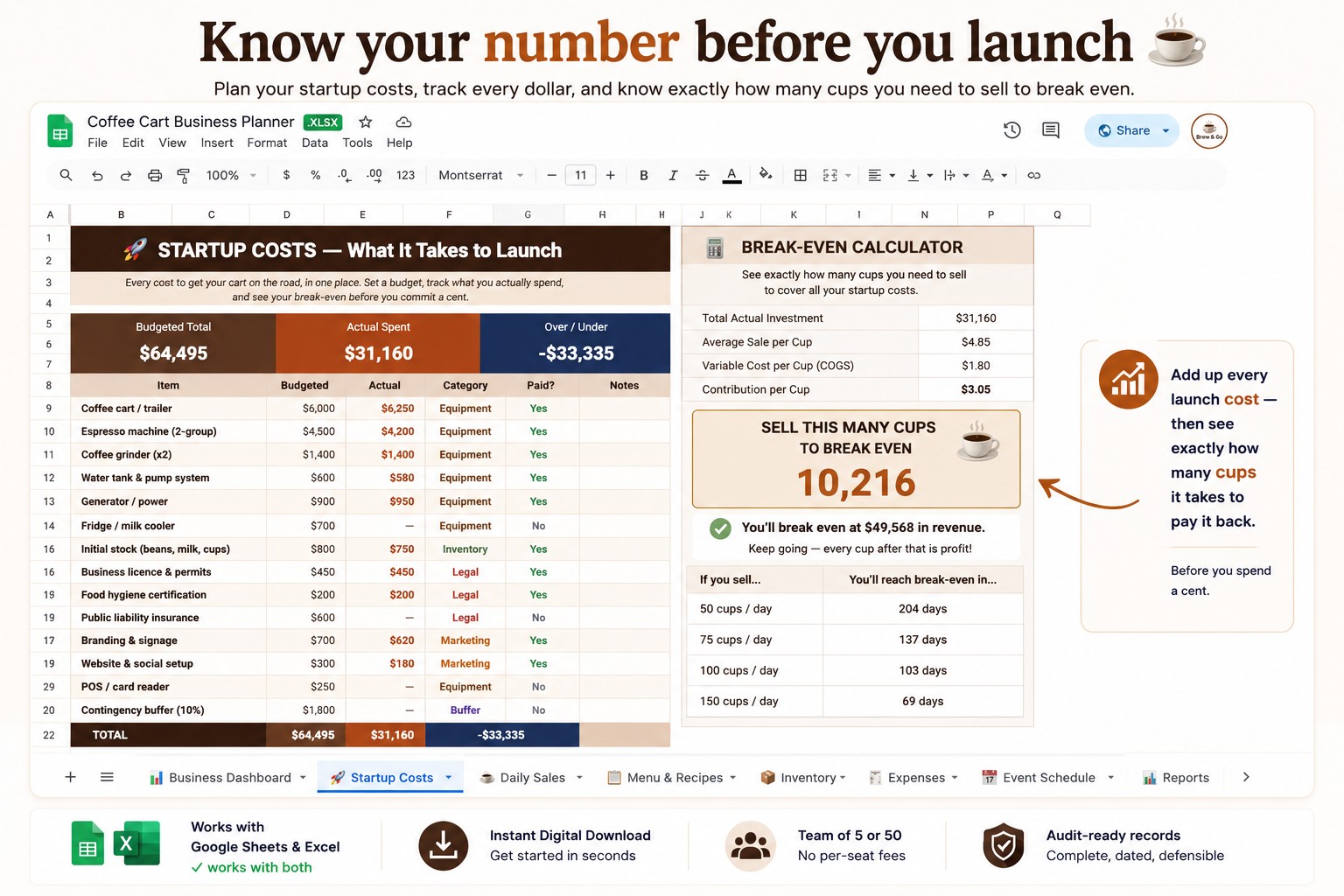
I built profit-per-pitch tracking and margin-based menu pricing into my coffee cart business planner in Google Sheets — see the real profit of each market you trade at, and enter each drink’s cost and price to get its profit, margin, and markup automatically, alongside daily sales, inventory, and a full P&L:
👉 Coffee Cart Business Planner for Google Sheets & Excel
Whether you use mine or work it out yourself, stop judging your days by how busy they felt and your prices by what feels about right. Track what each pitch actually pays, price each drink for real margin, and let the numbers point you toward the markets and menu that make money. The coffee brings people in — but it’s these two numbers that decide whether you get to keep doing it.
This reflects my own perspective and is a planning tool — not financial, tax, accounting, legal or business advice, and it guarantees no result; figures are examples, and licensing/food-safety/insurance are your responsibility to check. Coffee cart owners: what’s the most surprising thing you learned once you tracked profit by market? Tell me in the comments.